
How Slow Living Saved Me From the Toxicity of Hustle Culture
My first year of solo-entrepreneurship nearly killed me.
Nine months ago, I hit an all-time low in my life. I was reaching the end of my first year of solo entrepreneurship and I was dwelling, alone, in a suffocating mountain of exhaustion and debt.
I was drained from a year of aimless hustling and sleepless nights. I grew weary of my obsession to devour and test every other self-improvement or productivity hack I could get my hands on. I became angrier by the day, more resentful by the week, and eventually, I collapsed and reached burnout.
Life is funny, isn’t it? We desperately chase goals we think we want, only to discover — as we pursue them — that we’re making sacrifices we don’t want to endure, and deserting our soul’s basic emotional needs, in order to reach goals we don’t actually desire.
At first, we deny it. We keep hustling because that’s what you’re supposed to do. “Winners don’t quit,” we remind ourselves. Then, we start searching for hacks so we can optimize every mundane detail of our lives. How can I manage my time better? How can I optimize my day? Eventually, we grow resentful. We realize we’re living a life that’s not authentically ours, and we recognize that our emotional neglect has now grown into a gaping wound.
Hustle and hacks are two buzz words that have become so overused by motivational speakers, self-improvement gurus, and entrepreneur-wanna-be influencers, that they’ve now intoxicated our minds and diminished our abilities to think straight.
They’ve rewired our brains to imprint a compulsive obsessive addiction with searching for quick hacks on how to be happier, how to be more productive, how to be more successful, not recognizing that there are none — all these things don’t require hacks, they demand hard work and continued effort.
As a result, we’ve now become such mindless hustlers, optimization-seekers, and self-improvement addicts that we rarely ever stop to reflect and ask this golden question:
“Does this even matter to me?”
Thankfully, I did. Toward the end of last year, I realized that hustling for blind productivity does not bring fulfillment, aligning action with honest intention does. I realized that real change begins from within.
So I decided that I was done; I removed the words ‘hustle’ and ‘hacks’ from my dictionary and replaced the former with ‘slow living,’ and the latter with ‘mindful consistency.’ Today, less than a year later, I’m in a far better place, and I’m grateful to be.
But earlier this week, a tweet appeared on my newsfeed which instantly reminded me of how the hustle culture and productivity porn still exhale a toxic flame into a society that is emotionally fragile. Below is the screenshot, taken from a startup founder’s Linkedin status.
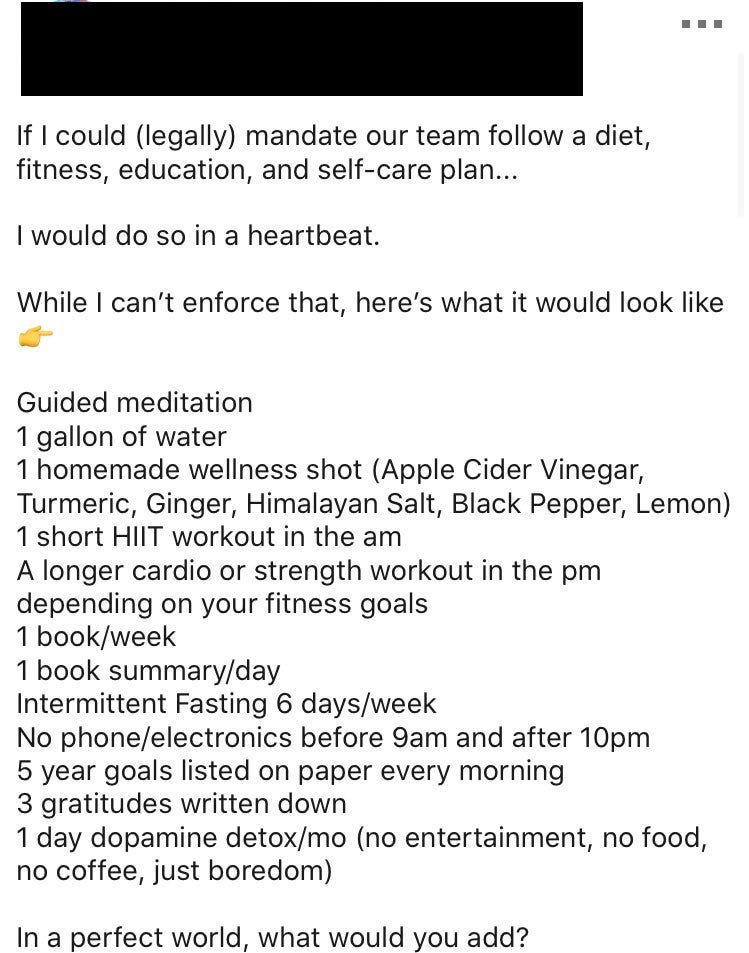
“In a perfect world, what would you add?”
Well, in a perfect world, this list would not exist because we’re not machines, we’re human. We have a limited capacity. Our energy gets drained as easily as water washes down the drain and our willpower depletes by the hour.
There’s no need to do two workouts a day and there’s no logical reason behind reading a book a week — it’s not a numbers game and there’s no judge keeping score. There’s no urgency to know exactly where you want to be in five years’ time — how could you when you live in a world of such uncertainty?
What’s most amusing to me is that this person wants to mandate the above as a form of “self-care” plan, when it reads more like a “self-destruction” plan.
Unfortunately, that’s the kind of mindless thinking that is bred in the hustle culture — one that is focused solely on speed, results, and increased productivity, and is void of any dose of self-awareness, emotional reflection, kindness, empathy, or compassion.
Here’s a better approach to living a good life:
- Slow down and enjoy your life.
- Find meaningful work you want to do and give it your best effort.
- Build slowly and mindfully so you can maintain a positive sense of mental and emotional stability.
- Create a “self-care” plan that works best for you.
- Reflect on your progress and only compare yourself to your previous self.
Doesn’t that sound like a much more pleasant world to live in?
How to Slide Back into a Slow and Meaningful Life
Slow living is a life philosophy and one that I live by today.
It’s a state of mind you embody in your day-to-day living and it’s the antithesis to mindless hustle. Living slow means living with a timeless purpose. It means savoring the minutes instead of counting them, finding balance in steadiness and consistency, and seeing the future through a long-term lense.
This way of life shifts the focus away from speed and efficiency and onto the idea that we should do what’s important to us and our growth, and do it as best as we can instead of as fast as possible. It improves attention, creates stillness, and develops emotional maturity.
“In an age of acceleration, nothing can be more exhilarating than going slow. And in an age of distraction, nothing is so luxurious as paying attention. And in an age of constant movement, nothing is so urgent as sitting still.” — Pico Iyer
So here’s an idea: How about we all slow down and reflect upon what really matters to us? How about we develop a self-care plan that tailors to our needs rather than to what society tells us a self-care plan should look like?
How about we drop the “side hustle” and revert back to the terms “side project” or “passion project?” And instead of productivity hacks that drive us to do more of meaningless work, why don’t we strive for mindful productivity that allows us to do more of what matters to us?
How about we work on our self-awareness before our self-improvement? Because if we’re not aware of what needs to be changed, then we wouldn’t know what to improve upon. As per the words of Sheryl Sandberg:
“We cannot change what we are not aware of, and once we are aware, we cannot help but change.”
Over the past year, I’ve worked on my self-awareness more than anything else. I’ve been much more intentional about how I want to live my life. I’ve cracked the code behind the façade of this blatant hustle culture and realized that all it did for me was create grater mental confusion and emotional suffering.
So I turned to slow living.
What’s ironic is that I became 10x more productive and a lot happier as I transitioned back to the natural flow of life. I downsized my business to suit my needs and I built a writing system that works for me and allows me to be consistent, which resulted in 110 articles in less than eight months.
I reflected on the lifestyle I wish to live (one that prioritizes health and wellness, nature, and time spent with good friends and family) and upon what I genuinely enjoy doing (reading, writing, creative work). I then consciously created more time for all those things that matter to me. In essence, I embodied the words Rumi wrote in the 13th century:
“Let the beauty of what you love, be what you do”
Once I worked from a place of love, not hustle or hacks or fear, everything changed. I simplified my life and slowed it down. I tuned out the noise of the hustle and tuned into the music of slowness. And you should do the same. You owe it to your mental health and emotional wellbeing.
Here are three strategies that can help you lead a more slow, meaningful, and productive life, one that steers clear from any productivity porn or hustle culture and dives into the world of mindful living.
1. Simplify and Stick to a Morning Routine
Confucius, the ancient philosopher, spoke of the importance of inner harmony and of its profound connection to the physical world we experience. One of his key teachings was that a virtuous life is built upon the commitment to rituals as a form of self-discipline.
A morning routine does just that.
It creates a daily ritual for you to renew your inner harmony and exercise your discipline. It serves as the building block for a successful day and that’s why it’s imperative for a productive and good life. It’s not meant to stress you, it’s meant to set the tone for a well-paced day.
The objective isn’t to do everything in the morning, it’s to do what swells your mind and body into a peak state of being. You want to facilitate focus, not distraction, and awakening, not exhaustion.
The ingredients for a powerful morning routine are quite simple:
- Start your day device-free (No screens for the first 30 mins). As per this study by IDC Research, checking your phone first thing after waking up increases your stress levels and primes your brain for instant distraction.
- Spend some time alone with your thoughts (Take 10 minutes to journal or meditate).
- Move and hydrate your body (Take 5 minutes to stretch and make sure to drink water before caffeine).
It’s really that simple, and how you mix those up is up to you.
You don’t need to drink a gallon of water first thing in the morning, you just need a glass. You don’t need a wellness shot, you just need a healthy and nutritious breakfast. You don’t need to read 50 pages, you can sit down to read for 10 minutes. And you don’t need to rush through that routine, you can pace out your activities over a 20-to-60 minute window.
“When you arise in the morning, think of what a precious privilege it is to be alive — to breathe, to think, to enjoy, to love.” — Marcus Aurelius
The premise behind morning routines is to empower you to live more intentionally. It’s to draw your awareness from mindless hustle to the beauty that lives around you — the smell of your morning coffee, the sound of the chirping birds, the blueness of the sky.
2. Focus on What Matters to You
Living slow doesn't promote laziness. In fact, it does the exact opposite; it implores you to work hard and give your best at what you do, but it encourages you to be intentional about how you do it.
It draws upon the principles of positive psychology — Cal Newport’s Deep Work and Mihály Csíkszentmihályi’s Flow — the idea that less mental clutter equates to more mental resources available for deep thinking and meaningful work and that, as per Csíkszentmihályi’s words, “the best moments usually occur when a person’s body or mind is stretched to its limits in a voluntary effort to accomplish something difficult and worthwhile.”
In essence, the mantra is:
Don’t just do more. Do less of what doesn’t matter so you can do more of what does.
The reason reverts back to your willpower, which is a limited resource that dwindles with the day and renews with the sunrise. As the day elapses and your willpower depletes, so does your ability to engage in focused attention and stay distraction-free. That’s exactly why it’s crucial that every day, you do your best to declutter and prioritize.
Here’s what you can do:
- Design an environment that helps you be productive. In Atomic Habits, James Clear wrote that “environment is the invisible hand that shapes human behavior.” In order to write, I’ve blocked 3 hours per day on my calendar, and when I sit down to write, I keep my phone on airplane mode and place it in my drawer.
- Manage your energy instead of your time. Managing your energy is what leads to a healthy life. And a healthy life is what facilities a productive one. So sleep well and rest often.
- Prioritize what matters to you. Start your day with the most important task (MIT) first because that’s when your will power is at its peak, your attention is sharp, and your energy is high. Replying to e-mails, requests, and messages can wait.
- Monotask. You can do two things at once, but you can’t effectively focus on two things at once. So don’t multitask. Instead, monotask and do one thing at a time. As Matt Perman writes: “The scarcity of time is the reason we have to concentrate on one thing at a time.”
In short, do more of what matters to you, do it in a manner that works well for you, and give it your best.
3. Build Slowly, Through Stability, One Day at a Time
I find that a lot of writers on this platform promote the need to write and publish every single day. But why? What’s the point? Whether you write six days a week, or three days a week, it’s not the frequency that matters, it’s the consistency that does.
At the turn of the year, I made myself a promise to write four times per week. So, I blocked out a 3-hour time slot on my calendar from Monday to Thursday and made it a goal to publish two articles per week, once on Tuesday and once on Thursday — everything else would be a bonus.
The result? I’ve now published 110 articles this year. I did it at my own pace, on my own time, and at a frequency that works for me.
Some articles went viral, others didn’t.
There were no hacks. I just built myself a system, wrote, reflected, evaluated, and improved. There was no hustling involved, there was only me doing what I enjoy — writing, reading, and sharing.
Here’s what I want you to realize: No matter how hard you hustle, you won’t build a business, write a book, or compose a music album overnight. All good things take time. So why rush through them?
Focus on the process and enjoy the journey. Stop looking for hacks and start doing the work. Stop searching for answers and start reflecting on your progress to find what works best for you; stick to what does and eliminate what doesn’t. Think long-term, not short-term.
Most importantly, stay consistent, because that’s how you build slowly, through stability, one day at a time.
What Matters to You
What Confucius wrote thousands of years ago still holds true today:
“Life is really simple, but we insist on making it complicated.”
Slow living is simple. It elevates self-awareness, it prioritizes health and wellbeing, and it advocates for more meaningful work. Here are three things you can do today to start living slow:
- Simplify and stick to a morning ritual that helps you find inner harmony while also exercise self-discipline.
- Focus on, and prioritize, what matters to you. Don’t just do more. Do less of what doesn’t matter so you can do more of what does.
- Strive for consistency: Build slowly, through stability, one day ay a time.
Less hustle, more flow. Less rush, more rhythm. Less criticism, more compassion. Less searching for hacks, more intentional, purposeful work. Less mindlessness, more awareness. These are the secrets to the simple, good, well-lived life. As per the words of Ralph Waldo Emerson:
“The purpose of life is not to be happy. It is to be useful, to be honorable, to be compassionate, to have it make some difference that you have lived and lived well.”
Stop hustling, start living.
Sign-up to my free weekly newsletter for more articles like this.


