
8 Must-Have Apps Every Writer Needs to Build a Writing System and Become Prolific
Tools to help you write better

What makes you a better writer? The number one piece of advice we receive to that question is “write consistently, and write every day.” I agree that does make you a better writer, but there’s one other thing that no one tells you: If you don’t build yourself a writing system, you’re going nowhere as a writer.
Allow me to explain.
I’ve been writing consistently for eight months now. I’ve published over 110 articles and my writing has been viewed by more than 500,000 people. It has made me a 5-figure income, and I’ve witnessed the euphoric sensation of having a few articles go viral — and here’s what I can confidently say: The magic doesn’t happen in your writing. The magic happens in the system you build yourself to support your writing.
This “system” is the scaffold upon which you lean on to create content on demand. It’s the foundation that makes it easier for you to find your rhythm as soon as you sit down to write, channel your creativity through higher productivity, and connect different ideas to carve out new ones. And when it comes to writing, building a system is paramount.
A system is the set of tools, routines, and rituals you have cemented in place to propel you forward to your desired outcome.
As James Clear famously put it:
“You do not rise to the level of your goals. You fall to the level of your systems.”
Once you build yourself a system and stick to it, you are much less likely to face these mundane issues:
- “I keep forgetting everything I read.”
- “I have no idea what to write about today.”
- “I’m struggling to get into my creative flow.”
- “I’m not seeing any growth with my writing.”
Once you build a system, you can become prolific.
I’m sharing below the eight apps and tools I use, and how to use them to shape a system that makes it easier to write. These tools are helping me become a better writer. And I believe that every writer needs these (or a version of them) in his or her toolkit.
An App or Tool to Summarize and Synthesize Your Inputs
As a writer, you’re constantly measured on one thing: Your output.
Clients are interested in the number of quality pieces you can deliver per month. Your audience is interested in the number of quality articles you will be sharing with them every week. Even algorithms favor frequency. And if you aren’t able to ship content regularly, you’ll simply fail to amplify your voice in the fast-moving online world.
In today’s age, prolificness wins.
What nobody talks about, though, is the cooking dough to that output. The quality of the books you read and the content you consume. The soil through which your work sprouts. In other words, your input.
There’s a saying that goes “you are what you eat.” And this holds true in the writer’s world — you are what you read. If you don’t have quality input, you cannot hatch and breed quality output. It’s as simple as that.
As Stephen King explains in his book, On Writing:
“If you don’t have the time to read, you don’t have the time (or the tools) to write. Simple as that. Reading is the creative center of a writer’s life.”
That’s why he spends his morning writing and then the entirety of his afternoons reading. Personally, I invest about two or three hours of my day writing, and I try to allocate at least an hour of my weekdays to read — on weekends I read a lot more.
But here’s the caveat: Reading is not enough.
Because what goes in, streams right out.
What you need is a system to synthesize the messages and the wealth of knowledge you attain from the books you read. You need to create summaries. Make notes. Re-arrange the ideas you pick up in books and personalize them into structures and frameworks that you can reference back to in the future.
You need a system that would allow you to forge connections through the network of information and knowledge you’ve compounded over time because that’s how you birth new and novel ideas.
What you need is a note-taking app.
Roam Research is the tool I use to build that system.
An App or Tool to Organize Your Article Ideas
You have a calendar for your scheduled meetings. You have a to-do list for your everyday tasks. You have a pipeline for your prospective deals and clients. Shouldn’t you have a tool to organize your article ideas?
The answer is yes. And that’s where Notion comes in.
Notion is a productivity tool to get your organized. I use it to organize my life (short-term goals, long-term goals, project roadmaps) and I’ve recently transitioned from Trello to Notion as a tool to organize my content ideas.
With this system, I rarely sit on my chair and think to myself: “What do I want to write about today?”
Here’s how I use it:
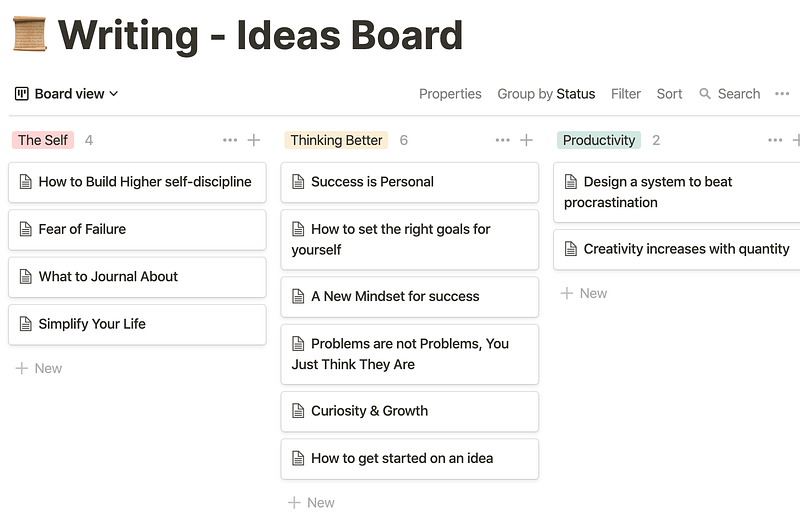
Ideas Board: Anytime I land on an idea that could make a great article, I add it as a note under one of the following categories: Self-development, Thinking Better, Productivity, Entrepreneurship, or Creative Writing Advice. At this very moment, I have 20 article ideas listed on this board.
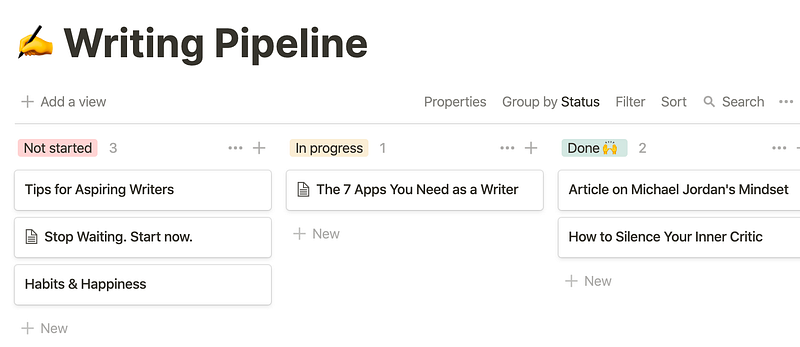
Writing Pipeline: Every Sunday evening, when I sit down to plan my week, I open that board and ask myself ‘what articles do I want to write about this week?’ I choose 3–5 and add them to the Pipeline List.
As you can see below, on this list there are three subheaders: Not Started, In Progress, Done (Ready to Publish). This doesn’t necessarily mean that I will publish all 5 topics this week — sometimes I wake up with the urge to write something completely off-topic. This just serves as a guiding compass so I spend less time thinking about what I want to write and just get straight to it.
Do these strategies help you become more productive? Absolutely! In fact, they even boost your creativity as you engage in a phenomenon called “active procrastination.”
When you set a project or task in motion and actively procrastinate on it, you allow your thoughts to circulate between the conscious and subconscious mind. You open the door for novel ideas and creative possibilities to flow and bloom into your field of vision.
And in The Originals, best-selling author Adam Grant demonstrates how this phenomenon is be attributed to in psychology. It’s referred to as the Zeigarnik effect: “Once a task is finished, we stop thinking about it. But when it is interrupted and left undone, it stays active in our minds.”
I find that when I know what articles I want to write about in a given week and I spend my remaining days contemplating them, new ideas and relatable stories that I could incorporate into those articles start popping up.
There’s one more thing I use notion for: A quote board.
Similar to the tables above, I’ve compiled all my favorite quotes under different categories within one board. Whenever I require a quote to dress up my article I know exactly where to go.
An App or Tool to Store, Read, and Highlight Online Articles
As mentioned above, you need a system to manage your input. Roam Research is the app I use to synthesize all my offline reading. Instapaper is the app I use to manage all my online reading.
And I absolutely love this app. It’s made my online reading experience so enjoyable. Similar to Pocket, it allows you to save all the articles you find online so you can read them at a later time.
Here’s how I use it:
- When I land on an interesting article, I use the one-click chrome extension to save it on my Instapaper.
- When I’m ready to read, I open up my account and browse through the list of unread articles I had saved.
- As I’m reading, I use their highlighter feature to highlight the quotes I want to remember.
- As soon as I’m done with an article, if I like it, I save it into one of my folders (productivity, mindset, mindfulness, research, etc.) so I can retrieve it if I ever want to reference back to it, and if I want to discard of it, I simply delete it.
The app was designed to offer a minimal interface that focuses on enhancing the user’s reading experience, and it’s priced at $2.99 per month.
An App or Tool to Add More Weight to Your Words
In a short blog post dating back to 2011, Seth Godin wrote these four words:
“Write like you talk.”
When we’re having a natural conversation with someone, we’re being ourselves. We’re speaking authentically, as we would in any other chat. The same principle applies to you when you write.
This is great advice, especially when it comes to beating writer’s block — if you’re struggling to find the words, step back, and voice what you want to say, then write down exactly what you said.
But when it comes to writing, as a writer, you must keep your reader’s experience in your rearview mirror. What do you want them to feel? The answer to that question determines the kind of words you will want to lean into — because it’s your choice of words, and the manner in which you sculpt them, that spark the reader’s imagination.
You want to paint an experience that would evoke a certain emotion.
If you’re frustrated, stain the article with tints of anger. If you’re determined to motivate your reader, wash it up with waves of inspiration.
How do you do that?
You add depth and weight to your words.
And how do you that?
Use a thesaurus.
The idea is not to complicate your work or try and make it sound more sophisticated by using longer words. The idea is to make your writing sound more poetic because poetry evokes emotion and that’s how you move people with your words.
As per George Orwell’s advice, when you write (or as you proofread your work), ask yourself these four questions:
- What am I trying to say?
- What words will express it?
- What image or idiom will make it clearer?
- Is this image fresh enough to have an effect?
Then use the thesaurus to find words that would add more imagery and depth to your work:
- I was so scared → I was terrified.
- Kindness can lead to positive change in this world → Kindness is the conduit for change.
- Negative self-talk leads to low self-esteem → Negative self-talk corrodes your self-esteem.
- The boy walked into the room; he was soaking wet → The boy walked into the room; he was drenched.
Use words that stroke my imagination. That’s how you add depth and weight to your work and make it more memorable. When you write — or more precisely — when you edit, keep a thesaurus tab open in your browser.
An App or Tool to Manage Your Grammar
Out of all the apps on this list, Grammarly is the most important when it comes to your actual writing.
As you’re writing, the app automatically and instantly scans for any mistakes in grammar and spelling, highlights them for you, and also offers insights on the style and tone of your writing. You can find out whether your tone sounds informative, friendly, or confident.
Oh, and it’s totally free.
You’re doing yourself a huge injustice if you haven’t installed it yet. This app will raise your writing game to another level. So go ahead, simply add the extension to your web browser and let the app do the magic for you.
An App to Help You Write Better Headlines
You can write the most profound, thought-provoking, and life-changing article to ever be published online, but if your headline doesn’t provide a “hook” and no one clicks on it, your article will flop.
It’s a shame, I know.
But there can be a way around it.
This free headline analyzer tool will “analyze your headline to determine the Emotional Marketing Value (EMV) score based on proprietary analysis technology developed by the Advanced Marketing Institute.” You simply type in the headline and it provides you with a score that portrays the emotions your headline triggers: intellectual, empathetic, or spiritual.
The goal is to produce a headline that doesn’t rank zero on the EMV score.
Remember, your headline is arguably the most important piece of copy. This tool can help you write better headlines.
An App or Tool to Track Your Growth
I treat my writing like a business, and you should too.
What does that mean? It means that I’ve built myself a dashboard to track my progress. I know how many articles I publish per month, on which platform, my monthly earnings, and how my follower and subscriber counts are growing and at what growth rate.
Why is this important?
Three reasons.
First, it inspires me to keep going — it keeps me motivated.
There is nothing more rewarding — or motivating — than to look at the work you’ve already done and the positive impact it’s had on you and others. And the only way to validate this growth is by tracking it.
Are you lacking the motivation to write another piece? Open your progress dashboard and look at how many articles you’ve published so far — look at your incredible growth. You’ve done so well, now keep going.
Second, it helps me stay disciplined.
Third, it helps me make better decisions.
If I see my newsletter subscriber list stagnating in growth, I can start asking myself “Ok, why has this happened this month and how can I grow it again?” In four months, I can reflect back on 2020 and compare my inputs and outputs to my outcomes. I would have data to work with. And with data, you have the priceless currency to make the right decisions.
Here’s what I track on a monthly basis:
- The number of original articles published on my personal blog.
- The number of original articles published on Medium.
- The number of original articles published elsewhere.
- My newsletter subscriber count.
- My Medium follower count.
Build yourself a spreadsheet and start treating yourself like a pro.
An App or Tool to Help You Get Into a Creative Flow
Spotify is the only other app within this toolkit that will cost you a monthly subscription. Chances are you’re already an active user.
I simply cannot write without having my earphones plugged in and my “Morning Creativity” playlist on. I’ve compiled a collection of instrumental music to voyage with me on a daily writing adventure.
Music helps me focus. It’s the conduit to my creative flow.
Find yours and stick to it.
What Matters to You
The magic doesn’t happen in your writing. The magic happens in the system you build yourself to support your writing.
Systems make it easier for you to channel your creativity through higher productivity. And when it comes to writing, building a system is paramount. But here’s the caveat: You can have the most well-designed system in the world, but if you don’t sit down and write, there will be no magic to bathe in.
In the words of Stephen King:
“If you want to be a writer, you must do two things above all others: read a lot and write a lot. There’s no way around these two things that I’m aware of, no shortcut.”
So stop looking for ‘hacks’; learn how to discipline yourself and then sit down and write.
Sign-up to my free weekly newsletter for more articles like this.