
3 Ways to Beat Writer’s Block With the Tension Triangle
On message, voice, and the best state of mind

I experienced an episode of writer’s block while writing this very article. I knew what I wanted to say, but I didn’t know how to say it.
Luckily, the strategies I describe below address this exact phenomenon, and so I could use one of them to overcome my writer’s block. Here’s what you need to know about writer’s block: Writer’s block is nothing more than the existence of tension.
Your job as a writer is to identify where that tension is sprouting from and then work through it to release it. Through the release of that tension, you can open the gates for the freeflow of your imagination to dance with your thoughts, compose a symphony of words, and spill them onto that page.
There are three areas that create tension knots and give rise to writer’s block:
- Messaging: You don’t know what it is you want to say.
- Voice: You’re trying to speak (write) in a voice that isn’t naturally yours.
- Mood: You’re not in the right mental or emotional state to create space for writing.
I call it the tension triangle of writer’s block.
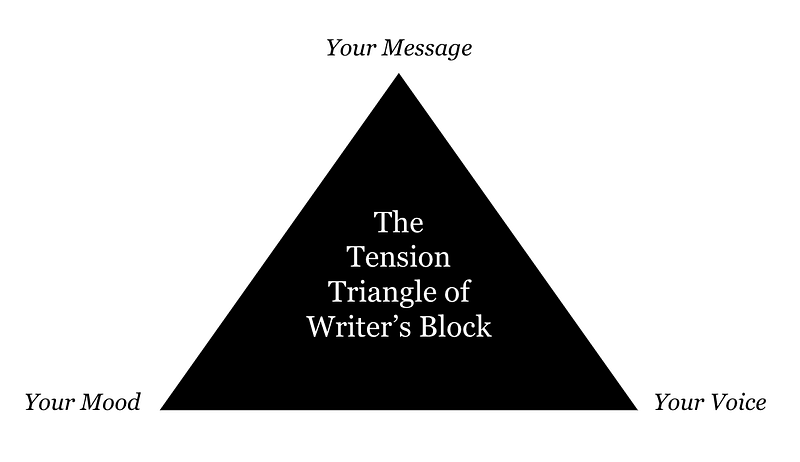
Each of the strategies below will show you how you can work through and release those tension points, and in doing so, beat writer’s block.
1. Define Your Message
If you don’t have a clearly defined message that summarizes exactly what it is you want to say to your reader, you will always face writer’s block.
Think about it: If you’ve been asked to go on stage and give a talk, but you have no idea what the talk is about, will you have anything to say? Most probably not. You might ramble on a few words, but you won’t have a clear message to deliver, and that’s the most important aspect of writing.
When you don’t know what it is you want to say, you will definitely face writer’s block. So the first step is to ask yourself this question: “What is my message to the reader?”
That’s it. What is the promise you want to deliver? What is the journey you want to take your readers on? Knowing exactly what it is you want to say, will make your writing experience easier and more enjoyable. So how do you define your message?
Use this structure: Problem → Story → Solution
Let’s use this article as an example.
- Problem: You’re struggling with writer’s block.
- Story: It’s okay, we all deal with it because of A, B, and C.
- Solution: Here are three ways to beat it.
So if we put all three together, this would be my message: “Writer’s block sucks. We get writer’s block because of A, B, and C. Here are three ways to beat it.” And that’s exactly how I structured my article.
People want to be led to a destination in life. Likewise, readers want to be taken on a journey. They want you to fulfill a promise and solve their problem, and they want that process to be engaging, enriching, and entertaining.
When you don’t know what it is you want to say, you will definitely face writer’s block. The first step then is to clearly define your message.
2. Write As You Speak
In a short blog post dating back to 2011, Seth Godin wrote these four words:
“Write like you talk.”
When we’re having a natural conversation with someone, we’re being ourselves. We’re speaking authentically, as we would in any other chat.
The same principle applies to you when you write. If you know what it is you want to say but you’re struggling to translate your thoughts into words, then the tension arises because you’re trying to say it in a voice that is too far removed from your authentic self.
“Write like you talk” is a brilliant piece of advice that follows what Ernest Hemingway once wrote:
“My aim is to put down on paper what I see and what I feel in the best and simplest way.”
“The simplest way” is rooted in how you naturally speak.
When I first started writing this article, this was the area I was struggling with. So here’s what I did: I got up and walked over to the whiteboard in my room. I held a marker in my hand and started explaining my message out loud to an imaginary audience while drawing out my concepts and writing bullet points on the board.
It took me about 3-minutes to explain my points to myself (and my audience). After that, I sat down and started writing. The reason is simple: I surfaced exactly how I wanted to deliver my message.
So, if you’re trying to write in a voice that isn’t naturally yours, you’re definitely going to face writer’s block. The way to release this tension is to simply explain the idea out loud. Have an oral conversation to find your natural voice, and then, put that into words.
3. Manage Your Mood
If you’re not in the right headspace, there isn’t an ocean in the world that can fill you with the motivation or focus you need to sit down and write.
Last week, I was trying to write an article, but I couldn’t get myself to write. I just sat on my chair and stared at the blank screen. I honestly had no idea what topic to write about or what I wanted to say. So clearly, the first tension point I needed to release was to figure out what message I wanted to deliver.
There were just too many ideas on my mind, and I felt a little overwhelmed, anxious, and unmotivated. So I got up and went for a walk. Twenty minutes later, I was back in my chair spilling words onto that page. I had found the clarity I was searching for.
Manage your mood, it helps you release your writer’s block. If you find yourself stuck in a negative thought pattern and emotional state, move. Get up and go for a walk around the block. Go to the gym. Get some fresh air. Step away from the task for a little while, active procrastination can be conducive to your creativity.
Movement invites new stimuli, which draws your attention away from the thoughts that have led you to your emotional state. Studies have shown that even a single bout of exercise results in positive changes in brain chemicals and can instantly improve your mood.
All it took for me to refuel the motivation to write that article were two things: clarity and sunshine. And it was only after I took a twenty-minute walk outside that I was able to find them.
What Matters to You
Writer’s block is nothing more than the existence of tension.
Your job as a writer is to identify where that tension is sprouting from and then work through it to release it. Clarify what it is you want to say (your message), write in a voice that is naturally yours (as you would speak), and manage your mood so you can get into the right mental and emotional state that will allow you to create the space to write.
Be clear on your message, be authentic to your voice, and be in the right emotional and mental space, and writer’s block will cease to exist.
And if despite all of the above you’re still struggling, then I leave you with this last piece of advice from Charles Bukowski: “Writing about a writer’s block is better than not writing at all.”