
How Human Artists Can Benefit From AI Image Generators
Just like any new technology, you can learn to use it to your advantage
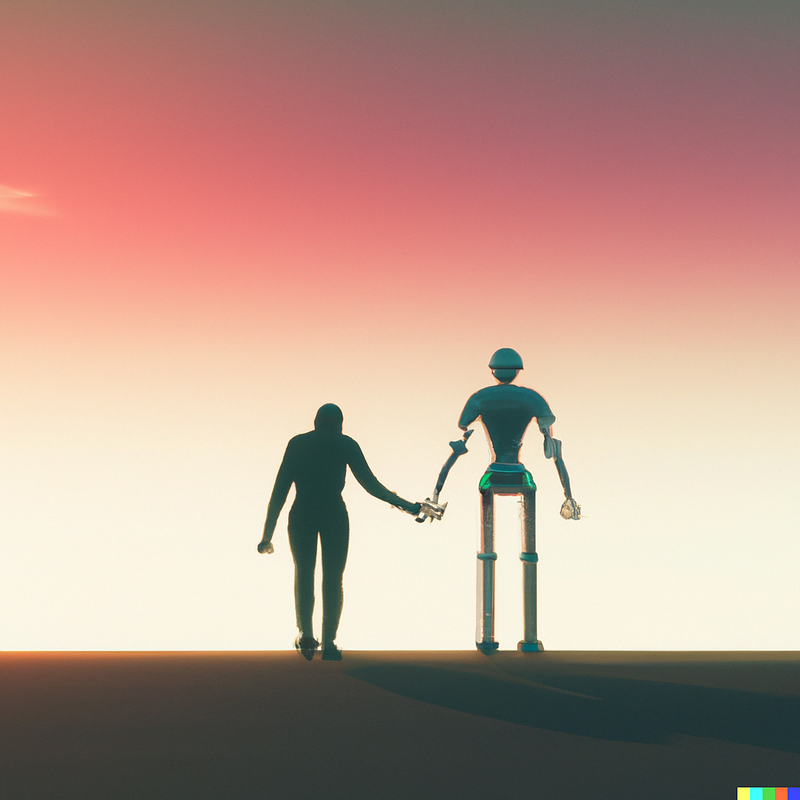
There’s a lot of buzz around AI image generators currently, and for good reason. They turn simple text prompts into pictures — highly detailed ones that can be quite specific, with the lighting just the way you want. You can also create images in the “style” of certain artists (living and dead), which is understandably leading to copyright concerns.
From what I’ve read, the AI platforms are fed millions of images, and no single generated result contains an exact element from somewhere else. In other words, it’s an “original” image, using machine learning to mimic the style or technique. In this way, it’s similar to a human artist whose style is inspired by the human-made art they consume. You can’t put a copyright on style, only specific works.
However, I can understand why artists would have their backs up about this. Suddenly Joe Blow the insurance salesman can generate fine art that look like theirs, and then even sell it? That can’t be right, can it? It’s true. Popular AI prompt generators like DALL·E say you have “full rights to commercialize the images you create … These rights include rights to reprint, sell, and merchandise the images.”
But let’s pause there for a second. I’d like to point out that if people are asking AI generators for “in the style of [your name],” then you’re likely already a commercially successful artist. I’ve created a lot of art over my lifetime, but no one is going to ask for “in the style of Jeff Hayward,” nor would the machine understand what to do with that command.
It’s kind of a big deal for someone to request an image that looks like one of yours. It means your style has made it into the collective consciousness (or at least the artificial neural network.) It will only make your work more known, as people will connect the artificial creations with the original artist. Who knows, your authentic originals may be worth more among of sea of copycats.
I’ve been subscribing to a few popular AI platforms for about a month now, and I have made some observations. Here are some other ways AI art might benefit the classically trained artist…
Use AI to preview your own work
Assume that you’re an artist creating a specific piece for a client. In the past, you’ve sat down in front of an easel or a tablet, and started created from the reference in your brain. Your own neural network takes over, and the result is something in your style that includes specific points detailed in the commission.
If you’re having trouble coming up with a concept, or you want to know how a piece might look, you can prompt AI to create something similar to what’s been requested. From here you can recreate it in your own way on the easel or computer screen.
For example, say a client asks me for an image of a grasshopper jumping over a city for an ad campaign. They want bright and bold colours, and a realistic touch. I could plug in a prompt including all the details to DALL·E or one of the other platforms I use such as Midjourney, and suddenly I have computer-generated concepts I can pull from. It’s not “copying” — I’m just getting ideas.
Here’s what DALL·E came up with from the prompt, “grasshopper jumping over a city, bright colours, realistic.”
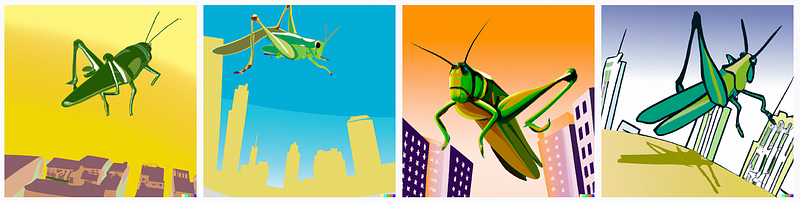
Both DALL·E and Midjourney present four results at a time, and usually at least one of the results is almost exactly what I asked for. I like some elements of all four results, but I wouldn’t recreate any one of them as they are. However, it gives me a visual cue to work from.
You could also send (watermarked) or downsized AI results over to the client to see which “direction” they’d like to go, and what they like/don’t like in the image to narrow down the scope of your final artwork.
Make new art from your existing creations
Another feature the AI generators I’ve used have in common is that they accept an existing image as a base. This means I can upload one of my own images, and ask the bot to do something different with it (which I can specify.)
In this way, the AI is using your own ideas and compositional elements in the final result. Here’s an example of a photograph I recreated using Midjourney:
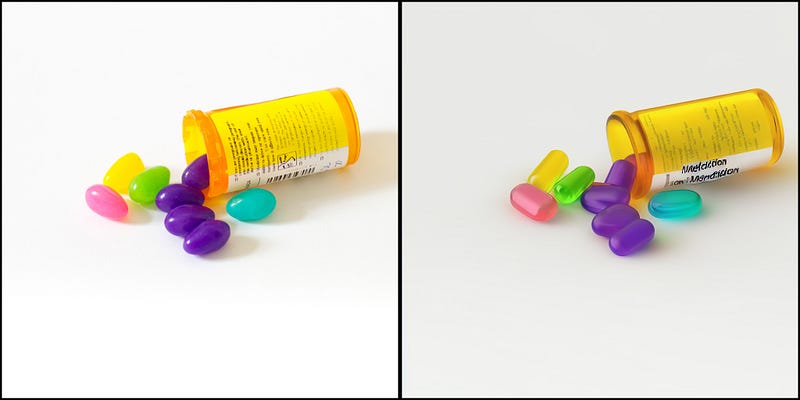
As you can see, the machine stayed fairly true to the original, but added the “digital art” touch that I wanted. It’s a bit surreal, but there’s no mistaking what it is — and I was the original creator.
I have also played around with feeding my old drawings into AI to see how they’d look. Admittedly some of the results are a bit weak, but imagine the possibilities here. You could add new elements to your existing pieces, completely change the colours, or render it in a completely different style.
Create a signature series
For a while there, non-fungible tokens (NFTs) were making a splash in the art world. Even big companies were adopting NFTs to generate revenue in a more creative way. Basically, NFTs offered unique digital ownership of a work, like owning an original painting. There can be unlimited copies, but only one owner of the “real” one.
While the hype around NFTs has cooled off considerably, there was one thing in common that made a lot of them successful — a theme. People would be interested in buying multiple pieces of an NFT release, rather than just one-offs. Collections such as CryptoPunks — which look like 8-bit headshots — were selling like hotcakes, and are still trading on NFT sites such as OpenSea. Another collection called Bored Apes is fetching upwards of $100,000.

If you come up with a unique and catchy concept, you could generate a number of images that are similar with some key differences. That can make your AI art more recognizable, and may increase its value. If you’ve already established a name for yourself in the art world, then selling your digital collections should be easier.
You could try your luck in the NFT world, you could sell prints of your best AI creations, or you could even submit them to stock image agencies.
Technology disrupting art is not new
Every advancement in the visual arts could be seen as a threat. An obvious example is Photoshop, which is now older than 30. Before the release of this software, photographers had to touch up photos by hand, a time-consuming and painstaking process.
I like this interview between PBS and Mia Fineman, an assistant curator of photography at the Met. The interviewer asked Fineman if they think using a computer to manipulate images “cheapens” the art. Fineman responded, “No. Photographers have always used whatever technical means were available to them to create the pictures they wanted to create — Photoshop is the latest tool.”
In other words, the final result (as envisioned by the creator) is what’s important to the viewer. Whether I spent an hour using Photoshop or I retouched a photo by hand, the end result is similar if I’ve done it well in both cases. The audience won’t likely want to know exactly how I achieved it.
It’s hard to picture a photography/design world without Photoshop now. Those who have learned how to use this tool properly have only increased their value to clients.
I know that AI is not exactly he same thing, as it is creating the base image. However, as I’ve learned by experience so far, getting AI to generate what’s in my head takes skill and effort. There’s a whole art movement of Promptism that’s about learning how to feed the right commands into a generator to get what you want. It takes several tries in some cases, and in other cases I’ve combined images to get the result I need.
Just like Photoshop, traditional artists/creators that adapt to this new AI technology will benefit from it down the road, rather than get left behind. Chances are it’s not going away, as more and more platforms are released, and improvements are made to existing ones.
There are still some limitations of computer-generated art. For example, it’s not going to paint a mural on a wall. The AI’s file output size is still relatively small (meaning you won’t likely be able to produce a high-quality large format print — yet.)
The human experience will always prevail in art
The traditional artist will never be dead, because the concept of a work comes down to them. Humans are the ones who know what looks good, and if the work fits the creative brief. Humans are the ones that can add context and emotion to a work of art, and also interpret its meaning. Humans are the ones that can curate the best selections for an exhibition.
As someone who makes my living mainly from writing, I’m a bit wary of platforms that write blogs using a machine. While both imaging and writing AI will no doubt become more powerful and widely used, they will never completely replace humans — and might even help us down the road, once more creators adopt the tech.
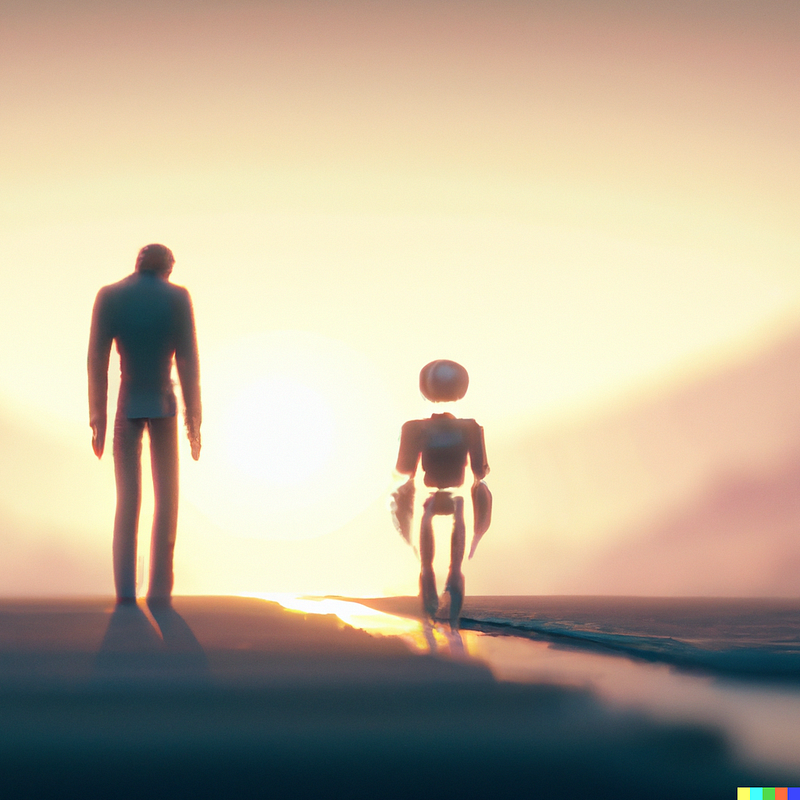
Your unique creations are the sum of your experiences, and AI will not take that away. However, it’s possible to make peace with the AI bots, and walk off into the sunset together towards a (hopefully) prosperous future.