
Why AI Will (Probably) Never Replace Writers
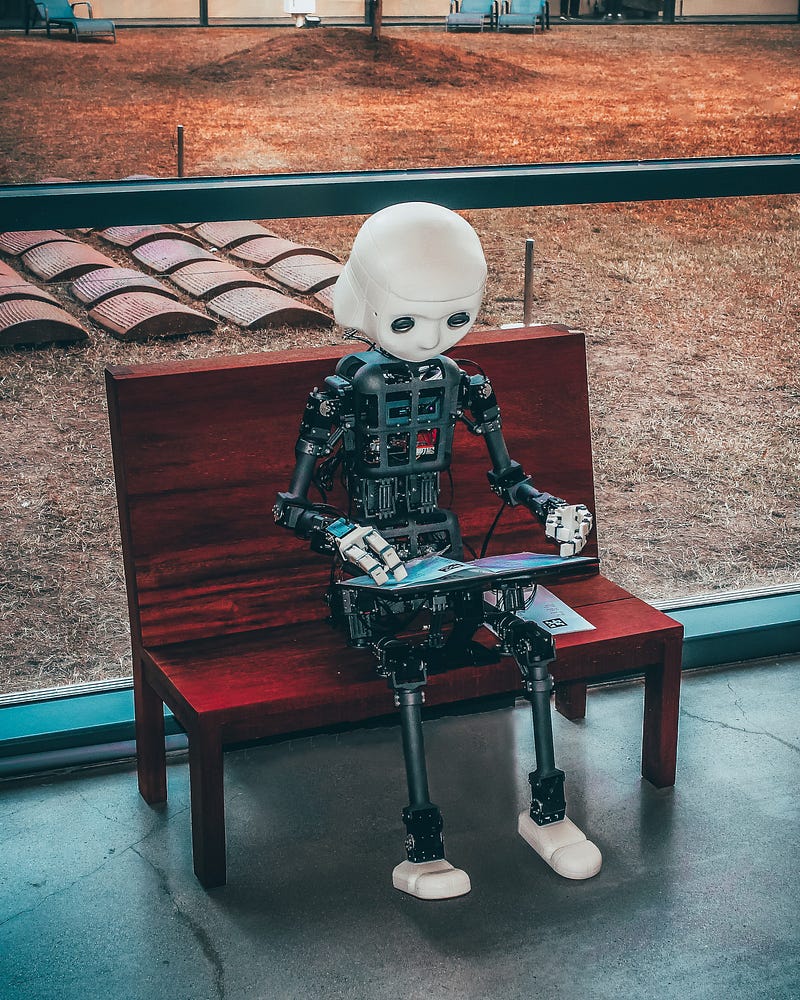
There’s no doubt that artificial intelligence (AI) is getting more sophisticated, and taking on more human tasks. In fact, the use of AI in some business functions from sales to customer service has grown by 270% in the past four years alone. AI can also learn, so theoretically it can get smarter and more predictive simply by feeding it information.
It also has made big advances in the world of art — generating images, music and even poetry quite impressively. Does that mean all of the writers on Medium (and elsewhere) will have to quake in their boots for their professional futures?
Well, not exactly. I’m here to give writers a bit of reassurance about their well-honed craft — and explain why robotic scribes won’t replace us any time soon (in my opinion.)
Why I’m Not Impressed With AI Writing So Far
I’m not going to name any specific AI writing applications that I’ve tried, because I don’t want to focus on a particular company. (Google search AI article writing, and you’ll see a list of hits. Some give a free trial.)
But I will put an excerpt of what spit out after I inputted “The Future of Crypto Art” into an article generator:
As blockchain expands into other facets of life, many artists are embracing the world of cryptocurrency. Digital artist Shanna Kim explains that her art is rather removed from the standard gallery environment. She focuses on “classic pop art styles and vintage themes, with a uniquely modern twist.”
On the surface, this generated piece of writing is quite impressive. I was like, “Woah, it even pulled in a quote!” The problem was, I couldn’t find a human that matched the artist’s name (in the art world), and was not able to verify the original source of the quote.
I emailed a customer service rep at the AI company about this and they explained: “In fact, we don’t have any clues where from our model is generating information. It has been trained on vast information of all fields and hence, it is not extracting information from one source.”
So from that explanation, I’m assuming the AI pulled an artist name and a quote out of thin air (unless the sources are out there and I haven’t found them yet.) While that’s all fun and good, this would not fly if you were using the article/blog for a client or for your own personal/company site. That would essentially be fabrication.
Another article generated on the same topic mentioned a “Gigi Santos, the co-founder and CEO of Wombat Lab.” I got excited until I realized this person doesn’t seem to exist, either. (Prove me wrong.)
These are just two examples, I doubt all AI writers would pull information the same way. But even if a program did use real names/quotes, there would still be context to consider.
An Editor Will Always Be Needed
I also noticed quite a few grammatical errors in the pieces I generated, along with problems with “flow” — namely how the ideas in the article move naturally from one to the next like this finely written piece.
Like many articles I’ve edited, I had to move sentences around to make it more readable, while cutting some copy out altogether that didn’t belong.
The grammar errors are easy enough to fix with modern spell-checkers. But even the greatest authors in the world, who write tirelessly, need an editor. Not just one to check for spelling and syntax, but one that can verify non-fiction information, and check for continuity of characters and plot. In other words, does the article/novel make sense?
So far, I don’t see AI being smart enough to take writing generated by AI and edit it until it’s a shining finished product. Surely this process will improve, but even with advanced AI, I believe a human will have to read over the words to ensure there are no glaring errors or glitches.
On a related note, I bought a novel from Amazon earlier this year that was generated by AI. Let’s just say it doesn’t seem like a human editor looked it over. I won’t call out the book by name, but here’s a typical line:
The towers were eraces and streamers of vapour in their mountains until once more some distance of the air-flicker of vapors.
Huh? Not only does most of the sentence not mean anything to me, the AI also managed to put two spellings of “vapor” into the same sentence. Impressive?
Anyhow, what I’m saying is that even if AI book writing gets good enough to take top spot on the New York Times best sellers list, human editors will likely be needed. So if you’re a writer, maybe take an editing gig or two now to beef up your resume. Y’know, just in case I’m wrong.
AI Can’t Draw On Experience, Emotions
This is where I truly think AI will never be able to catch up with a human writer. Sure, perhaps one day AI will flawlessly generate articles such as “Top 5 Vacation Spots On a Budget.” But what about when the article/story needs some finessing, some feeling?
Many fiction/non-fiction writers base their stories on personal experiences — there’s a long list of titles from Stephen King’s The Shining to Emma Donoghue’s Room (both also made into films) that are inspired by real events.
Unless a robot starts having experiences of their own out in the real world, it will have nothing to draw from other than web-crawling other people’s experiences and trying to piece them together.
Then there’s the subject of emotion: a human writer knows how to evoke sadness, fear, happiness, and excitement in a reader. While an AI could try, it doesn’t know what emotions feel like, so it won’t be a good judge whether it has hit the mark or not. (And don’t even get me started on AI trying to be funny or sarcastic.)
Keep On Writing In The Free World
So in conclusion, it seems like AI might be a good tool to play around with, perhaps even for generating simple blog posts (still be prepared to edit.) But remember, people connect with anecdotes in a story, and an AI won’t necessarily ever be able to have “real” experiences and then tell stories about them in a compelling way.
Not any time soon, anyway. Until then, keep writing, and be sure to leave me some claps if you liked this (human-generated) article!