
Why Educators Need to Take More Risk
You are the difference-maker.
One by one, cameras slowly awaken, and bright-eyed faces await on the other end — some excited, others bordering anxious and reluctant. I close my eyes softly, inhale deeply, and press the video button. With a glued smile, I happily greet each student by the first name. The class has officially begun.
If my camera were on 15 minutes earlier, you’d see me rushing to open my front door, feeding the pets, and glancing over our learning plan for the day. For the last hour, I’ve been playing chauffeur to our one-car family, driving my son to a daycare we can barely afford. If every morning begins as planned, I have the same window of time to physically and mentally prepare to teach my virtual class of 30 fifth graders.
The truth is, I’m playing it safe. I’ve fallen into the trap of doing what’s expected of me by those in charge. Now, I can feel the effects it’s having on my students.
I want to enjoy teaching, and I want my students to enjoy our time too. Something must change, and I can’t be the only teacher feeling this pressure.
My Class
I teach in a mostly affluent suburb of Seattle. The families I partner with all elected to learn virtually this school year due to the pandemic. In many cases, parents work for tech companies such as Amazon, Google, and Microsoft. 73% of my students come from BIPOC homes. Some kids are skiing this weekend, while at least one of my students cares for a younger sibling as their parent serves food at a restaurant.
Depending on the day, I may see half of my class’s faces for a meaningful portion of the time. Every day, the kids who use cameras are either 1) academically successful or 2) socially & emotionally confident. In rare cases, students have both traits and are much likelier to use their cameras often.
Suffice it to say that I teach a group of students extremely diverse in race and lived experiences. Every ounce of who they are influences how they show up each day. I love seeing every one of their faces and hearing their unique voices.
But this year is different.
Our class feels disconnected. The classroom culture is suffering, and every day feels like a task. There is not enough time to complete a curriculum on pace and have those memorable student-teacher moments.
The impromptu raps, fist bumps, and recess race the teacher challenges are missing.
Where I Come From
I come from a West Texas city, still showing the pains and aches of segregation. The elementary I attended until 6th grade was my haven and an obstruction to my freedom.
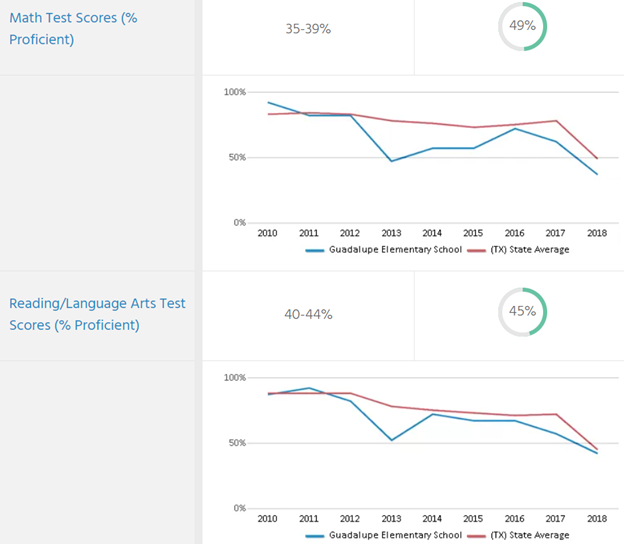
On average, 97% percent of students at Guadalupe Elementary are eligible for free or reduced lunch. Hispanic students make up 93% of the student body, and black students add a whopping 4% to that total. If you were a white classmate of mine, you were the obvious outlier. If you had extra money, you didn’t drive anywhere near my grade school.
I looked like my classmates, albeit a lighter shade of brown. My best friend and I found fragments of success along the way because of our natural curiosity to learn.
However, when you look at the big picture, you notice glaring concerns. Most students are not passing state standardized tests. In a state known for its academic woes, my childhood elementary is sinking (pictured below). And it has been for decades.
My grade-school teachers played it safe. They did their job as expected and ensured a traditional school experience for the brown and black kids. And that continues to be the problem.
My best friend and I were the exceptions, not the rule.
Failing is the Standard
The education system, along with the justice system, was designed to recognize clear winners and losers. All too often, it’s black and brown students who get the short end of the stick.
The Criminal Justice System Is Not Broken, It’s Doing Exactly What It’s Meant To Do ~ Reetu Mody
The system will continue to do what it does, but we educators and administrators are the ones failing our students. Educators failing students is not an idea sparked by the onset of the pandemic. The symptoms of our failures have further been exacerbated. Most students are missing the human connection factor, and it’s not only students of color struggling.
This pandemic has taught us that we’re all vulnerable, and we have more marginalized students than ever before. We must focus our efforts on relationship building. That is within our locus of control.
If you want to read more about who else is struggling, I recommend reading reports by the CDC and NPR. Both reports detail the rapid and sustained rise of mental health ED visits for our youth. While helpful, no data shows long-term outcomes.
Let’s hope that we’re not the kind of people who wait to see a six-alarm fire burning before we call first responders. When there is smoke, there’s fire, and it’s time we do something about it.
You Are the Difference Maker
Educators, we must speak up for the most vulnerable populations. As a professional, focus on developing and maintaining a relationship with your students. Whether a union supports you or not, our professional and ethical obligation is to prepare our students for life, not tests or college. You can argue with me later about how assessments have a place in closing the opportunity gap. If we prepare our students academically but do not help grow good people, we’ve let down an entire generation. Take a chance by completely flipping the script.
Why and How Do We Take More Risks?
When I have challenging days, I revisit the mantra, “you are the difference-maker.”
On the last day of school, my 6th-grade teacher took a stand for me. Instead of doling out justifiable punishment to me, she did what was right rather than what was expected. She stepped up to show me she cared and believed in my future. She risked being reprimanded for showing grace to one kid. She was a difference-maker.
In grades 7–12, I slipped between the cracks. I was a boy capable of learning so much, with no meaningful student-teacher connection. As classes became more diverse, I became a statistic. No longer was I the light skin brown student. I was simply a Mexican next to many more white students.
In the last semester of high school, my AP Economics teacher sat me down and firmly said, “if you’re not happy with who you are at this moment, right now is a good time to change that.” She re-ignited that feeling I had for so long in elementary but hadn’t felt since. I felt special again, and we didn’t have a special relationship. She risked a student or parent complaint by assuming so much about me. She was a difference-maker.
A system with no human factor should have swallowed me whole. If it weren’t for these two positive relationships, I would’ve remained lost. I certainly would not be hopeful for the upcoming changes in education.
It’s time we take down the system from within.
Challenge standardized tests because they are biased. Miss reporting deadlines to your supervisor because you’ve planned more meaningful experiences for kids. Slow the pace down because even one student behind the pack is one too many. Perform your best rendition of Ice Ice Baby a la Vanilla Ice. And take as many breaks as your class needs.
As Dr. George Sheehan once said, “don’t take the lead unless you plan on doing something with it.”
So, how have you, as an educator or parent, stood up for your students during this pandemic?
If you enjoyed this story, you might also like:


