
7 Reasons Why I Put Rocks in My Son’s Favorite Toy
My biological dad died in a bizarre accident, which some believe was an attempt to commit insurance fraud. My single mother raised me the best she knew how, but I had no real-life male role model to reference. That can be particularly challenging for a Latina mother. Mr. Feeney from Boy Meets World was the closest I ever had to a mentor. And I made sure to check-in with him every school morning around 6 am throughout elementary and middle school.
Fast forward twenty-nine years.
At the ripe age of two and a half, my son has a real affinity for basketball. Every time he shoots a tough shot, or any shot really, he shouts out “Kobe”!
If he’s not shooting from a few feet back, he’s likely driving to the bucket for a hard dunk on his plastic Little Tykes goal. You know which one I’m talking about: blue frame, black base, and orange rim. Recently, he slammed it as hard as he could, and the entire thing came crashing down. Luckily, I was able to catch it just before it landed on him.
The responsible version of me (certainly not always) recognized it was time to fill that puppy up with sand. Except, when I visited two stores, they were all out or didn’t carry a sand option. Next thing you know, my son and I are strolling down the street during our usual afternoon walk when we came across a mixture of pebbles and gravel that seemed endless. The bright idea of filling his Little Tykes goal with rocks instead of sand hit me square in the face.
Now, I’d be leading you astray if I failed to mention that this all began during one of my lame attempts to be frugal. Some may describe it as being “cheap.” I’d like to believe I’m not the only dad who attempts this sort of thing. Regardless, I am relatively proud of what resulted when I chose to include my son in my cheapness.
Here are the 7 lessons my son learned while filling his favorite toy with rocks:
1. Patience & Taking Turns — For twenty minutes, he and I patiently inserted every pebble into the basketball goal base. I truly wanted to complete this task on my own because I thought it would’ve been done faster. To my surprise, he was so quick at grabbing rocks from the bag that he would often be slowed down by my heavy hands trying to force rocks into the hole. He had to wait, and wait, he did. Not once did he fuss with me about it. Instead of having a full-blown conversation, I simply smiled and said, “thank you for waiting while daddy puts rocks in.” I want him to know that some things take time and sometimes even longer when working with others. It’s right to allow others an opportunity, and we should respect them as they try. I struggle to model this lesson when I’m behind the wheel of a car, and I want to get better about that. I take solace in the fact that I am patient with him, my students, and most everyday situations (grocery store, holding doors open, etc.). He learns quickly and doesn’t mind waiting for his turn.
2. Adapting — We were able to insert most rocks into the base with no hiccups. On occasion, he came across rocks resembling what he described as “triangle, daddy.” He pushed and pushed but was briefly unable to fit them inside. I reached for one of those rocks and said, “let daddy show you how he would do it,” as I rotated it until I was successful. He’s learning that when one approach doesn’t work, you must try another approach. Rather than give up quickly, take a problem-solving mentality. As a teacher, adapting to circumstances is an essential skill. I’ve found that kids need to see clear examples of how you problem solve and process your thinking aloud.
3. Embracing Failure — Remember those triangular rocks I mentioned? Well, not every piece fits inside. Without making a big hoopla about it, I simply said, “looks like that one isn’t going to fit,” as I placed it aside. I want him to know that sometimes, you will be unsuccessful even when you plan and readjust. Some rocks just don’t fit. We live, and we learn. As a teacher, I often see kids respond to failure by giving up on a project. We need to teach our children to expect failure and that it’s a very regular element of eventual success. My son and students embrace failure and consistently remain composed during difficult moments.
4. A Little Dirt Never Hurt — Let’s face it, kids need to be exposed to the great outdoors. My hands became dirty, and so did his. We washed our hands at least twice afterward (cause of germs, you know). He’s learning to use his hands as God gifted him to. If you didn’t have a dad to show you what productive, dirty hands could produce or fix, then it’s your responsibility to learn and model it.
5. Resourcefulness — For one week, I placed books on the base of the goal to prevent it from tipping over. I visited multiple stores, but when push came to shove, I trusted my instincts. I want him to know that he does not need anyone to provide him the answers and solutions to problems. Sometimes we just need to use what resources are readily available. This was also my excuse to be cheap.
6. Taking Joy in the Mundane — I did not buy this experience at the store. It was not flashy, and most would not consider this a fun activity. We sat in his room for twenty minutes with very few words spoken. He’s learning to enjoy the simplest of activities in life. According to Melissa Bernstein (Melissa & Doug), “Children need to learn to take the initiative and think of ways to occupy themselves that are not dictated by someone else.” Our kids could stand from good ol’ fashion boredom because it sparks creativity and ingenuity.
7. Delayed Gratification — Initially, all this kid wanted to do was play basketball, in his room, or outside. He enjoys it when his mother and I play with him and celebrate his success. In fact, he will bug us till one of us agrees to play with him. I told him, “first we collect rocks, then we can play basketball. First rocks, then basketball”. I want him to know that even when we enjoy something so deeply, it is still good to put first things first. Stephen Covey lists this as habit number three in his bestselling book The 7 Habits of Highly Effective People. The reward for waiting is plentiful. The key for parents is to follow through with promises because kids are pros at spotting an unreliable adult.
Speaking from the heart, I did not go into this situation thinking I would teach my son any specific lesson. It wasn’t until a few minutes before that I first realized he could learn about Taking Joy in the Mundane. Then, I captured the moment.
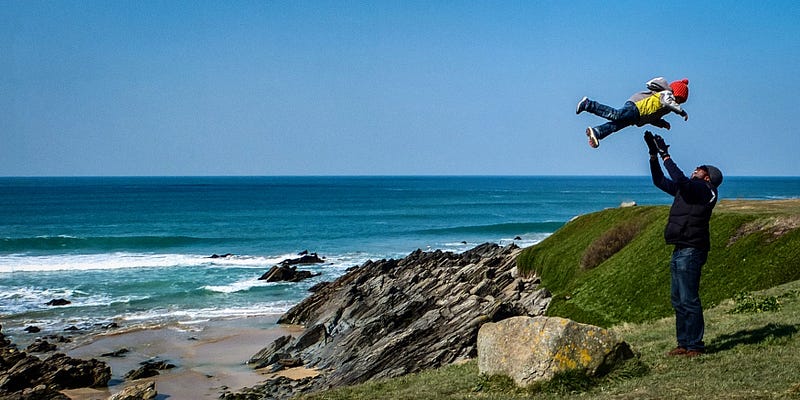
Growing up without a biological father can sometimes feel like a disadvantage. It can feel as though you’re playing catch up in life as an individual and as a father to a brown son. Whenever I feel these thoughts creep up, I reach for my son’s hand and learn alongside him.
Including your child in everything you possibly can opens the door to life lessons you might’ve otherwise skipped. When you don’t know what to say or even where to start, just do. Don’t lead with words. Allow them to come to you and capture them in the moment. If you include your kids in everything for no other reason, the result will be a helping hand to your already full plate.
What life lesson or skill are you still hoping to teach your children?


