
Houseplant / Outdoor Plant
Are they really different?
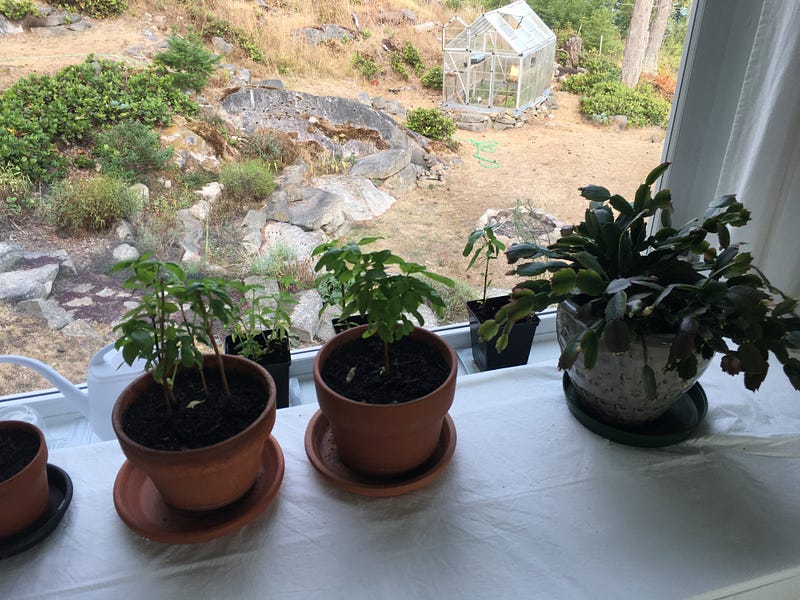
I believe the reason people have house plants is that they aren’t able to spend enough time outdoors in nature. To fill that gap they bring in as many plants as they can manage to help soothe their nature spirit.
For me, living in the country surrounded by trees, shrubs, and flowers, the craving for indoor plants is not very strong. The few I have are there for specific reasons.
The basil plants are for convenience when cooking, to trim of a few fresh basil leaves to add to a meal. The basil seems to thrive when trimmed. As long as I don’t trim back too far, the lower part of the plant continues to sprout new leaves and branches, getting bushier over time.
My flowering cactus, what my mother would call a Christmas cactus because hers would always flower for Christmas, was a gift five years ago. When I moved here, she (the plant, not my mother) came with me. I couldn’t abandon her. To quote Dr. Seuss, “a live’s a life, no matter how small.” Even a plant.
The flowering cactus’ name is Carol, as in Christmas carol, in honour of my mother’s name for them. She has been transplanted into bigger pots as she grew and she seems to be happy here. Each year she starts flowering in October and blooms through until May or June.
Outside my bedroom window I keep various plants in pots to be enjoyed during a leisurely cup of tea before getting up for the day. Occasionally the tea is made from leaves taken from the mint plants in the pots.
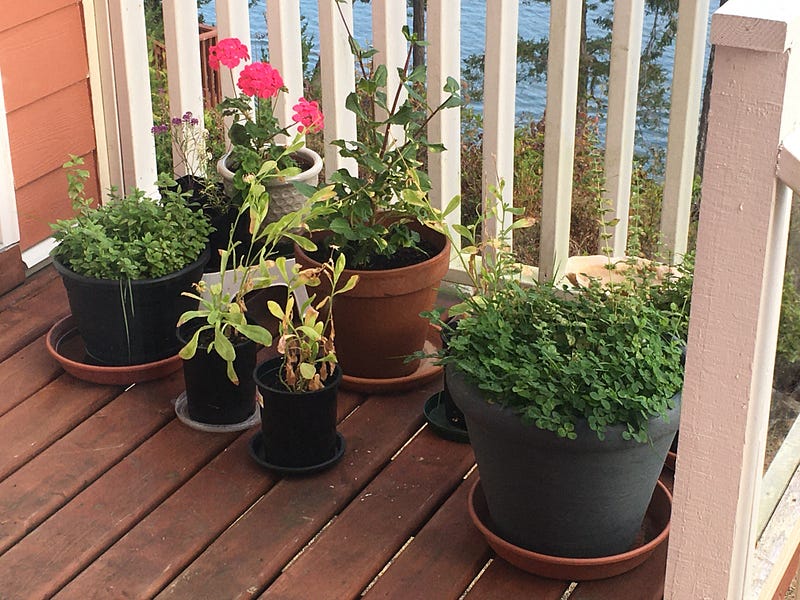
This year there is a mix of lemon balm, peppermint, spearmint, geranium, calendula, alyssum, and dahlias. Oh, and clover. The lemon balm pot somehow got a wild clover seed into its soil and the clover is spreading through the pot. The lemon balm peeks through in places but the clover is taking over.
When winter comes on, the perennials will get trimmed back and put into the greenhouse with Freddy for the winter, to come out again in the spring. For some of the annuals, in this case the calendula, I collect seeds from the flowers to plant new ones in the spring.
As I thought about Dr. Preeti Singh’s challenge to write about “Loving House Plants” I struggled about what to write. Then I realized the problem was that I make no distinction between indoor and outdoor plants. I love them all.
That made the writing much easier. I live on a beautiful country property full of plants to love, and that love me back. I treat the property as a tree sanctuary that is also a safe place for most any living thing, as long as it behaves itself.
As mentioned in an earlier article, I don’t have a lot of tolerance for invasive plants that try to take over. At the same time, many invasive species are only responding to climate change and moving into places that are now more suited to them.
People living in cities or other crowded conditions don’t have the luxury of stepping into nature whenever they want. For them, houseplants make perfect sense. This insight gives me one more thing to be grateful for, especially today which is Canada’s Thanksgiving Day.
Happy thanksgiving! May your life be filled with things that make you thankful to be alive!
Thank you for reading my article.
If you found this story interesting, here a couple of my other nature stories:
I am frequently inspired by other writers on Medium. Here are some I’ve particularly enjoyed reading recently:
Dr. Preeti Singh prompted my article with her piece about houseplants:
And apparently Dr. Preeti Singh was inspired by this article from Marta Henriques:
Another excellent houseplant piece is this one by Joyce Nielsen:
Since today is Canadian Thanksgiving Day, this article on gratitude by Lucia Landini is particularly pertinent:
I wish to thank the following people who recently chose to follow me and my writing. Your interest encourages me to continue writing. I hope you enjoy this new story.
Cybill Walsh, Rayne Elizabeth, B. Lorraine Smith, Mulan, Jagat J Saikia, MBA, DataisSacred.com, Lanceworton, Elizabeth Kaldeck Smith, Kalleel Myricks, Saleeha Som, Janet Valentin
Thank you for following me.
Finally, I would like to invite those that recently commented on my writing to share this story with me. If any of you would like to be excluded from my tags in future, please, please let me know!
Neera Handa Dr, Casey Stanley, Mary Chang Story Writer, Sandi Parsons, Charlotte Kingsbury- Fink, Jenny Lane, Lucia Landini, Megan Llorente, Dr. Fatima Imam, Barbara Mac, DL Nemeril, Mukundarajan V N, Saba Haider, Joyce Corey, Carol Labuzzetta, Mawde Olssen, Peter Wynn, Mani Goel, Josephine Crispin, Hemanth, Janin Lyndovsky, William J Spirdione, Laura Vegh
I wish you well!


