
Here’s How I Made $4,000+ on Medium in One Month
12 real tips for hitting four figures, with screenshots, based on my 30-day experiment
My Promise To You
Some of you are already rolling your eyes. I get it. Articles like this can easily come across as braggy and prideful and ugly. You don’t care that I made four grand in 30 days on Medium. And why should you? It’s only helpful if it helps you grow your own content marketing business.
Which is my exact goal with this story.
For subscribers who’ve been following my work for a while now, you know that I try to create ridiculously high-value content that’s well researched and brutally honest, containing legitimately unique perspectives and original insights you won’t see anywhere else on the internet. This meta-Medium article is no different.
It’s not one of those “Just pitch to publications! Make sure you use the right tags! Use a non-Pexels/Unsplash photo!” kind of posts. You already know all that stuff.
In this article, I’m going to show you the exact mindset I adopted toward the work. It’s an approach that anyone can use to contribute value to the lives of readers on this brilliant platform and everywhere else you market.
These ideas and principles also apply to content marketers in other fields, be they entrepreneurs, stay-at-home-parents, startups, scaling businesses, or established companies.
Shall we?
January’s Stats:
- 17 stories published across six publications
- 30,900+ words published (that’s half a book!)
- 163,000+ views
- 48,000+ reads
- 2,800+ fans
- 800+ new Medium followers
- ~80 hours invested in writing+editing+submitting+promoting
- $4,263.78 revenue earned in 30 days
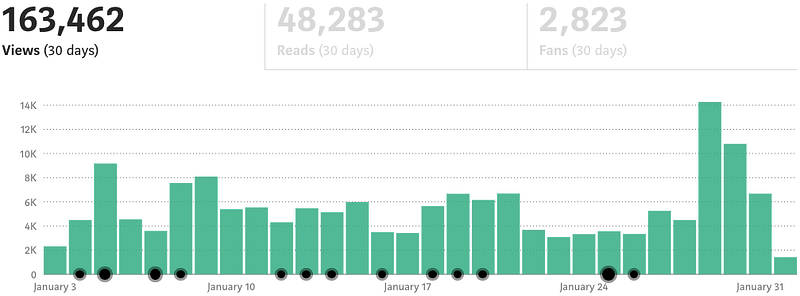
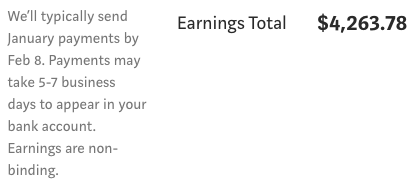
I’m incredibly grateful for these results. Fifty-five percent of all Medium writers who publish will earn something each month, but only 6%–7% will make over $100, so these numbers hopefully reflect that my writing is resonating with tens of thousands of people. (By comparison, I’ve written for Esquire, Huffington Post, USA Today, Smithsonian, The Guardian, and TIME Magazine, but almost none of them pay as much as many higher-end Medium writers are earning.)
Here’s what works for me:
1. Forget About What’s Popular and Commercial and Write What Makes You Physically Excited
When deciding what to write about, you need to feel something.
Rather than trying to be like everyone else, try to be a self-individuated human. We don’t need another Tim Denning because he’s ridiculously helpful in a way that only he can be. You can’t out-Tim Tim, so don’t try. Be you. No one can out-you you.
Also: Forget about curation. (I still don’t know if I’ve been curated, and I don’t care — you need to write for yourself and your audience, not to please Medium’s editorial board. Plus, I’m certain they’re very smart people who can sense when someone’s just trying to game them.)
Here’s what to do instead
- Turn off your phone, grab a pen and a notepad, and write a list of 50 story ideas.
- Go for a long walk, ideally under the stars.
- Come back and reread the list out loud.
- Circle the ten that make you feel something in your heart/stomach/loins.
- Ask your spouse/partner/bestie which one you should write first. Don’t take their advice, though… they, too, are probably thinking in “what the market wants” terms. Instead, watch how their body reacts. I know I have a winner if my wife yells, “Oh, that idea is SO YOU!”
When it comes to what to write, it’s either “heck yes” or “heck no”
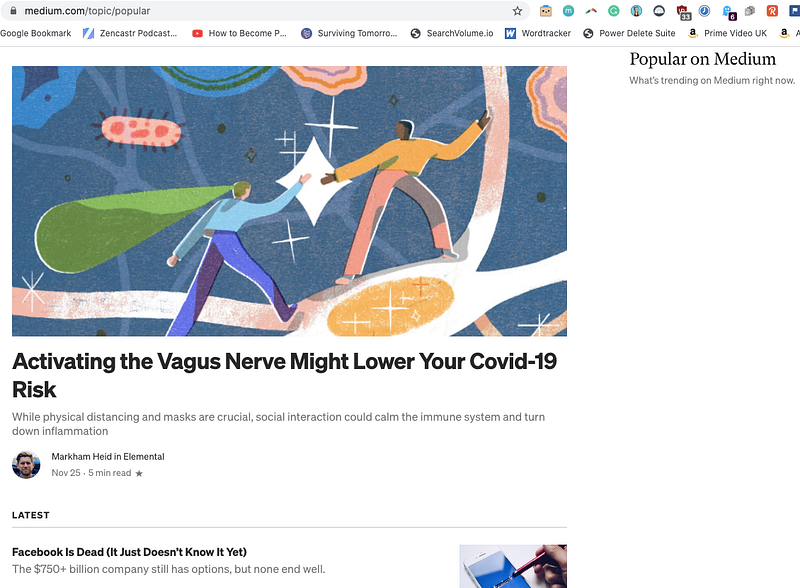
This is what I did when I wrote “Facebook Is Dead (It Just Doesn’t Know It Yet)”. I think Facebook is an incredibly dangerous addiction algorithm that’s wasting vast amounts of human potential and that it’s only a matter of time before it’s the next Myspace. I also knew some people would disagree and absolutely hate it. I hit Publish anyway.
It ended up trending to the #2 most popular post on Medium’s homepage several weeks after I published it. (See if you can spot it, hiding at the bottom.)
2. Craft a Must-Read Title
Do you know what I want to see every day when I log in to Medium?
A dozen titles in a row that make me say, “I have to read this article!”
Seriously, who’s not going to read a story like “This Revolutionary App Will Either Destroy Amazon or Make It Unstoppable”?
Make your titles surprising without being clickbait-y. Humor and intrigue are ideal, e.g., “Airbnb Is the Next Groupon (It Just Doesn’t Know It Yet)”.
Just make sure that the title is also hyper-truthful and reflective of the content, e.g., “QAnon Is a Brilliant Pyramid Scheme”.
This is crucial: The title needs to make a promise. The article needs to deliver.
For my article “How To Never See an Ad on the Internet Ever Again (Including YouTube Commercials)” the promise is that I’ll show readers how to reclaim their attention and privacy. The strategy has protected me from 2.5+ million ads, and by over-delivering, it will save readers hundreds of millions more.
3. Start Strong
Your opening sentence needs to grab readers by the throat and never let go.
Here’s my opening salvo in “Mailchimp Is Dead (It Just Doesn’t Know It Yet)”:
“Until now, Mailchimp may have been the 800-pound gorilla in the newsletter-delivery ecosystem, but there’s a new silverback Alpha that’s about to chop down the whole rainforest.”
It’s one of the most-highlighted lines in the whole article.
4. Surprise People (or Be Mildly Controversial)
One article that was both surprising and mildly controversial was “Uber and Lyft Are Dead (They Just Don’t Know It Yet)”.
Another was “Jeff Bezos Is the World’s Most Dangerous Politician,” which looks at a facet of the billionaire’s life that most people have never considered.
I knew I had a winner in “Facebook Is Dead (It Just Doesn’t Know It Yet),” and I didn’t pull any punches. I immediately opened the article with a controversial statement that was also somehow surprising and funny:
“I have the privilege of teaching Sunday school every week (via Zoom) to a bunch of fantastic teenagers aged 14–16. They’re all digital natives with a high degree of cultural savvy, a strong distaste for anything that violates their personal privacy, and a nose for political bullshit.
“So naturally, none of them have Facebook.
“I asked if any of their friends have it. They laughed. Not a single one could think of any friends who still had Facebook. One of the boys filled me in: ‘Dude…Facebook is for moms and grandparents.’”
5. Be Oddly Specific
“Mailchimp Is Dead (It Just Doesn’t Know It Yet)” isn’t for everyone. Half the reading public has probably never even heard of Mailchimp. This article is for a very specific group of readers — content marketers — but the response from that community has been overwhelmingly positive.
The takeaway: Write to exclude. Some people should be mildly-but-not-too lost — and ideally, want to catch up on the conversation.
6. Be Stupidly Helpful
I want my books to be unputdownable. I want my films to keep people glued to their seats. I want people to finish reading my articles and say: “Dang, I’m so glad I gave Jared ten minutes of my day! That was worth every second and will deliver value for years!”
I want them to clap it up, email it to dozens of friends and colleagues, and share it widely on social media. Most importantly, I want to build enough personal trust with readers that they subscribe and keep coming back for more.
How do you do that? Quality writing.
Quality is the ultimate form of marketing.
Before I publish a post, I stop and ask myself: “If my readers do X, how will it improve their lives?”
Example: If 10% of the readers of “Mailchimp Is Dead (It Just Doesn’t Know It Yet)” switch to Sendy, I’ll have saved my readers $1.5+ million over the next five years.
Being stupidly helpful is incredibly valuable. Never ever publish a post without having a stated helpful goal.
7. Finish With a Bang
Just like a movie, every article needs an emotionally satisfying conclusion.
Readers should walk away from your article feeling satiated. They should want to clap it up and share it with others and bookmark it for rereading.
Check out my last line of “If Sleep Isn’t One of Your Top Three Life Priorities, You’re Doing It Wrong”:
“Unfortunately, this let’s-all-get-nine-hours-and-love-our-lives proposal is undoubtedly ‘radical’ to most modern people… in the same way that our great-great-grandparents would look at our stressed-out, hectic, busy, indebted, medicated, over-stimulated, sleep-deprived world and think we are all absolutely bat$#!t insane.
“Maybe we are.”
For many readers who are sleep-deprived, constantly exhausted, and have a sense that something is deeply broken with our modern world, this was an emotionally satisfying conclusion.
8. Write Quickly
I’m lucky to say that I’m an extremely fast writer. For articles, I average 800+ words per hour. (I wrote my first published book — a 113,000-worder — in just 3.5 weeks.)
The secret? Neocortex disablement.
“Never go to sleep without a request to your subconscious.” — Thomas Edison
Lucid dreaming is incredibly helpful for my job as a writer. I’ve rewound entire scripts and worked out busted plot points by replaying specific sequences. I’ve come up with book ideas and fleshed out entire outlines by sunrise. (The only downside is that the sheets on my half of the bed are covered in pen ink!)
The good news is that you don’t have to be asleep to turn off your brain and access all that raw inner creativity. Why do you think so many famous writers were alcoholics or took amphetamines? ;)
There will come a time where you’ll need to fully engage that highly critical, rational, forward-thinking editor-censor part of your brain, but for now, that bossy librarian needs to sit down and shut up so you can get your blue-sky thoughts on paper, canvas, or code. Find whatever (safely) works for you.
Jack Kerouac, the ultimate stream-of-consciousness writer, put it well:
“Remove literary, grammatical, and syntactical inhibition.”
Give yourself permission to create extra-ugly first drafts.
9. Edit Sllllllooooowly
Once you’ve crushed out your creative 1.0 draft, it’s time to polish that ugly duckling into a readable piece that will bless thousands of readers.
Leave zero fluff
If you or your test readers find themselves skipping sentences or scanning through certain sections, rewrite or cut them. Never waste a reader’s time. Never publish an extra word.
Craft arresting sentences
The power of a well-crafted sentence is hugely underappreciated. As a writer, there’s nothing more gratifying than when a dozen people highlight the same sentence in your article. A few examples:
“Sadly, for most of us, the internet has become a highly-toxic, anxiety-inducing, privacy-eroding, sleep-robbing, work-distracting, ad-blitzing, time-devouring wormhole to nowhere. (Or, you know, believing the earth is flat.)” — From “How To Never See an Ad on the Internet Ever Again (Including YouTube Commercials)”
“The reality is that all tools use us. A hammer literally cannot hit a nail without using a human. A saw cannot cut through a board without using a human. A phone cannot deliver ads without using a human.” — From “How To Never See an Ad on the Internet Ever Again (Including YouTube Commercials)”
“If you make the choice to keep your word, and your friend is willing to extend grace, it’s only a matter of time before things are not only back on track, but are actually stronger than before. Rather than coasting through life on the assumption of trust, you journey together on the intention to trust.” — From “I Betrayed a Friend’s Trust and It Nearly Destroyed Our Relationship”
Kill the passive voice
Until you have a knack for avoiding passive sentences, the Hemingway App is great for catching them.
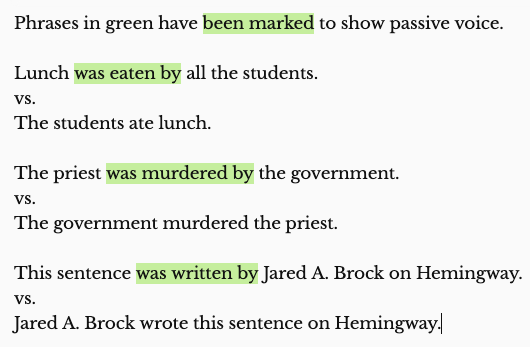
Then:
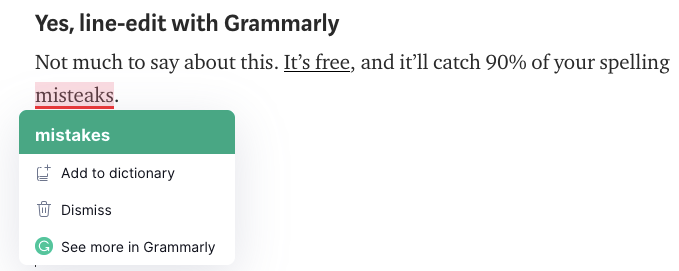
But then: read it out loud
Or better, because your brain sometimes skips over mistakes even when you read it back: Let your computer read it to you in a sophisticated British accent.
Apple logo > Systems Preferences > Accessibility > Speech > Change the key to Command-R for “read.”
Then all you need to do is highlight a block of text, hit Command-R, and your digital butler will read it back to you in the Queen’s English. If you’ve run your piece through Hemingway, Grammarly, and Text-to-Speech, you should be 99% of the way there.
And then: get someone else to read it
My wife reads and comments — and therefore improves — nearly all of my articles. She’ll occasionally catch a typo or two, but usually, it’s more substantive on the editorial level.
I never submit a piece to publications until I’ve reread my story seven times.
10. Market Everywhere, Spam Nowhere
Every time an article gets accepted, I see it as my mission to help the story perform as best as possible. When publication curators take a chance on my work by giving me one of their limited daily slots, I owe it to them to give my best effort in driving people to their publication.
I want every single post to be a major win-win. Obviously, this doesn’t happen every time, and it’s extremely disappointing when stories don’t take off, but curators always appreciate it when you give it your all.
Quantity
I limit myself to max three shares on Facebook/Twitter/LinkedIn over a five-day window. I also limit myself to max one email to my list.
Quality
Obviously, the cover image, title, and subtitle do a huge amount of the heavy lifting, so when marketing I try to add a note that conveys the reader benefit. My article isn’t about me — it’s about my audience.
It’s never, “Hey, read my story.”
It’s always, “Here’s how this free article will add real value to your life.”
Say yes to new distribution opportunities
I was approached by several people who asked to translate my articles into other languages this month. So we’ve partnered together to release several so far:
Instagram está Muerto (Solo aún no lo sabe)
Facebook está muerto (Solo aún no lo sabe)
If you’ve done all the hard work of writing a great article, take time to make sure the maximum number of people can gain value from it.
11. Check Your Stats Constantly
I decided from day one that I would check my notifications and traffic levels at least ten times a day, six days a week, and that I’d check my income update first thing every single morning except Sundays.
The hope was to lean into this 30-day experiment and really try to gamify it. I started calling them “money points,” and pretty soon my wife started asking me how many money points we’d earned while we slept.
Why? To get that little hit of dopamine working for you
Have you ever noticed that when you log in to Facebook, the little red notification button is the very first thing to load? That’s engineered on purpose — to hook you. (Medium, to its eternal credit, does the exact opposite and loads content first.)
But seeing that little green notification circle should still give you the warm fuzzies — it means your work is connecting with real people.
Green notifications and green money points are the exact kinda crack this typing monkey likes because it’s an instant source of validation. This, of course, can be an incredibly dangerous double-edged sword — there are many writers who just write what’s popular and not what’s true — but if you can keep your head and feel the buzz, you’re in the sweet spot.
Pro tip
Install the Enhanced Medium Stats plugin for even more metric juice:
12. As Soon as You Start Making Money: Subscribe to Medium Pro, Give 10+% to the Poor, and Re-Invest the Rest in Your Writing Career
Because this was just a 30-day experiment for me and any money earned was just gravy, I decided ahead of time how I’d reallocate the revenue.
A. Get Medium Pro
Not only for personal growth. Not only to support great ad-free writing. Not only for self-improvement tips on a binge-worthy scale.
Get a Medium subscription so you can see what’s already out there, become inspired by new ideas, and figure out what niches and needs you can fill.
Also: You can write it off on your taxes as market research!

B. Help the poor
It’s an incredible privilege to: a) be literate b) have access to a computer and the internet c) live in a country that doesn’t overly censor our opinions d) have the health and time to share our words with the world
The fact that we can get paid to write gives me giddy pleasure, but it also puts a big weight of responsibility on our shoulders, to care for our global brothers and sisters who will literally never have the opportunities we take for granted every day.
Being grateful isn’t enough.
We need to give back.
We are blessed to be a blessing.
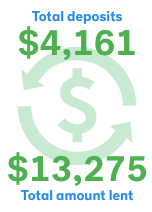
My allocation of choice is KIVA. For those who haven’t discovered this amazing platform yet, it’s like a GoFundMe for developing-world entrepreneurs. You loan in $25 increments, along with a whole bunch of other people, and the overseas entrepreneur — often groups of enterprising women in rural villages — uses the money to build their business and pay you back interest-free.
Michelle and I have made over 350 loans in 36 countries, continually re-cycling our money to help more people. Our goal is to use Medium money to invest in 365 entrepreneurs this year. It’s a hand up instead of a handout, and it’s a sustainable way to lift people out of poverty with my writing.
C. Invest in your writing career
Blogging is just the start. If you’re a good writer and can find a way to connect with readers on an emotional level, Medium is a great way to earn some side income and grow your readership, but it’s not the endgame. Writing on Medium can lead to all sorts of new opportunities to contribute value: creating courses, publishing books, doing speaking tours, etc.
I’ve invested more than $20,000 in my writing career — in editors, writing coaches, publishing mentors, and training courses. It’s paid back more than 1,100% in the past decade, and hopefully, we can add another few zeroes in the years to come. Then, instead of increasing our standard of living, we can increase our standard of giving.
In Conclusion
I will be honest: I waffled back and forth about even publishing this article. I thought: Am I just helping the competition?
I eventually realized that, no, there’s room enough for all of us on Medium. We’re barely even competing against each other. Think about it:
- Users spend an average of 58 minutes per day on Facebook.
- Americans spend over 8 years of life watching TV.
- People spend an average of 40 minutes per visit on Youtube.
That’s the equivalent of billions of people each reading 1,000+ seven-minute Medium articles per month.
We have the opportunity to help people rescue their time — to transition to more mindful modes of consumption.
We need more and better stories. We need more and better publications.
There’s still plenty of room for great writers on Medium — at the end of the day, if you’re helpful and kind, you’ll probably find a welcome audience on Medium and beyond.
Signing Off
I hope this article was tactical, practical, and highly useable. If this article helps you write more lifegiving, timesaving, health-improving, heart-tugging, mindset-altering stories that draw people away from passive consumption and into active growth and contribution, if it improves your ability to be a marketer with integrity, then I’d say we’re all the better for it, and instead of competing, we’re actually growing together.
And we’re only just getting started.