
Mailchimp Is Dead (It Just Doesn’t Know It Yet)
There’s a new 800-pound gorilla in the email marketing jungle, and its name is Amazon

Until now, Mailchimp may have been the 800-pound gorilla in the newsletter-delivery ecosystem, but there’s a new silverback Alpha that’s about to chop down the whole rainforest.
When email marketers discover the true potential of this new challenger, the established providers can kiss their current business models goodbye. Mailchimp, Aweber, Constant Contact, ConvertKit, MailerLite, CampaignMonitor… if they don’t respond to what’s coming, they’re all toast.
Email Is King
Forget Facebook ads and YouTube pre-rolls and Instagram influencer sponsorships and whatever the heck’s available on TikTok… direct email marketing is still the most profitable form of digital marketing by a mile.
According to Hubspot, “email generates $38 for every $1 spent, which is an astounding 3,800% ROI.” Their findings also report:
- 3.9 billion people check email daily. (This number is expected to climb to 4.3 billion by 2023.)
- 73% of millennials prefer communications from businesses to come via email.
- 59% of respondents say marketing emails influence their purchase decisions.
Obviously, email marketing is a core piece of strategy for most entrepreneurs, but there’s one glaring problem:
It’s Far Too Expensive
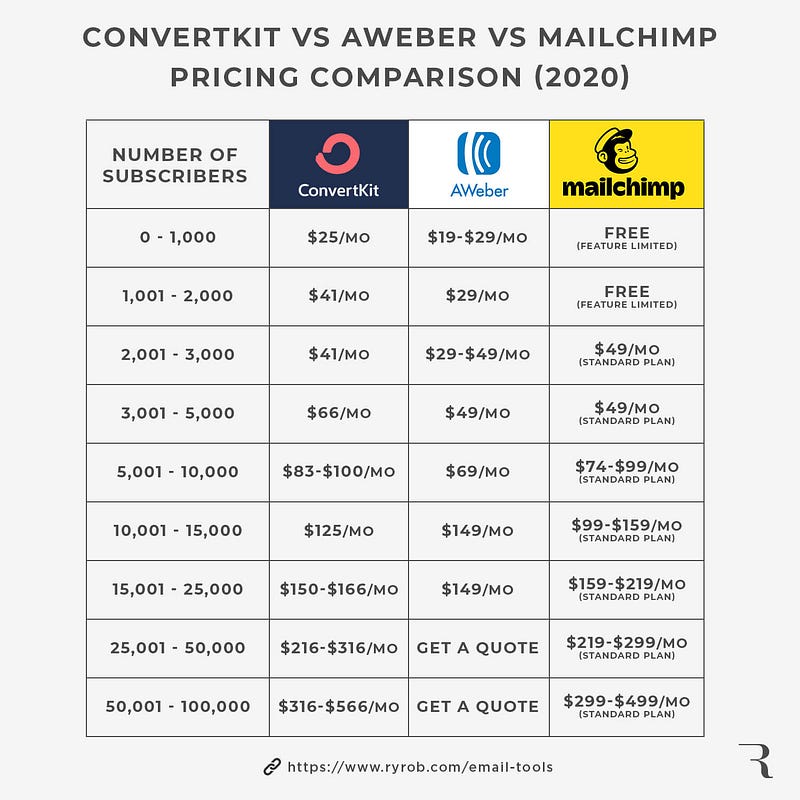
Once your free trial expires — or you reach more than 2,000 subscribers on Mailchimp — the cost to send emails to your fans gets heavy.
- To send a monthly email to 5,000 using ConvertKit will cost you $83/month.
- To send a weekly email to 10,000 using Aweber will cost you $149/month.
- To send a daily email to 100,000 using Mailchimp will cost you $1,190/month plus significant overages.
All told, the U.S. spent over $350 million on email advertising in 2019.
Despite their massive profits, the big secret that none of the email companies want you to know is that sending mass emails is actually super-stupid cheap.
Thankfully, there’s an Amazon company that’s about to expose the truth once and for all.
Introducing Amazon SES
Love them or hate them, Amazon’s ability to legitimately (and sometimes illegitimately) dominate new industries is undeniable.
- They did it to bookselling. (Amazon.com)
- They did it to audiobooks. (Audible.com)
- They’re doing it to grocery shopping (Whole Foods), parcel delivery (Amazon Logistics), web services (AWS runs the CIA’s servers), and dozens more. (They’re even toying with a cryptocurrency.)
Amazon Simple Email Service (SES) has been around for a few years now, and despite the fact that it’s the service of choice for huge players like Duolingo, Reddit, and Netflix, everyday email marketers are just starting to realize that SES is an absolute game-changer for their newsletter businesses.
I was paying just under $100 per month for Mailchimp to send emails to my 6,000ish subscribers. One hundred bucks… for what? Gmail’s free. Why so much money — for the templates I never used? For the complicated segmentation and A/B testing that we little guys don’t have time to explore?
The really crazy thing? Even if I didn’t send an email for an entire month — or an entire year — Mailchimp still charged me full price, every single month, no matter what. Some weeks I was literally paying them for nothing.
So I ditched Mailchimp for SES.
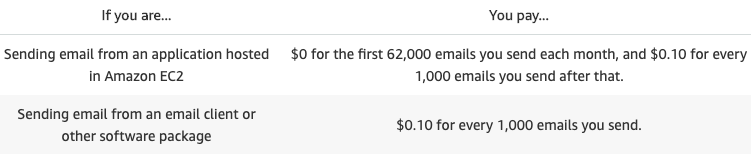
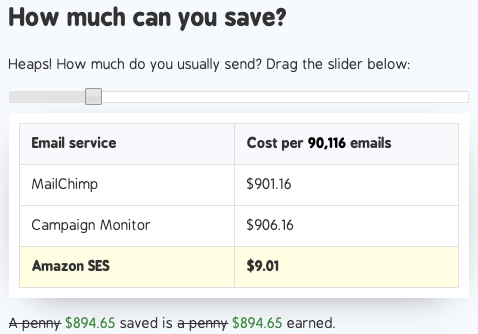
Now, instead of paying more than $1,000 per year, sending roughly 24,000 emails per month costs me just $2.40.
That’s right: it’s literally 34X cheaper.
- Ben Hardy could email his 400,000 fans for just 40 bucks.
- James Clear’s half a million? 50 bucks. (By contrast, ConvertKit charges $24,990 for 500K subs billed annually.)
- Tim Ferriss’s 1,500,000 subscribers? 150 and call it a day.
So Why Hasn’t Everyone Switched Already?
If you visit the Amazon SES website, you’ll see that it’s very nerdy and technical — not in any way built for the average email marketer who doesn’t know how to code. The setup process is absurd. You have to get your web gal to set up an EC2 instance (whatever that is) and find or build a third-party application that lets you self-host it on your website. I literally couldn’t use it without my web team.
A few small companies have created platforms that make it a bit easier to send via SES on the back end, but have prettier user interfaces:
Sendy
This is what I use. It’s a very small one-time fee (less than a month on Mailchimp) and you’re set for life. It’s so cheap!
MailWizz
Probably the most established player in the SES game so far.
MuxEmail
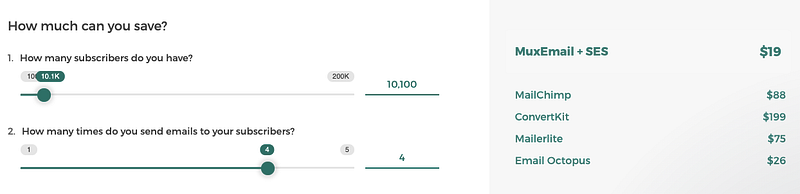
Despite a name that sounds like “mucous” meets “acid reflux”, Mux offers unlimited email subscribers for a flat $19/month.
These New Emailers are Just the Start
In this regard, the best really is yet to come. Mailchimp has been so dominant for so long simply because it’s so easy to use. Anyone who knows how to send an email can send an email with Mailchimp. SES isn’t that simple… yet.
In the next 12–24 months, it’s likely that a number of hackers, entrepreneurs, and startups will realize this ten-million-dollar opportunity and create Mailchimp-looking front ends that operate with an SES backend and charge on a per-send basis with no more monthly fees, ever. When this happens, millions of marketers will wake up and make the switch to SES.
Alternately, if an employee at Amazon were to build an elegant Mailchimp contender that lived on SES — call it AmazonMail — the entire non-SES email marketing business would simply evaporate in a matter of months.
What’s Ahead
In the next year or two…
- Expect to see several new newsletter startups rocket to prominence on SES thrusters.
- Expect to see a mass exodus from the established emailers.
- Expect several established players to go out of business as a result.
- Expect several established players to completely re-vamp their pricing model. Expect more flexibility, including pay-per-send instead of monthly vigs. (That’s right: we’re about to see the end of subscriber-based pricing. Hallelujah!)
- Expect several established players to hold fast to their bloated pricing, but begin to offer a new range of innovations that justify their 10X price tag.
In the Meantime
If you’re an email marketer, play around with Sendy and MuxMail and get a feel for SES.
And if you’re a coder or programmer, what are you waiting for?!
All told, these new developments are extremely exciting for the average email marketer. While Mailchimp & Co. will likely suffer catastrophically as a result, we can expect to see a lot more affordability in the newsletter business, more payment flexibility, all paired with better deliverability and some great new innovations. As they say in the business: stay tuned for updates.


