
The 365 Days of Giving Challenge
We can elevate the poor, one day at a time
2020 has been an objectively horrible year for much of humanity:
- Millions of families have lost loved ones.
- Tens of millions of people have lost their jobs or businesses.
- Millions more have claimed bankruptcy or are seriously delinquent in their payments to for-profit private bankers and predacious land-lorders.
- Global debt levels have soared to a height never seen before in human history.
- Many nations (especially China) have used the pandemic as a pretext to expand their panopticon surveillance network to unprecedented levels, including under-the-skin tracking for the first time.
- Corporate-controlled “democracies” have printed trillions of zero-value-backed dollars — competitive currency debasement has become a global political bloodsport at this point — robbing its own citizens of huge amounts of purchasing power, skyrocketing manufactured inequality, and further inflating a stock market bubble that will eventually cause the greatest reset of all time.
Yet, for most of the people in my circle — myself included — 2020 has been relatively… nice.
- It’s been nice to slow down and shed unwanted social commitments.
- It’s been nice to stop driving and polluting so much.
- It’s been nice to work from home.
- It’s been nice to spend less money.
- It’s been nice to spend more time with spouses and kids.
Sure, some of us tried to do our part by fundraising for starving orphans in India or supporting out-of-work moms in Ghana, but no amount of giving can ever offset the guilt that living a privileged life induces. (Also: guilt-reduction isn’t the point of giving!)
Now is the time to give like never before.
“He who does not help at the right time does not help at all.”
As the Covid vaccine rolls out and things slowly “get back to normal” in rich nations over the next 12–24 months, it’s more important than ever to make sure we don’t forget about the economic recovery of the “bottom” 90+%.
The reality is that hundreds of millions of people around the world work for day wages: they work all day for criminally-low wages, get paid cash at sunset, then buy meager rations to feed their families. Any blip in global food prices has a devastating effect on the poor. Any increase in real estate prices increases houselessness. Any engineered-inflation guts their purchasing power. Because of our corrupt global economic system, over 1 billion of our global brothers and sisters live in slums, and that number is growing by 1 million people per day.
So what are we to do?
Throw money at the major charities? Sure, but much of it gets spent on Western salaries and fancy offices.
Lobby Western governments to cancel foreign debt and send more aid? Sure, but debt-trapping is a form of geopolitical control that powerful nations are loath to surrender — there’s a reason why China owns Greece’s major seaport and many of Ethiopia’s toll roads — and much of our foreign aid money ends up in the pockets of the corrupt dictators who ruined poor nations in the first place.
We need a better way to help the poor.
Imagine giving DIRECTLY and PERPETUALLY
What if, instead of giving people an inefficient and unaccountable handout, we gave them a verifiable hand up?
What if, instead of blindly tossing money into the insatiable maw of Western philanthropy, we could invest in developing-world entrepreneurs who are engaged in the on-the-ground hard work of society-building?
What if we could loan them money and they could pay us back with the profits of their new business?
Introducing micro-finance
Most people have heard of it before, but I don’t know very many people who are actively engaged in it. And it’s not hard, at all.
While there are plenty of good options out there, my lending platform of choice (for sheer ease of use) is KIVA.
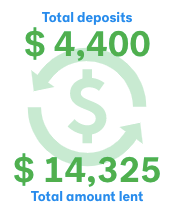
In the past 11 years, slowly but surely, my wife and I have deposited $4,400 onto the platform. Because most of the loans have been paid back, we’ve been able to re-loan that same money again and again:
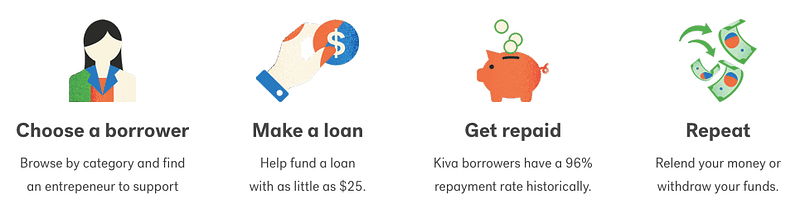
Here’s how it works:
KIVA was established in 2005 as a not-for-profit, and it’s the real deal: In the past decade, 1.6+ million lenders have supported more than 2.5+ million borrowers and have made a $1+ billion impact. That’s a lot of small businesses built, families fed, children sent to school, and people lifted from poverty.
Your portfolio
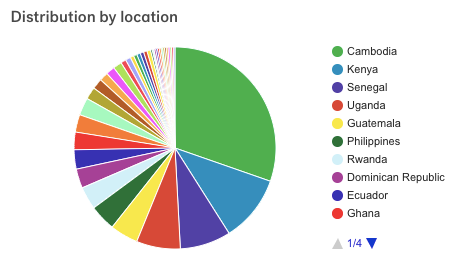
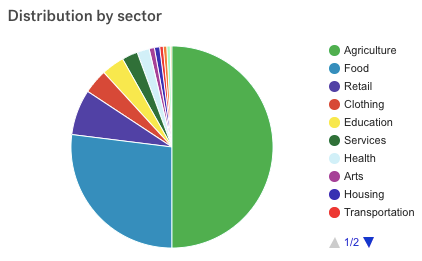
KIVA has a great dashboard where you can check out all the loans you’ve made, all the countries you’ve supported, what sectors you like to invest in, and a whole host of other details:

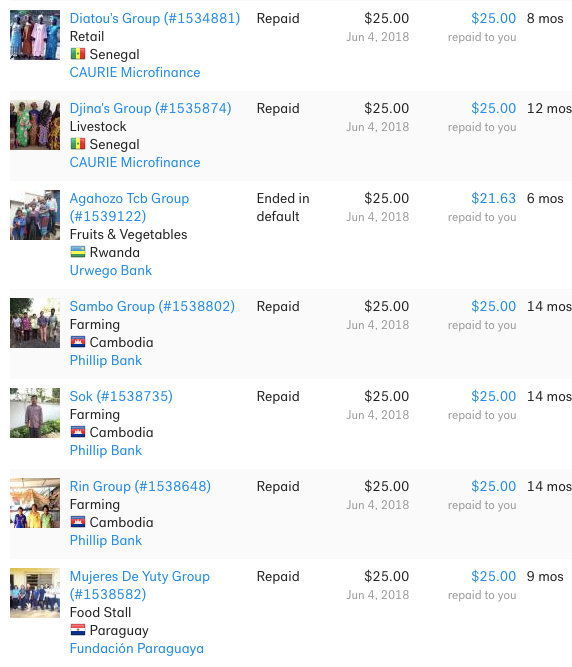
There’s also a page that lists all your loans and their repayment rates.
This is a handy way to track which nations and organizations tend to have the best re-payment rates, which is especially good if your goal is long-term retention of cash to re-give again and again:
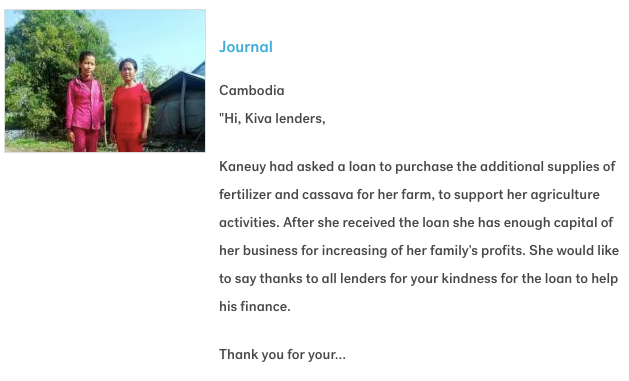
You can also receive updates from the entrepreneurs you’ve supported:
It makes for a great gift, too.
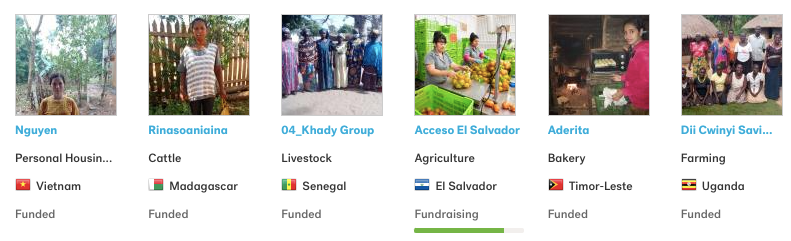
For Christmas this year, my wife and I bought a $150 KIVA gift card for my friend Rob and his four daughters. It was a delight to watch his little ten-year-old fashionista scroll through loans in search of a clothesmaking business, while the twelve-year-old went for a bakery and the fifteen-year-old farm girl invested in livestock.
The best part is that next Christmas when all the loans are paid back, the girls and their dad can re-loan that $150 to another six entrepreneurs. Hopefully, overseas giving becomes a regular holiday tradition for years to come.
So what does it cost to get started?
Twenty-five bucks.
$25.
That’s it.
Your loan is then batched with dozens of loans from other people and is sent to the entrepreneur so they can start or grow their business, usually with support and training from an on-the-ground NGO. Best of all, KIVA doesn’t take a hefty cut: 100% of your loan goes to the field.
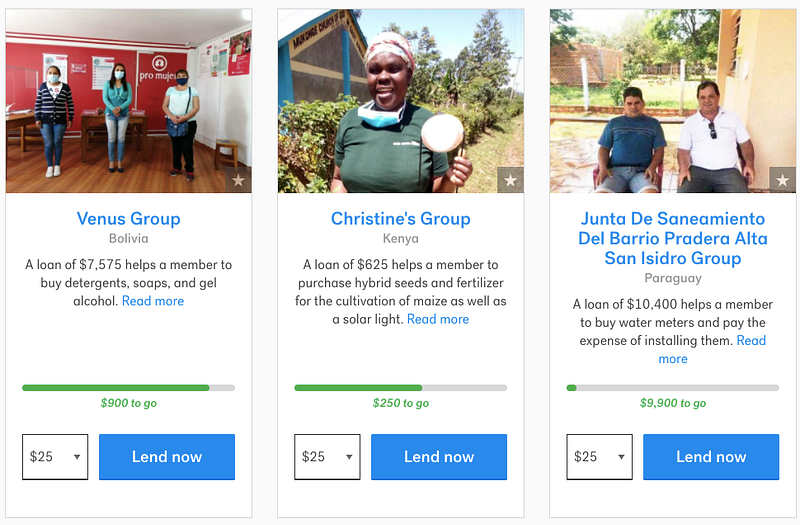
And you can REALLY customize your loan options:
You can search by country. You can search by sector. You can search by gender. You can search by religion. You can search by default rate. You can search by need.
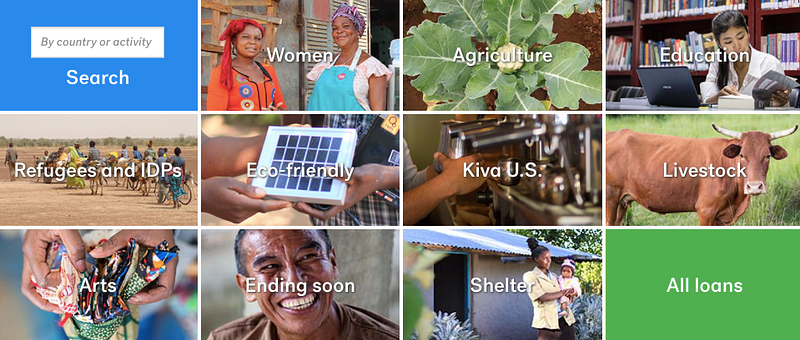
For example, you can customize your search to only show you loans made to groups of female artists in Cambodia, or to Christian single-parent refugees from Syria who are focused on eco-friendly projects.
The number of options is endless!
It’s time for a new New Year’s resolution
As we enter 2021, many of us will sit down to journal and reflect on the past year, and look forward to the year ahead; to dream and scheme and hope and plan for our own lives. Let’s not forget to think about others in the process. Let’s not forget about giving; about making a contribution to the betterment of our global family.
One of my resolutions this year is, barring some unforeseen catastrophic circumstance, to make 365 loans on KIVA.
This might seem like a ton of money — thousands and thousands of dollars — but unless a loan defaults (which, in my experience, is extremely rare) or there’s significant currency exchange loss (which, in my experience, is negligible) it’s actually one of the most cost-effective ways to elevate hundreds of families from poverty.
To be clear, I earn significantly below the national average income. And I understand that, because of how our system has been engineered to squeeze the working class, many people can’t even afford to make rent right now, let alone help an overseas entrepreneur with a $25 loan.
But many of us can. The key is to give first and re-prioritize everything else around your giving. It’s also important to remember that a $25 loan only ends up costing you $0 to $2.50 on average. If you need to withdraw your money in the future, you can do so. But, hopefully, by giving it once, you’ll be able to live without it, and can continue to re-invest it in others.
So: will you join me?
One year.
Giving every day. Or week. Or month.
365 loans to help 365 families.
Or… take the first step and make just one $25 loan, at a cost of mere pennies.
There’s nothing more exciting than knowing a small slice of your hard-earn money is going to help elevate a fellow laborer from poverty.
To the impoverished person receiving it at the end of a horrible 2020, it might be the best present you anyone give this year.


