
Healing Through Connection
Increasing emotional intelligence and connecting with your higher self may offer profound hope for anyone battling substance abuse

Introduction
Recently I read a masterpiece by Keri Mangis, Six Real-Life Ways to Experience Inner Peace. Keri talks about truthful, honest, and open expression as a path to inner peace, which is much more than speaking the truth. It requires self-awareness and honesty with self too. Keri also offers a unique approach to how to access creative expression, and finding purpose, singular or plural, in one’s life and how that leads to inner tranquility.
In a comment to Keri’s story, I wrote:
“I love what you said about connection, creativity, and meaning-making. All of those things give us purpose and without purpose, we feel empty, lonely and depressed. Sadly, I have seen a lot of folks turn to substance abuse as a result.”
Substance abuse, depression, and domestic violence are all on the rise on the heels of Covid-19. Sadly, we as a global society are facing desperate times and we need inner peace, as Kerri wrote about, more than ever. Having survived both physical and emotional abuse, my passion is to awaken inspire and empower others to live the life they love and I deeply believe one way to do that is to strengthen our emotional intelligence skills.
In this article, I will show how employing techniques to improve and expand one’s EI provides tools to walk the path to inner peace described by Keri, and also to connect to our higher self and others and in doing so align with our authentic self. By combining these techniques anyone overcoming addiction, specifically, has a better chance of long-term recovery.
In the case of someone very close to me who abuses alcohol, he thought he was simply miserable from a rough breakup, but it was so much more. I could see what he could not — very often people are in denial and their thoughts are distorted. All he did was watch t.v., sleep all day (due to insomnia at night), and drink. He had no purpose. No job. No creative outlet. No connection. Nothing to give him a sense of meaning or self-worth. He is not an isolated case, many people who fall prey to substance abuse do so because they cannot face their own emotions, cope with the stress in their own lives, feel disconnected either from themselves or society, lack self-love and acceptance, and lack a greater purpose. Losing his girlfriend was the effect of his accumulating problems, not the other way around.
Emotional Intelligence
Daniel Goleman made the term emotional intelligence popular in the mid-’90s with his book Emotional Intelligence. Many people feel a high EQ provides a greater indication of the potential for success than IQ.
“If your emotional abilities aren’t in hand, if you don’t have self-awareness, if you are not able to manage your distressing emotions, if you can’t have empathy and have effective relationships, then no matter how smart you are, you are not going to get very far.” ~Daniel Goleman
Personal Awareness
Personal awareness is the catalyst for transformation, and I believe we all need some tuning up now more than ever. No one can solve a problem, personal or otherwise, without first gaining awareness of and owning that it exists.
We are coming out of isolation from Covid-19, or are we? Some of us globally are re-entering or still in lockdown and it has had a tremendously negative impact on mental health around the world. According to the CDC, anxiety in the United States alone elevated by 31% and people started or increased substance use by a rate of 13%. I believe many people are turning to drugs and alcohol largely or in part because they cannot cope with their emotions. Feelings of loneliness stemming from separation from friends and family for long periods of time, fear of losing jobs, fear of losing homes, and grief from losing loved ones to Covid or other causes with no hospital beds available to treat, for example, a patient in need of intensive cardiac care are all very difficult situations to get through without a high level of emotional intelligence. The good news is we all have the ability to strengthen our emotional intelligence and grow it.
Emotional Intelligence (EI) begins with personal awareness. Anyone who possesses self-awareness has the ability to identify and name the emotion he or she is feeling, understand their thoughts, and practice “the pause,” which means to pause and respond rather than act with a knee-jerk reaction they may later regret. Self-awareness is a very important step in the recovery process because it is the first step to admitting the existence of a problem.
To illustrate what a growing problem substance abuse has become here are some of the latest statistics:
22 million people suffer from active substance use disorders
23 million people are in active addiction recovery
45 million people are directly impacted by addiction
1 in 3 households suffer from, are exposed to, or are otherwise impacted by addiction
Seek Contentment Rather than Chasing Happiness
When I teach my clients emotional intelligence, I like to talk about the emotional scale in terms of a teeter-totter (or seesaw) with the most positive emotions of empowerment, appreciation, and love being on one side and then the most negative emotions of fear, despair, and powerlessness on the other side. When the teeter-totter is perfectly balanced in the center, we feel content. That feeling is our baseline, and the feeling we strive for the most to avoid the highs and lows of the teeter-totter, where we lose our tummy, like going down a giant hill on a roller coaster and go into the fight or flight zone.
Recognizing Triggers and Self-Soothing
Most of the time that we feel a negative emotion we either remember something from our past or worry about something in our future. It helps to come back into present moment awareness, where we can remind ourselves we are safe, recognize what triggered us, and use self-soothing techniques to get back to our baseline of contentment as quickly as possible. Emotional Intelligence techniques can help people identify and manage their triggers without self-medicating with alcohol or other drugs. Identifying triggers is an essential component of relapse prevention.
“”Don’t ask the question ‘why the addiction,’ but ‘why the pain?’ ~Dr. Gabor Mate
Common Triggers:
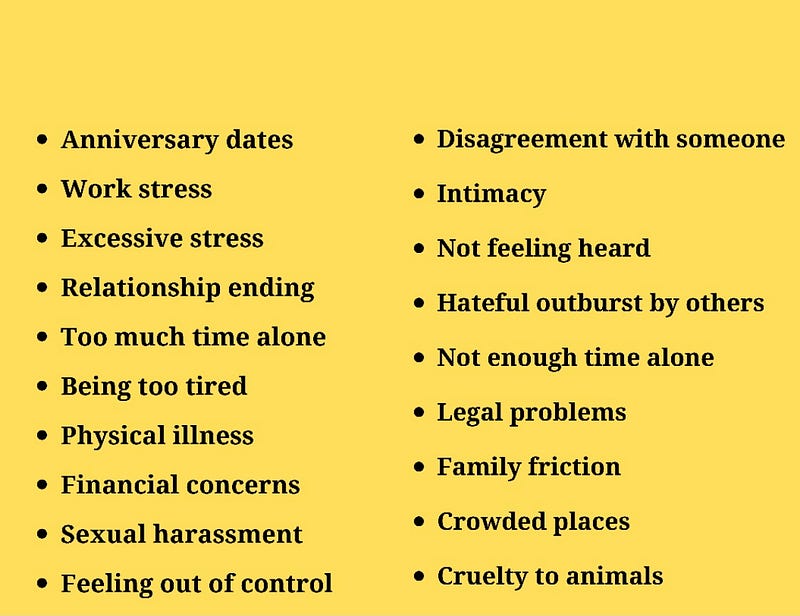
An axiom often heard in recovery circles is FEAR is an acronym for false evidence appearing real. If we can direct our minds back to present moment awareness, we can remind ourselves that we are safe and come back to calm states of mind. The fastest way to implement this is to practice a breathing technique that will activate the parasympathetic nervous system and lower our heart rate and blood pressure.
One Easy Breathing Technique
Breathe in 4 counts — Hold 4 counts — Breathe out 6 counts — Hold 4 counts — Breathe in 4 counts
Repeat at least three times or until you feel calm
Examples of other self-soothing techniques
- Exercise
- Meditate
- Go outside
- Bake
- Sing or dance
- Journal
- Do a creative project
- Clean
- Call a friend or loved one
When we bring ourselves into present moment awareness, we have the ability to choose our thoughts and free ourselves from suffering. Once you feel closer to that baseline of contentment start to contemplate the following:
Identify and name the feeling you are experiencing
Become aware of the thoughts
Ask yourself if the problem is solvable in the moment
If not, distract yourself. If so, plan how you will solve it.
Ask yourself why the thought bothers you
Ask yourself if there are any benefits to that thought
Everything we do in life is because we are either avoiding pain or moving towards pleasure — ask yourself which one is more valuable to you. Have self-soothing techniques available so that when you are triggered by a negative thought or event you can soothe yourself and get back to that baseline of contentment faster.
“Goleman concluded in 2004 that low EI is related to issues such as violence, depression, crime, and addiction, as they are all caused by an individual’s inability to cope with emotions.” ~Hindawi.com
Self-Regulation
Being able to recognize and express emotions constructively and respond rather than react is the process of self-regulation. It is also something that many of us struggle with. It is important to recognize the physical and mental signs and symptoms of stress and anxiety and to use the self-soothing techniques discussed earlier when triggered. As we learn more about ourselves, we bring the unconscious or subconscious thoughts into consciousness revealing the truth behind what was causing our self-limiting and destructive behavior leading to substance abuse. Once we bring that into the light then and only then can we break those patterns.
To heal at a root level and break the cycles of repeating harmful patterns, we must reprogram the subconscious mind which constitutes 90% of our brain. Several tools aid in doing this including visualization, positive affirmations, breathing techniques, exercise, and meditation.
“Far more than a quest for pleasure, chronic substance use is the addict’s attempt to escape distress…Addictions always originate in pain, whether felt openly or hidden in the unconscious. They are emotional anesthetics.” ~Gabor Mate
Visualization
Visualization is a great way to reprogram the subconscious mind, but also to manifest all that you truly desire. By actually visualizing the life we want to create, free from addiction, feeling light and energized, happy and connected, soulful and plugged in, we then start to see ourselves active in the community. By visualizing and thinking these thoughts we are putting that energy out into the universe and therefore starting the process into action.
Positive Affirmations
Saying positive affirmations daily is another great way to build confidence and reprogram the subconscious mind. You might consider leaving yourself sticky notes on bathroom mirrors, on your car dashboard, and on the refrigerator to help you remember to say them out loud throughout your day. The key is to believe them as you say them and to repeat them several times each day. Some examples include:
I am strong enough to remain sober
I am happier living a clean life
I am committed to improving myself
Building emotional Intelligence Deepens Not Only Your Connection with Others but With Your Higher Self
In his story Drilling Down to the Root Cause of Addiction, Marcus writes:
“What I have described and what Mr. Chugtai’s description have in common is a life out of alignment with one’s core purpose. The root cause of addiction is an intense conflict between one’s conscious mind and one’s subconscious — if you believe in souls, between one’s human side and one’s spirit.”
A reader of Marcus’ story, Shaun Thomas Villafana, who seems to have left Medium, commented:
“sincerely, you are too also so close, but there is a root more universal and one you surely will feel it when you see the dynamic, as you have entirely outlined and proposed and with exact reasoning unto what would be the cure.
The root cause of addiction is disconnection.”
Mr. Villafana pointed Marcus to this incredibly moving and poignant video:
and another writer and spiritual healer, Frank Ontario, just the other day amplified this point.
Now I will address how working on EI can cure feelings of disconnection by restoring connections to others and our inner spirit, and thus both sides of the same root-cause-coin of addiction identified by Marcus, Villafana, and Frank.
Self-confidence and Self-love
Which came first the chicken or the egg? In the end, it does not matter because whether the person’s confidence was low when starting to drink or use drugs abusively or at the point of quitting — either way, building confidence is of the utmost importance to the recovery process. A great way to accomplish confidence-building is to establish new hobbies and creative outlets to express emotions non-verbally. Establishing personal interests will motivate the recovering addict to maintain sobriety because it gives him or her a sense of purpose or meaning, which builds connections to the inner and outer spirit and fosters joy and fulfillment. Another thing I encourage as a coach is volunteer work. This again creates connection but also builds confidence by making one feel important and useful by giving back to the community.
“substance abuse impairs our ability to have intimate relationships with our loved ones, ourselves, the world, and God” — Father Bill from Caron (shared with me from a friend’s lecture notes)
Building Empathy
People who are high or drunk often overlook the needs and feelings of both loved ones and themselves. They are often very out of touch with their own emotions and in denial about reality. People with high EI build empathy which eliminates self-pity and creates connection. With this empathy, the emotionally intelligent person can now ask when they need help or support rather than isolating and turning to the bottle or doing drugs and they no longer will alienate friends and family.
As you strengthen your own personal awareness and become more mindful of your words, thoughts, actions, and emotions, you will also become more aware of the space and people around you. You will begin to notice how you feel around other people as well as their energy around you. Humans are hard-wired for connection. However, some relationships are not healthy and can leave us feeling more drained and even rejected. Loneliness is one big cause of substance abuse as we have witnessed during Covid, and we see it when people are in toxic relationships as well.
Having a strong support system and feeling connected with like-minded people helps with long-term substance abuse recovery because it helps combat stress, cope with difficult situations, and realize we are not alone.

Many people attend AA meetings as a way through recovery. Their family members can attend Al-Anon as a support group. In the process of AA people attend meetings to get to know one another, but more importantly to get to know themselves. They plug back into the emotions they have been numbing out, their feelings, their interests, and desires.
This is an excerpt from “The Big Book” from Alcoholics Anonymous, pages 316–317, written by a rebellious teenager after entering rehab:
“Sobriety is nothing like I thought it would be. At first, it was one big emotional roller coaster, full of sharp highs and deep lows. My emotions were new, untested, and I wasn’t entirely certain I wanted to deal with them. I cried when I should have been laughing. I laughed when I should have cried. Events I thought were the end of the world turned out to be gifts. It was all very confusing. Slowly things began to even out. As I began to take the first steps of recovery, my role in the pitiful condition of my life became clear.”
Another article that Marcus wrote is an excellent take on spirituality, in which he seeks to remove the stigma of substance abuse that people attach to the 12 Steps and the yoke of having to believe in “God” from the steps and spirituality so that anyone and everyone can benefit from Step work. That leads wonderfully into my next and final segment.
Spirituality
Having a spiritual component such as meditation, a religious affiliation, volunteerism, or healing energy work allows the individual to connect to a higher purpose and their higher self, or soul. It allows us to have faith. Faith allows us to let go of the attachment to outcomes, the fear of failure, and to forgive ourselves for our mistakes. To know that even in the darkest of times we will get through it because there is a god or higher being. It allows us to connect with the divine within ourselves as well and the realization that we were put in this universe to learn about ourselves and to connect with other living beings and practice acceptance. Yet as Marcus points out, true spirituality transcends belief in the existence or non-existence of God. Faith comes from your belief in anything higher than yourself, whether a god, the laws of nature or physics, collective consciousness, or simply G.O.D — good orderly direction — any of these concepts amounts to a belief in something higher than just yourself and allows for feelings of connection to envelop you.
Holly Kellums has written many wonderful articles about addiction and recovery and this one illustrates why it is important to have faith:
Conclusion
In addition to personal awareness, it is critical that we love ourselves and practice self-acceptance. Once we can do that we grow into the best version of ourselves. Until we live authentically we will not be in alignment. Until we are in alignment we will be living to please others and our energy will not feel right to us nor will it feel right to others, it is a losing proposition no matter how hard we try.
“Humanity is spiritually ill. We have created a system that favors attachments over spirituality — a system that values the accumulation of wealth over one’s health — a system that defines happiness based upon the acquisition of possessions, including other people, over the spiritual alignment.” Marcus
Once we are living authentically, meaning not trying to please others or worrying about what others think of us, we are in alignment pursuing the life we desire. We are easily accepted by others because they are magnetized by our newfound energy. Once we do this there is no need to numb out with drugs and alcohol because we are not living on autopilot like robots anymore. We are excited to jump out of bed and create the life we love each day. With our newfound desire to be personally accountable, we show up in life, accept criticism, and apologize for our mistakes because we want to do better without drugs and alcohol distorting our perceptions. When we tune into each other as well as into our own needs and stop judging we rise into a much higher version of ourselves.
It is my personal belief that substance abuse is not a choice. People who suffer from drug and alcohol addiction do not consciously choose that path. I believe that the subconscious mind chases the high and tricks them into needing the substance to feel good and avoid feeling their emotions. I feel that to achieve long-term success with recovery it is important to integrate emotional intelligence coaching, psychological counseling, a physical component such as yoga or another personal hobby or interest, and spirituality.
The combination of these practices will increase confidence, teach the individual how to properly process and express emotions, teach them personal and present moment awareness, teach them empathy and self-regulation, teach breathing techniques, and give them tools such as positive affirmations and visualization techniques which increase both confidence and self-efficacy. With these tools and the connection with like-minded support of other people I believe they would have a far better success rate at long-term recovery and living the content and joyful life they deserve.
Thank you so much for taking the time to read this. I do not suffer from substance abuse, but I do know loved ones who do. I deeply believe emotional intelligence can be a wonderful tool in aiding recovery from both addictions as well as for domestic violence. I hope you will comment and let me know what you think and how you are feeling today because I simply want you to know you matter. Our mental well-being is so very important. You are never alone.
I am leaving you with one more story which is a fabulous collection and wonderful resources from Holly Kellums as well as a couple more of my articles.


