
He Stabbed 21 Elementary Kids and 2 Teachers In Minutes
The story of the Ikeda Elementary School Massacre.
“I could have killed more if it had been at a kindergarten.”
Sometimes there are crimes that are senseless and unexpected. In a fit of rage, someone might attack or kill another person without any warning signs. Other times, crimes are meticulously planned out and the criminal takes steps to carry out the crime and then avoid detection. The third kind of crime is one that is like a ticking time bomb. With a string of crimes, the criminal has repeat offenses and somehow has chances to keep committing crimes.
This story is about one such criminal, Mamoru Takuma, a man who was troubled and continuously acting out in illegal and violent ways from childhood. He suffered from a mental illness that was either never diagnosed, diagnosed poorly, or never treated. He jumped from one job to another, committing one crime after another, until finally, he committed his most vicious and violent crime.
Mamoru Takuma ended up walking into an elementary school and stalking from classroom to classroom stabbing and slashing kids and teachers. In less than ten minutes, he ended up killing eight children ages 7 and 8, and seriously injuring 13 more as well as two teachers. Why did he target an elementary school, what were the other crimes he committed, and how was he captured?
This is the story of the troubled and uncontrollable man who committed one of the biggest and severe mass murders in Japanese history.
The Crime
“I am worried for the children. This is an awful case, so hard to understand. I’ve lost my words to console. These children are at their cutest, sweetest age. How can we deal with the fact that our safe society is beginning to collapse?”
- Prime Minister Junichiro Koizumi
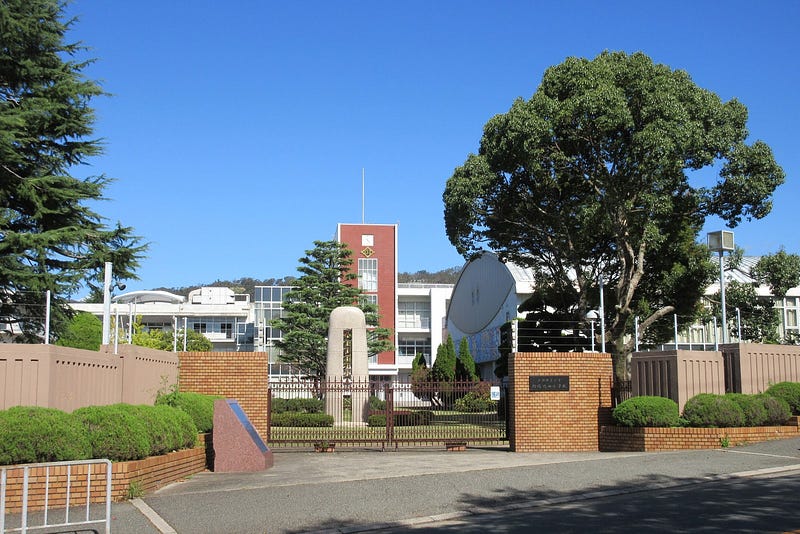
On June 8, 2001, a man named Mamoru Takuma entered Ikeda Elementary School in Osaka Japan. Ikeda Elementary is connected to Osaka Kyoiku University and is known as an elite school that accepts the brightest and most dignified students in Osaka.
Takuma didn’t just randomly choose this school but targeted the school because it was a school that has many children who come from privileged and wealthy families. When asked why he targeted the school he told reporters, “I wanted the public to know that even clever children of wealthy families can be killed in five or six seconds.”
On the morning of June 8th, as recess was ending, Takuma walked through the unmanned entrance, walked through the playground, and into a first-grade classroom. He was carrying a kitchen knife with a six-inch blade and entered the back of the classroom and started slashing kids.
Slashing children randomly, he moved forward into the classroom and then into the hall over to the next classroom and the next and the next. He ended up stabbing 23 people in total. Two teachers and 13 children were injured, most in serious condition but survived. Unfortunately, 8 children (7 girls, 1 boy) succumbed to their wounds.
As the attack was happening, in minutes two male staff were able to hit Takuma with a chair and overpower him until police arrived. As Takuma was marching from classroom to classroom cutting children, he was yelling and once police arrived he started rambling. At first saying, “I went to the elementary school,” but then saying, “I went to the train station and stabbed 100 people with my knife. I did not go to the elementary school.” He also told police he had dosed himself with 10 times the amount of his medication.
After his arrest, a medical examiner reported that he had taken three types of medication; an antipsychotic drug, an antidepressant, and sleeping pills. But medical examiners said even if he had taken 10 times the dosage it would only make him sleepy, not change his behavior.
In police custody, he also screamed, “I’ve become disgusted with everything. I’ve tried to kill myself several times, but couldn’t. I wanted to be caught and be given a death sentence.” While searching his car parked outside the school, police also found an ax, two ice picks, and another knife.
The Victims
“A strange man came in the school, and I got stabbed,” the second-grader told cashier Ikiyo Irie as she laid him down on a piece of cardboard.
The rampage that took just minutes ended with the death of 8 children. Seven were girls in the 2nd grade, while the final victim was a boy in the first grade. Here is the list of names of the victims:
- Yuki Hongo
- Mayuko Isaka
- Yuuka Kiso
- Ayano Moriwaki
- Maki Sakai
- Takahiro Totsuka
- Hana Tsukamoto
- Rena Yamashita
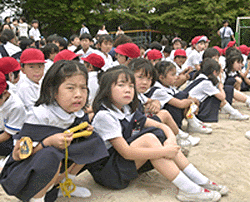
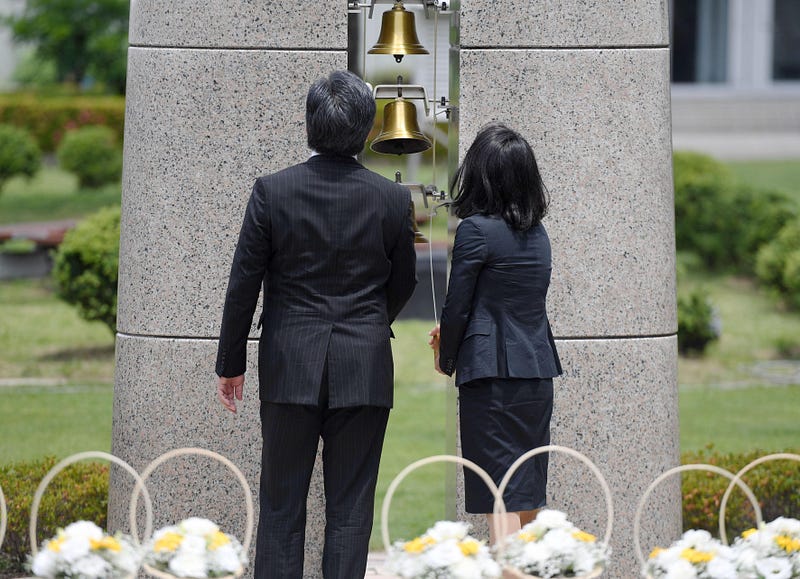
Hundreds of flowers, toys, and letters were left at a memorial for the victims and the school held a special memorial service for the eight children. Around 1,500 relatives, schoolchildren, their parents, and teachers attended the ceremony. Children from the school read poems and sang songs in memory of the lost souls.
Principal Yoshio Yamane gave an address saying,
“We remember you leading a cheerful and lively school life. We are deeply sorry we were not able to protect you.”
And along with the victims who survived, many children in the school reported feeling trauma and suffering from PTSD. Many students were visibly ill during the ceremony and were being attended to by a team of psychologists.
A relative of Maiko, one of the girls killed said, “It is scary. It’s hard to believe that it was an act of a human being.”
Another girl who died, Mayuko’s father said, “I saw her in the morning. She was chirpy and warm. The next time I saw her, her body was cold.” He read an excerpt of an essay she had written at school at the ceremony. She had written, “I’m really looking forward to going to Universal Studios over summer vacation with my family. My family’s the most important thing for me in the world.”
Ikeda Elementary school had been closed since the attack and the principal was still unsure of when it would open. “I don’t know if the children want to return to their classrooms and so I don’t know when we can resume classes,” he said in tears.
The Killer
“I’m fed up with everything. I have tried to commit suicide many times, but I couldn’t do it. Please execute me.”
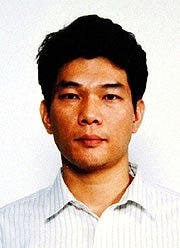
Mamoru Takuma was born on November 23, 1963, in Hyōgo Prefecture, Japan. His history from childhood seems to have been filled with neglect, abuse, and violent tendencies. When he was three years old, he drove his tricycle onto a highway causing a massive traffic jam.
He also displayed a variety of cruel behavior such as setting cats on fire. He was bullied and bullied others himself in his elementary school, often getting into fights, both verbal and physical.
In high school, Takuma attacked a teacher as well as ran away from home for several months. His father often neglected him and was violent towards him and his family.
Takuma, sick of the abuse from his father, attacked him and said he often dreamt of stabbing his father while he was asleep. After attacking his father, his father attempted to get psychiatric help but the hospital refused. Takuma instead dropped out of high school and was disowned by his father. He moved away with his mother leaving his father and brother behind.
Once out of school and away from his father, he started working at a gas station until he decided to enlist in the Japanese Self Defence Force. But he was discharged after only a year for having sexual relations with a minor. His mother went back to Takuma’s father leaving Takuma alone. Takuma got married and found work at a condominium management company.
But while collecting rent for the company he was arrested for raping a woman and sent to prison for three years. But even prison didn’t seem to slow Takuma down and his crimes continued to grow. He was arrested for driving his car on the expressway in reverse but was released after he was found mentally unfit.
Takuma then found a job as a driver and also remarried. He drove a garbage truck and a bus and life seemed to be steady. However, one of Takuma’s coworkers at the bus company said he was “a quiet and unremarkable man, but a bit of a loner who did not like dealing with customers.” It seemed that Takuma could never really fit in anywhere. Once again, Takuma got in trouble and was fired. He assaulted a female passenger over the smell of her perfume.
He then found a job as a janitor at Itami Elementary School which is a few kilometers away from Ikeda Elementary school. At this elementary school, on March 3, 1999, he added some of his tranquilizer pills that he was taking at the time into the teacher’s tea supply in the staffroom. Four teachers ended up falling sick and were taken to hospital. Takuma was arrested once again.
His excuse for spiking the tea being,
“I was ignored by the teachers and did not go well with my family, and I wanted to relieve my anger due to human relationships. My wife wanted to divorce me, and I wasn’t having good relations with co-workers. I didn’t bear grudges against those four teachers, but I just wanted to release my stress.”
He was arrested for the crime but instead of going to prison, he was sent to a psychiatric hospital for a month because he was diagnosed with schizophrenia. While in hospital he jumped from the roof hoping to commit suicide but failed.
Despite his failed suicide attempt and string of past crimes, he was released from the hospital and placed back into society where he continued to struggle with mental illness and delusions. He claimed he was a survivor of a plane crash and he was also arrested for entering a private home but the charges were dropped.
His social life was also troublesome. He was married and divorced four times over his life and he didn’t have any strong connections with anyone including his family. He was also arrested for domestic abuse of his wife in 1998.
Holding onto a job was difficult for Takuma and he took his last job in September 2000 as a taxi driver. However, he was fired a month later for assaulting a bellhop at a hotel.
Not only was he fired from a variety of jobs, but he was also kicked out of several apartments for causing disturbances and throwing garbage out his balcony. With nothing going his way, once again he decided to get treatment and voluntarily admitted himself into a psychiatric hospital for depression on May 23, 2001. But he checked out of the hospital the next day.
In total, Takuma had been in trouble with the law at least 11 times before committing his final crime at the elementary school in June 2001.
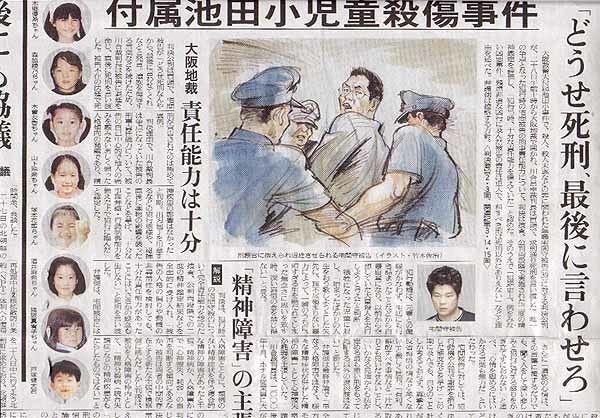
Arrest and Sentencing
“If I killed children, I knew I would get the death penalty.”
During the school attack, after the two teachers subdued Takuma and police took Takuma into custody, he was arrested and charged for multiple counts of murder and injuring 13 children and 2 teachers. In his trial in December, he pleaded guilty and asked for the death penalty. Despite his wishes, his lawyers argued he should not be punished as he suffered from schizophrenia.
They also argued that he was suffering from temporary insanity at the time of the attack and was on a variety of medications. The diagnosis of schizophrenia in the past by Takuma's doctor however was overturned. The doctor said he had misdiagnosed his patient and that Takuma actually suffered from a paranoid personality disorder.
In Japanese law, schizophrenics are not criminally responsible for their actions and can not face charges however those with a paranoid personality disorder can.
According to medical examiners, “People suffering from paranoid personality disorder tend to harbor a delusional distrust of others. While schizophrenics suffer from hallucinations and frequently make incoherent statements.”
Masaaki Noda, a professor of psychopathology said that personality disorders involve character, not an illness. Speaking of Takuma’s crime at the school he said, “Since it does not appear that (Takuma’s) thinking is really out of order in this case, it is possible that he is not schizophrenic.”
The court agreed and on August 28, 2003, he was convicted and sentenced to death by hanging. It also did not help his case that Takuma was not remorseful or even respectful in court and towards the victims and their families.
Takuma refused to apologize to the families and in court was often seen yawning, fidgeting, seeming uninterested, and staring at the victim’s family members. Throughout the trial, he didn’t show any signs of regret or compassion and instead insulted the victim’s families.
On the last day of the trial, Takuma caused an uproar and shouted, “I’m going to get death anyway, so let me say what I have to say,” but the judge refused to let him continue and he was removed forcefully from the courtroom by guards.
And after only just a year on death row, Mamoru Takuma got his wish and was executed on September 14, 2004.
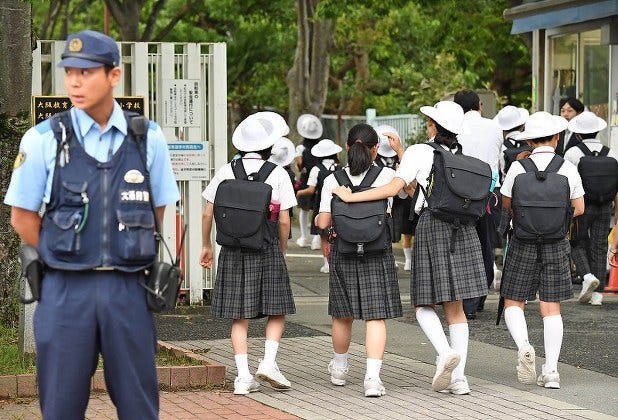
Despite this crime being a sad mark in Japan’s history, a few positive things came out of this tragedy. Schools and teachers were given more resources to keep the school secure and guidelines of what to do if something like this happens again. Ikeda Elementary school announced that it would bring in a security guard, and became the first school to do so.
Laws concerning those with mental illness and how to ensure those who are mentally ill and commit crimes have more support were enacted. Protecting children but also protecting those with mental illness came to the forefront of discussion in Japan.
The brutal act that Takuma committed received both national and international exposure. Japan was shocked that such a horrific tragedy that often occurs in other countries could happen on domestic soil. With low crime rates and violent crime being rare compared to other countries, Japan was facing the second biggest massacre at the time. Unfortunately, now there have been other massacres that have claimed more lives than this one.
If you enjoyed this article, here are some more articles about true crime in Japan you might like:


