
Disgruntled Anime Fan Burned Down Studio and Lit Staff on Fire
The Kyoto Animation Massacre that shocked the world.
How far would you go to retaliate against a company that you feel wronged you? Would you call their headquarters and complain? Get a lawyer and file an official claim? Boycott their products? Address your complaints via social media in hopes to disparage people from consuming their products? Would you kill people?
Unfortunately, a 41-year-old anime fan felt so wronged by the Kyoto Animation Studio located in Kyoto Japan that he decided to visit their studio building with 40 liters (11 gallons) of gasoline and light both the building and people on fire. The fire and smoke burned so badly that 33 employees were injured and 36 died.
What did he have against the company and why did he feel he had to murder to send his message? Was he suffering from mental illness? Find out what happened and why the Kyoto Studio fire incident is one of the deadliest massacres in Japan and the biggest building fire since 2001.
The Crime
“I thought I could kill many people by using gasoline”
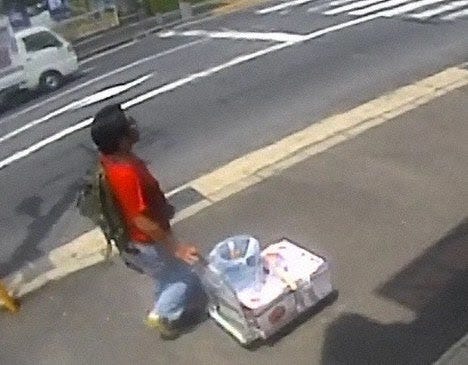
On July 18, 2019, just after 10 am, Shinji Aoba was walking along the street in jeans and a red t-shirt he had been wearing for days. He was pushing a cart that was carrying 40 liters or 11 gallons of gasoline. And no one knew it yet but he also had a lighter, hammer, and many knives in his possession as well.
He looked disheveled, tired, and quite strange pushing the cart along the street in the Fushimi area of Kyoto but no one stopped him as he made his way to the entrance of Studio 1 building of the Kyoto Animation Studios.
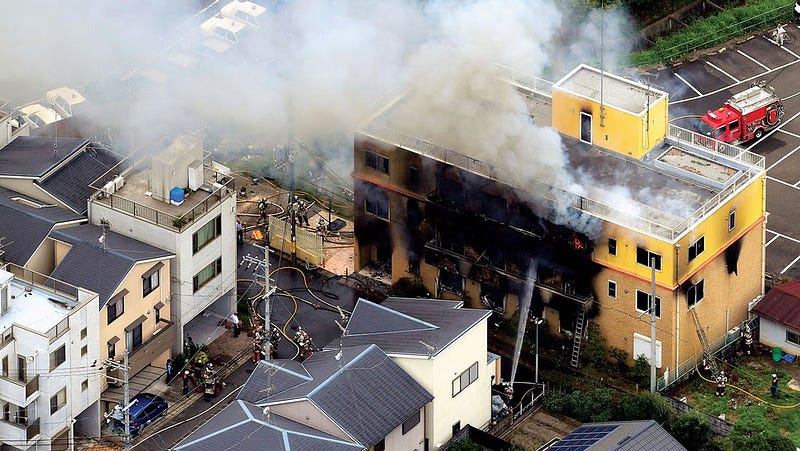
At around 10:30 am, Shinji pushed through the unlocked front doors, dumped a large bucket of gasoline while dousing the building, some workers in the building, and also splashing gasoline onto himself. He then flicked a lighter and screamed, “Die!” in Japanese.
About 70 people were working in the building at the time, most of them women and in their 20s and 30s. The building which was 3 floors high, housed many artists, designers, photographers, and other staff involved in the production of animation.
The fire Shinji initially started on the first floor caused an explosion and became an inferno that rose up from the first floor all the way to the third floor taking many victims with it. Emergency calls to the city fire department reported there had been an explosion on the ground floor and eyewitnesses described a loud bang followed by a blaze that rapidly engulfed the building.
The New York Times reported,
Within minutes the studio was a scene of horror: a man hanging from a ledge as flames licked the walls; a pile of bodies on a staircase leading to the roof; a barefoot woman so badly burned that all a bystander could do was spray her with water and wait for help.
Windows on the third floor fell off 25 seconds later. In less than a minute, toxic black smoke of more than 200 degrees had filled every corner of the building.
A witness outside the building said, “black smoke was rising from windows on upper floors. Then there was a man struggling to crawl out of the window.” Some staff jumped out of windows or ran out onto the street. But unfortunately, since it's common in Japanese offices to remove shoes at the entrance, workers were forced to flee barefoot on broken glass and rubble with witnesses saying “the street’s white traffic lines were smeared with bloody footprints.”
According to the Fire Department, two people were burned and died on the first floor. The second floor had another 11 people who died from the blaze. The third floor had the highest number of casualties with 20 people found all piled on top of each other.
They had been attempting to climb the spiral staircase to the roof to safety but apparently didn’t make it and died of carbon monoxide poisoning. Their bodies were found at the door of the roof. The door itself was unlocked, but no one had been able to open it. If they had been able to get the door open in time, they would all most likely have survived the fire.
“It would be difficult for people to evacuate through the indoor staircase to the rooftop, as their whole body would have been engulfed by smoke,” noted a report compiled later by Tomoaki Nishino, an associate professor at Kyoto University’s Disaster Prevention Research Institute.
Along with the dead, 36 others were injured, some critically some with minor injuries. Unfortunately, three of the injured ended up succumbing to their injuries and died in hospital.
“I saw some people with burns, covered with something. They were rushed to the ambulance,” one neighbor said. Another witness also noticed the lack of exits. “There was no fire escape on the outside of the building and I think that was a big reason why so many people died. There was only one way for them to escape.”
Professor Yuji Hasemi, an expert in fire safety and materials told reporters that a combination of poor ventilation, an abundance of paper used by artists, and a large amount of gasoline likely caused the fire to spread too quickly for people to escape.
Along with the injured, Shinji himself had caught on fire while dousing the building and workers with gasoline. He fled the building and was being chased by some of the staff from the Kyoto Animation Studio when he collapsed. His clothes were burned and his hair was singed.
A woman who saw Shinji on the ground noticed,
“his hair got singed and his legs were exposed because his jeans were burned below the knees. He sounded [like] he had a grudge against society, and he was talking angrily to the policemen, too, though he was struggling with pain. He also sounded [as though] he had a grudge against Kyoto Animation. He was screaming ‘You ripped me off!’”
Another witness also said they “saw the attacker being approached by police and that the man admitted spreading petrol and starting the fire with a lighter.” Because of his massive burns and injuries, Shinji was not arrested but instead taken to a hospital in Osaka for treatment.
The Killer
“I did it because they stole my novel. They plagiarized my work. Call the president. I have something to tell him.”
Shinji Aoba is from Saitama Prefecture in Japan and had a troubled and dismal history. His father was a school bus driver and had six kids with his first wife. He then married a kindergarten teacher and had three more children. Shinji was the middle child of the three.
His father committed suicide in 1999, and Shinji then cut off relations with his siblings and started showing signs of mischief.
He was arrested and received a suspended sentence for stealing women’s underwear off a laundry line. This is a popular crime in Japan committed by men referred to as hentai, or perverts.
In 2012, he was convicted of robbing a convenience store and spent three and a half years in jail. A neighbor of his in Saitama said she sometimes saw social workers visit Shinji to conduct wellness checks.
A recent neighbor of his named Matsumoto also had a variety of run-ins with Shinji and even filed a police report against him. Matsumoto explained his different problems with his neighbor Shinji,
“He was unkempt, with messy, ungroomed facial hair. He often wore the same clothes several days in a row. He smelled terrible. Really, really bad. I’m sure restaurants wouldn’t let him in because of the way he smelled. He blasted loud music through a large speaker late at night. Around midnight he often played noises that sound like the synthetic tones used in video games.”
Matsumoto called the police about half a dozen times over the previous two years because of noise complaints. Matsumoto also recalled a time when Shinji approached him and threatened him because he thought he was making noise which was actually from a different apartment.
Shinji emerged, banged on Matsumoto’s door angrily then went back to his place. Eventually, Matsumoto knocked on Shinji’s door, lifted the metal mail slot, and shouted, “It’s not me making the noise, it’s the upstairs neighbors.”
But Shinji began throwing things against the wall they shared and then came out into the hall to talk to Matsumoto. Shinji grabbed Matsumoto by the collar and said, “You’re too loud, shut up! I’m going to kill you! You’re annoying. I’ll kill you. I have nothing to lose.”
A few days after this attack, Shinji left Saitama and headed to Kyoto via bullet train. He stayed at a downtown hotel and was seen on camera in various locations including an Internet cafe, the area where Kyoto Animation studio was located, and a hardware store where he bought a metal trolly.
In the afternoon he was seen at Eneos gas station where he purchased 11 gallons of gasoline divided into two red, plastic containers, which he loaded on the trolley. Security cameras also caught Shinji near sites that appear in Kyoto Animation’s Sound! Euphonium, a TV series about a high school music club, set in Uji, the city south of Kyoto in which the company’s headquarters are located. Kyodo News reported that he visited bridges, roads, and other spots featured in the animation.
Police later searched Aoba’s apartment in Saitama after the fire, finding Kyoto Animation DVDs and his smartphone. Shinji was not carrying a phone when taken into custody and had instead used an internet cafe to search for information about the company’s location. Shinji also had a long-running problem with the studio.
Kyoto Animation Studio reported getting over 200 threats over the last year from the same person. According to police reports,
“The online messages — which were sent using encryption technology to disguise their origin — escalated from insults and threatening language to death threats on individual workers.”
The company reported the threats to police in October and both the studio and homes of people who were threatened were patrolled for a short time but were stopped. It is believed that the sender of these messages was Shinji.
Since 2009, Kyoto Animation studios have held a contest for amateur writers to submit a short novel. Winning novels are published and chosen for development into a film or series. Shinji claimed that he had entered the contest and his work had been plagiarized and his ideas stolen. He said he decided to carry out the crime because he was angry and seeking revenge against Kyoto Studios for stealing his idea.
After the fire and his allegations of plagiarism, originally the studio said they had not received any works from anyone by that name. However, after further investigation, the company discovered that Shinji had indeed submitted his own novel during a past edition of the contest.
However, his entry never made it past the first screening round and the studio reviewed the work and reported that it in no way resembled any of the studio’s released works.
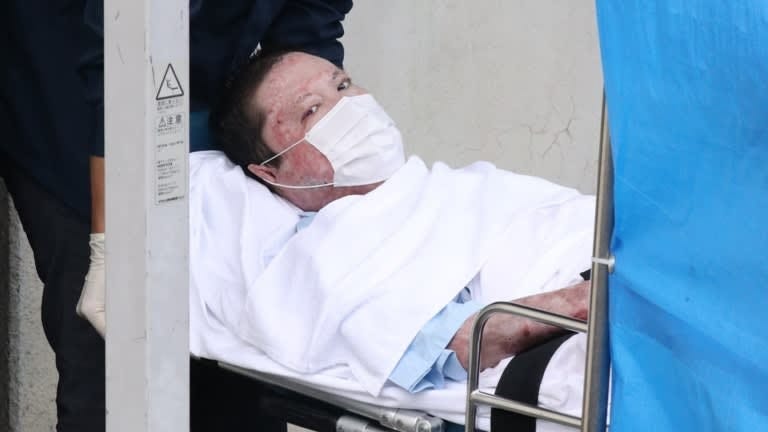
Shinji, who was badly burned from the fire himself, was in critical condition and unable to move or communicate for months. Originally, doctors said he had a very low chance of survival and would most likely die of his wounds.
But two months after the incident, doctors reported his burns were no longer life-threatening and he would undergo skin graft surgery in Osaka. Instead of using human donor skin on Shinji, the doctors decided to provide the donor skin to victims. Shinji was given experimental artificial skin, a first in Japanese medical history.
Shinji started talking and sitting up in October and was still bedridden and sent to a hospital in Kyoto to recover. In May of 2020, he was finally well enough to be arrested and was charged in mid-December of 2020.
The Victims
The Kyoto Animation company known as KyoAni for short, which has created world-famous titles such as The Melancholy of Haruhi Suzumiya, K-On! and Violet Evergarden was the target of Shinji’s hate.
The studio is praised by many not only for the wonderful animation they produce but also because of their message. Unlike other Japanese anime that are extremely violent or depict women in a sexually exploitive way, anime from Kyoto Animation Studios tend to be more innocent, a slice of life material focusing on positive messages.
The company employs many young and female artists which is rare in the anime industry and pays a salary rather than a per frame payment. The company was founded by a Japanese couple, Yoko Hatta and Hideaki Hatta, in 1981, and most of the studio’s production takes place in the building. Kyoto Animation Studios put out a statement,
“We have nothing to say to the suspect…Our fellow workers whose lives were lost will never come back and the wounds of our colleagues will never be healed.”
Even the prime minister of Japan, Shinzo Abe commented on the incident,
“Today, we had many casualties in a fatal arson attack that happened in Kyoto. It is so horrifying that I am at a loss for words. I’d like to express my deepest condolences to the victims. I offer my thoughts to those who have been wounded and pray for their recovery.”
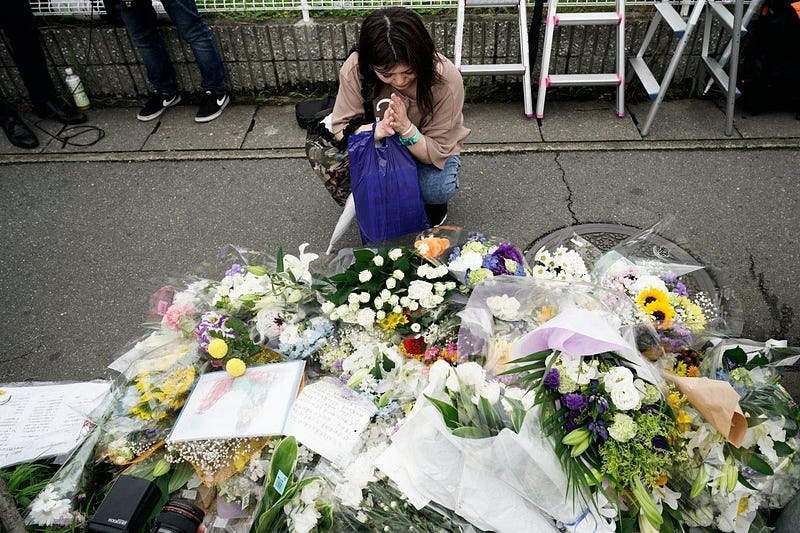
Originally, about 20 family members came to the studio after the fire to find their loved ones. Many of the bodies were so badly burned that investigators had no way to identify them until DNA tests could be conducted.
The victims ranged in ages with the majority being women and in their 20s and 30s. Some were new to the company while others had carved out a good career and many anime credits with the studio. Of the 36 dead, most were women.
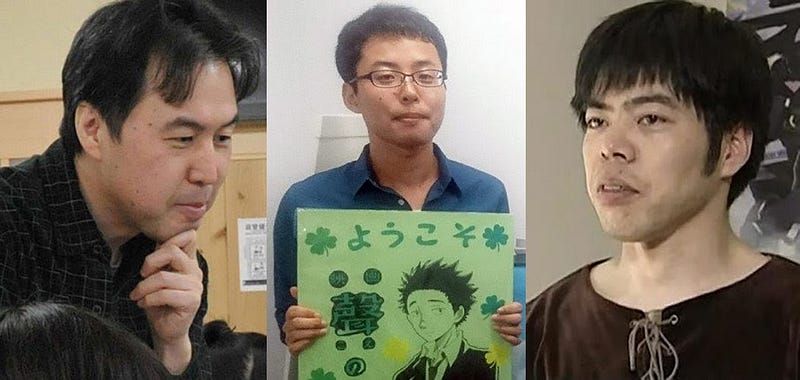
An industry veteran Yoshiji Kigami, who worked on films including Akira and Studio Ghibli’s Grave of the Fireflies before moving to Kyoto Animation was killed in the fire. Yasuhiro Takemoto, who was known for his beautiful visual style and had spent most of his career at the studio was also killed in the blaze. A famous animator and character creator Futoshi Nishiya also lost his life that day.
Arrest
Although Shinji Aoba was taken into custody the same day as the fire when he collapsed after fleeing the building, he was not officially arrested until May of 2020.
After recuperating in hospitals and going through a variety of skin grafts and rehabilitation programs he was judged to have recovered sufficiently from life-threatening burns and finally arrested. He is charged with murder, attempted murder, and arson.
The police had planned to arrest Shinji in January of 2020 but arrangements were affected by the spread of the new coronavirus and his unstable health condition.
Shinji has been in detention for expert examinations between June 9 and Dec. 11, with doctors conducting a psychiatric examination. According to reports, he will likely be determined by medical experts to be mentally competent based on his calculated actions, such as purchasing gasoline prior to the incident, meaning he can be held criminally liable for the attack.
And though capital punishment is practiced in Japan and Shinji could possibly be charged with it, most likely due to his documented history of mental illness, prosecutors will have to prove his mental capacity.
The police also reported that Shinji has not apologized or expressed regret for his alleged actions during questioning but thanked the medical staff and those around him for helping him recover.
Shinji is currently under detention at the Osaka Detention House, which has medical facilities. He is awaiting his trial and is bedridden and in need of daily care.
Despite knowing the crime, the motive, and catching the criminal at the scene, there are so many issues with this crime, it’s hard to know who to blame and how to avoid it from happening again.
Shinji had a past criminal history and was obviously suffering from some sort of mental illness. But he was able to plan out and attain all the resources he needed to commit this terrible crime. His weapon was gasoline so how could this have been prevented? Would a gasoline limit idea that has been floated work? Couldn’t someone just visit a variety of gas stations and stock up?
Would changing the fire codes and regulations that Japan currently has, help? The company was following the fire regulations required but if they had done more than just the bare minimum would things have gone differently?
Should the company take the blame for the lack of safety? Or should the building construction and designers who built a building with a spiral staircase, no outdoor fire escapes, and only one main entrance that lacked measures for big fires and emergencies take the blame?
Security was also low as there was easy access in and out of the building with doors being unlocked. And despite getting death threats, the police might not have done enough to investigate the threats or protect the staff of the building. Are they to blame for the extent of death and injury?
In the end, Shinji Aoba is responsible for setting the fire and killing and injuring so many people. But Japan is a modern and high-tech country with many buildings and organizations that are still not up to date or lack the safety and security that should be available to people at the workplace. Shinji might be the one who sparked the fire but it was failures on all ends of society that fanned the fire and helped aid Shinji Aoba in starting a fire that killed and injured dozens and became one of Japan’s biggest mass murders in modern history.
If you enjoyed this article about crime in Japan, here are some more true crime articles you should check out: