
Man Stabs Dozens of School Girls Then Himself At Bus Stop
The senseless rampage in Japan known as the Kawasaki Stabbings

Early in the morning just before 8 am around 70 people, mainly children between the ages of 6 and 12, were lined up at a bus stop. They were waiting to board the bus bound for the only Catholic school in Kawasaki, Japan. As the students were about to board, a man wielding two knives came running from the street and in less than 20 seconds stabbed 19 people, mostly schoolgirls, before stabbing himself in the neck.
Among those who were stabbed, 6th grader Hanako Kuribayashi would be one of the people to die that day. This is the story of the Kawasaki stabbings, the incident, the victims, and the perpetrator of this senseless and horrific crime. What was his motive and why did he target little girls?
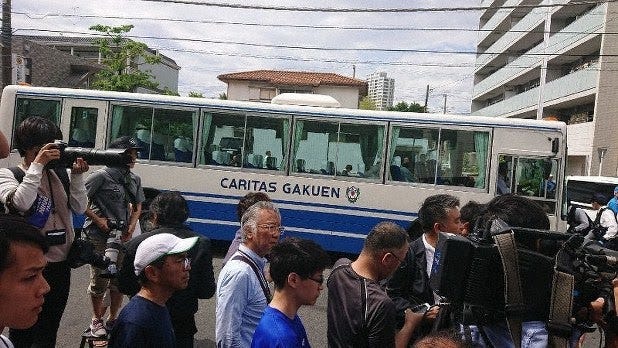
The Crime
“Innocent students who are raised with love by their parents (have fallen) victim to the pathetic incident. I’m suffering from an unfocused anger and from (the) deepest regret,” — Director of Caritas Catholic School
On May 28, 2019, just before 7:45 am in the city of Kawasaki, Japan, a man identified as Ryuichi Iwasaki came running towards a bus stop where groups of children were lined up to go to school. There were only a few parents accompanying their children as most children in Japan age six and up commute to school alone.
With one of the lowest crime rates of any industrial nation and strict gun laws, the streets are generally safe and the community watches out for children who walk, take buses, subways, or trains alone or with groups of friends.
However, on this day, the quiet and safe neighborhood would hear the sounds of screaming and panic as Ryuichi held two long thin blades that are used for cutting Japanese sashimi, to run and slash children and parents randomly.
The bus, which was a private bus for students, was getting ready to board students when the incident began. The bus headed for Caritas Catholic School in Kawasaki held the bus driver and vice-principal, who were both getting ready to board the students.
“A man holding a knife in both hands walks in the direction of the bus and stabs primary school children one after another,” explained the driver of the bus to NHK, Japan’s National News Network.
Tetsuro Saito, the school director added, “the students were standing in two lines when the school’s vice-principal, Satoru Shitori, who was helping students get on the bus, witnessed a man holding two knives stabbing children one after another while running.”
Within 20 seconds, Ryuichi had managed to stab 19 people, of whom 17 were school girls. Of those 17 girls, 14 were in the first grade. A witness, Toshichika Ishii, was sitting on a park bench when he heard a child scream, “I’m scared,” and heard the attacker shouting, “I’m going to kill you!”
A local resident who had just come out of her home saw a man lying on his side, apparently bleeding and unconscious. She also saw an injured young mother, along with her son, staggering into the parking lot of the nearby convenience store.
Many of the children waiting on the bus had run to this convenience store to escape from Ryuichi. Another resident who was awakened by the noise of girls screaming said he saw “groups of girls huddled in fear and ambulances pulling up, and one man down on the ground across the street from his house, where a doctor was administering CPR.”
While some children had run to the convenience store, others were led on to the bus and away from Ryuichi. Despite all the pandemonium around them, both the bus driver and the vice-principal “saw the attacker racing toward the bus stop, slashing at students as he ran.”
The vice-principal chased the attacker, but the man ran away. The bus driver came off the bus and continued to chase the attacker, so the vice-principal could help the injured children and call the police.
When the bus driver caught up with Ryuichi he shouted at the man, “What are you doing?” then the man stabbed himself in the neck.
When the police arrived at the scene, a bleeding man was found on the ground next to some shrubbery. Because two kitchen knives with bloodstains on them were found nearby, police suspected he had been involved in the attack and took him into custody.
The man also had two more kitchen knives in his possession when he was found. He appeared to have stabbed himself in the neck and was confirmed dead at the hospital to which he was transported.
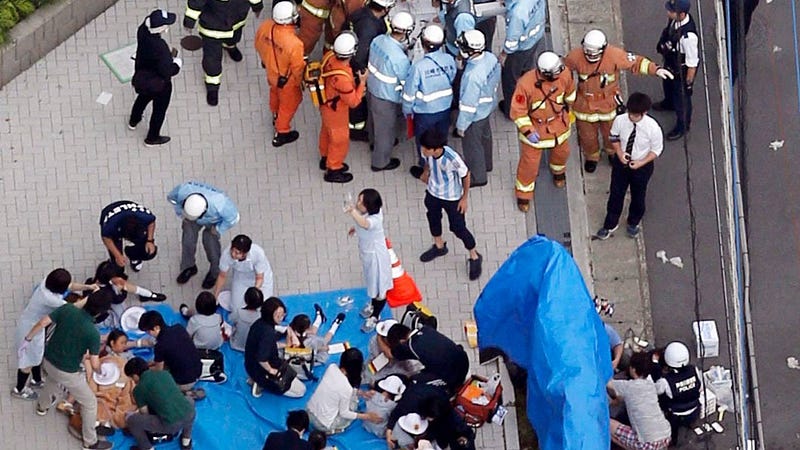
The Victims
Among those who were killed were 11 year old Hanako Kuribayashi, a 6th-grade student who was waiting for the bus to Caritas Catholic School, Satoshi Oyama, 39, a father of one of the first-grade girls who was waiting with his daughter for the bus, and the killer himself Ryuichi Iwasaki, 51, who took his own life immediately after his rampage.
Hanako who died from her neck wounds was a kind and bright girl. Teiko Naito, the elementary school principal at Caritas, told reporters that every morning the girl would greet her with a wide smile and an energetic “Good morning!”
Satoshi Oyama, the father of one of the children was a member of the Foreign Ministry and was seeing his daughter off to school went he fell victim to Ryuichi’s rampage as well.
Of the 17 others injured, all were female and 16 of them were children. A woman who was the mother of one of the children was injured seriously along with two other children who were in critical condition but survived.
Since most of the victims were under the age of 12, parents of the school were called to pick up their kids and the victim’s parents were later notified of the incident and made their way to the hospital where ambulances took the kids after initial treatment at makeshift tents at the scene.
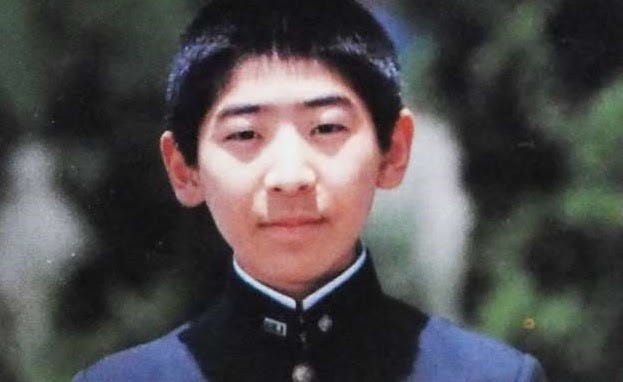
The Killer
Ryuichi Iwasaki, 51, was a resident of Kawasaki and was unemployed. He was living with his uncle and aunt and was known as a hikikomori, which roughly translates to a recluse. He rarely went out, didn’t have any friends, was anti-social, and was said to have a lot of pent up anger.
According to interviews,
“Those who knew Iwasaki did not seem surprised by the attack. His classmates from junior high school described him as a troubled child often losing his temper, behaving violently, and being bullied at school. More recently, Iwasaki was verbally aggressive to his neighbour because the leaves from the neighbour’s garden had brushed against him.”
And because Ryuichi killed himself immediately after the stabbing spree, we don’t know his exact motives. However, police investigations found security cameras showing a man resembling the assailant at a train station and other locations close to the crime scene four days before the stabbing. This may indicate that he was planning out the location of his crime.
He also bought two knives at a shop in advance which shows he was planning to kill more than just himself. Why buy two knives and bring four if you were just going to kill yourself?
Professor Takayuki Harada of Tsukuba University is a criminal psychologist who suggested that Ryuichi,
“Iwasaki had a detailed plan and that purchasing the knives indicates a strong desire to kill people, possibly even an obsession. However, the stabbing may have been an ‘extended suicide.’ The suspect’s main objective was to kill himself — not just other people. He wanted the world to pay attention to him in a warped desire to be noticed.”
Talking to Ryuichi’s uncle and aunt who he lived with, they mentioned he had been unemployed for a long time and communication with him was difficult. They wanted him to be able to take care of himself and be independent as they were getting older. And because Ryuichi was a shut-in, they left him letters under his door expressing their concern.
A specialist in hikikomori behavior explained, “I can imagine that people who are unemployed for a long time and in their 50s or older could feel hopeless about the future. They might think of committing suicide, rather than remaining isolated from society for the rest of their lives.”
Was it this loneliness, lack of communication, contact with people, lack of career, and purpose that led Ryuichi to not just kill himself but to attempt to take many innocent children with him?
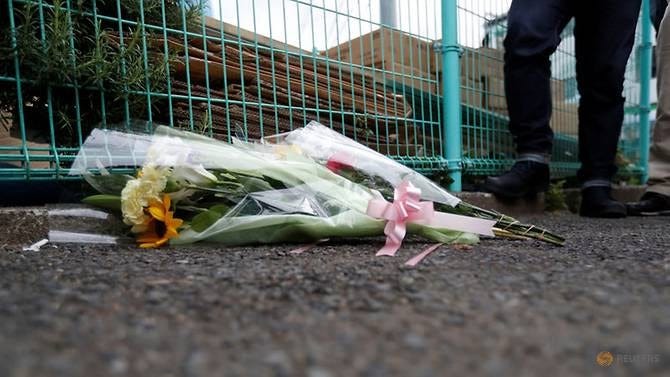
Aftermath
After the terrible attack, funerals were held for the victims and the prosecution attempted to posthumously charge the Ryuichi with suspicion of murder, attempted murder, and carrying knives, a violation of the swords and firearms control law. However, Yokohama District Court dismissed the case because of the death of Iwasaki, and the motive of the suspect, who had been socially reclusive, remained unknown.
Prime Minister Abe also addressed the incident,
“We must keep our children safe at all costs. I’ve instructed the related ministers to take immediate action to ensure the children’s safety in going to and leaving school.”
After the attack, the school decided to boost security with additional security guards and increase the number of counselors who can provide students and parents with psychological support. They also started staggering the arrival times for their students by grade to avoid forming a long line at bus stops.
Many parents, children, friends, family, and neighbors left flowers and gifts by the bus stop as well as stopped for prayers for the deceased and injured. A one-year memorial was also held on May 28th of 2020 around the time of when the attack first began a year prior.
“I’m overwhelmed with sadness when I think about the feelings of the bereaved families. I’m praying they can somehow find even a little peace,” said one of the attendees of the memorial.
A memorial Mass was also conducted in the morning at the Caritas Catholic School. A prayer bouquet was placed on the altar with messages from all 645 pupils of the school attached.
Mai Sato, a researcher, and writer at The Australian National University expressed the difference between these mass killers in Japan, compared to others across the world,
Unlike a number of lone actor attacks that have occurred outside of Japan in recent years — such as the Christchurch mosque attacks and the Pittsburgh synagogue attack — the attacks carried out in Japan are not motivated by right-wing ideology. What lone attackers in Japan have in common are social exclusion and low social capital.
And although we may never know the real reason why Ryuichi Iwasaki decided to leave such a shocking and unfortunate legacy, it might be a message that society needs to pay closer attention to the needs of every member of society.
Here are some other stories of terrible crimes in Japan if you are interested:


