
Man Plowed Truck Into Pedestrians Then Went on Stabbing Spree
The horrific mass murder known as the Akihabara Massacre.
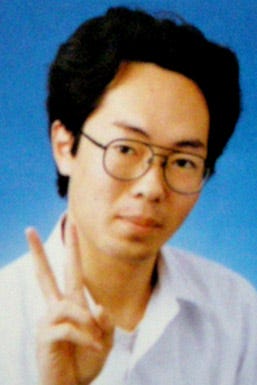
Dubbed the Akihabara Massacre, this vicious crime took place in the popular and crowded shopping district of Akihabara in Japan. This area that is popular amongst Japanese and tourists from around the world, has thousands of people strolling the streets shopping for anime and electronic goods. The killer chose Sunday, which happens to be the day the main streets are closed to vehicle traffic and instead open to pedestrians who fill the streets.
Along with slamming into a group of pedestrians who were crossing these shopping streets, killing three and injuring two, the driver then got out of the truck he was driving and stabbed 12 people, killing four.
When all was said and done, Tomohiro Kato had either hit or stabbed 17 people in two minutes. Why did he decide to drive his truck into a crowd of people who were enjoying a Sunday afternoon shopping? Who were the victims and how did police capture him before he could kill again?
The Crime
On Sunday, June 8, 2008 midafternoon, people filled the streets of the popular shopping district of Akihabara. The popular street Chuo-Dori was bustling with people both on the sidewalk and street itself.
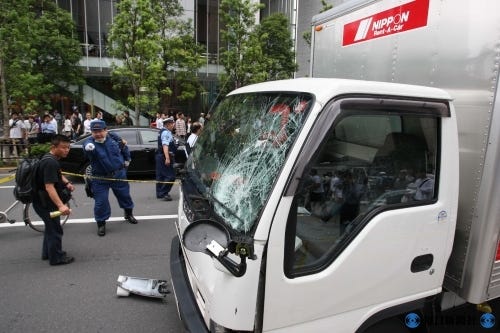
At 12:33 pm, a connecting street that was still open for traffic held a white truck that was rented by Kato barreling down towards the intersection and running a red light. It zig-zagged as it aimed to hit as many people as possible, while pedestrians and shoppers had no idea what was to come next.
As the truck ran through the red light and into shocked pedestrians, five people were hit by the truck. Of those five, two ended up dying from their injuries. When the people were hit by the truck, many bystanders stopped to help those injured.
Shunichi Jingu, 26, told Kyodo news,
“At first it looked like there had been a traffic accident. Then a man got out of a vehicle and began to brandish a knife.”
A store owner close to the accident also noted, “People came rushing into the shop, yelling at us to call an ambulance. I went outside to see what was happening. There were people running in all directions and then I saw the attacker. He wasn’t running, just walking in a really strange way.”
After hitting people and stopping the truck, dressed in an off-white suit and black t-shirt, Kato emerged from his vehicle with a dagger and started slashing people. “He was screaming as he stabbed people at random,” a witness told NHK, Japan’s national broadcasting service. Kato later told police, “I am tired of life. I came to Akihabara to kill people. It didn’t matter who they were. I came alone.”
From the initial hitting of pedestrians at 12:33 and for the next two minutes, Kato would go from random person to person stabbing and slashing anyone he came upon. In total, he stabbed 12 people of whom four died.
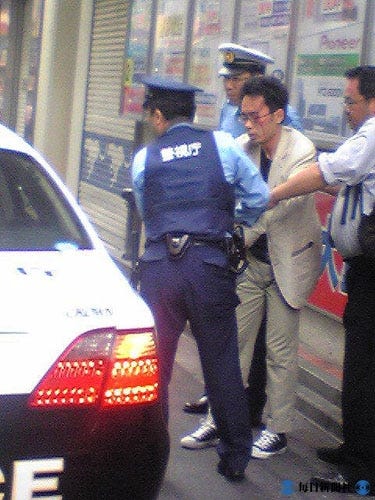
Luckily, an officer was on site while the car accident and stabbings were taking place and confronted Kato. The Guardian reported the officer struck Kato with his baton but failed to subdue him. Kato only dropped his weapon when the officer drew his pistol and threatened to shoot him.
A person in the crowd who arrived just after the stabbings explained the chaos that was unfolding,
“As I walked down the street, I noticed there were a lot of police cars. I noticed there was a guy literally just lying there with tape on his eyes and blood pouring out of the side of him. I was appalled. “I could see carnage — bodies everywhere. Some were conscious, some were not, lying by the side of the road and on the road. There were people everywhere, a lot of onlookers.”
The police officer, who saw him stabbing a woman, arrested him for attempted murder and he was taken into custody. He was later charged for running down five pedestrians in a vehicle-free zone causing injury and death to three, four murders using a dagger as well as stabbing and injuring eight others.
Before driving his rented truck to Akihabara, Kato documented his morning online to explain his motivations and possibly in hopes that someone would try to stop him. Unfortunately, no one did. Here is a timeline of his messages of that morning,
05.21 Sleepy. Will drive into [the crowd] and, if the car becomes useless, I will use a knife.
Goodbye everyone
05.34 I can’t get over this headache
05.35 Rain is forecast. Bad
06.02 I’m used to playing the role of a good man. Everybody is so easily deceived
06.03 Am I incapable of having friends?
06.10 It seems the road I planned to take is blocked. After all, everything is against me
06.31 The time has come. Let’s go
06.39 It seems I’ll be battling against my headache
06.49 . . . against rain
06.50 . . . against time
07.30 What a dreadful rain . . . even though I prepared everything perfectly
07.47 Even though the scale is small, I’ll do what I decided to in the rain
09.48 Into Kanagawa and having a rest. Things are going well at the moment
10.53 Awful jam. Will I be in time?
11.07 Shibuya. It’s awful
11.45 Reached Akihabara. It’s the day of “pedestrians’ paradise”, isn’t it? Just minutes left now
The Victims
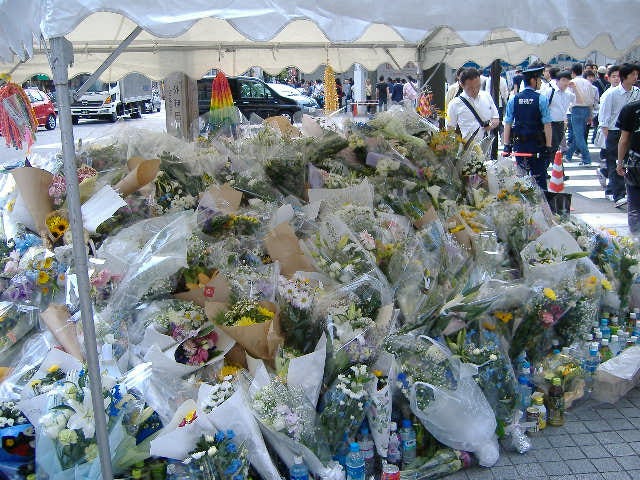
The massacre that took place at the intersection in Akihabara took the lives of seven people ranging in ages from 19 to 74 and included six men and one woman. Along with police, ambulances were dispatched and despite the quick response and support from first responders and people at the scene, five victims died at the scene. Two later passed away from their injuries in the hospital.
The victims included 19-year-old friends, Kazunori Fujino and Takahiro Kamaguchi, 21-year-old Mai Muto, 31-year-old Naoki Miyamoto, 33-year-old Mitsuru Matsui, 47-year-old Kazuhiro Koiwa, and 74-year-old Katsuhiko Nakamura.
Mai Muto, 21, who quickly called police on her cellphone as the attack was going on was stabbed in her right side with the dagger. The blade penetrated her liver, and she died about four hours later at a hospital in Tokyo.
A man who was Muto’s classmate and placed flowers at the memorial at the intersection recalled Muto in school. “She was the leader [of our choral group] at a choral-singing festival. That was the kind of outgoing person she was. I’m so angry about the outrageous way she was killed,” he said.
Kazunori Fujino, 19, a sophomore at Tokyo Denki University, and Takahiro Kawaguchi, 19, a sophomore at Tokyo University of Information Sciences, were victims of Kato who were hit by the rental truck he first used to slam into pedestrians. Kawaguchi was also stabbed by Kato after he was hit by the truck. They were scheduled to meet two other friends in Akihabara to watch a movie.
Fujino’s 50-year-old father said, “I’m so, so upset. This happened so suddenly. All I can say is that I’m filled with anger and sorrow. It feels like I’m in a bad dream…My poor boy.” Kawaguchi’s father was in tears asking, “Why did you have to die? I’m so sorry I was unable to protect you. I can’t understand why my son had to be killed so brutally in broad daylight.”
Nakamura, 74 was a retired dentist. On Sunday, he went to Akihabara with his son to buy some items for his personal computer. His wife told The Yomiuri Shimbun, “I can’t say anything, just that I’m very sad.”
Other victims included Naoki Miyamoto, 31, who was also mourned by his friends and family who said he was a “quiet and earnest person.” Mitsuru Matsui, 33, another victim in his thirties had been attending a cooking school and was enrolled in a nutrition college in Yokohama.
Kazuhiro Kobayashi, 47, was a family man who often was seen playing catch with his son outside their house. His family released a statement about his passing. “We’re knocked sideways, and unable to sleep. We’d like to mourn his passing and say goodbye.”
The Life & Collapse of Tomohiro Kato
“Will drive into (the crowd), and after the vehicle gets unusable, I’ll use the knife. Goodbye everyone.”
Tomohiro Kato, born in Aomori North Japan in 1982, was part of a typical middle-class family and was well educated and a good student. He was usually at the top of his class in elementary and junior high school and was even the captain of the tennis club in school. However, all that seemed to change when he entered an elite high school in his town, Aomori High School.
At this school, the pressure to keep his grades up and parents satisfied with his efforts started taking a toll. A former classmate of Kato told reporters “his class rank slipped to around 300 among the 360” and a teacher of his also recalled, “He wasn’t outstanding in studies or extra-curricular activities at all. He was really a mediocre student.”
Later, Kato would tell police and courts that he was abused as a child and extreme pressure was put on him to get good grades and excel in school. He recalled an incident where he was pushed into a tub of water when he wasn’t able to solve a math equation. He was also punished in strange ways such as having to eat off the floor. “I was also told to pick up rice on the floor and eat it, and I tried so hard to do that,” said Kato. A neighbor described an incident of Katō being punished by his parents, who made him stand outside for hours in the deep cold during winter.
After high school, Kato failed his entrance exams to university and was forced to give up his dream to be a car designer. His dream crushed, he enrolled to study mechanics in a community college and worked as a part-time employee at a car parts company.
Earning a low wage, feeling shunned from his family, and his dream life slowly evaporating, he attempted to commit suicide in 2006 by ramming his car into a wall.
Along with working at his part-time job, Kato was active online in a message board where he often felt like he was being harassed or made fun of. He also seemed defeated because his company was in plans to cut staff and he was afraid he was going to be fired, writing “When I went to my workplace, I found my work clothes were missing. Does it mean I should quit my job? I guess the company is happy about getting rid of me.”
He also constantly complained of having no friends, no girlfriend, and being alone. Some of his posts included things like,
“I don’t have a single friend and I won’t in the future. I’ll be ignored because I’m ugly,”
“If I had a girlfriend, I wouldn’t have just left my job or be addicted to my cell phone. A man with hope could never understand this,”
“I’m lower than trash because at least the trash gets recycled,”
People who knew him described him as a “typical Akihabara type — a cartoonist of reasonable talent who would lose himself for hours in cyberspace. When he went to karaoke, he would select the theme tunes of TV animations; when it came to women he would declare that he was only interested in two-dimensional girlfriends.”
It seems his fear of losing his job, his debt, his lack of success in career, relationships, and socialization, began a downward spiral he couldn’t cope with. And his online presence was not much better. He admitted in court his reasons for committing the crimes,
“There are three reasons. One is my own thinking. The two others are harassment against me on the bulletin board, and my way of life, which was deeply dependent on the board.”
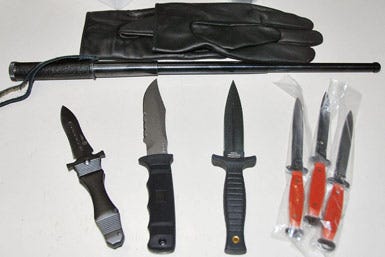
Japanese media reported that Kato told police he went to Akihabara the day before the rampage to plan his assault and that he visited Akihabara to sell his home computer to raise money to rent the truck. NHK also reported Kato “bought a knife at a camping and outdoor supply shop two days before the rampage. Surveillance video showed him laughing with the shopkeeper and making stabbing motions with his hands.”

Arrest and Sentencing
After being detained by police after the incident, he was taken into interrogation. Kato told police that he was mentally ill and prosecutors planned mental examinations to decide if he could be held accountable for the crimes he committed. A police spokesman said, “Kato has generally been cooperative, though unapologetic, during questioning and has at times broken down in tears.”
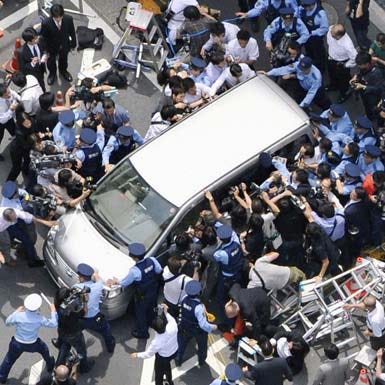
On 24 March 2011, Katō was sentenced to death by the Tokyo District Court after it found him guilty for the attack. The Tokyo High Court upheld the death penalty on appeal in 2012. The Supreme Court also upheld the death penalty in 2015.
Apologizing to the victims, Kato said he wanted to clarify why he committed the crime so such a massacre would never happen again. It seems that though he is remorseful and does claim that past traumas were part of his motivations, he takes full responsibility and doesn’t blame his parents or others for his actions.
And though, justice seems to be served as Kato is still set to be executed, the lives he took can not be replaced and the people he hurt will always remember. The country will always be reminded of the horrific scenes of that day and despite Kato’s confessions and apology, similar crimes continue in Japan to this day.
Bringing light to this crime also brings light to the problems that society holds that ignore the weak, bring down the poor, and sometimes force people to extremes they would otherwise not go. Would Kato have committed the crimes if he hadn’t been pressured by his parents, disposed of by his company, bullied by online members, or overlooked by friends?
Would he have more self-esteem and healthy relationships if he had spent less time on those message boards and more time socializing with men and women in person? No one really knows what motivates people to take someone else’s life, especially in crimes like this where innocent people are randomly murdered. But loneliness, a lack of social skills, and a support structure might be some things that pushed Kato to commit one of Japan’s most shocking massacres in Akihabara.
Here are some more stories of crimes in Japan:


