
Have You Heard About Obelisks?
They are even smaller than virus particles but still have the ability to pass instructions to larger forms of life.
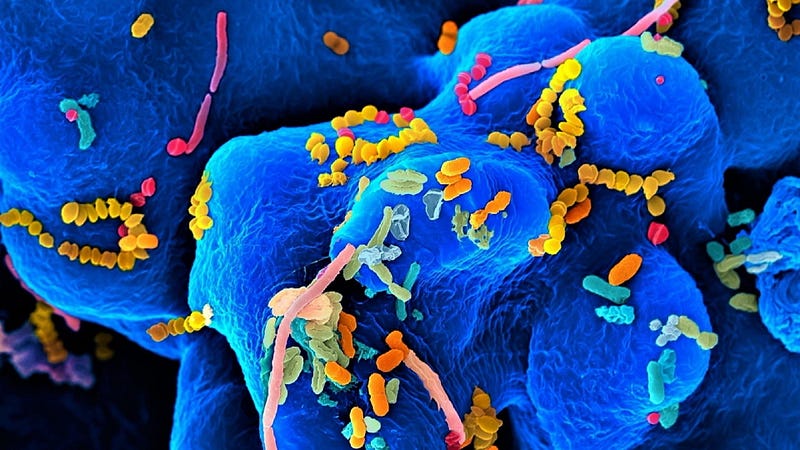
It’s not very often that a completely new form of life is found. Oh, we find new species of all different kinds of organisms but an entirely new class of organism? That is a rarity. Especially for the small ones.
In 1676, Antonie van Leeuwenhoek, who is often called the Father of Microbiology and who made his own microscopes by grinding the lenses, was the first person to see and describe the organisms we now call bacteria.
And it was more than another 100 years until someone else saw and described them! He also saw what we now call the protozoans, small creatures that can have both plant and animal features in a single organism and that are often also called protists.
So how many distinctly different classes of life forms are there? Before we found the organisms I’m going to tell you about today, the tree of life looked like this:
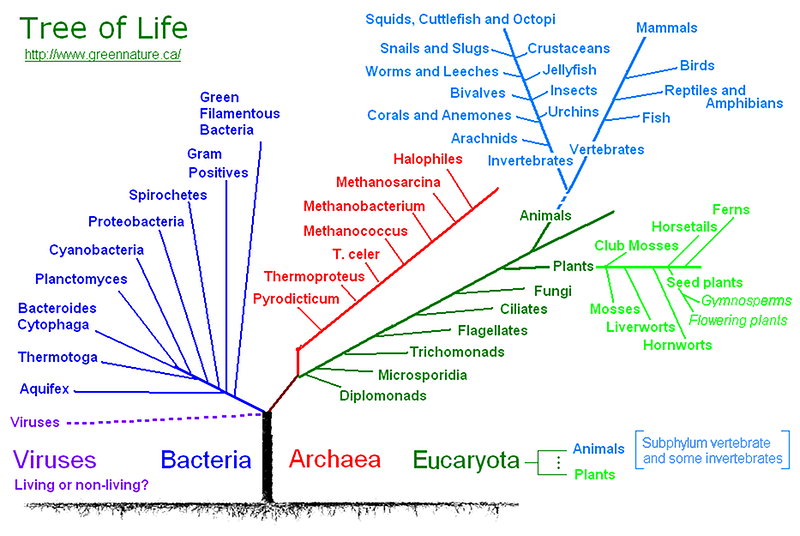
Don’t worry; there’s no quiz here, so you don’t have to memorize any of this! As you can see, if we include viruses as a life form, there are five different major overarching classes of life forms: Viruses, Bacteria, Archaea, Animals, and Plants.
And some taxonomy trees will also designate the Fungi as a separate class of life. As taxonomists often disagree and periodically reclassify organisms, we can think of this one as a set of excellent suggestions backed by a lot of scientific research and evidence.
But it’s not the last word by any means. So let’s get to the new life form just discovered and see what it’s all about. The “creatures” are called Obelisks.
Viroid-like
The new Obelisk entities are both similar to and different from what molecular biologists call viroid-like particles.
So to better understand just what these new forms are, we need to know a bit more about the other viroid-like particles that they’re closely related to.
Then we’ll have a full appreciation of what was found. Let’s start with viruses, since viroid-like means they somewhat resemble virus particles.
Here’s an article titled “Have You GoneViral?” I wrote a while back if you need a refresher on viruses.
Briefly, remember that there are 2 major virus types, ones that have an RNA genome and ones that have a DNA genome.
Viruses range in size from 20–300 nm. That’s pretty small and it’s why you need special masks with filters (N95) that can screen out particles that small to prevent you from inhaling them and becoming infected with viruses like COVID or Flu or RSV.
Viroid-like particles were discovered over a decade ago and are all small pieces of RNA.
Originally, they were only observed in plant cells. There were grouped into two types based on the structures their RNA formed, their activity, where they are found in their host cells, how their genome is organized, how they replicate, and their phylogenetic relationships.
That’s LOT more technical detail than we need to get into here; I just want to make you aware of it.
But if you’re curious, check out this review!
The reason these viroid-like particles were given so much attention is that they infect and generate crop losses. So farmers wanted to know if they could prevent that.
Obelisks
When is the last time you heard someone call something an obelisk?
I can’t remember when I last heard but I can guarantee it wasn’t any time in the near past. I’m actually surprised that I knew that obelisk was a real word. Well, I do lots of crossword puzzles so maybe I came across it there in the past.
A bit of where the word comes from thanks to Wikipedia:
It is from Ancient Greek: ὀβελίσκος obeliskos; diminutive of ὀβελός obelos, “spit, nail, pointed pillar” and refers to a tall, four-sided, narrow tapering monument which ends in a pyramid-like shape or pyramidion at the top.
The Washington monument in the District of Columbia is one of the more famous obelisks in the United States.

So, now we know what the shape of an obelisk is and that it’s actually an architectural designation. Are these viroid-like particles shaped like this?
Well, that’s a bit of a tricky question. The reason I say that is because as far as I can tell, no one has actually taken a picture of one of these viroid-like obelisks.
But I’m getting a bit ahead of myself here. Let’s learn a little bit more about these “creatures” and see why Zheludev and colleagues decided to designate them as such. And how did they even come across these new potential life forms?
It started with their interest in examining our human gut microbiome. I’ve written several articles about microbiomes. Here’s one if you’d like a bit more info about our microbiome. I wrote it almost three years ago but it’s still a pretty good intro to the topic. Check it out here.
So Zheludev decided to look at the human microbiome and to look specifically for viroid-like and other new genetic elements. They thought that with all the other life forms present there, they might find some new genetic elements related to the viroid-like ones found in plants.
To do that, they developed a bioinformatics screening tool they called VNom that would identify novel viroid-like elements.
And here’s what I think is really cool. Rather than take samples from microbiomes, do a lot of sequencing, etc, they used the data from a study that had already done all that almost five years previously.
That study examined fecal stools from 104 donors that each gave several samples over the course of a year. Needless to say, it is a very large dataset!
Taking that data, which was freely accessible to any scientist that requested it, they took their VNom tool and scanned it to see what they could find.
VNom was specifically designed to look for elements that were made from RNA, not DNA. Bingo! They found a new kind of viroid-like genetic element not previously identified. And they found a lot of them!
If you remember, RNA molecules, like those of DNA, are strands of chemically connected nucleotide molecules similar to the ones that make up DNA but have a slightly different chemical modification.
Not only were these molecules different, they all had the same number of nucleotides making up their chain — 1164 and other shared characteristics.
They called them Obelisks. From their paper
Obelisks share several properties: (i) apparently circular RNA ∼1kb genome assemblies, (ii) predicted rod-like secondary structures encompassing the entire genome, and (iii) open reading frames coding for a novel protein superfamily, which we call the “Oblins”. We find that Obelisks form their own distinct phylogenetic group with no detectable sequence or structural similarity to known biological agents.
RNA chains often fold and form links to maintain a specific 3-D structure and based on the sequences of these molecules and what was already known about the 3-D structures of other RNA molecules, Zheludev’s team were able to predict what these would look like.
As quoted above, they are strongly predicted to fold into rod-like RNA secondary structures as shown in the first image below. The second image shows the circular RNA genome of 1164 nucleotides.

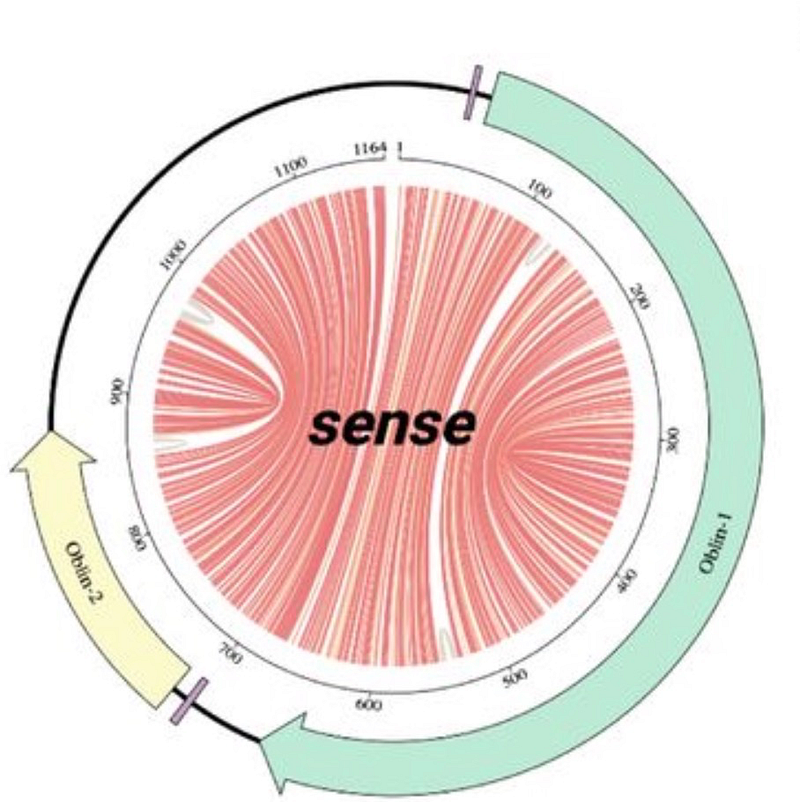
The enlarged yellow and green arrows in the image above are two proteins that are encoded for in the RNA sequence and they are named Oblin-1 and Oblin-2.
Once they discovered these elements in their pilot study, they expanded their work using another data scanning tool to search another 5.4 million datasets and found around 30,000 Obelisks!
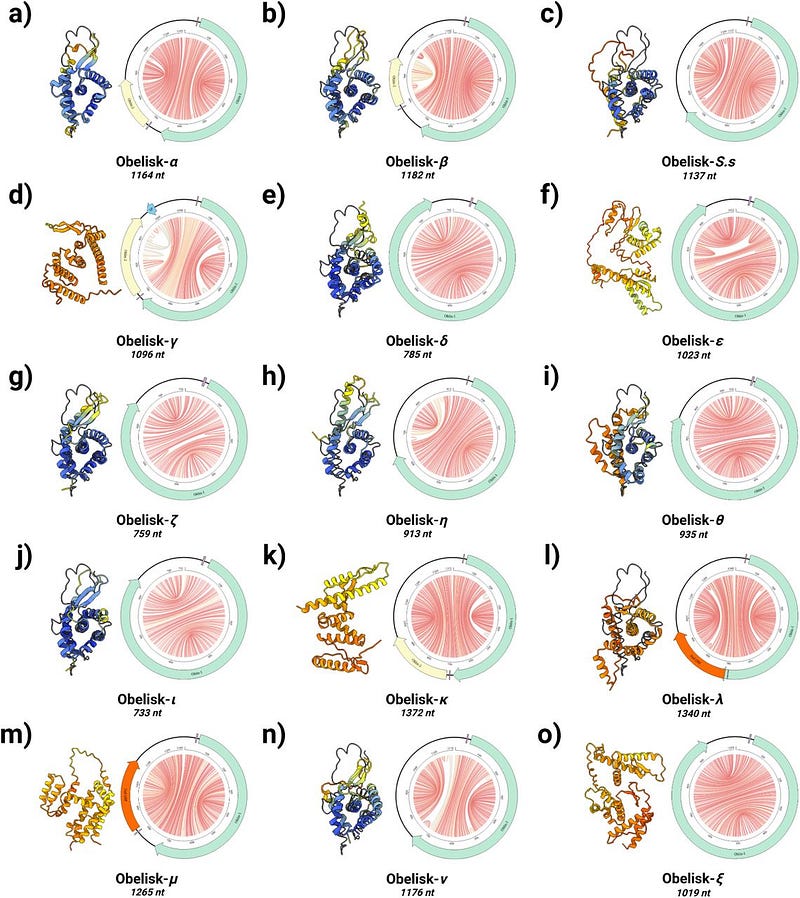
They were able to separate these into 15 different subtypes based on the number of Oblin proteins encoded and the predicted secondary structures of these proteins.
Here’s what all that looks like, also taken from their paper.
Which now brings up the obvious question, “How do they reproduce”
Obelisk reproduction
Like viruses, viroid-like particles also require a hosting agent to make new copies of themselves.
Recall that I mentioned the first viroid-like entities were found in and/or associated with plants. So where were these elements being hosted and multiplying?
It turns out that they weren’t actually using the plant’s cells to host them and reproduce. Rather, they were being hosted by a pathogenic fungus that infects plants, Botryosphaeria dothidea.
[B. dothidea] is an important phytopathogenic fungus with a worldwide distribution, which infects numerous plant species including apple, pear, and grape causing symptoms that include die-back, stem and shoot blight, gummosis, canker and fruit rot.
If you want the nitty gritty details, you can read all about them in this paper.
So how about our Obelisks? What organisms are they co-opting for reproduction? We already know that they were isolated from fecal microbiomes but those contain bacteria, yeast, fungi, and other viruses.
Zheludev and colleagues used a variety of methods and had this to say:
The task of identifying specific host-agent pairings from metagenomic data presented a number of challenges. Most samples with Obelisk homologues that were retrieved from the various searches were from metatranscriptomic samples derived from complex mixtures such as highly biodiverse microbiome and waste water samples…. As such, the potential host(s) of Obelisk elements were not immediately clear.
When they looked for other sequences that occurred in the same samples as the Obelisks, they found a correlation with a bacterium, “Streptococcus sanguinis (strain SK36), a commensal bacterium of the healthy human oral microbiome.”
That’s a good thing. Since S. sanguinis is commensal, that means it is a friendly microbiome component 😃 so our Obelisks are not likely to be causing us any pathogenic problems.
And again, as they say
“…the robust co-occurrence of S. sanguinis SK36 with Obelisk RNA-seq reads … positions S. sanguinis SK36 as a model system for future Obelisk characterisation.”
Future work will determine whether this correlation holds true and may also reveal additional commensals that host Obelisks.
Why call them Obelisks?
Ok, and now I’ll get back to the whole issue of whether these actually resemble actual obelisks. Zheludev and colleagues called them Obelisks because of the predicted secondary structure of the RNA strands:
Owing to a strong predicted rod-like secondary structure, we term this group of RNAs Obelisk-alpha …. At 1164 nt in length, the rod-like secondary structure was striking because typical mRNA sequences are not predicted to readily fold in this manner (as evidenced by the efforts required to maximise the degree of “rod-ness” in mRNA vaccines.)
Frankly, I‘m a bit sceptical of this designation. Rod-like is not the same as a structure with a wide base on one end that tapers to a narrower or pointed end at the other.
I think that they played a bit loose and fancy-free on this one.
But what could you call it? What would you call it?
I have to say, I don’t have any really good ideas at the moment. If you have some, it would be fun to hear them in the comments!
In summary
As always, in a publication like this, there is so much more detailed and technical information than I can present in an article like this. What I try to do is highlight some of the critical science so you can appreciate just what it is that was done and its ultimate importance.
And I highly recommend you read the original source if you like that kind of stuff! You’ll definitely learn a lot!
I mean, think about it. They started by looking at a few million bits of data in their first probe with their VNom tool and then expanded to looking at over 5 million data sets! Wow!
That wouldn’t have been possible just a few years ago! We have certainly come a long way in our technical bioinformatic abilities and I can only assume we’re still at the tip of the iceberg here.
Who knows what else we’ll find. And then there’s the whole question of where the Obelisks fit in the evolution of life.
We life scientists are constantly evaluating and theorizing how life began. Obelisks provide yet another instance of entities that have some of the characteristics we currently use to define life, and lack others.
Zheludev and colleagues argue their strange discovery may not be viruses at all, but instead an entirely new group of entities that may help bridge the ancient gap between the simplest genetic molecules and more complex viruses.
Whatever you think, I found these entities, elements, or however you want to classify them to be another fascinating example of how much we know and how much we still don’t know about life on this planet.
Until next time,
Rich
P.S. If you liked this article, you might also enjoy these posts:
Exploring Frogs With Transparent Skin: They’re called glass frogs and you can see their insides right through their skin!
Gigantic Genomes and Supersized Salamander Cells Surprise Scientists and Put a Wrinkle in…
How Did Amazing Tiny Structures Called Plastids Help Make Plants and People Possible?
Thank you for reading my science story. If you’d like to get my Biology4Everyone updates, sign up here. The newsletter also has short naturalist pieces, photographs, and reading suggestions. It only comes out when I’ve published a new article or two.
Referenced Sources:
“ ‘Obelisks’: Entirely New Class of Life Has Been Found in The Human Digestive System”, by Tessa Koumoundouros in Science Alert (Jan 2024)
“Viroid-like colonists of human microbiomes”, by Ivan N. Zheludev, et al., in Biorxiv (Jan 2024)
“Novel Viroid-Like RNAs Naturally Infect a Filamentous Fungus”, by Kaili Dong et al., in Advanced Science (Dec 2022)
“Viroids: Survivors from the RNA World?”, by Ricardo Flores et al., in Annual Review of Microbiology (Sep 2014)
“Multi-omics of the gut microbial ecosystem in inflammatory bowel diseases”, by Jason LLoyd-Price, et al., in Nature (May 2019)