
Unravelling Rafflesia- A Most Unusual Parasitic Plant
It makes a very large and very unpleasant smelling flower that also steals genes
There are so many beautiful, fascinating and unusual creatures living on this wondrous planet that we inhabit. Everything from the smallest viral particles, whose claim to biological life is still being debated, to giant whales and elephants.
So you’d think that I would have already heard about the Rafflesia flowers, right?
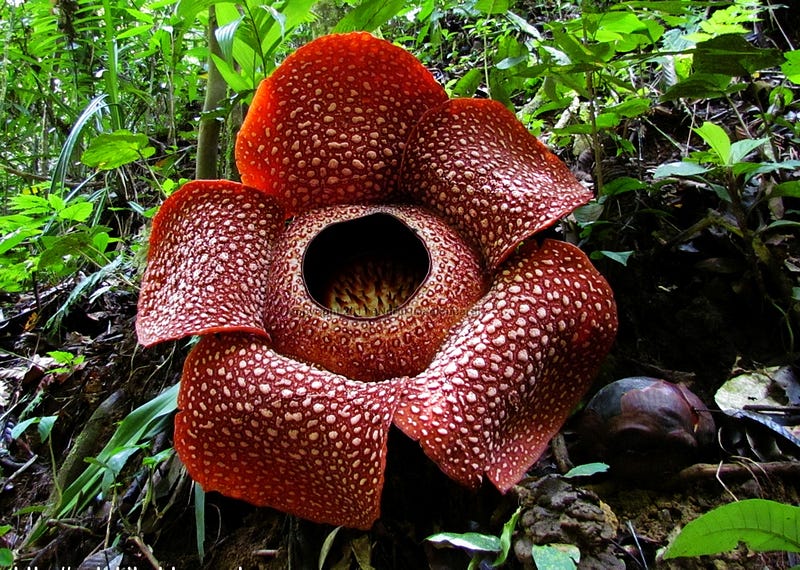
Because one of the species in this genus makes the largest, stinkiest flower ever recorded on Earth.
Its flowers can reach a metre or more (~ 3 feet) in width and their smell has been compared to that of rotting meat. In the area of the world where they grow, the locals also call them meat or corpse flowers because of the smell.
eeeww!
But until I stumbled across it in a short little info piece in Scientific American, I had never heard about it.
Well how can a curious biologist and plant lover like myself not correct such a big gap in my knowledge?
And if I’ve piqued your curiosity, then I invite you to tag along to learn all about these very unusual parasitic plants.
I warn you in advance, these are not simple stick-the-seeds-in-the-ground and watch them grow sort of plants.
Unh Unh.
Way more interesting than that.
So let’s follow our noses and see what we can sniff out about them.
…the largest, stinkiest flower ever recorded on Earth
Basic info
The Rafflesia plant was first discovered by the Western world in 1818 in the tropical forest of Bengkulu (Sumatra), somewhere near the river Manna, Lubuk Tapi, South Bengkulu. As a result, Bengkulu then became famous as The Land of Rafflesia.
It is an endemic plant in Sumatra, and Kerinci Seblat National Park is an area of major conservation of this species.
In spite of this, the plant is in serious decline, due to several factors including climate change altering it’s habitat and human tourists carelessly walking around the vines and flowers.
Before we take a deep dive into Rafflesia’s biology let’s acquaint ourselves with some basic information about habitat and so forth.
There are around 40 species of Rafflesia currently known and all occur in Southeast Asia and Indonesia.
Rafflesia is a parasitic plant that lives exclusively on vines of the genus Tetrastigma, plants that are members of the grape vine family.
It has no roots, stems, shoots or leaves; the only parts of Rafflesia that you see are the 5-petalled flowers. And while they are a feast for the eyes with their giant size and striking colour in the rainforests they inhabit, they smell incredibly obnoxious; like rotting meat or a decaying corpse.
Although many popular articles in the modern media say that locals call them corpse flowers, this is actually not true! It turns out that in 2003, two students from the USA published a webpage where they reported that one of the local names translated to “corpse flower”.
This was picked up by Wikipedia a month later and it kept getting passed along until now, when the designation is used as if it’s always been that way.
Media misinformation. Not uncommon. Check your sources!
In fact, the name that locals do give to these flowers is padma, which comes from the Sanskrit language where it is the name for the lotus flower. In Indonesia and Malaysia, the largest of all the Rafflesia, Rafflesia arnoldii, is called padma raksasa, and patma in Java and krubut or kerubut (great flower) in Sumatra.
Lotus flowers are revered in Buddhist culture and spirituality. So the flowers were actually being praised by this designation, not the other way around!
The first scientific paper on Rafflesia was published in 1821 by the Scottish botanist, Robert Brown.

Brown started off in university studying medicine but his interest in plants soon had him swerving off and onto that path. By 1800 he was well known and in 1801 embarked on an expedition to New Holland (now called Australia) as their naturalist.
He returned in 1805 and published many articles and collections over the course of his illustrious career. His publication of the orchids he collected in Australia include over half of the known species of orchids found there.
Other interesting facts about Brown include that as one of the first botanical microbotanists, he named a cell organelle he saw in many plant cells, the nucleus, not realizing at the time it’s importance to all Eukaryotic life forms. He thought it was only associated with monocotyledons, grasses and other such kinds of plants.
He also observed and described the random “jittery” movement of pollen grains and other small organelles under the microscope and saw it also in inorganic particulate matter. To this day it is referred to as Brownian motion.
Ok, all of that is great, fun information but now it’s time to delve into the biology of this creature.
You won’t be disappointed.
A Brief Biology Background
How do Rafflesia species live their lives; grow, mature, flower, and reproduce? And what place do they inhabit in the natural order of the ecosystems that harbours them?
Good questions. Let’s start to address them.
Here’s a nice, fun picture of the Rafflesia life cycle.
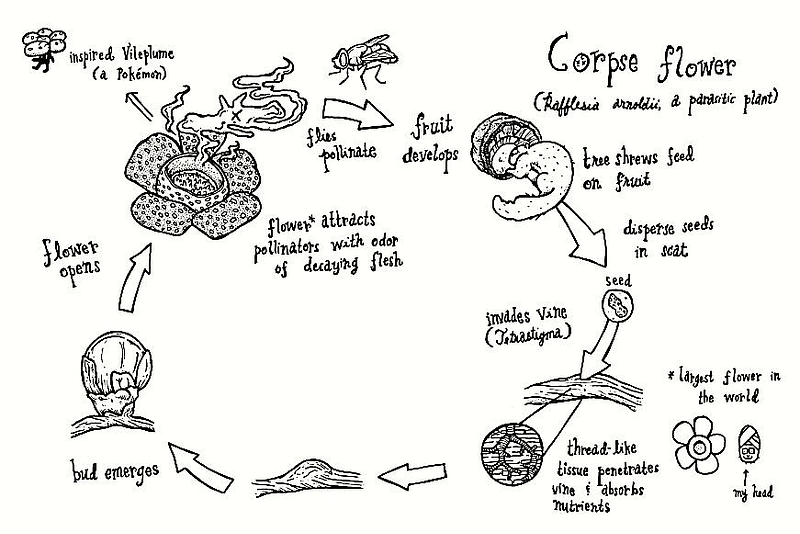
I quite like this diagram because it shows all the basic information and is also a bit humorous with comparing the size of the flower to the artist’s head and giving the Pokeman character reference 😄
But it needs a bit of fleshing out to better understand the details and it may not be 100% accurate.
Let’s start with how Rafflesia produces seeds.
Like its host Tetrastigma, Rafflesia is also dioecious (a term which means there are separate male and female flowers). So in order to make seeds for its dispersal, pollen from the male flowers has to get to the ovaries of the female flowers.
This is accomplished by carrion flies. Aha! Now you know why it smells the way it does. Carrion flies are attracted to rotting meat by its smell and Rafflesia mimics that smell. In fact, mass spectrometry analysis of samples collected by vacuum when it’s emitting that smell yields a chemical profile remarkably similar to that of rotting meat!
Of course, how that all evolved is still a mystery but we never do know everything, right?!
Ok, back to seed production.
Carrion flies transfer the pollen from males to the females during their feeding journeys. In fact, tracking studies have shown that some of these flies will travel up to 14 miles while visiting different to feed upon!

As described by Charles Davis, Professor of Organismic and Evolutionary Biology and Director of the Harvard University Herbaria and Curator of Vascular Plants, in Shaw’s article:
In most plants, the pollen is powdery, but in Rafflesia, it is “produced as a massive quantity of viscous fluid, sort of like snot, that dries on the backs of these flies — and presumably remains viable for quite a long time,” perhaps weeks. In their pollinating efforts, the flies may travel as much as 12 to 14 miles. Davis’s fieldwork seems to indicate that because Rafflesia bloom rarely, successful pollination and fertilization occur infrequently. “But when it does,” he says, “it’s like winning the lottery, because the female flowers produce fruits that look like a manure pie, filled with hundreds of thousands of tiny seeds.”
Ok, how do we get from seeds to mature parasitic plants?
Well, first the seeds have to be dispersed and find a grapevine host to germinate on. One fanciful idea of how this is accomplished is illustrated in the diagram above; the seeds are eaten by tree shrews and moved on the feet of elephant. Fun idea but no real supporting data.
Another, more logical explanation is put forward by Davis and goes like this.
Each seed is about a millimetre in length and carries a little droplet of oil. These droplets of oil attract ants. Davis further suggests that the
ants are not only spreading the seed, but may also somehow play a role in infecting the host. Perhaps the ants chew into the vine, or are attracted to sugar water leaking from nicks in the vine’s bark caused by animals. Or perhaps the ants drag the seeds back to underground nests where, stored next to the roots of the host vines, the seeds germinate and insinuate themselves into the host.
Bottom line: we don’t know how they are dispersed or what causes them to germinate.
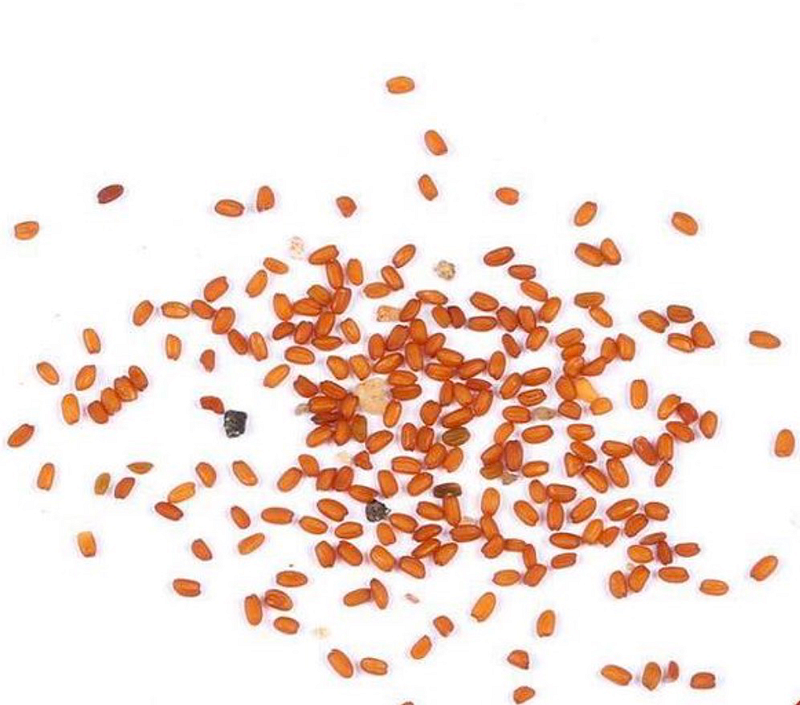
female flowers produce fruits that look like a manure pie, filled with hundreds of thousands of tiny seeds
One reason we don’t know much about how the seed germinates is because Rafflesia has resisted cultivation.
Ok, a seed has somehow germinated on the forest floor and it has found its host, a Tetrastigma grape vine plant. How do they do that?
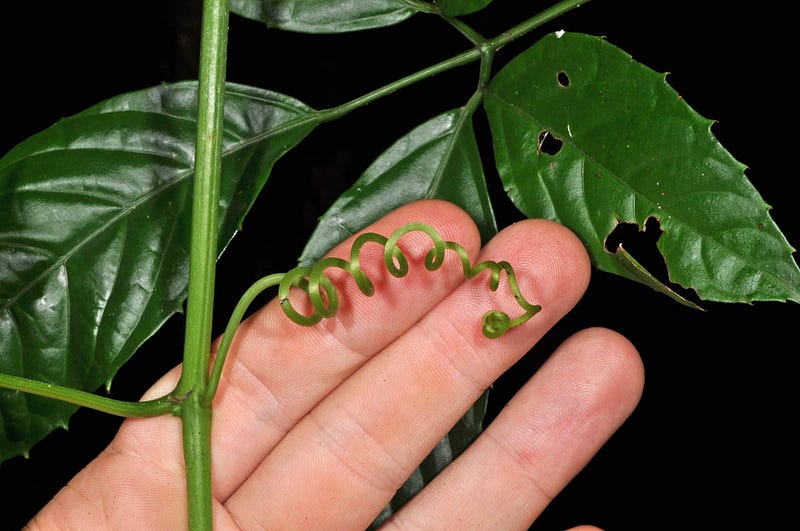
Interesting info: the vine plants of the Tetrastigma genus are also dioecious, have separate male and female flowers and climb up trees by forming long stemmed woody trunks that produce vines called lianas that have tendrils to clasp and attach to the plant it’s climbing. (you can see these in the image shown earlier in this post).
Back to the invasion of the vines by Rafflesia.
Once the seeds do germinate, as the plant grows, its cells produce filaments that intertwine throughout cells of the vine host. These filaments and cells produce a structural feature called a haustorium.
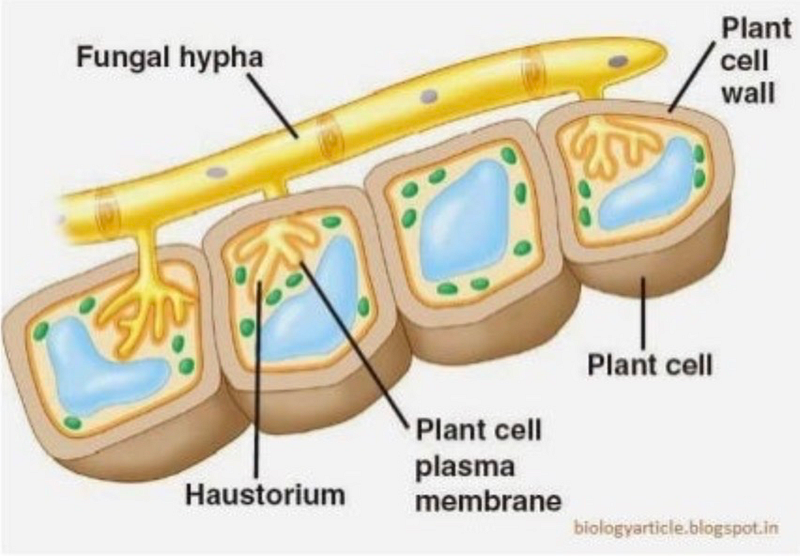
Here’s more information about how plant haustoria work taken from here:
In general, haustorial cells occupy intercellular spaces and displace the host tissue, but enzymes also digest the host cell walls. Once a parasitic plant has encountered a host, it must penetrate the cambium and establish an interface…
Host-derived materials may be transferred through strawlike intrusions into the host vascular tissue, or they are simply absorbed across cell walls.
After forming the initial haustorium, parasites may enhance local root growth to increase the number of haustoria and strength of the connection with the host.
Whether Rafflesia use their haustoria in the ways described above is still uncertain. Highly likely, but still uncertain.
Another common parasitic plant with haustoria that we all know and love, especially during the Yuletide time of year is mistletoe. Mistletoe plants use their haustoria to attach and to extract water and nutrients from their host plant.
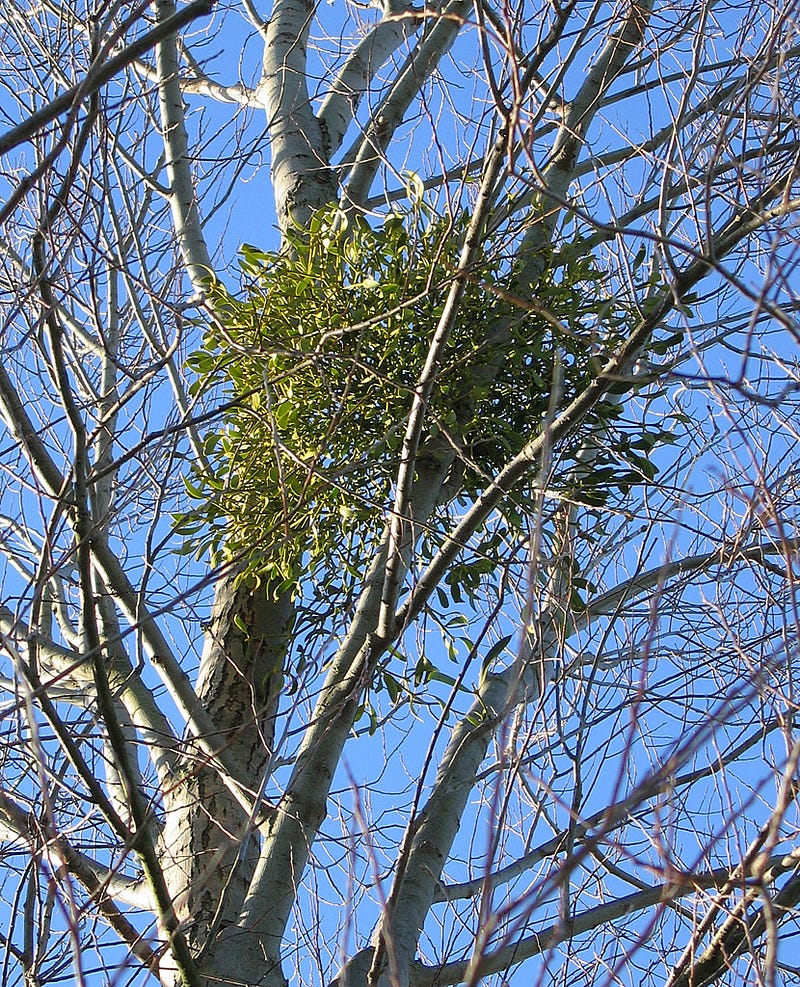
Rafflesia parasitize the grape vine Tetrastigma plants. How do they do that?
As mentioned above, they invade and parasitize the grape vine plants of the Tetrastigma genus, plants that have separate male and female flowers and climb from long stemmed woody trunks using vines called lianas that have tendrils to clasp and attach to the plant it’s climbing.
Ok, we’ve germinated the seeds, they’ve attached themselves to the grape vines and are collecting nutrients and water via their haustoria. What next?
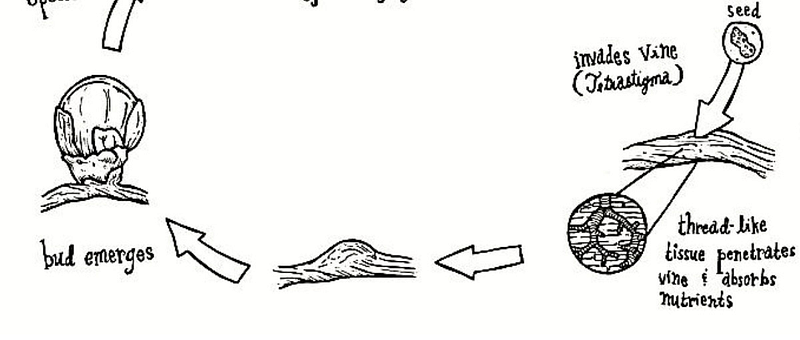
Next, a drab, golfball sized bud emerges.
Over the next few months, this bud swells to about the size of a cabbage.
Here’s a photo of a fully grown bud as seen in the Shaw article:
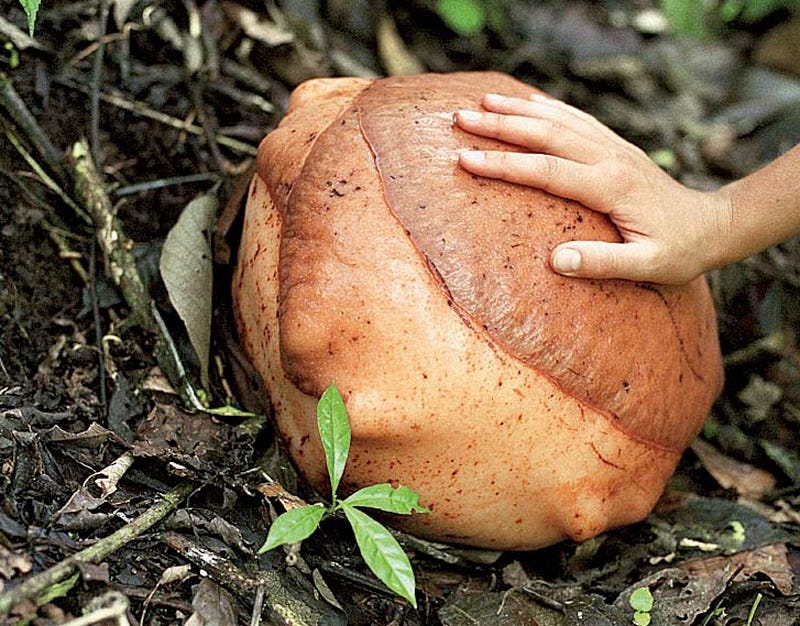
The buds open to reveal the flower which lasts for about week with the strongest odour being produced from days 3–4.
And the cycle starts over and repeats ad infinitum.
Well maybe not. More about that later.
But now you know more about Rafflesia biology then you ever thought you would!
And now we can look at some of the really interesting things that researchers are discovering as they look more deeply into these plants.
Understanding invasion
As you might think, Tetrastigma is not too happy about having this stinky plant parasitize it!
Does it do anything to discourage Rafflesia from making such unwanted advances?
That was a question that Dr. Jeanmaire Molina set out to answer.
Here’s Dr. Molina from her Pace University professor page.
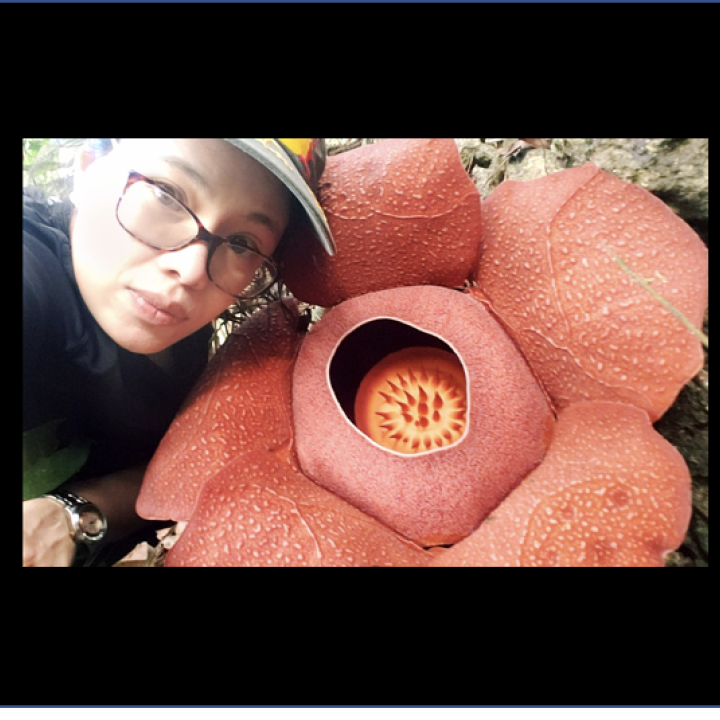
As you can see, she’s definitely committed to researching Rafflesia!
Given the strong carrion smell of the plant, I don’t think you’d find me putting my head that close to a flower!
So what did she do?
Something pretty simple, actually.
Molina extracted over 10,000 chemicals from parasitized and non-parasitized Tetrastigma plants and looked to see what, if any, differences showed up in the two different populations.
A quick summary of Molina’s methods are worth looking at to get an idea of how this “funnelling” process to identify compounds of interest works.
From the extracts of the 2 populations of vine cuttings, Molina’s lab initially saw 14,457 mass spectometry metabolites/features. These are usually visualized as peaks on a digital chart. Of those features, 422 showed a 2.5 times difference between parasitized and non-parasitized cuttings. A total of 18 of the initial 422 were present in sufficient quantity to be further analyzed. Of these, 9 were found mainly in the non-parasitized extracts and 8 were found in the parasitized vines.
That’s a lot of work! And because they only analyzed a total of 5 grapevine cuttings in total, they consider this a preliminary result, not a definitive one.
From their paper:
Results from [the] analysis showed benzylisoquinoline alkaloids were naturally more abundant in non-infected shoots and are here reported for the first time in the genus Tetrastigma, and in the grape family, Vitaceae. These metabolites have been implicated in plant defense mechanisms and may prevent a Rafflesia infection. In Rafflesia-infected shoots, oxygenated fatty acids, or oxylipins, and a flavonoid, previously shown involved in plant immune response, were significantly elevated. [bolding is mine]
Ok, that’s a lot of chemical language. What does it mean?
The alkaloid chemical compounds in the non-parasitized vines are in a group which also includes morphine and codeine. As you know, these are strong, bioactive compounds and while Molina doesn’t know why the vines produce them, one possibility she suggests is that they might function to prevent Rafflesia from invading Tetrastigma.
If that is the case, then one of the things that Rafflesia must do is to either neutralize or somehow bypass the protective action of these alkaloids.
What about the parasitized vines? How were they different?
The elevated oxygenated fatty acids and the flavonoid were both compounds that plant immune systems produce to fight off invasions. And Rafflesia is definitely invading the vines.
Interestingly, there is also a study that showed flavonoids promoted the formation of haustoria in a root parasite. And we know that Rafflesia uses these structures, too.
As is often the case, Molina’s study poses more questions than it answers but it gives a good direction for future research on how Rafflesia successfully parasitizes the Tetrastigma vines.
*Note: There is a much more detailed discussion of the various compounds and their potential roles in the actual paper. If that’s the kind of material that churns your butter, don’t hesitate to check out the source paper 😄.
And this is also important from more than a simple biological research viewpoint.
There are about 30 different species of Rafflesia in these Southeast Asian rainforest habitats. They are all large with R. arnoldii being the biggest and most grandiose.
Because of novelty sales, Indigenous medicinal use, climate change and habitat destruction, these plants are slowly disappearing, are endangered and are rapidly approaching extinction.
If we could cultivate them, maybe we could prevent the loss of these magnificent plants but in fact, we are currently unable to grow them. So Molina’s work is a step in her efforts trying to overcome that obstacle to preserving them.
“I think there is a way. We just don’t know it yet. We’ll get there somehow.”
Hope springs eternal!
Relationship to other plants
Non-parasitic plants use photosynthesis to generate the chemical compounds they need to grow and prosper. This process takes place in small organelles called chloroplasts that are found inside plant cells.
Again from Wikipedia: Photosynthesis is a biological process used by many cellular organisms to convert light energy into chemical energy, which is stored in organic compounds that can later be metabolized through cellular respiration to fuel the organism’s activities.
These days, the cost and time of sequencing and analyzing an organism’s genome has become quite manageable for researchers so it’s not surprising to think that an enterprising researcher might be interested in looking at the genomes of these unusual parasitic Rafflesia plants and their grapevine hosts.
When one of the Rafflesiaceae species was examined by the Davis lab, some very interesting results emerged which they published in a paper by Limin Cai et al.
And here’s where it gets interesting.
Davis wanted to know what Rafflesia’s relationship was to the rest of the plant world.
The chloroplasts in plants also contain within them a small DNA genome. Researchers have sequenced these genomes and can use these data to compare the various chloroplast genomes and establish genomic relationships such as the degree of relatedness and diversity.
But in this respect, Rafflesia is a very unusual plant. It has no standard vegetative plant parts like stems and leaves and completely lacks chloroplasts so obvious morphological characteristics like size and shape etc. of stems and leaves can’t be compared and neither can chloroplast genomes.
Since that line of investigation was blocked, the Davis lab sequenced the DNA found in the cells that made up the parts of the plant that were available.
When they did that and compared the results to other closely related plants, what they uncovered was remarkable!
Stealing and transferring genes
In a project Davis conducted during his post doctoral training he looked at a plant group called the Malpighiales, which represents nearly 40 percent of the flora in some tropical rainforest understories. Davis was attempting to map out the evolutionary relationships between the different plant species in this group.
Previous genomic research had indicated that Rafflesia was also a member of this group. The first thing he set out to do was to confirm that as other scientists had shown, Rafflesia was a member of the over-arching Malpighiales group.
What he found astounded him.
from Shaw’s article:
Some of the genes he sequenced confirmed that Rafflesia were indeed part of Malpighiales — but other sequenced genes placed them in an entirely different order (Vitales) — with their host plants. Davis had stumbled upon a case of massive horizontal gene transfer, the exchange of genetic information between two organisms without sex.
Horizontal gene transfer
This is not uncommon in bacteria and other simpler creatures — that’s one part of how superbugs that develop resistance to our antibiotics can develop — but in organisms as large and complex as plants, it went against all the standard Darwinian methods for gene transfers during evolution.
Normally, the transfer of genes and/or other pieces of DNA between two different individual creatures would occur during sex.
That, dear reader, is what happened when your Mom and Pop made you; it’s why you might have your Mom’s hair and your Dad’s eye colour and so on.
And it’s how in the botanical world, how people who breed plants to get features they want from several different plants to combine into a hybrid.
So for complex organisms like plants, to see gene transfer without sexual “relations” was very rare!
What David found was that in Rafflesia, about 2–3% of the nuclear genes that the plant expressed during its normal living activities came from Tetrastigma. And up to 50% of the genes that are expressed in the mitochondria, the organelles that produce energy were from the host.
Interesting note: Both chloroplasts and mitochondria cellular organelles are thought to originally be parasites that their hosts retained over the course of evolution because they offered benefits in energy production for the host. Since they were originally independent organisms, they needed and had their own genomes to enable reproduction, and which they still have in order to retain and perform their function. As these genomes are unique, small, and easy to sequence rapidly, they are often used for evolutionary mapping studies. In fact, you can have your own mitochondrial genome sequenced to use to help discover and/or confirm ancestors in your own family tree!
This amount of gene swapping/theft actually blurs the distinction of Rafflesia and its host as two unique plants!
Not only did Rafflesia “steal” the genes from Tetrastigma, but they also swapped them in at the same genomic location where the same gene was in the Rafflesia genome. So they weren’t just popping them in at random spots!
Remarkable!
the host and parasite share so much biology that the boundaries between them have become blurred.
Does this gene transfer offer any evolutionary survival advantages?
Since we normally like to think about actions like this in the context of how this might benefit either the parasite or the host, Davis suggests that perhaps by having and expressing the Tetrastigma genes, Rafflesia is able to conceal its parasite identity and thus avoid detection and attempted elimination by Tetrastigma’s protective immune system.
Another question that pops up for me is — is this horizontal gene transfer between parasite and hosts more common than we think it is? How many other host-parasite genomes have we compared to see if it has occurred?
Is this a way that parasites enhance their fitness of survival on this planet?
And might our knowledge of how this system works give us insights to improve our results when people’s immune systems reject organs transplanted into them from donors?
It’s definitely something to keep on our radar.
Is there anything else we should know about these fascinating plants?
More cool stuff about Rafflesia
Upping the temperature
Ok, back to the whole question of smelling like rotten meat.
It turns out that there are other plants that also use foul smells to attract pollinators; the Stapelias from South Africa and Skunk cabbage. I regularly encounter skunk cabbage on my hikes and woodland walks here in British Columbia and can confirm it makes a fairly putrid smell.
Stapelia gigantea and skunk cabbage
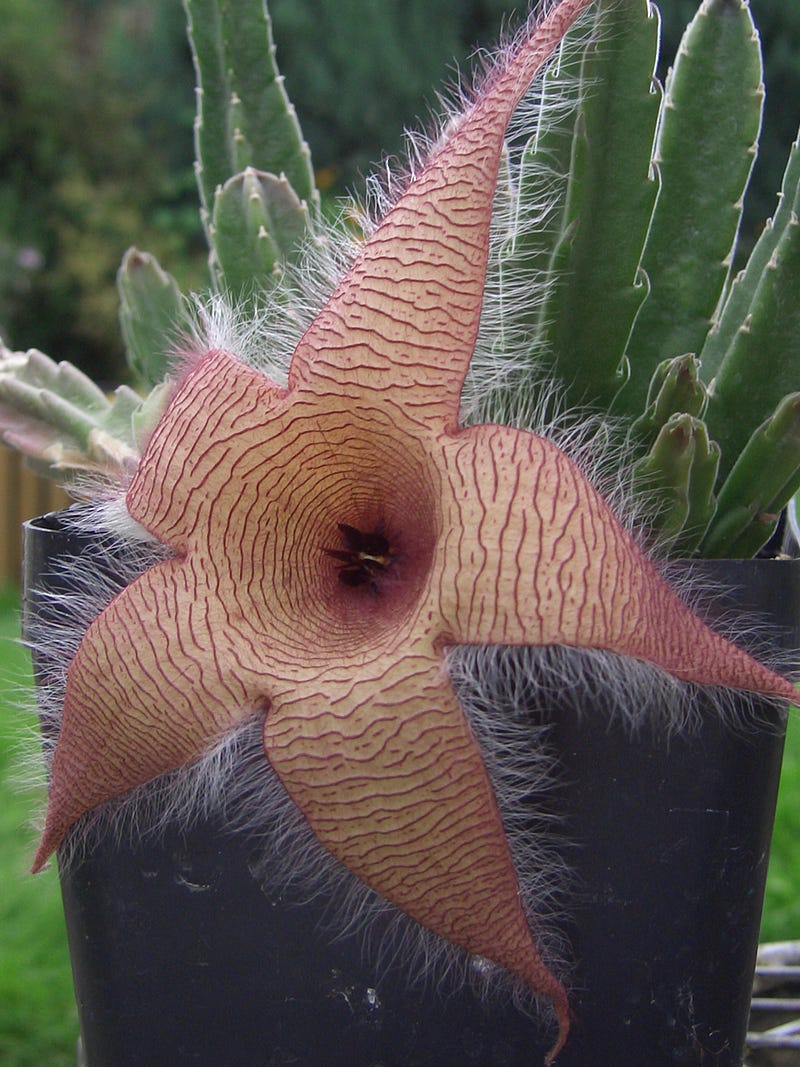
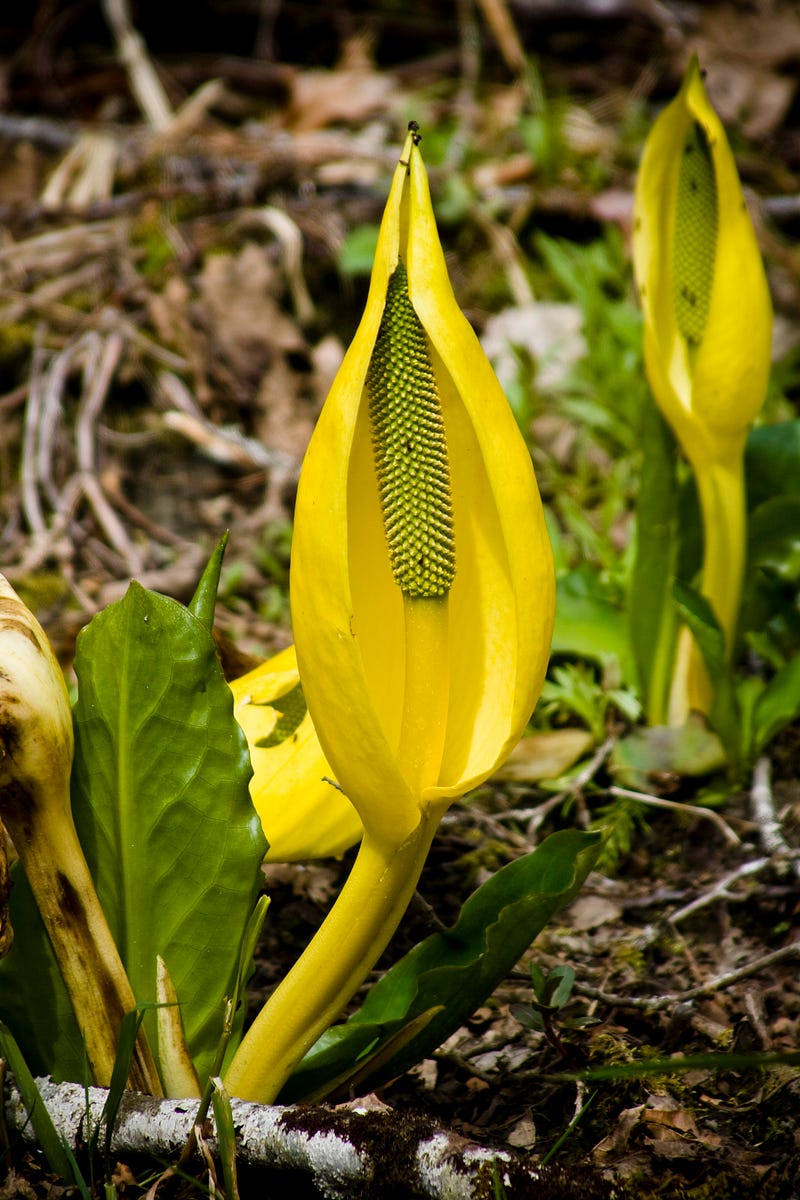
Well, it turns out that both Rafflesia and skunk cabbage can turn up the heat.
By nearly 30 °F (~17 °C)! Davis suggests that
…the ability to generate heat probably first evolved to help plants like Rafflesia and skunk cabbage volatilize the foul odors they produce to attract pollinators. The heat — which in skunk cabbages requires a metabolic rate akin to that seen in animals like mice or birds — also creates a cozy microenvironment that allows visiting pollinators to operate at a lower metabolic cost.
Remember, insects metabolism is directly related to their temperature; when it’s cold, they can’t move very well and when it’s hot, just try to swat a fly in the summer! So if skunk cabbage flowers in the early spring, which it does in my locale, then raising its temperature means the odour will spread more rapidly so more insects will find it and do what they need to do, faster.
Is that cool or what? I mean hot 😉
Myths
taken from here:
The people of Rejang tribe who inhabit hills from Central Bengkulu, Kepahiang, Rejang Lebong, and Lebong, nicknamed the Bengkulu iconic flowers as Bokor Satan’s flowers. Others call it the Ibeun Sekedei or the Ghost Grail. This is because Rafflesia Arnoldii is believes to be Bokor betel of the forest, either in the form of mystical creatures and wild animals, such as tigers. Therefore, the people of the Rejang tribe had always been avoiding Rafflesia flowers if they’re in the middle of the forest.
Indigenous usage
From Kew Gardens:
“The flower buds are used in traditional medicine to help with pregnancy, and as an aphrodisiac.”
And more from Wikipedia:
In Thailand the buds and flowers of R. kerrii are considered a delicacy. They are also harvested for herbalism, a concoction is believed to act as a sexual stimulant and to help for fever or backache. In the Philippines the plants are also used in folk herbalism, but the flowers are also fed to swine as fodder. On Java the buds of R. zollingeriana are harvested and dried for use in jamu, the ancient traditional herbalism of the island. It is unknown for what the buds are supposed to be good for; jamu concoctions are often complex mixtures and often are supposed to help with sexual prowess
All these allusions to sexual applications but there is no proof that any of them are actually true! Try it at your own risk, if you can get any!
And lastly, here’s a fun informative video so you can be a digital tourist and see just how easy it isn’t to get to see Rafflesia arnoldii in it’s natural habitat!
I hope you enjoyed this exploration of a plant and its flower that most of us have never heard of.
Until next time,
Rich
P.S. If you liked this one, you might enjoy these, too.
Gigantic Genomes and Supersized Salamander Cells Surprise Scientists and Put a Wrinkle in…
How Did Amazing Tiny Structures Called Plastids Help Make Plants and People Possible?
Sources:
Living with a giant, flowering parasite: metabolic differences between Tetrastigma loheri Gagnep. (Vitaceae) shoots uninfected and infected with Rafflesia (Rafflesiaceae) and potential applications for propagation, by Jeanmarie Molina et al., Planta (Nov 2021)
Giant Rotten-Smelling Parasite Flower Rafflesia Evokes Host Defenses by Shi En Kim in Scientific American (Mar 2022)
Wikipedia sites: Rafflesia, Robert Brown, Haustorium,
Colossal Blossom, by Jonathan Shaw, Harvard Magazine (Mar-Apr 2017)
Hemiparasitism by David Smith et al., in Encyclopedia of Biodiversity (2001)
Biggest Flower in the World: Rafflesia arnoldii by Redfern Natural History Productions, YouTube (2017)
Deeply Altered Genome Architecture in the Endoparasitic Flowering Plant Sapria himalayana Griff. (Rafflesiaceae), by Liming Cai et al., in Current Biology (Jan 2021)
Flavonoids Promote Haustoria Formation in the Root ParasiteTriphysaria versicolor by Huguette Albrecht, John I. Yoder, Donald A. Phillips in Plant Physiology (Feb 1999)
Thank you for reading my science story. If you’d like to get my Biology4Everyone updates, sign up here. The newsletter also has short naturalist pieces, photographs, and reading suggestions. And it only comes out when I’ve published a new article.


