
Gigantic Genomes and Supersized Salamander Cells Surprise Scientists and Put a Wrinkle in Evolutionary Theory
Does the size of a creature’s cells or genome specify its evolutionary path? That was what we thought, but data from salamanders question whether this is really the case.
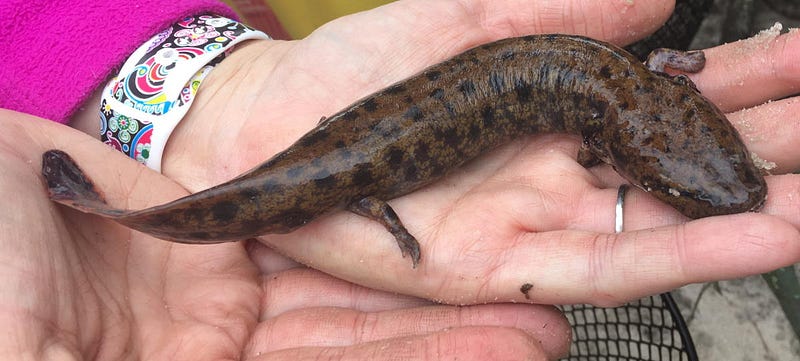
Once upon a time, I thought that salamanders were just cute little beasties that toddled along around creeks or the forest and served some kind of link in food chains but never gave them any more thought than that.
Well, I’ve been dispelled of that idea. There’s definitely more to them than I dreamed of when I was a kid. If you’ve been following me for a while, you might remember this post I did about an interesting salamander, the axolotl.
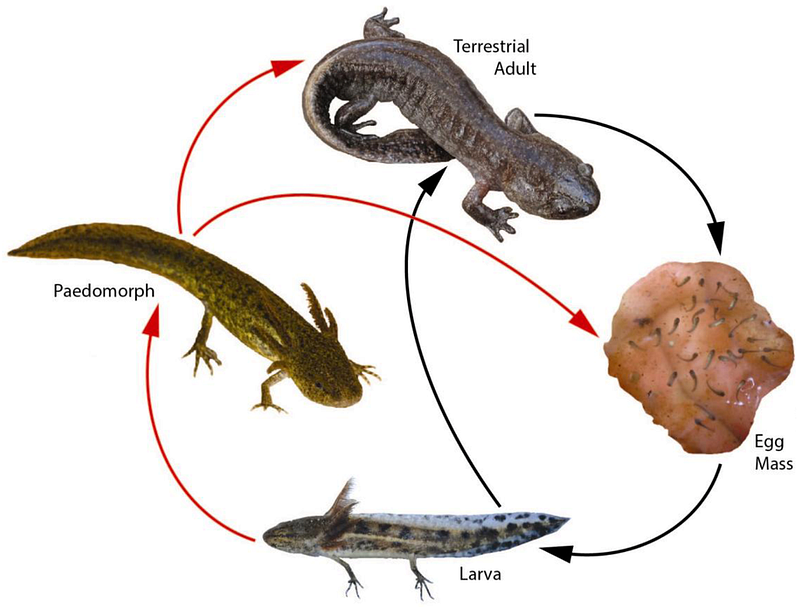
In that post, I took you through the typical salamander life cycle, but here it is again for a quick reminder. We’ll refer to it again later in the post, but basically, they mate, the adult female lays the eggs, the eggs hatch into larvae, and the larvae pass through a stage of development (paedomorph) to ultimately become adult salamanders.
Pretty neat and simple. But if you follow the arrows in the diagram below, you can see that there are some other “options,” which we’ll get to later in this post.
I also talked about the remarkable ability of salamanders to regenerate severed body parts and their very large genomes,
[They are] capable of the regeneration of entire lost appendages in a period of months, and, in certain cases, more vital structures, such as tail, limb, central nervous system, and tissues of the eye and heart.
Axolotls have extremely large genomes. If you count both sets of chromosomes in our cells, the ones from Mom and the ones from Dad, humans have more than 6 billion nucleotide pieces in our genomes. Axolotls have over 32 billion!
What I didn’t talk about, because I was unaware at the time, was the very large cells that salamanders can have.
I don’t know about you dear reader, but I am about a year and a half behind in reading some of the publications I subscribe to for ideas and topics to write about. So I try to make sure that the kind of things I write about are more long-lasting, far-sighted, and not likely to go out of date any time soon. Let’s face it, there are so many great articles about so many different areas in biology that no one can keep up with all of them.
So, imagine my pleasure when I came across another salamander article that allowed me to extend my knowledge into another facet of their biology. And that’s what we’re going to look at in this article.
The size of their cells and the size of their genomes and how these features may disrupt what we thought we knew about the evolution of salamanders and a lot of other creatures, including ourselves!
The article by Douglas Fox is “Junk DNA Deforms Salamander Bodies.”
So hop in, buckle up, and come along for the ride.
Are Bigger Genomes Better?
The current trend of thinking for biological evolution argues that, in general, this is the case; bigger is better. For salamanders, this is not a simple question.
In my life I tend to lean towards the saying “Less is more” because I want to reduce my impact on the environment and learning to do more with less is a skill I think is admirable.
But does biological evolution agree with me? Salamander biology says maybe yes, maybe no. Let’s start with salamander genomes.
Genomes
Most of the more highly developed creatures like birds, reptiles, and mammals have about 0.5–6.0 billion base pairs of DNA in their genomes. If you remember, I talked about the chemical makeup of DNA in this article:
Since the prefix “giga” means billion, we can say those genomes are 0.5 — 6 gigabases in size. That’s a lot of bases. But not compared to salamanders.
Salamander genomes vary a lot between species and range from 10–120 gigabases! That’s anywhere from ~2 to 20 times more DNA than the higher organisms.
So what’s going on here? How did they evolve such large genomes? And what is the advantage of such a genome? Or is there an advantage? Do they have more genes than we do, or just more DNA? Does genomic DNA look or act any different when it’s so much more of it?
Ok, one question at a time! It turns out that salamanders don’t have more genes than we do, so why is there so much more DNA?
Transposons
And now we’re getting into the crux of the issue.
Most of the organisms we know about have small pieces of parasitic DNA incorporated into their genomes. These pieces have a resemblance to viruses but they are not viruses, as far as we know.
We call these parasitic pieces transposons. Here’s a quick definition from Britannica:
“Transposon, class of genetic elements that can “jump” to different locations within a genome. Although these elements are frequently called “jumping genes,” they are always maintained in an integrated site in the genome. In addition, most transposons eventually become inactive and no longer move.”
There are several different types of transposons depending on whether they are DNA- or RNA-based. The ones we’re interested in are DNA-based.
The important feature regarding genome size is that transposons contain their own genes that can make copies of themselves which then insert into a different location in the genome. That’s the reason we often refer to them as jumping genes.
When several salamander genomes were completely sequenced, we discovered that their genomes had a lot more transposons than most other creatures. Most creatures try to limit the number of transposons in their genome.
One way to do that is via mutations that randomly or purposefully delete sections of DNA. But that’s not completely effective so there are always some transposons still hanging around. And they can make more transposons and so on and so forth.
For reasons we don’t quite understand, salamanders get rid of transposons at a much slower pace than other organisms like fish or humans.
All that extra DNA does come with a cost; it alters salamander bodies, brains, and other internal organs. It also changes the physical structure of salamander chromosomes.
In all multicellular creatures, genomic DNA is tightly packaged by certain proteins into a cell’s nucleus as tightly wound structures that resemble sausages. We call these DNA packages, chromosomes. That happens in salamanders, too.
But since their chromosomes are much larger they look like overinflated sausage balloons! That’s because there is so much more DNA which requires a lot more packaging proteins!
Downstream Effects of Supersized Salamander Genomes
Bodies and Brains
There are more than 750 known species of salamanders. In about 40 species with supersized genomes, the larvae have lost the ability to metamorphose into adults.
Remember this picture from above?
Instead of developing into Paedomorphs and then adults (the 2 outside red arrows), these species’ development is arrested in the larval or paedomorphic stages. In essence, they fail to undergo the final metamorphosis stage. They are still able to procreate (inside the red arrow leading to egg mass), but several other features are compromised.
For instance, some of them are missing a few toes or even missing their back legs. Those are easily seen as external deviations.
What about internally?
Internally, they can have larval- or baby-like traits such as unfused skull or foot bones. And some of them have larva-like brains.
When scientists compared these species' brains to those of another close amphibian relative, frogs, the brain cells looked more embryonic and were lacking features that would normally indicate development into more differentiated cell types.
This was especially true in their visual system. Their optic nerves had only about 75,000 nerve fibres compared to around 470,000 in frogs! And the salamander nerve fibres tended to lack a specific set of proteins around their fibres that form what we call myelin sheaths. These sheaths help messages get to the brain a lot quicker.
It turns out that the visual system in salamanders with supersized genomes is simpler than that in frogs and other salamanders with less DNA. And as their brains are less highly organized, they are more like immature, larval brains.
So did this incompletely developed neural system have any other noticeable effects? Did it compromise or otherwise have any impact on their ability to regenerate severed body parts?
Yes.
When limbs from 27 different species with genomes ranging from 13 to 74 gigabases were severed, regeneration of the limb and its muscle and bone tissues in the species with larger genomes took significantly longer. This could also explain why some of the species with larger genomes had fewer toes or lacked limbs normally present; maybe the slower rate of development might also explain why they failed to metamorphose into adults.
But what about these larger genomes was responsible for these effects? Was it simply the gargantuan size?
Transposons again!
Remember those transposons? Well, that parasitic DNA is scattered throughout the genome, and one critical place where they occur is in areas of DNA called introns.
Huh? What the heck are introns?!
Ok, this is getting a bit too biochemical and you, my friends, don’t really need to know these specific biochemical details to get how this might be working.
Hmmm….
How can I explain the gene, intron, and transposon situation in a non-biochemical, simple way?
Let’s try this analogy.
(Really, if you want you can skip this bit if you’re not interested or already know all about genes, or come back to it later if you get interested by other information further on in this post.)
Let’s imagine that a gene is a freight train with a set number of cars, say 20, that is delivering the coal from point A to destination B. Of those 20 cars, 15 of them are carrying coal and the other 5 are just empty flatbed cars. With only those 20 cars, the train can travel pretty fast.
The whole 20 cars are one gene, and the five empty cars are parts of that gene that have no effect on the function of that gene. We call those sections introns, so the empty cars are normal introns.
But suppose while the train is traveling, it has to stop at other stations, and when it does, more cars are added on to it that are not coal cars, but they also aren’t empty flatbed cars either because the transposons carry their own cargo (transposon genes).
Now, after a number of stops, there are more of these transposon-carrying cars distributed throughout the train than there are coal cars or intron cars!
Now the train (gene) has gotten really long due to all those transposon cars that were inserted.
Let’s say that after the last stop before destination B is reached, the train (gene) is now 80 cars long, and 60 of them are transposon cars.
With that many cars, the train couldn’t move at nearly the speed it could when there were only 20 cars.
I hope that analogy made it a bit clearer for you. It’s not perfect, but it helps you to visualize genes with introns that have lots of transposons.
Ok, back to our cells with supersized genomes. A long gene with introns full of transposons is harder for the cell to “read,” and it takes longer for the cell to use the gene to do what it’s supposed to in a rapid, timely manner.
If there are normal genes that tell the cells to move to the next stage regardless of whether other genes have done what they were supposed to, then development may be affected and, in some cases, be incomplete.
To quote one of the scientists studying these salamanders, “[they] never quite grow up.”
Large cells
Ok, remember those large chromosomes I talked about that look like over-inflated sausages?
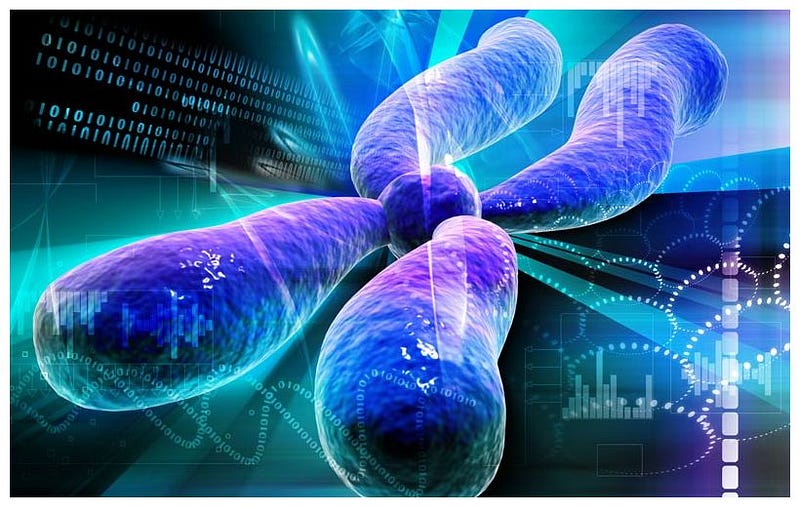
The chromosomes are where most of the genes in a creature are kept; genes are made up of sections of DNA. And we saw that salamander genes have lots of over-sized introns because of the insertion of transposon DNA.
Well, it turns out that cells with a lot more DNA have to be larger to carry all that extra baggage. So, some salamanders have blood cells that are 300 times more in volume than the ones we humans have.
Big cells mean big, clunky bodies. Going with that 300 times the size of human cells, you would think that salamanders would be huge! A lot larger than we humans.
However large cells have their own limitations. So let’s say I have 100 of those really large cells I can use to build an organ in a salamander. That means in the same space, I could have 300,000 of that kind of cell to build a similar organ in a human.
Do you see what I mean about being clunky? In the human, you can incorporate all sorts of fine details and intricate structures into the organ when you have 300,000 small cells to work with vs. what the salamander can do with its 100.
If a salamander were to try to make an organ with 300,000 of those huge cells, it would need all kinds of infrastructural support to keep things held together.
So, with these limitations, it is evolutionarily fairly economical to keep the bodies of salamanders pretty simple.
You know how small some salamanders are, so now you see that it has to do what it can with a minimum number of cells, so it doesn’t have to be so large; but in fact, some of the species are pretty large. The Chinese giant salamander can grow up to almost 2 meters in length!
Regeneration
One of the features that scientists like to study in salamanders is their ability to regenerate body parts.
The scientists do this in the hopes that the knowledge they gain can someday be applied to help treat people who have had serious injuries.
So it’s not just a simple, hey, these guys are cool; give me some money to look at them. Recently, some scientists started to look at salamander brains.
Brains
And to their surprise, salamanders can regenerate brain parts! Now this is highly unusual. Most creatures that have regeneration capability can only do so in a limited way. To regenerate brain tissue is very exciting and special.
It’s special because parts of a brain are not something that a creature would lose in the course of their normal life. Regenerating external features like limbs, feet, toes, tails, and such are the kind of body parts that you might expect evolution for, but brains?!
That’s because all previous investigations and observations have indicated that evolution generally proceeds in response to various environmental stresses.
So this may directly contradict our current evolution theory because you don’t normally lose or damage pieces of your brain from environmental stresses.
At the very least, it’s a significant wrinkle in the prune. Other than having a piece of their heads bitten off by a predator, or a rock etc falling on their head, what would cause the loss of brain tissue in salamanders?
Nothing that is obvious, that’s for sure. So, if that’s not the case, then how or why might this ability have arisen for salamanders?
There’s one possibility. Transposons!
Remember, their gigantic genomes are caused by the inclusion of so many of these buggers. This leads some scientists to suggest that because they slow down development and interfere with cells completing their development into adult tissue, the salamanders are full of immature cells that can be recruited to develop into whatever tissue might be required.
All creatures have a certain amount of these cells. We call them stem cells.
In humans, they can be found nestled in many of our tissues, like nerves and muscles and skin. It turns out very specific regions of our brains also contain stem cells that can regenerate new brain tissue, but if these cells go rogue, they may also be responsible for causing brain tumors, so it’s not a simple win-win situation here for us.
With all the cells with gigantic genomes and supersized chromosomes, here’s how Sessions and Wake have referred to them:
We thus envision salamanders as essentially “walking bags of stem cells.” They are organisms that “never really grow up” — they are truly forever young! Because of this, salamanders can regenerate just about any body part at any time.
So, does the supersized genome and high number of transposons actually give an advantage to salamanders?
That’s not a simple question to answer, and scientists are still researching to gain a good answer. But here’s a simple way to look at it.
Fossils tell us these creatures have been around for around 164 million years, so even if these genomic features aren’t actually conveying any specific evolutionary advantage, they certainly aren’t negatively affecting their survival over the millennium!
I could go on with even more intriguing salamander information, but I think this is a good place to leave off for now. As you can see, there’s a lot more to salamanders than meets the eye.
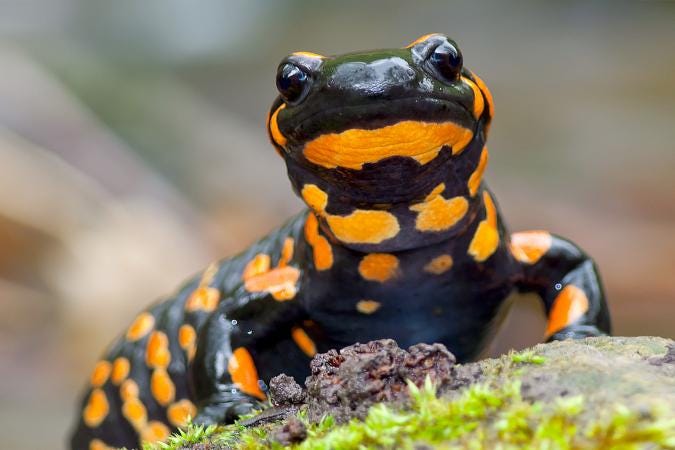
I’m sure I’ll have other posts about these fascinating creatures in the future, especially as scientists keep studying and learning more about them all the time.
News Flash!! If you want to help preserve the natural population of axolotl salamanders, here’s a once-in-a-lifetime unique opportunity!
“…ecologists at Mexico’s National Autonomous University are giving the public the chance to virtually adopt an axolotl. For $30, $180 or $360, donors can choose the sex, age and name of the little buddy they get to call theirs for a month, six months or a year, respectively. The axolotls stay in Mexico, but donors receive an adoption kit with an infographic, the axolotl’s identification card, a certificate of adoption and a personalized thank-you letter.” Taken from this Washington Post article.
So the next time you see a salamander, you can point to it and say to the friend next to you, hey, did you know…..
Until next time,
Rich
P.S. I’d love it if you shared this article with like-minded friends 😃
Here are a few more of my articles that might interest you.
How Did Amazing Tiny Structures Called Plastids Help Make Plants and People Possible?
Cited References
Junk DNA Deforms Salamander Bodies, by Douglas Fox, Scientific American (Feb 2022)
Forever young: Linking regeneration and genome size in salamanders, by Stanley K. Sessions and David B. Wake, Developmental Dynamics, (Dec 2020)
When is the Last Time You Talked About Axolotls? by Rich Sobel, in ILLUMINATION-Curated, (Aug 2020)
Drought, Deluge and Declines: The Impact of Precipitation Extremes on Amphibians in a Changing Climate by Susan C. Walls, William J. Barichivich andMary E. Brown, Biology (Mar 2013)
Thank you for reading my science story. If you’d like to get my Biology4Everyone updates, sign up here. The newsletter also has short naturalist pieces, photographs, and reading suggestions.