
Suck it up Sponges-Comb Jellies Came First!
New data has comb jellies replacing sponges as the closest known living relative of the very first animals that appeared on Earth.
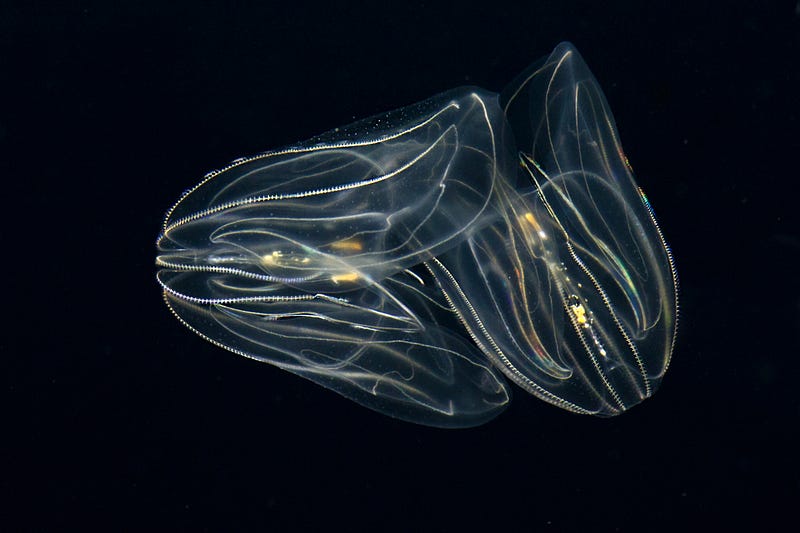
There is a long-standing paradigm which contends that evolution progressed stepwise; from simple to more complex, less sentient to more sentient, and so forth. And for the most part, this is what we observe.
But not always.
One question that evolutionary scientists have sought to answer is what creatures alive today are most closely related to the very first animals that appeared 100s of millions of years ago.
There were 3 main contenders for that spot; sponges (poriferans), comb jellies (ctenophores) and sea anemones and their relatives (cnidarians). In this article, I’ll mostly be using those common names, not scientific ones.
Classical techniques that compared morphological characteristics typically led to sponges being selected as the closest relatives. But not always. Some investigators proposed that comb jellies were just as likely to be the closest relative.
And even as recently as 2017, this paper by Manuel’s group used DNA sequencing to assert that sponges were the closest relative.
It was pretty convincing. We’ll look at what they did in The Debate section further along in this article.
But as convincing as they thought it was, there were still other ways to look at DNA that could shed doubt on their assertion.
A paper recently published this year in Nature, “Ancient gene linkages support ctenophores as sister to other animals” also applied modern DNA sequencing tools and analytical methods to answer that question and their data asserts that the ctenophores, or comb jellies, are the winners.
One of the things I love about writing these articles is that I get to learn all kinds of interesting things about creatures I know so little about. In fact, I never even heard about comb jellies before. Or at least not that my memory triggers! I certainly have no idea what kind of beasties they are.
So….
Let’s familiarize ourselves with the creatures they examined, unpack the methods they used to dig deeper into this question and see how they arrived at their answer.
Ancient creatures
Who are the ancient creatures they are seeking relatives for?
First, we need to define a few things so we’re all on the same page.
In this article, we’re interested in phylogenetics, defined in Wikipedia as “…the study of the evolutionary history and relationships among or within groups of organisms. These relationships are determined by…methods that focus on observed heritable traits, such as DNA sequences, protein amino acid sequences, or morphology.”
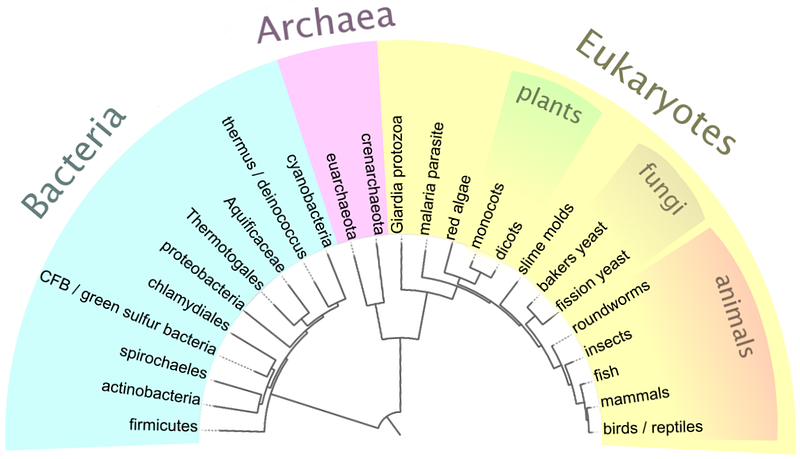
So when you see a tree of life like the one below, you’re looking at a graphic designed to portray these phylogenetic relationships.
If you look at it closely, you’ll see that some lines that connect organisms are longer than others. The longer the line and the more “steps of connection”, the greater the “evolutionary distance” or the weaker the relationship between them. So mammals and birds/reptiles are more closely related to each other than insects are to fish.
So, what are the ancient animals that modern-day sponges or comb jellies are closely related to?
“…relationships are determined by observed heritable traits, such as DNA sequences, protein amino acid sequences, or morphology.”
Now this can get a bit tricky. First we need to know what characteristics need to be present to call an organism an animal. How do we distinguish it from a plant or a fungus or a bacterium or other life forms?
Just how simple can we get? A single cell?
Well, we can get down to a single cell!
Single-celled organisms fall into the category commonly called protozoa. Here’s a few you might have heard of if you took an introductory biology class and examined some pond water under a microscope:
- Amebas
- Paramecia
- Euglena
- Radiolarians
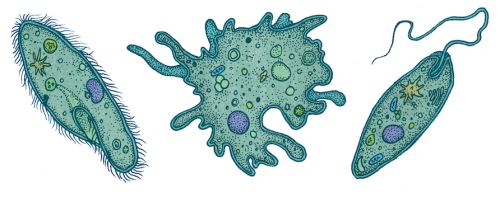
But protozoans are not actually considered animals. Because animals are NOT single-celled. Here’s a definition from the Encylopedia Brittanica:
“Animals are multicellular eukaryotes whose cells are bound together by collagen.”
Remember, cells are living entities that are bound by a membrane of some kind, have genetic material (DNA or RNA) and some kind of fluidic substance inside the membrane. Eukaryotic cells contain their DNA in a membrane-bound micro-organelle called a nucleus. We don’t need to know what collagen is at this point. We just need to know that in animal cells, it is used to bind cells together into multicellular creatures.
You can see in the 3 protozoans above, they all have a membrane-bound nucleus (the dark grey-blue organelle), a membrane that separates them from the environment, and a substance inside the membrane that contains all the organelles, including the nucleus.
OK, I think we’ve got everything we need to know about eukaryotic cell components!
We also need to understand what is meant by the word “sister” in Schultz’s paper. I mean, can a sponge really have or be a sister?
Well, yes. It’s actually an official designation used by geneticists who create phylogenetic trees.
A sister is defined here as “On a phylogeny, sister groups occur anytime a single ancestral lineage gives rise to two daughter lineages: the daughter lineages are sister groups, and since they arose from the same ancestor at the same time, sister groups are always the same age.” [bolding is mine].
Here’s a figure that clearly illustrates that.
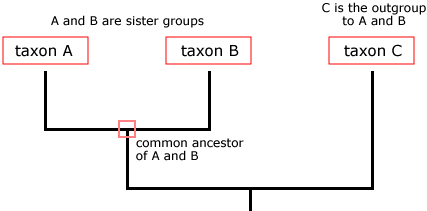
In this figure we can see that taxons A and B are sister groups and taxon C is what is known as an outgroup.
Looking at the simplified universal phylogenetic tree shown previously, we can see lots of sister groups and outgroups. For instance, in the Archea section, Euarcheota and Crenarchaeota are sister groups. And in the animals section, mammals and birds are sister groups and fish is the outgroup to them.
Getting back to Schultz’s question at hand, is it the sponges or comb jellies that are the sister group to the earliest animals?
Here’s a typical animal phylogenetic tree you could come across before they published their investigation.
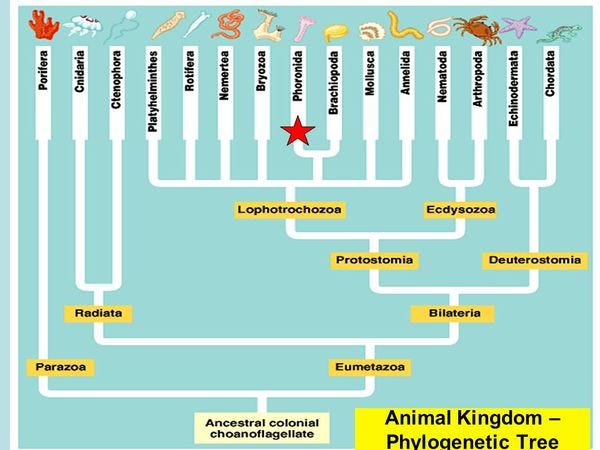
In this tree, we can see that the Parazoa, which contains the sponges, and the Eumetazoa are indicated as sister groups and the Radiata, which contains both the Cnidaria and Ctenophora (comb jellies) may or may not be a sister group. And they all are related to ancestral colonial choanoflagellates.
Choano whats?
Choanoflagellate is a word that comes from the Greek χοάνη (khoánē) meaning “funnel” (due to the shape of the collar) and the Latin word flagellum. The flagellum is a hair-like structure that is oscillated around or whipped back and forth and is often used by unicellular organisms for locomotion. See the picture below.
Here’s a quick intro to them taken from here where you can find tons of info about them.
Considered to be amongst the precursors of the animal kingdom and share a common ancestor, the choanoflagellates are free-living, single-celled eukaryotes that can form colonies, occupying a unique evolutionary niche. Choanoflagellates are abundantly found in a wide variety of marine and freshwater environments, soil, and permafrost, and have been identified in ice cores up to 32,000 years old.
So they are unicellular and as we previously saw in the tree above, they can also form colonies. Here’s a couple of pics from Wikipedia showing a single cell and a colony.
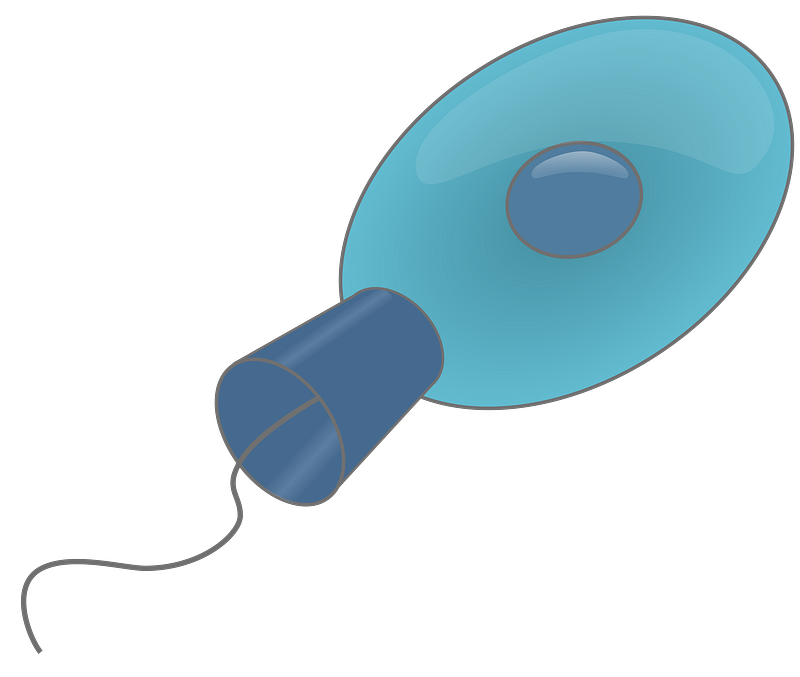
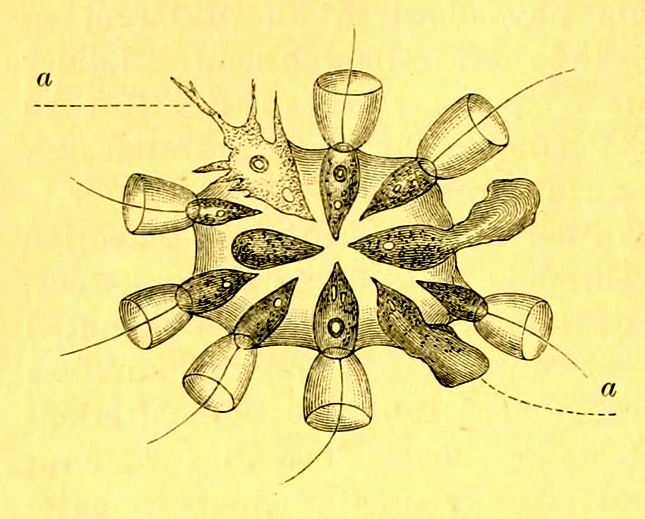
It turns out that choanoflagellates and sponges have several highly related features.
Sponges have cells called choanocytes that line the interior of several different species of sponges. As you can clearly see, it looks very similar to the choanoflagellate! From Wikipedia “The cell has the closest resemblance to the choanoflagellates which are the closest related single-celled protists to the animal kingdom (metazoans).”
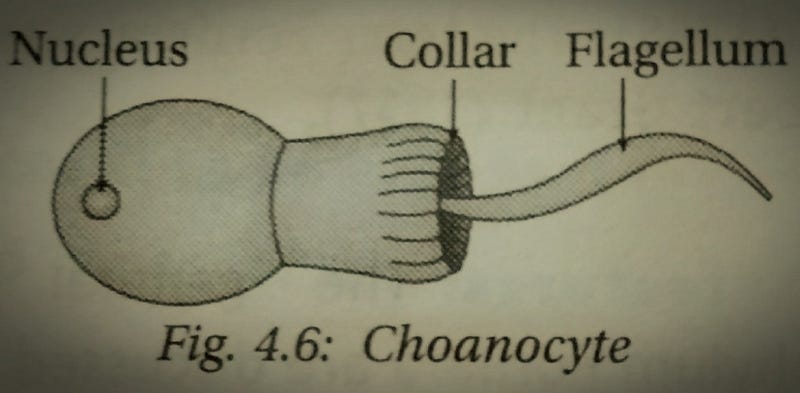
And most interestingly, choanocytes can turn into sperm cells when the sponges initiate sexual reproduction. You can sure see how they resemble sperm cells, too!
*Note of interest: Makes me wonder…did my sperm cells originally evolve from choanocytes and choanoflagellates all those millennia ago?
So the primary question is, are choanoflagellates animal precursors? The DNA sequence comparisons support this.
Similarities occur in:
- 18S rDNA sequences
- mitochondrial sequences
- nuclear protein-coding genes
- cell signalling genes
- adhesion genes
- and of 19 known eukaryotic meiotic genes tested (including 8 that function in no other process than meiosis), 18 were identified.
- sexual reproduction
Thus, choanoflagellates are currently considered more closely related to animals than other organisms such as plants, fungi or algae.
Ok, we’re getting closer to our ancient animal ancestors.
But wait, if we only go with this information, then sponges with their choanocytes are looking pretty good to be highly related to choanoflagellates.
What about the comb jellies?
What else can we look at?
The sister debate
As to whether sponges or comb jellies were the sister to all other animals.
As a first step, we’d want to know whether the major cell lineages in ancient, predecessor animals including the gut, muscle cells and nerve cells are more closely related to those found in the sponges or the comb jellies.
That makes good sense, right? So if we compare sponges and comb jellies, we should be able to see which one of them has tissues and cells that are more like the ancient animals. And that should answer the question, right?
But maybe not.
What if one of the organisms actually lost a cell type or lineage during evolution? Or some other information or function that it once had? Could we find that out? How would we do that?
It turns out that there is a way to determine that and it’s what Schultz and colleagues did to show that the comb jellies were more closely related to the ancient animals than the sponges.
What they did was look at the DNA of different closely related lineages. And they didn’t look at small pieces, they looked at really big ones.
Chromosomes!
Remember, in essence, chromosomes are simply very long pieces of DNA that have lots of other different molecules bound to them that compact them into their unique shapes and access the DNA to “read” the genes. If you want a quick review, here’s my article about DNA and genes.
In 2017, Simion and colleagues took the sequences of over 1700 genes and using methods that go way beyond the scope of this review, showed that the sequences of the genes from modern sponges more closely matched those of the ancient animals.
It is a pretty impressive article and if all we wanted to know was how well do the DNA sequences of independent genes match those of the ancient species, it would be hard to question this conclusion.
But there is a gap in their investigation.
And it is a big gap.
They looked at genes and gene clusters but not at whole chromosomes and the layout of those genes on the chromosomes. What do I mean by that?
Lets say we have three chromosomes we want to compare the genes on them. And let’s say there are 6 genes and we’ll call them genes A, B, C, X, Y, Z.
Here’s how they’re arranged on the 3 chromosomes and chromosome 1 is the ancient version.
- A — B — C — X — Y — Z
- A — B — C — Z — Y — X
- A — B — X— Y— C— Z
If you look at 1 & 2, you can see that the only difference is that the order of the X, Y and Z genes that follow C has flipped.
How do these new gene layouts come about?
Chromosomes can break and then the pieces can come back and reattach but the pieces may simply attach at the “wrong” ends. We call this process chromosome rearrangement.
For chromosome 2, a single break happened between C and X to form 2 pieces, A — B — C and X — Y — Z. When they reattached, X — Y — Z flipped around and attached at the Z-end instead of the X-end to create the new layout.
If you look at chromosome 3, you see that there have been several rearrangements and now X & Y have been re-inserted between B & C. There are several ways this could have happened.
The first explanation for this rearrangement is if chromosome 1 broke at the C — X position and the X — Y — Z also broke into 2 pieces, an X — Y piece and a — Z piece. The X — Y inserted between B and C and Z reattached to C to remain at the end. That’s 3 breaks and 2 reattachments.
Alternatively, chromosome 2 could have broken at both the B — C and Z — Y junctions to form 3 pieces, A — B, C — Z and Y — X. These 3 pieces then reassembled in the order we see in chromosome 3. That’s 2 breaks and 2 reattachments.
You can come up with a similar scenario starting with chromosome 1 to arrive at chromosome 3 by using 3 breaks and 3 reattachments.
Regardless of how chromosomes 2 and 3 were created the simple fact is that if we started from chromosome 1, we only need one rearrangment event to evolve chromosome 2 and more than that to evolve chromosome 3 from either 1 or 2.
The frequency of these types of chromosomal rearrangements are rare. So the more rearrangements from the ancestral chromosome, the greater the evolutionary distance between the two organisms.
And that’s how Schultz’s analysis and methods differed from Simion’s. Schultz used newer sequencing methods which gave longer sequences of the DNA and was able to assemble these sequences into chromosomal pieces containing many genes and the precise order they were arranged on the chromosome.
When they compared their DNA sequences and chromosomal gene layouts, they were able to show that the chromosomes of comb jellies more closely resembled the chromosomes of the ancestral metazoans. So even though the comb jellies lost a lineage of tissues, the chromosomal layouts were strong enough evidence to argue for the comb jellies as the sisters.
In Summary
I really enjoyed learning about sponges and comb jellies and their evolutionary sister relationships to earlier animals.
I particularly liked how we could follow the evolution of conclusions through the use of newer sequencing methods and also the 2 ways of looking at evolution, through single gene sequences or via chromosomal sequences and layouts.
It just goes to show that when we think we’ve reached the limits of an inquiry, all it takes is a slightly different viewpoint to suggest other ways investigate the question that may or may not come up with a different answer. It was quite possible that Schultz’s method could have confirmed Simion’s earlier result and that would still be great information to have!
I look forward to sharing more biological discoveries with all of you. Just stay tuned. I’m not prolific but you nevva know when another will come along. If that sounds like something you’d like to know about, just click on the follow button.
Until next time,
Rich
If you’d like to get Biology4Everyone updates, sign up here. The newsletter also has short naturalist pieces, photographs and reading suggestions.
Sources:
- The Closest Living Relative of the First Animal Has Finally Been Found by Viviane Callier in Scientific American (May 17, 2023)
- Ancient gene linkages support ctenophores as sister to other animals by Darrin T Schultz et. al., in Nature (June 2023)
- Wikipedia- Phylogenetics
- General characteristics and classification of phylum Protozoa by Sushil Humagain, Online Science Notes (December 2017)
- A Large and Consistent Phylogenomic Dataset Supports Sponges as the Sister Group to All Other Animals by Paul Simion et. al., in Current Biology, (April 2017)


