

Everything You Need to Know About DNA and Sequencing Your Genes
For laypersons who know nothing about DNA, sequencing and genes!
Have you ever wondered what all the big fuss was about genes and sequencing? Or, for that matter, what the heck does it mean when someone says they had their DNA sequenced? Or maybe you got your DNA sequenced for one of the genealogy sites to find relatives and they tell you that you probably came from such and such a place and these people might be related to you, 3rd cousin three times removed?!
If this sounds like you or you’d just like to increase your knowledge about DNA and genome sequencing, this article will give you enough of the basic info you need to clearly grasp what’s being talked about.
We’ll start at the beginning and assume you never took any biology or chemistry courses. By the time you’ve finished reading this article, that won’t be a problem anymore.
So hang on, it’s going to be a bit of a rapid ride!
Disclaimer: I'm a scientist and my creation story will not invoke religion or Divine Beings in any way. Feel free to add that in for yourself if you like but it's not necessary for the story I'm telling.In the beginning
The universe came into being.
And there was a whole lot of energy and gazillions of really tiny bits of matter that we call atoms that were created.
These atoms played around with the energy and acquired different characteristics. Some got really big, some stayed really small, some got themselves a plus or minus electrical charge, some stayed neutral, and I think you get the picture. Just a lot of variety emerged and formed what we on planet earth call the elements.
A quick bit of chemistry lingo will help us here and be useful later on, too.
An atom is the smallest particle of matter that has its unique properties. Elements are substances that are made up of only that one kind of atom. So in the figure below, you see them in the same large circle, with atoms being a subset of the elements. So if you have a big balloon filled with helium, it’s filled with lots of helium atoms and helium gas is the element.
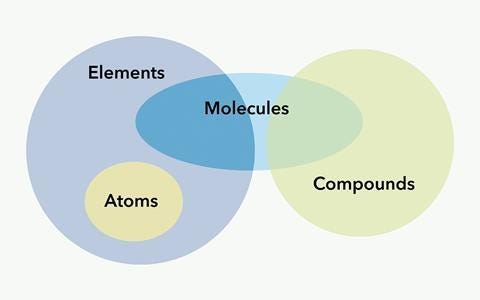
Molecules are when 2 or more of the same atoms join together and compounds are when 2 or more molecules of different elements join together, hence the elliptical shape that overlaps both the Elements and Compounds circles.
There’s hydrogen and oxygen and sodium and calcium and carbon and sulphur and more than a hundred more. If you want to see them all, then look at this table.
Opposites attract. And often complement each other in good ways. So it should come as no surprise that with all these positive and negatively charged atoms running around, they would be attracted to each other and form compounds, right?!
You all know that is how batteries work, right? Without the positive and negative ends, there would be no electric energy generated.
Ok, so we’ve got all these plus and minus charged atoms banging into each other in a random fashion and the attraction is so strong that they stick together. First in very simple combinations and then in more complex ways. So if sodium and chlorine atoms stick together, you get sodium chloride which makes the salt we put in our salt shakers. Or 2 hydrogen atoms go out and snag an oxygen atom and voila, you now have the compound, water. H2O. And so on and so forth.
Let’s make some cells
Eventually, we get some elements that join together that make bubbles or something that creates a little sac that has an inside and an outside.
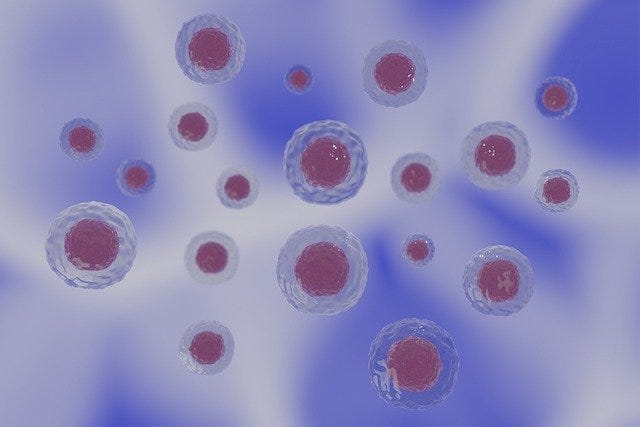
Over another gazillion years or so, those sacs get lots of new compounds and other tiny sacs inside them.
Well, we need a name for these structures so let’s call them cells.
And some of those compounds inside those cells are called nucleic acids. Now you don’t need to know anything about the chemistry of nucleic acids, just that they are compounds that join together to make even more complex compounds made up of many molecules of different nucleic acids.
And here’s the cool thing. Some of those nucleic acid compounds can make exact copies of themselves without any help from any other molecules as long as the same nucleic acids are around to use for that purpose.
One class of those compounds shown capable of reproducing themselves are ribonucleic acids, often abbreviated RNA. There are a whole bunch of scientists who think about how life as we know it came to be and many of them are pretty convinced that RNA was the molecule that started it all!
So these RNA compounds and the cells are now intimate partners.
Ok, just a tiny bit of technical info. The “ribo” prefix stands for ribose, which is a sugar and is part of the RNA. And this sugar has as part of its makeup, an atom of oxygen.
Now, if we remove just that oxygen atom, as Nature did, then we have a de-oxy ribonucleic acid. And compounds with those deoxy-RNA molecules are called DNA, the “D” stands for the “deoxyribo-” prefix. They could have been designated DRNA but scientists like brevity so DNA it is.
Are you starting to see where this is taking us?
Ok, another few gazillion years of evolution pass.
Now the cells have all sorts of little sacs inside and in some of those cells, one of those sacs becomes designated to carry the DNA molecules and we call that sac the nucleus of the cell. Now not all organisms chose to put their DNA in nuclear sacs. For example, bacteria don’t have a nucleus. Their DNA is kind of located in an area of its cell but not enclosed in any additional sacs.
Over time, the DNA took on the job of “running” the business of the cell.
How does it do that?
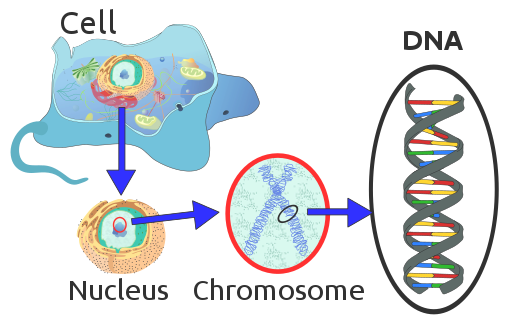
Well, as organisms got larger and more complex, these pieces of DNA also started to get longer and longer with millions and millions of deoxyribonucleic compounds joined together. These long DNA molecules eventually got some other compounds, proteins, to associate with them and the whole shebang formed what we call chromosomes.
And lucky for us, it turns out that DNA only wants to use 4 different nucleic acid compounds. For our purposes, all you need to know is that these 4 compounds are abbreviated A, T, G and C and in the sequencing world, they’re called bases.
And here’s where we begin our journey into sequencing.
DNA, Genes and Sequencing
For many years, this “simplicity” stumped scientists.
How come there are only 4 different nucleic acids found in DNA and what purpose do they serve? They were eventually able to determine that genetic traits were passed along via these DNA chromosomes, but how?
Again, we’ll skip over all the major discoveries and just tell you that the order, or sequence, in which these 4 bases, A, T, C and G were joined together was not random. And it took a lot of great experiments to discover that!
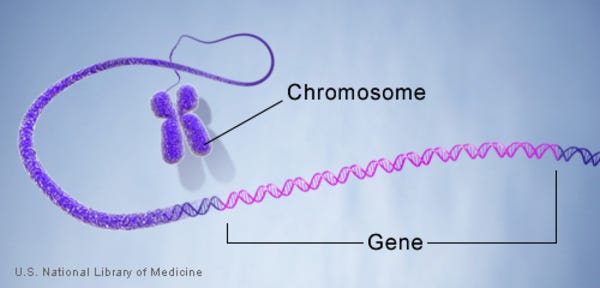
It also turned out that these long pieces of DNA chromosomes had different “sections” and each section, or gene, specified a particular trait such as eye colour, or how long a tail would be, or what kind of fur an animal would have, and so forth.
So…. with that knowledge, it became necessary to be able to determine the exact order, or sequence, that these 4 nucleotide bases were joined together.
Again, without going into the details, the first methods designed were very work-intensive, expensive and time-consuming and you had to use a fair amount of radioactive Phosphorus-32 (also known as P-32).
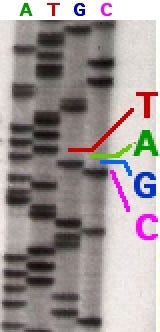
Here’s an example of what a typical sequencing result looked like using those techniques.
It’s kind of like a ladder. And again without going into the details, what you do is “read” from top to bottom which dark line in one of the 4 labelled columns is the highest to get your sequence.
So if we start at the very top and work our way down, this ladder tells us the sequence is C, G, T, T, A, T, C, T, T, C, A, A, G, G etc. Does that make sense? Try it yourself. And when you do, you begin to see how time-consuming that is! And the images often had blurry areas and weren’t as nice as this one. I have to admit, if you were in a hurry, it could be frustrating but these were all problems that could be dealt with.
(In my education and training to become a molecular biologist, I dealt with all of them and a whole lot more! You don’t want to hear about the time I contaminated a whole room with radioactive P-32!
Well maybe you do but that’s all I’m willing to admit right now!)
However, the best thing was that it worked! You could read the sequence of the nucleotides. And it only took a few days from start to finish if the piece of DNA wasn’t too large. So when lots of scientists did that with lots of different pieces of DNA and shared their results in an online database, they were able to compare the sequences and start to notice lots of similarities and differences.
They started sequencing DNA from all sorts of different organisms!
One important realization that emerged when they started comparing these was that certain sequences were so highly similar that they were essentially the same sequence, but in different organisms!
Wow! You could see that yeast, flies, mice, dogs and people all had the same gene or a similar enough variation of it that it was recognizable.
And of course, it was inevitable. Especially when they decided to sequence all the human chromosomes, commonly referred to as the human genome. Which was a truckload of DNA nucleotides!
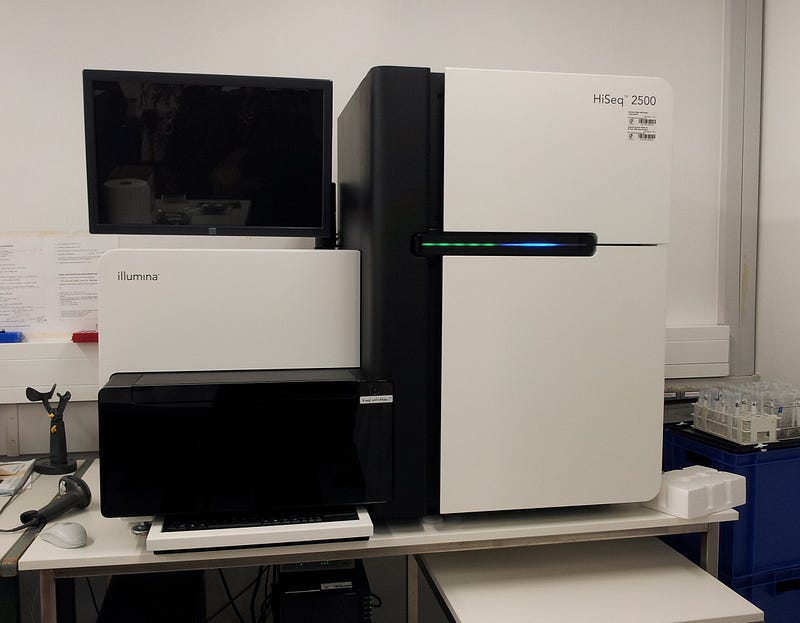
Biotechnology kicked in big time and sequencing became cheaper, easier, coloured dyes replaced radioactivity, high-throughput methods were developed and machines were invented with whole companies created that just did DNA sequencing.
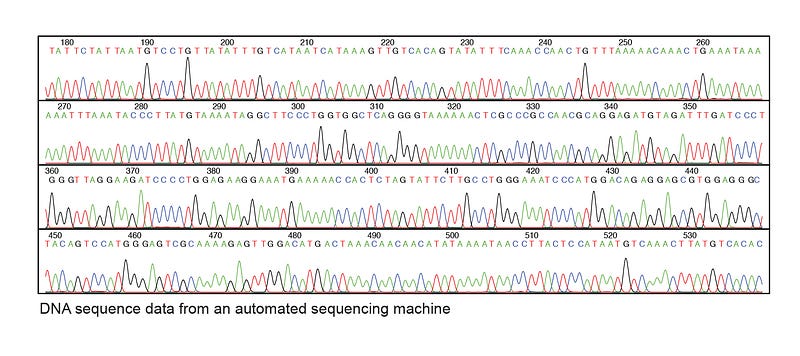
A typical sequencing print-out from one of the high-throughput machines. Nowadays, it’s all just sent in a file and you don’t even have to “read” it yourself. Just upload it and you’re ready to use it for searching other online DNA databases.
Ever hear of 23andme? They were the first company to offer DNA sequencing direct to layperson consumers. They still do that and it’s not very expensive to get a quick sequence of your genome.
As to where scientists go to get the DNA they want to be sequenced, here’s an article from the life sciences industry published in 2019 that talks about some of the bigger ones.
There’s lots more!
Summary
So, to briefly summarize DNA, genes and sequencing:
- There are 4 molecules that make up the large complex molecule we call DNA
- These 4 different molecules are called nucleotides or bases and are abbreviated A, T, G and C.
- These 4 bases form long chains by chemically binding to each other and those long chains are pieces of DNA.
- DNA is found in our cells in a compartment called the nucleus but in more primitive cells, it just “hangs out” inside the cell.
- The long DNA chains form structures called chromosomes.
- Sections of the chromosomes are discretely organized into units called genes that specify traits like eye colour, sex, hair colour, etc.
- These genetic units are sections of nucleotides that are attached to each other in a non-random order.
- DNA sequencing determines the order in which bases are attached to each other.
And that pretty much does it for now.
Yes, there are variations and mutations of genes and whole textbooks more information about how DNA and genes work etc., but I think this is all you really need to know for a basic understanding of genes and DNA sequencing.
To quote one of my favourite authors, mystery managed!
Until next time,
Rich
Hey! If you read all the way to the end of this article you need to subscribe to my newsletter and get a free fun ebook!


