
What Microbes Tenaciously Persist in Your Gut and How Did They Get There?
There are 3 unique kinds of persistent microbe populations in your gut.
Investigating gut microbiomes is all the rage these days, and for good reasons.
Finding out what organisms we have in our gut microbiome can tell us a lot about our health. And with a few simple strategies, we can promote the ones that help us become even more healthy.
In former decades, determining the trillions of microbes in our microbiome was a daunting task. But as DNA sequencing methods become streamlined, more economical, and databases fill up with the genomes of thousands of microorganisms, it has become more routine.
And it’s pretty simple.
The investigator takes a small sample from whatever tissue they are interested in and sends it out to be sequenced. They get back the DNA sequencing results, use them to query the microorganism databases, and BINGO, you have a list of all the microbes.
And not only a list, but if the sequencing is done on a deep enough level, you can determine the relative amounts of each organism.
Once you do that, you can start asking all kinds of interesting questions, and that’s exactly what Hildebrand and his colleagues did.
They described their findings in an article they recently published in Cell Host and Microbe entitled “Dispersal strategies shape persistence and evolution of human gut bacteria.”
They knew from the literature that some of the microbes in our microbiomes stay around for decades while some come and go.
They sought answers to a few very simple questions:
- Who hangs around?
- For how long?
- Where did they come from?
- Does taking antibiotics affect any of them?
Let’s see what they did to get answers and what those answers were.
The people they studied
From over 2,000 individuals, they looked at a combined total of 5,278 adult and fecal microbiomes from previously published and unpublished studies in the literature.
That’s a lot of microbiomes!
Some of the studies had sampled the same individuals over an extended period of time at 2–3 month intervals.
Some individuals lived in cities and ones who lived in a more rural setting.
This meant they could also determine if microbes were associated with specific geographic locations.
Also, there were samples of several individuals from the same household. So were any of the bacteria passed on from mother to infant or maintained within the family?
Hildebrand identified bacterial groups that had different “dispersal strategies” and persistence characteristics.
These dispersal groups can be broadly categorized into three strategies of persistence; tenacity, inheritance, and geography.
Tenacity
How long a given species remains in a person’s gut can be thought of as its tenacity. Its ability to persist.
Tenacious microbes stick around a long time. Those that lack tenacity disappear sooner.
What Hildebrand’s team found was “ that most strains of bacteria present in a person’s microbiome are very persistent — with the chances of a strain persisting for at least a year being over 90%.”
“most strains of bacteria present in the microbiome are very persistent”
But in newborn babies, the persistence dropped a bit to 80%. They felt that was to be expected because infants are constantly changing their diet, and gut microbiomes would also alter as they did so.
Then, at about the age of 10, the microbiome reaches what can be considered a “steady state. Not much change was observed after that.
These tenacious species seem to be able to use different sources of nutrition. So as the individual ages and eating habits change, they are not affected all that much.
Interestingly, these microbes were the ones that were most susceptible to antibiotics. Something to keep in mind if you are on a prescriptive course to treat a disease.
If that’s the case, you may want to look at ways to re-introduce them into your system for optimal health after you’ve finished taking the antibiotics.
Inheritance or heredipersistence
Remember I mentioned that Hildebrand's team looked at several individuals within families sampled over an extended time period.
They weren’t very surprised that there was a good correlation of bacterial species within such a tight-knit cluster. Still, to their knowledge, no one had ever officially tested for or demonstrated this.
Caveat: A reminder to the non-scientists out there. There is a saying in science: Correlation is not causation! This is one of the golden rules of research. Without sufficient and proper testing and unbiased evidence you can't assume things are related just because they happen to be correlated. Nuff said.In this case, they did have unbiased data. And lots of it!
From these data, they could say something about the hereditary component of the microbiome. And as scientists often seem driven to do, they made up a new term to combine heredity with persistence, heredipersistence.
One way that heredipersistent bacteria maintain their numbers is by simply reinfecting a person many times over.
They can also form spores and spread that way. So the spores could be passed amongst individuals in a given family or people that share the same residence. This could be between siblings or from a parent to their children. Or roommates.
You get the idea.
Geography or spatiopersistence
Of course, since they made up one new term to combine heredity and persistence, it made perfect sense to make up another one that combined geography and persistence, spatiopersistence.
I bet that this post is the first and last time you’ll ever see these new words, LOL! 😆 so let’s enjoy them while we can!
Spatiopersistent bacteria tended to cluster in different geographical areas and were not associated with families.
Conclusion
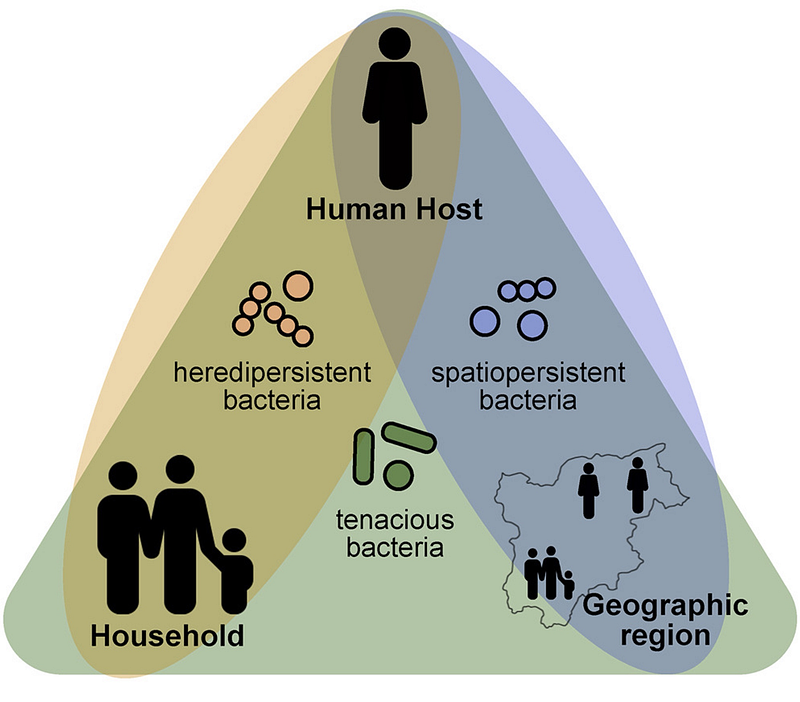
This figure I also used as the feature image for this article sums up their results quite nicely, so let’s have a closer look at it.
I personally love it when many complex ideas can be brought together to form a simple picture! 😄
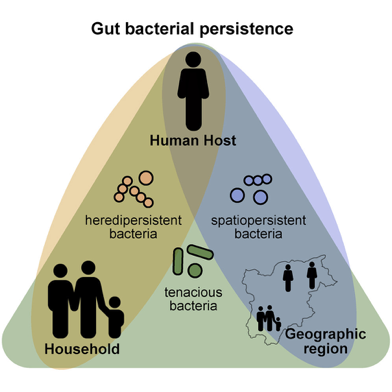
You have a general background in your microbiome of tenacious bacteria, shown in the figure as the light green triangle.
Then you have the human host at the top of the triangle whose microbiome is associated with two categories: household and geography.
The heredipersistent microbiome contains the bacteria found in a household cluster and is shown in the light tan ellipse on the left side.
The geographic or spatiopersistent microbiome bacteria are shown in the lavender ellipse on the right side.
Pretty simple, really.
Of course, there is a lot more data in the original paper, and they talk about evolution and all kinds of other stuff, but that’s for other scientists or bionerds to read.
So now you know a little bit more about all those trillions of tiny little guys that live in your guts.
Until next time,
Rich
Hey! If you enjoyed this article, you need to join my tribe and share it with your social media friends!
Sources for this article:
- Dispersal strategies shape persistence and evolution of human gut bacteria by F. Hildebrand et al., in Cell and Host and Microbe, June 2021.
- The Microbiome’s Evolution is Shaped by Dispersal Strategies in GEN, June 2021.