
How to Help Increase the Good Guys in Your Gut
4 simple things you can do to be healthier and prevent disease.
Every time I go into the kitchen looking for a quick snack, I always seem to come away with the same thing; some form of bread product.
It could be a slice of toast or crackers or a cookie but no matter what shape or form it takes, it’s bread!
Now in my defense, I make all my own bread so it’s pretty nutritious with a high whole wheat flour content and lots of good things in it like nuts and seeds and other good grains, but it’s still bread. Which is kinda limiting.
If you fall into similar habits, then this is your wake-up call.
We gotta stop doing that! But how?!
I don’t know about you, but I need a good reason to motivate me to change an ingrained habit like that.
Well, today I found one. It was in an article by Bolte, et. al., entitled “Long-term dietary patterns are associated with pro-inflammatory and anti-inflammatory features of the gut microbiome.”
What these scientists found is that the types of bacteria found in people’s gut microbiome seemed to correlate nicely with what they ate.
If you eat the “bad” foods, you get more of the bacteria that are associated with inflammation (not a good thing!). If you eat the “good” foods you get more of the bacteria that are anti-inflammatory and provide protection. They do this by “telling” your stomach to produce more mucus. That is a good thing!
Since I’m a science-minded kind of person, I like this kind of evidence. This is the kind of data that can push me through my resistance barriers and get me to make serious changes.
So let’s spend a little time learning about our gut microbiome and see what these scientists found out about how diet may affect the various bacteria that live there. Both the good and the bad guys.
Once we know the kinds of food that make more good guys and less bad guys we can devise strategies to increase the good foods in our diet. Pretty simple, eh?
Ok, let’s get to it!
The gut microbiome
I want to make sure everyone is on the same page here so let’s spend a couple of minutes refreshing ourselves on just what a gut microbiome is!
I’ll assume you all know where your gut is so let’s just focus on the microbiome part!
Identifying the organisms in a microbiome requires a slightly different kind of DNA sequencing than you’re probably used to.
Over the past few years, as DNA sequencing has become more efficient and economical, a method known as metagenomic sequencing has become increasingly more popular. How is that different from the usual sequencing methods?
Metagenomic sequencing
In plain old genomic sequencing, you get some cells all from the same organism, isolate the DNA, and sequence it to learn about that organism’s genes.
And that’s very useful. You can look for genetic mutations that might be causing a disease. Or get your DNA sequenced to look for relatives. Police investigations use DNA sequencing in forensics to help identify criminals. And lot’s more.
Metagenomic sequencing is a slightly different kettle of fish.
This is where you take a sample from someplace and sequence all the DNA in it to identify all the different genes present. You don’t know what organisms are there, yet. You just have a bunch of recorded stretches of DNA sequences.
Now you take those stretches of DNA sequence and use them to search databases containing all the genes known, so far, and what organisms they are found in. When you find matches between your stretches and what’s in the database, it follows that since that DNA was present in the sample you sequenced, so was that organism.
And the number of times you had that stretch of DNA come up in your sequence gives you an idea of the quantity of that species.
So let’s say you had 100 pieces of one organism’s gene A and only 5 pieces of another organism’s gene B. Then you could say you have 2 different species and that there were about 20 times more organism A in the sample than organism B.
How is metagenomic sequencing related to the microbiome?
Microbiomes
Oxford Languages defines a microbiome as “the combined genetic material of the microorganisms in a particular environment.” Which translates to all the microorganisms you find in a particular biological niche or biome.
Hence the word microbiome (micro- for the beasties and -biome for where they were found)
So you might take a soil sample, do metagenomic sequencing and see what bacteria, viruses, and fungi are present in that soil type. Then you would have a soil microbiome.
In this case, the niche we’re looking at is our human gut and the biome is all the microorganisms that live there.
You knew that lots of other microorganisms lived inside your gut, right?! Like. A. Lot.
So samples are taken from our gut and the DNA is isolated and metagenomically sequenced. The sequences are then used to search the databases to identify what organisms are in that person’s or population’s gut(s).
Got that?
Now that we know what microorganisms are present, we can lump them into good guys and bad guys.
Good Guys and Bad Guys
That’s what Bolte and colleagues did. In plain language, the title of their paper basically says, as far as the gut microbiome goes, you are what you eat.
Without going into excruciating experimental details here’s what they did.
They metagenomically sequenced gut samples of 1425 people from 4 populations; normal folks, people with irritable bowel diseases (Crohn’s disease or ulcerative colitis), and inflammatory bowel syndrome.
They also asked these people to fill out dietary questionnaires. With this information, they could classify the people within the 4 groups according to foods they ate. So they have three things they can compare; dietary composition, state of health, and gut microbiome.
What they found was “significant associations that replicate across patients with Crohn’s disease, ulcerative colitis, irritable bowel syndrome, and the general population, implying a potential for microbiome-targeted dietary strategies to alleviate and prevent intestinal inflammation.”
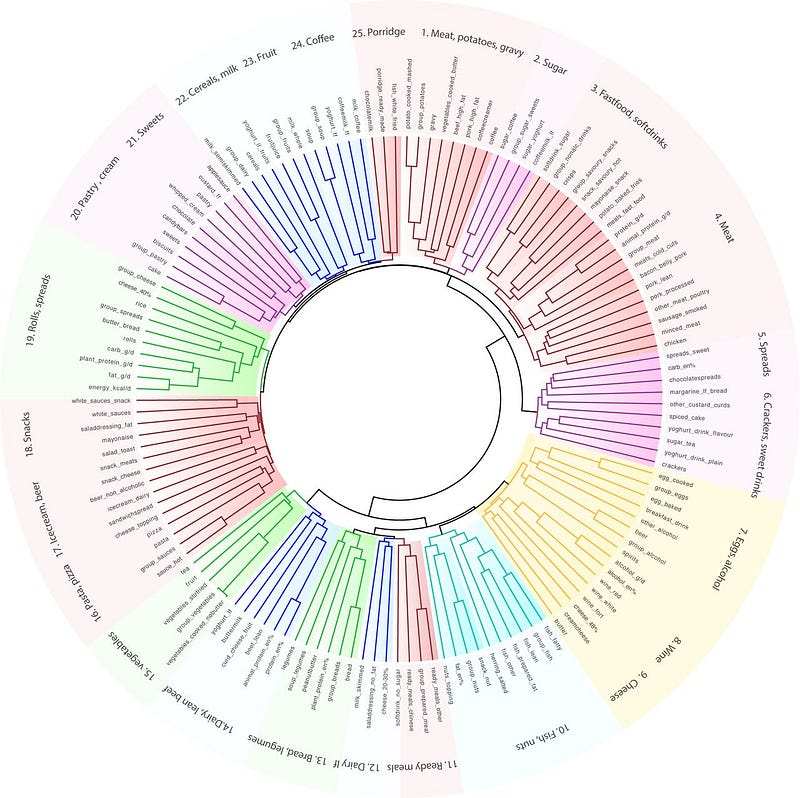
If you look at the feature image I posted above from their article, you can see that they found 25 different food groupings from the questionnaires. And there are lots of interesting details about the quantities of the various good and bad bacteria and their association with these groups.
Again, there is a fair amount of excruciating detail so I’ve created a little table here to help summarize their results. FYI, the pro-inflammatory bacteria are the bad guys.
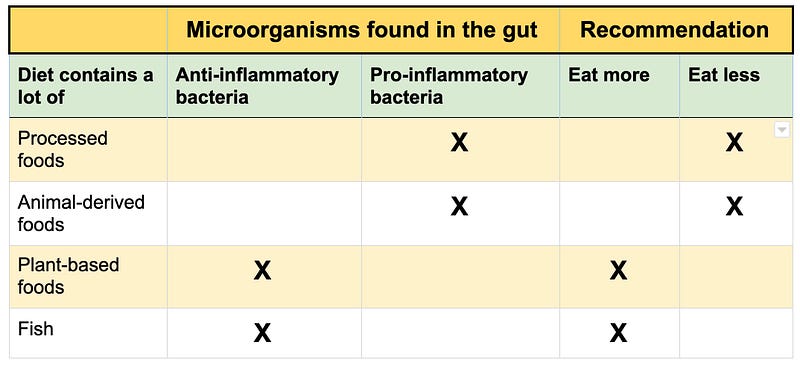
Ok, there’s nothing here we haven’t been told before by lots of other people. Eat less processed foods and meat and eat more plant-based foods and fish.
But now we have a more solid scientific basis for why to do that! Not just because it makes you feel better, which it does, or because it’s better for the environment, which it is, but because the evidence shows that it actually promotes the growth of microorganisms that provide beneficial effects.
significant associations … for microbiome-targeted dietary strategies to alleviate and prevent intestinal inflammation
This brings us to the 4 things you can do to promote a healthier gut microbiome and possibly prevent disease.
4 Strategies to increase the good guys
Eat less processed foods
Look, I know you know processed foods are bad so stop eating them.
If you simply must have some, enjoy them from time to time but put them in the category of treats, not major food groups.
Potato chips are not the same as baked potatoes!
Eat less meat and other animal products
We’re talking butter, eggs, dairy, meat, fatty foods like bacon, etc.
Notice I didn’t say stop eating meat (even though that’s what I did almost half a century ago!).
I said eat less.
If you eat meat, have it occasionally instead of every day. Especially if you have a family history of any of the bowel diseases the investigators looked at or heart disease.
Ok. Let’s face it. I’m not going to stop putting butter on my toast. But I can certainly reduce my intake of eggs and cheese. And since I don’t eat meat, that’s not a problem for me.
Eat more plant-based foods
We’re talking veggies, fruit, nuts, legumes, grains.
I already eat a fair amount of these foods. But I tend to leave out the nuts and legumes and like I said, eat a fair amount of grain-containing foods. So I’m going to reduce the grain food and increase the nuts and legumes. And fruit and veggies in salads and such.
Why are fruits and veggies so good for you?
One of the major benefits of eating this kind of food is they produce short-chain fatty acids, often referred to as SCFAs.
Well, it’s not the foods themselves that contain or produce the SCFAs. It’s the good guys in your microbiome that do that. The ones we want to encourage!
Here’s a great article telling you why SCFAs are so good for you!
A quote from the above article.
“They may reduce the risk of inflammatory diseases, type 2 diabetes, obesity, heart disease and other conditions.”
Again, there’s no one-size-fits-all here. For instance, I eat a mostly plant-based diet
Eat more fish
Ok, I love fish!
And I’m a pescavore (A word I made up years ago from the Spanish word for fish (Pesca); carnivores eat meat, pescavores eat fish).
I could probably eat fish almost every day.
But.
It’s not so easy to get fish that is caught in a sustainable way. Oh, the labeling on lots of fish products say caught local, not farmed, etc., but that doesn’t tell you how it was harvested. Or how many untargeted species were also caught that were killed and on and on.
So I try to be pretty careful about where my fish is coming from.
But again, not always. If I’m pressed for time and order take-out, I tend to not want to ask too many questions!
For the most part, I try to do the best I can in any given circumstance. But I’m human, I’m not perfect, and sometimes I just need to accept the necessary compromises that entail.
In conclusion
Don’t beat yourself up.
Just do the best you can with this and over time, see if you can’t improve little by little. For me, it keeps coming back to that Taoist saying; “A journey of a thousand miles begins with a single step”.
Take that first step and another and another and you're on your way.
Maybe this article will help you take that first step.
Because we all want to be healthier and live happier, energetic lives. And a few simple dietary alterations that lead to a better gut microbiome might help make that happen.
Until next time,
Rich
Did reading this post energize you? Want more? Subscribe to my newsletter and get a free, fun ebook!
Disclaimer: I’m not a medical doctor, dietician or have any kind of professional degree that qualifies me to give medical advice. You follow these dietary recommendations at your own risk.