
Greenland’s Shifting Baselines
Visualizing the climate crisis in black and white
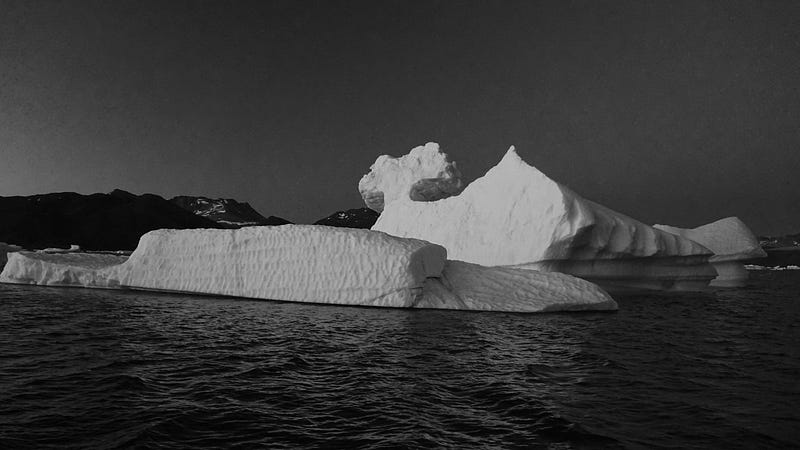
Shifting Baselines
In Greenland, faster-than-average warming translates to a loss of 286 gigatons of ice per year, on average. I will spare you the tired trope of converting that amount to the equivalent number of Olympic swimming pools or Empire State Buildings. Numbers that largely defy comprehension.
Meltwater runoff and rapidly retreating glaciers are changing Greenland’s coastlines. These, in turn, alter the marine and terrestrial ecosystems that support the local economy and society. While changes in far-off Greenland may not immediately register as a threat to most of us, melting glaciers contribute to sea level rise, which already affects residents in coastal cities like Miami. In other words, unlike Vegas, what happens in Greenland does not stay in Greenland.
If that’s not bad enough, the melting of the Greenland Ice Sheet cannot be reversed, even if the world somehow managed to curb greenhouse gas emissions. The accumulation of snow during the winter cannot keep pace with the melt.
At the same time, Greenland is, and will likely remain, exceptionally beautiful. As a result, taking photographs that demonstrate the impacts of climate change in Greenland proves challenging. Without fail, Greenland’s inherent natural beauty takes center stage, masking attempts to visualize the ravages of climate change. These challenges highlight the dangers of shifting baselines.
Each visual representation of Greenland impacts public perceptions of normality. Tourists, as well as first-time viewers of online content, may accept what they see as a baseline for future comparisons. The danger of shifting baselines, therefore, lies in the tendency to normalize an altered or damaged state, causing people to underestimate the extent of environmental damage over time.
Viewing Climate Change in Black and White
As a scientist and an amateur photographer I enjoy sharing my experiences on Medium. Several of my recent posts have focused on some aspect of my travels and research activities in Greenland and I can’t wait to go back. It’s an incredible place, with a lot to teach us. I’ve visited archaeological sites, surveyed coastal ecosystems, and explored pristine fjords, while also developing an unhealthy distrust of humanity.
Put simply, I do not want to contribute to the problems caused by shifting baselines. While considering the challenge of balancing my love for Greenland with my concern for its future I read Anne Bonfert’s November Challenge in Globetrotters. I found additional inspiration from Ronald Smit’s travel photos and Kathryn Scurci’s adventures in Greenland.
Converting one picture to monochrome sold me on the idea. I spent hours converting images and adjusting contrast curves. My first cut produced over 30 candidate images. After much deliberation, I settled on a set of images that were taken on a sailing expedition to southern Greenland in the summer of 2022.
Getting to Greenland — the hard way
I usually fly to Greenland. The pandemic, however, complicated non-essential travel, which included most scientific research. After travel restrictions resulted in cancelled trips in 2020 and 2021, I was desperate to return to Greenland. I started planning in early 2022, trying to protect my travel and research plans from restrictions imposed by governments and airlines.
With no way of predicting air travel COVID requirements six months in advance, I made the decision to sail to Greenland from Canada. From Newfoundland, the crossing to Qaqortoq, Greenland took about six days. The weather held for the first four days, but then our route intersected with the trajectory of a low pressure system. As an oceanographer, I knew that storms frequently churned up the Labrador Sea. But experiencing one first-hand in a small sailboat was another matter entirely.
On one hand, the strengthening winds allowed us to cut the engine, saving fuel by actually sailing. On the other hand, the storm’s trajectory and wind patterns made the ride especially violent. Our northward course, combined with the storm’s southeastward trajectory and counterclockwise rotation resulted in strong winds that sometimes launched us up large waves, much like a stunt rider jumping a ramp. The difference between a motorbike and a 13 m aluminum sailboat is a mere 13 tons. When all that weight crashed back down, the rapid deceleration sent any unsecured items flying, including people.
For the first time in my life, I had to make a plan to change my socks. First, I sat on the deck, wedged in between two bunks. Then, fighting the downward pull of gravity as the boat accelerated up the face of a 4 m wave, I quickly ripped off a soggy sock with one hand. I enjoyed the fraction of a second of weightlessness at the apex of the boat’s trajectory and braced myself for impact. If changing socks was challenging, using the toilet was nearly impossible.
And just like that, it was over. After battling the storm for almost two days, the roaring winds and raging seas faded almost as quickly as they began. Like a gaslighted lover, I began to question my recollection of the last 48 hours. Had we really survived a storm, or had I simply imagined it? While I mulled it over a fog bank rolled in. Sea and sky merged in a wall of impenetrable grayness. Visibility plunged to 1–2 boat lengths.
While my friends and I emerged the storm unscathed, the two-day beating dislodged the radar from the mast. Exhausted by the storm and enveloped in fog with no radar, we had no choice but to continue northwards to Greenland. We were frustratingly close to a safe harbor and a good night’s sleep. But the closer we got to shore, the more icebergs we encountered.
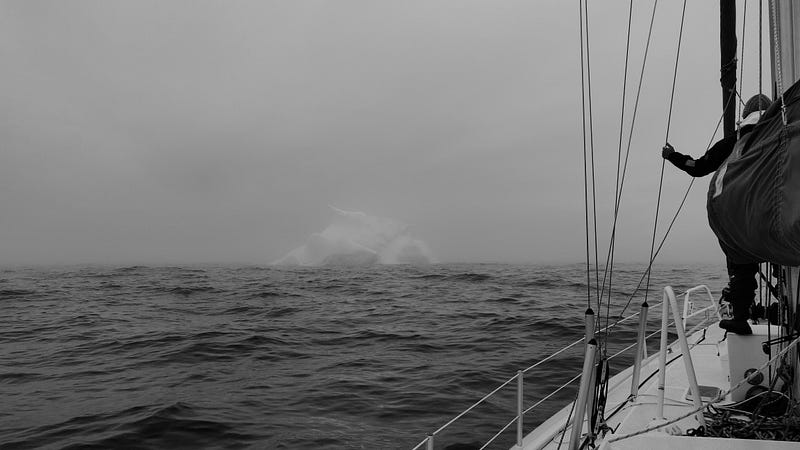
The first picture that I converted to black and white featured an iceberg almost concealed by the fog. As most photography courses will teach you, black-and-white images work best in high-contrast scenes. Many of Greenland’s landscapes, especially those that feature glaciers and/or icebergs, have naturally high contrast. That said, the high-contrast rule begs to be broken.
When sailing in ice-infested waters, low-contrast conditions pose a serious problem for navigation, not just photographic composition. I heard this iceberg before I saw it. Actually, I heard waves lapping against something. Alerted by this anomalous sound, I strained to get a visual. Catching a glimpse of what I thought was an iceberg, I turned to alert Giuseppesuaria, losing sight of it in the process. In my sleep-deprived state, I started to second-guess my brief sighting. We moved forward cautiously until the iceberg came into view. At the time, I took this picture to prove to myself that I wasn’t losing my mind.
In terms of artistic presentation, I assert that the black-and-white version of this photo better illustrates the dangers that we encountered that day. With the lack of contrast, the iceberg all but merges with the fog, lurking like a phantom.
Despite losing our radar and dodging icebergs in the fog, our Labrador Sea crossing had a happy ending. After a visit to the local watering hole in Qaqortoq and much-deserved sleep, we set off to climb some glaciers.
Blurred lines
Climbing onto glaciers presents a challenge. Getting up onto the glacier required much more hiking and climbing than this oceanographer anticipated. To save weight, I left my high-end DSLR behind. My humble Sony a6000, paired with an 18–200 m zoom lens, fit easily around my neck without impairing my movement.
The camera itself is fine, but the lens lacks sharpness. While the lack of sharpness may seem like a shortcoming at first, the slightly blurred features, especially when viewed in black and white, produce somber images that remind me of the film cameras that I used back in the 90s.
Facing my fears
I took most of my good pictures at sea level. Looking back, I know why. I am comfortable in boats of all sizes. The sea is my comfort zone. On the other hand, the glacier, with it’s seemingly bottomless crevasses and other-worldly groans and cracks, ignited a primal fear within me. Keep in mind that our icy adventures took place only days after a glacier collapsed in the Italian Alps, killing at least six climbers. While on the glacier, I spent more time not dying than I did thinking about photography.
Melancholy and the infinite sadness
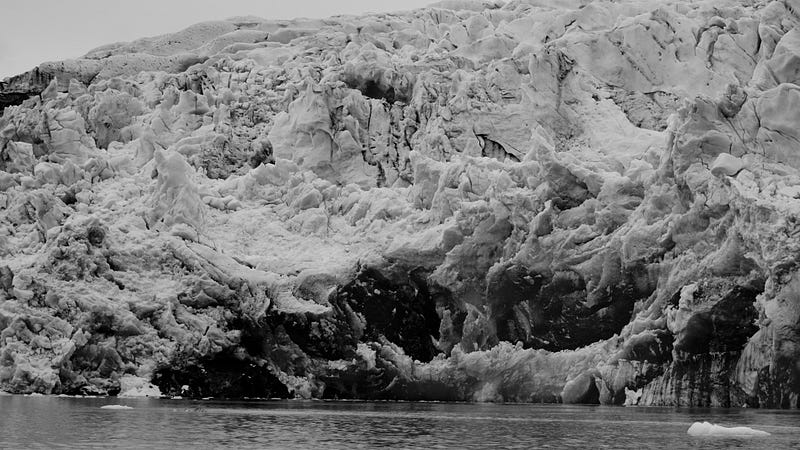
When considering the unstoppable momentum of climate change, stripping out the colors lends these photos a vague feeling of sorrow. Deep blues, like the sky and some glacial ice, appear black. Similarly, the golden hour’s long rays lose their luster. The lack of color and the resulting pervasive sense of sadness, help to convey the gravity of the climate crisis.
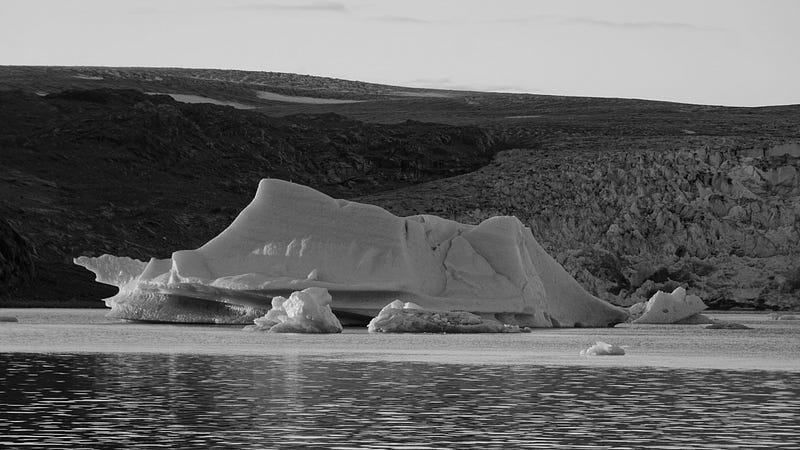
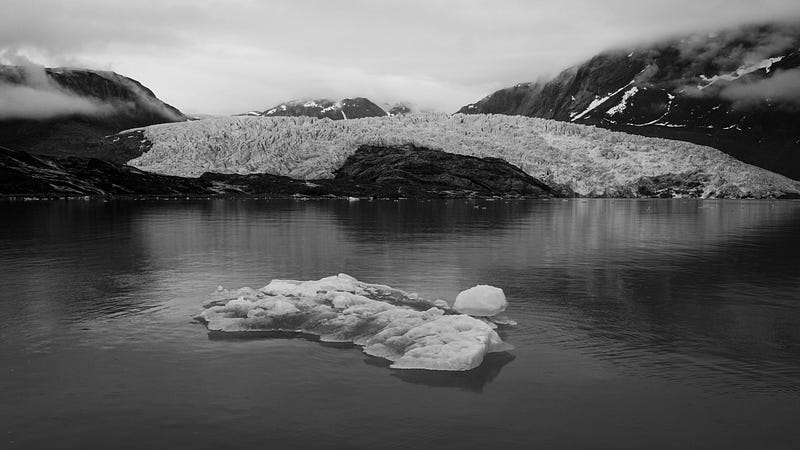
Enhanced contrast isn’t everything. Composition still matters. I took the photo below because I was struck by how small this once mighty glacier looked. When viewed in black and white, the image below captures the retreat of the glacier. The bright ice mass looks small when surrounded by dark bedrock. The same applies to the melting iceberg in the foreground. The dark water surrounding it emphasizes the iceberg’s fleeting existence.
Uncharted waters
In many fjords, navigational charts have not kept pace with retreating glaciers. New coastlines have emerged. Some were exposed so recently that they have yet to be colonized by plants. The lifeless rocky terrain looks alien and hostile. New areas of the fjord have opened up, creating eery coastal landscapes. Sailing into some fjords quite literally took us into uncharted waters.
On the final day of our trip, I reflected on my experiences. The small boat that ensured our survival was anchored in an uncharted part of the fjord. Our now-useless chart plotter showed us anchored approximately 3 km inland. We had to trust our instincts and each other. We had to work together and adapt to the situation, all while entrusting our survival to limited resources on a small ship in a vast ocean.
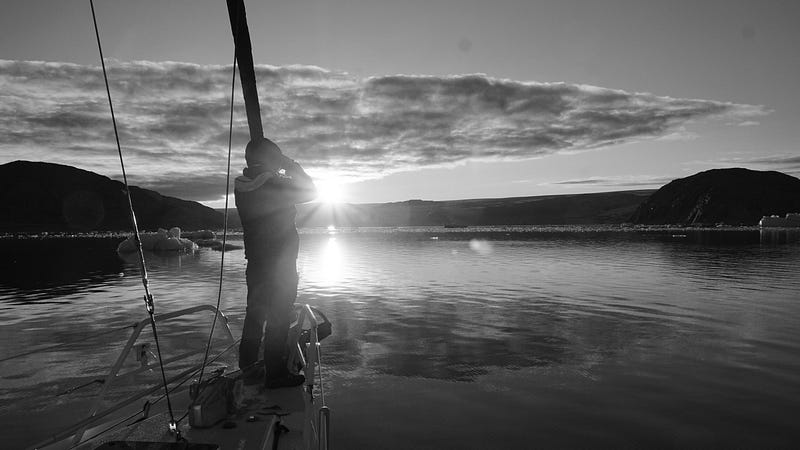
The symbolism is not lost on me. Planet Earth is a small ship sailing through a vast, indifferent universe. Our planet’s resources are limited. Some of us have shouted ourselves hoarse, warning of the massive icebergs and uncharted waters looming ahead. Let’s hope our warnings roust the captain from his drunken slumber in time to adjust course.


