
Sailing Away from Climate Anxiety
Why I prefer storms at sea over my fellow humans
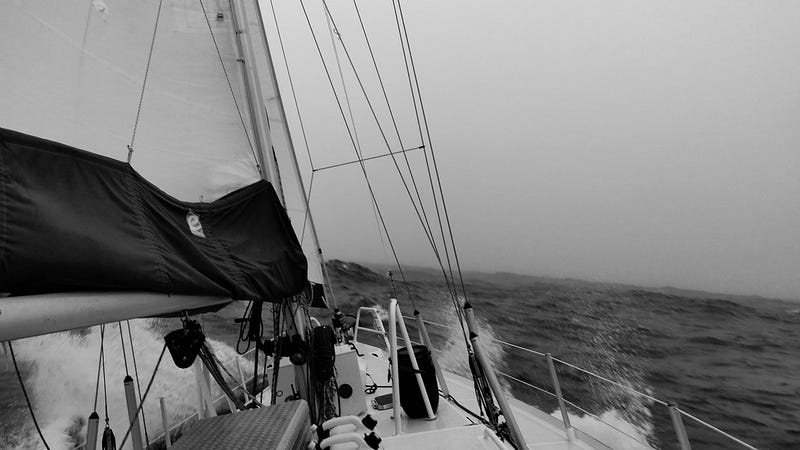
In my 25 years as a sailor I have witnessed the awesome power of storms at sea from vessels large and small. Spend enough time sailing and, one way or another, you will find yourself in a storm, struggling to survive each individual wave. You’ll find yourself thinking, as the boat heels over farther than ever before, “This is it. This is how it ends.”
Despite the storms and all the other risks, I get my best sleep when I am at sea, even on a small sailboat. Sailboats are loud. Halyards rattle against the mast. The rigging hums in a stiff breeze. Sails luff in a cat’s paw. The footsteps of my mates on the deck above my bunk echo through the hull. The water gurgles past the hull just outside my pillow. All these noises, and more, combine in a maritime symphony of sorts. But my sleeping brain quickly adapts to the cacophony, learning which sounds to ignore and which sounds require my full attention.
That said, I surprised myself when I somehow managed to sleep during a storm in the Labrador Sea. When viewed through the objective lens of risk management, sailing a 13 meter sailboat through 30+ knot winds and 4–5 meter waves in the icy waters of the North Atlantic appears more dangerous, or at least more worrisome, than domestic life. Objectively, I agree, at least to some extent. My fellow sailors and I certainly contended with severe risks during that storm. Had our efforts failed or had our luck simply run out, any one of those risks could have proved fatal. And yet, I was still able to nod off.
The decisions that we made as we weathered that storm had consequences that hardly ever arise during my terrestrial domestic activities. It might seem counterintuitive, but I sleep very poorly in my quiet, safe apartment in my quiet, safe community. Back on land, fear and anxiety attack my mental fortress as soon as I lay down and turn off the lights. Sleep comes fitfully, if at all.
How then, am I able to drift off to sleep on a sailboat that could easily vanish beneath the waves in a matter of minutes? After more than a bit of introspection, I think I finally know why.
I understand the ocean, both scientifically and spiritually. Though complicated, the motion of the ocean can be explained, or at least accurately approximated, through a set of mathematical equations. As a scientist, I know what kind of oceanic response to expect for a given set of external forces.
As a sailor, I trust my mates, who are not just experienced sailors but solid, dependable people. The fact that I surrendered to sleep while they took the watch during a storm should demonstrate the level of trust that I place in them.
In terms of risk management, the risks posed by the storm were known and could be named. We had trained for them and we were well-equipped to deal with them. There was a safety net in place in case we failed. We might have spent an uncomfortable day or two in a life raft, but help would have arrived at some point.
I cannot say the same for humans and their institutions. Human behavior cannot be explained or accurately estimated through a set of mathematical equations. While reactions to very specific external forces can be predicted, humans are emotional and irrational. Human nature, therefore, adeptly eludes attempts to comprehend and foresee its responses to external stressors.
Put simply, I do not trust my fellow humans any longer. I do not trust humans to take the actions necessary to address the climate crisis, income inequality, water/food shortages, or war, to name a few.
And these are just the threats to society that can be named in one short sitting at my computer. Unknown threats lurk menacingly in the fog, just out of sight. The ripple effect of the climate crisis or the combination of any of the known threats could create unknown problems for which we have not prepared. Add the unchecked proliferation of artificial intelligence and who knows what to expect or how to respond.
Our governments and institutions mirror our individual decline, thus offering little in the way of optimism for the future of our species. The increasing popularity of far-right politics and the systematic erosion of societal safety nets might shorten the fall to rock-bottom but they promise a much harder landing.
These stark realizations form the basis of my fear and anxiety. My time on land, immersed in the sea of humanity, brings these fears into focus. I cannot effectively mitigate the risks posed by humanity, nor can I ignore them. At the moment I pay the price in the quiet hours of the night. Soon I fear we will all pay a much higher price.
In a recent post, Richard Gingras explains this far more eloquently than I ever could. Richard attributes the ever-increasing divisive tendencies in today’s society to our tribal roots and the spread of opinions via the internet. Richard reminds us of our distorted view of risks, of the importance of words, and proffers hope through constructive journalism, empathy, and self-similarity.
I admire his optimism and I certainly don’t want to discourage his efforts. But seeking out information from constructive journalists, approaching divisive topics with empathy, and looking for similarities in others requires a level of self-awareness that few can achieve. I cannot blame anyone for failing to put in the effort, as most of us get lost in the churn.
I hope that I am wrong. I hope that you prove me wrong. But don’t blame me if I sail away.


