
Greedy for the Green: An American Political Ideal?
“Politics is not just a matter of parties; it’s a matter of philosophies.” — Unknown
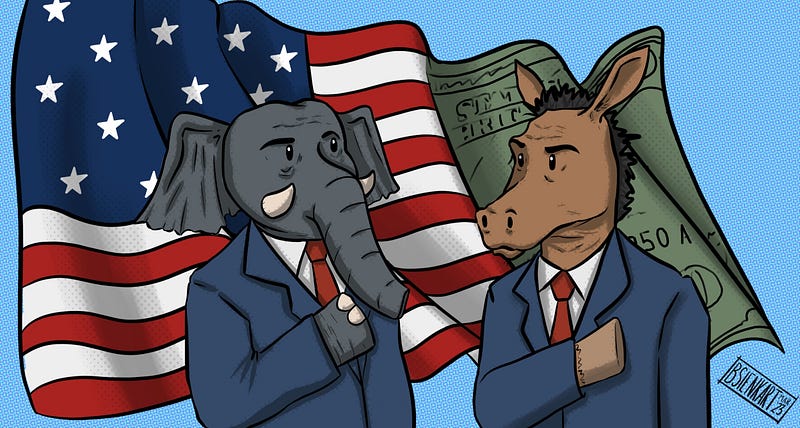
When it comes to understanding the political landscape of the United States, it’s crucial to have a working knowledge of the underlying principles and beliefs that drive the two main political parties. Democratic and Republican philosophies have evolved over time and will certainly continue to shape policy decisions that impact people’s lives for the foreseeable future. But as Rupert Murdoch stated in his recent deposition, “It is not red or blue, it is green”.¹ It’s difficult for a politician to represent constituents if he or she is neither Democratic nor Republican but merely greedy for the green.
Democratic philosophy is rooted in a commitment to social justice, equality and individual freedom. Democrats tend to believe in a strong social safety net, including programs like Medicaid, Medicare, and Social Security, as a support mechanism for people experiencing hard times. One of the less discussed Democratic ideas is advocacy for income and wealth redistribution, which some folks think can be achieved by progressive taxation, with the aim of reducing income inequality. A study by the World Bank found that more equal income distribution is associated with greater human development outcomes, including higher life expectancy, better education, and lower rates of poverty and crime.²
It appears that idea is impossible for some Republicans to wrap their heads around. I suspect the reason is that certain mindsets can not easily adjust to examining the root of a belief, and there are a number of folks on the right that feel that everyone should earn their own way in the world, and many of those folks seem to think that lesson is more important than their own well-being. These folks would rather punish a man for being poorer than they are rather than to give him a hand to be able to pull his own weight and some more.
A core tenet of Democratic philosophy is the need for income equality in a democratic society. Income inequality not only creates economic problems but also has adverse social effects like increased crime, reduced trust in government, and political instability. A more equal distribution of income leads to a more nearly stable society. Research by economist Richard Wilkinson and epidemiologist Kate Pickett has shown that more equal societies tend to have better health outcomes, higher social mobility, and lower rates of crime and violence.³ Almost sounds like a solution to things Republicans complain about all the time.
In contrast to Democratic philosophy, Republican philosophy is grounded in the principles of limited government, individual freedom and personal responsibility. At least they believe in these things when it is most convenient. They also support individual rights and personal freedom, such as the right to bear arms and a limited government’s interference in private affairs. Additionally, Republicans advocate for lower taxes and fewer regulations to stimulate economic growth and incentivize individual initiative. Republican philosophy is grounded in the idea that individuals should have the freedom to make their own decisions and that government should have a “minimal role” in people’s lives, except for zoning, traffic law, voting rights, books they do not approve of and everyone’s sex lives. I guess we could say that’s the company song at least.
In comparing the two political philosophies, perhaps the most noticeable difference is the role of government in society. While both Democrats and Republicans agree that government has a role in society, they differ in the extent to which they advocate for power. Democrats often believe in a more robust and active government, whereas Republicans advocate for a limited government role. For example, Democrats support government intervention in the economy, particularly in areas such as healthcare, education, COVID-19 relief and even national infrastructure. By contrast, Republicans favor less government intervention in these areas and believe that the private sector should handle most of these issues, but for a profit.
Another key difference between the two parties is their respective views on social issues. Generally, the Democratic Party is socially liberal, advocating for equal rights and supporting issues such as abortion rights, gun control and environmental protection. Republicans, on the other hand, are often socially conservative, opposing issues such as same-sex marriage, abortion rights, and gun control. While both parties say they want the same things, they differ in how they believe these goals should be achieved. Red-minded folks want everyone to be self-sufficient into their old age. Blue-minded folks want everyone to be able to be self-sufficient into their old age. Green-minded folks don’t care one way or the other, as long as they have everything they want right now.
Both Democratic and Republican philosophies have been subject to criticism from various quarters and for various reasons. Democratic philosophy has been criticized for being too reliant on government intervention which can lead to inefficient and ineffective policies, and for advocating for policies that erode individual freedom. Critics argue that overreliance on government programs can create a culture of dependency, where individuals become reliant on the government for assistance instead of learning how to be self-sufficient. Others criticize Democrats for seeking to promote equality at the expense of individual freedom, arguing that some policies may impede economic growth and punish those who work hard and innovate.
Republican philosophy has also faced criticisms. Critics argue that the Republican Party’s commitment to a limited government role ignores the inequalities and injustices that arise in a free market system. Republicans’ preference for minimal regulation and low taxes lead to situations where the wealthy and powerful get richer while the poor become poorer. It is precisely these kinds of situations which lead to social unrest, higher crime rates and distrust of authority. It seems as though the very things Republicans complain about are the things they insist on bringing about by favoring the color green over their claimed color red.
Understanding the philosophical differences between the Democratic and Republican Parties is crucial for anyone interested in politics or public policy. Both parties offer distinct perspectives on the role of government, the expression of individual freedom and the promotion of the common good. These perspectives about believed reality shape what we experience in life. There is no “right” way to approach these complex issues. Nor is there a “wrong” way. There are ways where the rich get richer and the poor get poorer and there are ways where both the rich and the poor live better lives.
There is one way which has proven to be disastrous throughout history. Those who belonged to the Green Party of Sr. Murdoch have failed as political leaders. The Green is a demanding mistress. It must be fed at all costs. No one can be faithful to hearth and home while they are in the service of The Green. Those who belong to The Green must sell their souls in order to pursue the prize without encumbrances. The Green path is a never ending downward spiral. Want an example? Look no further than a certain notorious resort in Florida. There’s a fellow who lives there who was once The President of the United States. He now champions the destruction of that country because he was neither Red nor Blue but lusted after the Green. Oh well.
References
1. ‘Not Red Or Blue, It Is Green’: Murdoch Admits Fox News Hosts Pushed False Election Fraud Claims. (2023, 02 28). Forbes. Retrieved March 14, 2023, from https://www.forbes.com/video/6321407519112/not-red-or-blue-it-is-green-murdoch-admits-fox-news-hosts-pushed-false-election-fraud-claims/?sh=54a7f7017e56
2. Publication: Conditional Cash Transfers : Reducing Present and Future Poverty. (n.d.). openknowledge.worldbank.org. Retrieved March 14, 2023, from https://openknowledge.worldbank.org/handle/10986/2597
3. Pickett, K., & Wilkinson, R. (n.d.). The Spirit Level. The Equality Trust. Retrieved March 14, 2023, from https://equalitytrust.org.uk/resources/the-spirit-level
Forging Agreement’s newest on-demand workshop is available on Teachable now. Learn more about the ideas that John introduces in his blogs in the Program Theory On-Demand Workshop!
One way to think about how your mind works is to consider it as a biocomputer. It has an operating system and different types of applications and programs that run when called, in similar fashion to a regular computer. The results of this workshop will give you new ways to consider your own beliefs, emotions, feelings and logical thoughts and how you can choose to modify them to meet your own requirements.
The workshop combines a series of on-demand videos with group discussions. Program Theory is taught by John Worthington and Paul Grenci. Contact @forgingagreement on Facebook or Instagram or email [email protected] for more information!
The most recent online Reality Creation Through the Dyad Workshop has just wrapped up. The Dyad workshop is an exploration into the relationship that exists between two people- any two people. A Dyadic relationship can be with a spouse, significant other, business partner, co-workers, family members, etc. These relationships can be wonderful and challenging all at the same time, but that is the beauty of relationships; traversing the good, the bad and everything in between.
In this interactive workshop, couples/individuals are afforded the opportunity to examine ever so common problems and tried and true solutions that guarantee an ongoing relationship if one is warranted.
This workshop will be happening on a monthly basis and runs over 2 weeks of 4 consecutive evenings. Contact @forgingagreement on Facebook or Instagram or email [email protected] for more information!
If you would like to support John, please consider subscribing to Medium using his referral link. Due to Medium not supporting mobile-based referrals, please use a desktop browser to sign-up. This ensures that a portion of your commission goes straight to John to support his work on this blog. You will get unlimited access to all of John’s blogs, plus unlimited access to thousands of other writers. Thank you!


