
How Relationships Support Democracy Through Extending Trust
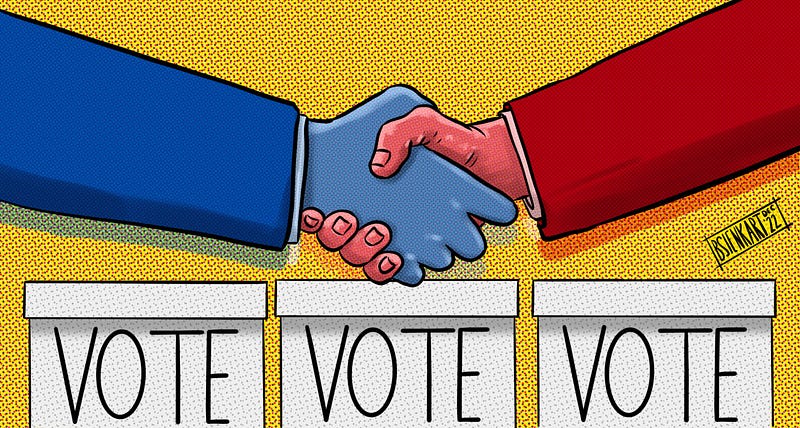
I ran across an interesting idea the other day. I was listening to this fellow talk about how he extends trust to see what people would do with it. It seems when he hires someone, he gives them something to do that requires that they demonstrate that he can trust them. I had to wonder what the poor guy was smoking. I mean, everyone knows that trust is earned. Not given away for nothing. Don’t they? But this guy kept on about how he wants to know if he can trust people or not. So he gives them trust up front before he has to trust them or before it costs too much. That idea nearly broke my head. But then I thought about how our political system works, and realized that is exactly what we do when we elect someone. We extend trust to that person to represent us. In theory, if that person fails to do the job that we collectively like, then we replace him with someone whom we have reason to consider as more trustworthy.
I think that concept was demonstrated perfectly well in the election that was just held. The majority of the political wind blew away from the MAGA crazy candidates. There were eddies of disinformation swirling about still but the general forecast of a red-tinged weather event turned out to be mostly fair. It just so happens that the majority of the candidates who were deemed to be fair were also Democrats. You see, we as a people gave the Leopard King our trust and as it turned out he really did not change his spots. He always was narcissistic and probably always will be. That’s not a horrible thing by itself, but a belief that allows one to be that proud of oneself sets oneself as being the only important person in the universe. We all know that can not be true but we often indulge in the feel goods of that emotion. If one were to wallow in that kind of unbalanced behavior it could be surmised that such a person should not be trusted with material such as classified documents. Perhaps that is a contributing factor as to why we prefer to see how a political hopeful does in the lower ranks of political responsibility. Before we want to extend trust to someone, we want to see demonstrated action of the variety of which the populace prefers at that time.
“One of the issues most often discussed by philosophers interested in trust is the weight and rationality of evidence justifying trust–that is, the evidence for the trusted person’s trustworthiness.” — Solomon and Flores¹, Building Trust: In Business, Politics, Relationships, and Life.
I suspect that the voting public subscribes to the idea of “Fool me once, it’s your fault. Fool me twice, it’s my fault.” To treat a known lie as a fact is not a behavior that we condone even in children. We condone it even less in grown adults. Behaviors such as claiming a lie as the truth does not build trust. Why grown adults would willingly go along with a misrepresentation of reality as though there were not dangers associated with such behavior is baffling to be sure. However, there could be some compelling reasons for certain people. I could understand why someone would feel it necessary to back his club. We all do that in sports but we also demand that our sports heroes comport themselves as appropriate to the esteem in which we hold them. For example, pretty much everyone can forgive Michael Jordan smoking a cigar. The man should be proud of what he has accomplished. But we also appreciate the man’s brutal honesty about his own failures which built his phenomenal successes. If only Marge, Jim or even Kevin could do as much. Sigh.
It was Abe Lincoln who said, “I am a firm believer in the people. If given the truth, they can be depended upon to meet any national crisis. The great point is to bring them the real facts.”² Wouldn’t that be a wonderful thing? Here’s where some of our politicians seem to have missed out on an important concept. To extend trust means that you are going into a relationship with a person. I don’t mean that you’re about to go to bed with them, but I do mean that you are about to form a relationship with that person. This is simply because to extend trust to anyone is to acknowledge that person as being more important to you than other people. However, when someone takes the position that they can and should be allowed to do things all by themselves, we all feel slighted somehow. It’s as though we all recognize refusal to participate in a democratic decision as a threat to our very survival. There is a strong argument to be made for this perceived threat preventing the vaunted red wave that failed to materialize in this last election.
We live in a world with a population of 8,000,000,000,000 people. It seems to me that to ignore any group of people’s problems is to ignore our own vulnerability. When I hear goofy folks say things like “I pledge to not support Ukraine,” I have to wonder what that kind of person is thinking with? Even a quasi-functioning AI could be reasonably expected to recognize a dangerous situation. Yet I hear people like that boy from Florida, Matt and the girl from Georgia, Marge and even that washed out wrestling coach from Ohio, Jimmy, speaking with an arrogance which should be rooted in something real and it isn’t. Most often their arrogance is rooted in an overvalued opinion of their own cleverness in conning people with asinine claims that anyone with any common sense knows is balderdash. (Balderdash is a technical term referring to piles of horse manure.)
The way people like that miscalculate the reason for extending trust leaves them forever frustrated although they tend to blame other folks for their frustrations. It isn’t the other folks though. It’s that they can not bring themselves to extend trust. These folks think that trust must be earned. That’s true, but it is also true that what that phrase means is that to keep trust we must earn that continued extension of trust. It appears to me that the only way we can do that is if we are in a relationship with the people we trust. It does no one any good to be in a relationship with only oneself.
I think we have two eyes which allows us to calculate distance through binary visual inputs. It’s difficult to construct three-dimensional imaging only on visual input. I think these are self-evident truths that in the context of the politiverse are easily ignored. Those who are overly narcissistic may very well miss the inherent dangers of the collective ire of those who self-govern through extending trust to volunteer leaders. From that perspective, I can at least understand the delight that the good old boys who support Marge must get a real kick out of the fairy tales she invents because they obviously don’t think she’s going to accomplish anything up in Washington that is going to make their life any better. But then no one up there ever does, so might as well get some enjoyment out of it all.
References
1. Flores, F., & Solomon, R. C. (2003). Building Trust: In Business, Politics, Relationships, and Life. Oxford University Press, USA.
2. A Biography: Abraham Lincoln — www.legacyproject.org. (n.d.). Legacy Project. Retrieved November 28, 2022, from https://legacyproject.org/activities/biolincoln.html
— — — — — — — — — — — — — — — — — — — — — — — — — — — — — —
Forging Agreement’s newest on-demand workshop is available on Teachable now. Learn more about the ideas that John introduces in his blogs in the Program Theory On-Demand Workshop!
One way to think about how your mind works is to consider it as a biocomputer. It has an operating system and different types of applications and programs that run when called, in similar fashion to a regular computer. The results of this workshop will give you new ways to consider your own beliefs, emotions, feelings and logical thoughts and how you can choose to modify them to meet your own requirements.
The workshop combines a series of on-demand videos with group discussions. Program Theory is taught by John Worthington and Paul Grenci. Contact @forgingagreement on Facebook or Instagram or email [email protected] for more information!
— — — — — — — — — — — — — — — — — — — — — — — — — — — — — —
The most recent online Reality Creation Through the Dyad Workshop has just wrapped up. The Dyad workshop is an exploration into the relationship that exists between two people- any two people. A Dyadic relationship can be with a spouse, significant other, business partner, co-workers, family members, etc. These relationships can be wonderful and challenging all at the same time, but that is the beauty of relationships; traversing the good, the bad and everything in between.
In this interactive workshop, couples/individuals are afforded the opportunity to examine ever so common problems and tried and true solutions that guarantee an ongoing relationship if one is warranted.
This workshop will be happening on a monthly basis and runs over 2 weeks of 4 consecutive evenings. Contact @forgingagreement on Facebook or Instagram or email [email protected] for more information!
— — — — — — — — — — — — — — — — — — — — — — — — — — — — — —
If you would like to support John, please consider subscribing to Medium using his referral link. Due to Medium not supporting mobile-based referrals, please use a desktop browser to sign-up. This ensures that a portion of your commission goes straight to John to support his work on this blog. You will get unlimited access to all of John’s blogs, plus unlimited access to thousands of other writers. Thank you!


