
Getting pleasure out of Pain(e)…and a new career as screenwriter and director

19. NancyO: Share a story about a day in the life of your dream job.
I make no literal or figurative bones about this (read to the very end for my explanation of bones): my dream job would be to write a screenplay on the life of Thomas Pain(e). And direct it.
Some of you who’ve read my other essays will know I spent a grueling five to six years writing a book on Thomas Paine’s Rights of Man. Y’all are wondering by now: ARE YOU A MASOCHIST?
No, I really do get a pleasure out of Pain(e). And I think others will too!
For those of you unfamiliar with American history–or have taken it so long ago that you’ve forgotten some of it, Thomas Paine was an Englishman who took to the American shores in November 1774 after being bankrupted and dumped by his second wife. He arrived with little more than a trunk and a letter of recommendation from Benjamin Franklin who praised him as an “ingenious worthy young man.” But he fired up the country in less than two years with his pamphlet, Common Sense, the first publication to openly advocate American independence.
You see, Paine’s life was one huge adventure, filled with fights, chases, several near deaths, and a bizarre afterlife. You could say he was the first Thomas who could!
He was born to a Quaker corsetmaker and his wife in 1737, whose name was originally spelled as “Pain.” Yanked out of school at the age of 13, he began an apprenticeship under his father. No doubt bored by sewing corsets all day and dreaming of the faraway places he learned about in his geography classes, he decided to run away to a recruiting privateer manned by a Captain Death. As he stood signing his name to the roster, however, Tom’s father arrived in the nick of time to prevent him from sailing away. Can you imagine this being played out on the screen–with a Captain Hook, er Death, standing in the background? It was a good thing Paine’s father did because the entire ship perished and Captain Death…died.
Then two years later, Pain(e) headed up to London to launch his own corset shop. But he was lured away on another privateer, albeit with happier consequences. With money jingling in his pockets, Pain(e) hung around London and sat in on a number of lectures by leading scientists. After making his way to Sandwich, he married a servant named Mary Lambert. The couple was so hard up that one night, they snuck away after they couldn’t pay their rent. Their marriage lasted only two years as Mary died in childbirth. (This could be a fully tragic scene which every film needs.)
After a few years, Pain(e) started a new job as an excise officer at Lewes. Here, he married again and became a leading figure at the Headstrong Club, where he won many debates. Because of his debating skills, he was asked to write a petition to Parliament to demand higher wages for excise officers. And so he took a leave of absence from his job to go to London, handing out copies of his pamphlet. In the meantime, the grocery which he co-owned with his wife foundered and the couple went bankrupt. That’s when she dumped him, requesting a separation (divorces were out of reach for the vast majority of people since they could only be granted by an Act of Parliament.) And that’s how he ended up sailing to America–even as he barely made it alive on the shores, taking six weeks to recover. Perhaps tired of all the pain he suffered, he added an “e” to his name.

After the publication of his best-selling Common Sense, the entire proceeds of which he donated to the Continental Army, Paine took up a musket and joined the Continental Army. The string of losses suffered by General (George) Washington’s army led Paine to write his American Crisis paper, one intended to rouse discouraged soldiers, many of who were fleeing like rats aboard a sinking ship. This is the paper that begins with the famous lines:
THESE are the times that try men’s souls: The summer soldier and the sunshine patriot will, in this crisis, shrink from the service of his country; but he that stands it now, deserves the love and thanks of man and woman. Tyranny, like hell, is not easily conquered; yet we have this consolation with us, that the harder the conflict, the more glorious the triumph.
To get this printed in Philly, Paine walked all the way from Trenton on a late December night so as not to be noticed by the Brits, who could easily charge him with treason. Wouldn’t this make a great scene in a film–Paine darting behind trees as horses gallop by?
A few years later, he was appointed as a secretary for the committee of foreign affairs. When he happened to notice some money laundering on the part of Silas Deane, he called it out. Deane’s henchmen were not slow in getting revenge on Paine as they tripped him and landed him under a gutter. Since film directors love fight scenes, they would no doubt relish this!
Paine was then sent to accompany the young Henry Laurens on a trip to Paris to request more arms from Louis XVI. It is said that as the ship was intercepted by a British privateer, Paine got into a swordfight. Another fight scene!
Fast forward a few years after the American victory in 1782 and Paine rewarded with a confiscated Loyalist property in New Rochelle, New York. Taking a rest from politics, he busied himself with the design of a single span iron bridge–one that would not fall apart as easily with the snow and ice. Since he could get little funding for the design here, his old pal Benjamin wrote him letters of introduction to various bigwigs in Paris.
As Paine ran into difficulties with the sponsorship of his bridge, he grew increasingly interested in the political turmoil percolating in France. The Fall of the Bastille on July 14, 1789, fascinated everyone–including Paine himself. So when his erstwhile friend, Edmund Burke, previously a supporter of the American revolution, criticized the French, with his Reflections on the Revolution in France, Paine leapt into the fray. His Rights of Man, a defense of the revolution, became an instant international bestseller. Here, Paine would criticize hereditary government (No kings! No aristos!), propose early forms of Social Security (because no one should work into their 70s and 80s), welfare, NATO and the UN. Pretty damn visionary when you think about it.

This is where things get interesting again. The popularity of Rights of Man, not surprisingly, alarmed the powers that be–namely, the aristocracy and landed gentry. They denounced the work, encouraging everyone to burn effigies of Paine up and down Britain, while plying them with food and punch. You might say they were the first astroturfers. Time for some rowdy peasant scenes!
Finally, the Prime Minister charged Paine with seditious libel, setting his trial for December. But not wanting Paine to become a martyr, he decided to have him hounded out of Britain. It is said that the poet William Blake warned Paine not to go home or he would be a “dead man.” So Paine decided to hightail it that night to France since he’d just been elected a member of their National Assembly. He was soon pursued by His Majesty’s authorities all the way to the coast where they confiscated his papers but let him go. As Paine boarded the ship to France, he was pelted with stones and called “a leveller” (the 18th-century equivalent for socialist and communist) by all those who had been brainwashed by the aristos and their government. Now, which director would let a midnight chase scene, stoning, and more rowdy peasants go to waste?
But revolutionary France under the control of Robespierre was not much better. A year later, Paine found himself in trouble as he urged the National Assembly to banish, not behead Louis XVI. Those who voted for the banishment of the king (to America) were outvoted by single vote–before falling prey to Robespierre who sent them to prison where they would await the guillotine.
What happened to Paine was nothing short of a miracle. Suffering from a coma and acute diarrhea, his roommates opened the door to his cell in an effort to air it out. Afterwards, a clerk made the rounds, placing an X in the doorway of all those who were to be guillotined the next day–including Paine. However, Paine was able to escape his fate just narrowly. When his roommates closed the door the previous night, the person rounding up the prisoner did not see the X because the clerk had placed it on the inside of the room rather than outside. Imagine the suspense!
Paine was eventually rescued from prison by the future president, James Monroe, then Ambassador to France. Some relatively peaceful years would pass as Paine finished off his Age of Reason, a deist manifesto and Agrarian Justice.
However, Age of Reason would destroy whatever reputation Paine had as the Second Awakening blossomed. Old friends such as Benjamin Rush (who encouraged him to write Common Sense) and Sam Adams deserted him. Even Thomas Jefferson, who arranged for Paine’s return to the US, kept his distance despite his apparent cordiality.
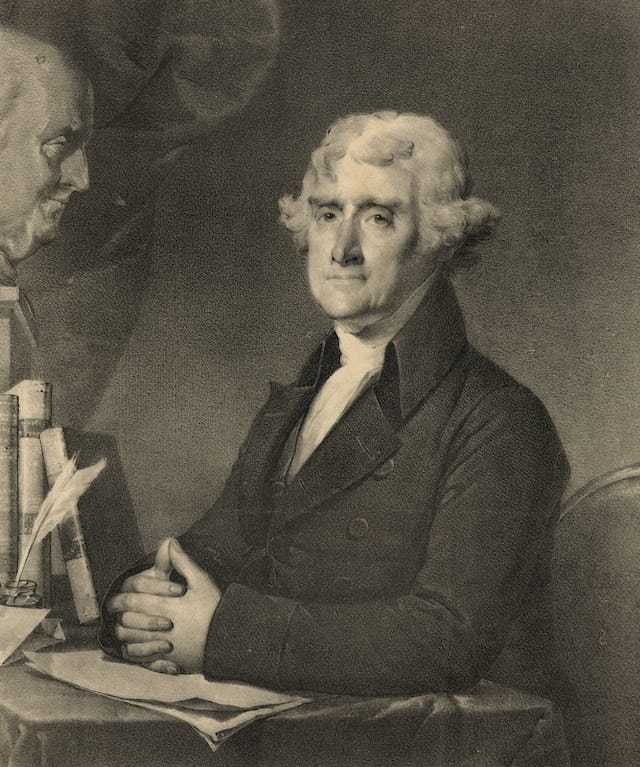
Away from Jefferson, Paine was spat at and pelted with stones–once more. One carriage driver refused to drive him because he didn’t want to “burn in hell.” In New Rochelle, Paine was denied the right to vote as the judges insisted he was not an American citizen even though he was nationalized. When he died on June 8, 1809, his funeral was attended by six people–two Black youths and four of his closest friends: a very different affair from the lavish funerals of Franklin, Adams, and Jefferson, which gathered thousands.
Then ten years later, Paine’s bones were dug up by a former enemy turned admirer, William Cobbett. Cobbett wanted them reinterred in England since the Americans clearly didn’t appreciate him.
This is a film waiting to be made — and I want to do it (never mind that others have tried and failed!) Paine was not only a great revolutionary and visionary who also supported the abolition of slavery, but he put his money where his mouth was — and for that, he suffered. He was a true Modern Prometheus– and one who deserves a full, cinematic treatment.
©️Frances A. Chiu, August 19, 2023. All rights reserved.