
Remembering Thomas Paine on the Fourth of July
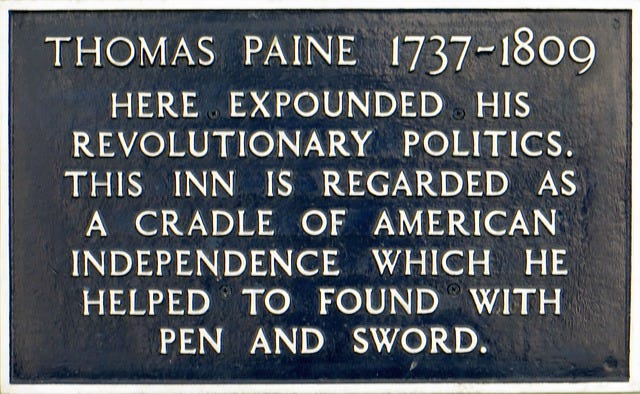
When we celebrate the 4th of July, we tend to think of that famous painting of the founding fathers signing the Declaration of Independence, with John Adams and Thomas Jefferson standing at the forefront.
But one man is conspicuously absent – the English-born Thomas Paine. The man whose bestselling pamphlet Common Sense, published on January 10, 1776, galvanized the nation into declaring independence nearly six months later.
An apparent failure and bankrupt who had been sacked by the British excise and subsequently dumped by his second wife, a desperate Paine made his way to the American shores in November 1774 with not much more than a letter of recommendation from Benjamin Franklin praising him as an “ingenious worthy young man.”
Upon his arrival in Philadelphia, Paine knew little about his new country, but was immediately revolted by the existence of slavery. (See my recent article, Thomas Paine and the Juneteenth on this subject.) As an editor for the Pennsylvania Magazine – one for which he attracted many subscribers despite his lack of formal education – Paine was quickly drawn into the brewing debate on American independence.
I say “brewing” because the idea of independence was not quite a debate in the colonies even though its prospects had been broached in England by a few radically-inclined men like Major John Cartwright who claimed in his Letters on American independence (1774) that it required no more than “common sense and common honesty” to know that no one had a right to take anything from another “without his consent.” (In Britain, the phrase “common sense” was already a phrase used by many to push back against perceived elitism.) Here too, he mentioned the “inherent and unalienable rights” of the colonists and their “rights of independency.” (Emphasis mine.)
In certain respects, Cartwright may even have ventured beyond Thomas Jefferson whose Summary View of the Rights of British America – also published in 1774 – avows “It is neither our wish, nor our interest, to separate from her [Britain]. We are willing, on our part, to sacrifice every thing which reason can ask to the restoration of that tranquillity for which all must wish.” Summary View, it’s worth bearing in mind, was one of the most daring American publications in its criticism of George III.
At this point, we may wonder if Thomas Paine had read Cartwright’s Letters or Jefferson’s Summary View– to which the answer is we may never know since he made no reference to them.
But whatever the case, there is also no denying that Paine went considerably beyond both men. For one thing, Cartwright proposed a federation by which the colonies would legislate for themselves but still belong to Britain in much the same way that Scotland did. Paine, on the other hand, desired complete independence.
Paine also firmly rejected hereditary government while proposing a republican one – an argument that had not been raised since the English Civil war of the 1640s. He would argue that because all men were “originally equal,” no one had the “right to set up his own family in perpetual preference to all others for ever.” Besides, kings do nothing but “declare war and give away places.” (Hmmm…wonder what Paine would make of our constant wars and military spending?) In no uncertain terms did he cast doubt on the seeming benevolence of the king whom colonists still overwhelmingly admired. Check out Paine’s use of italics and caps:
And in order to show that reconciliation now is a dangerous doctrine, I affirm, that it would be policy in the King at this time to repeal the acts, for the sake of reinstating himself in the government of the provinces; In order that HE MAY ACCOMPLISH BY CRAFT AND SUBTLETY, IN THE LONG RUN, WHAT HE CANNOT DO BY FORCE AND VIOLENCE IN THE SHORT ONE.
Only Paine had the boldness to write this unabashed condemnation of the king – even if Common Sense was initially published anonymously.
He would certainly venture beyond the vast majority of American pamphleteers too. Instead of rehashing the acts passed by Parliament that outraged many – the Stamp Act, the Townshend Acts, and the Intolerable Acts – he went for the jugular by criticizing the brutalities perpetrated by the British with a series of questions.

But if you say, you can still pass the violations over, then I ask, hath your house been burnt? Hath your property been destroyed before your face? Are your wife and children destitute of a bed to lie on, or bread to live on? Have you lost a parent or a child by their hands, and yourself the ruined and wretched survivor? If you have not, then are you not a judge of those who have.
Anyone who can forgive the British is “cowardly” and “unworthy the name of husband, father, friend, or lover” Indeed, he vindicates American rage by explaining that “The Almighty hath implanted in us these unextinguishable feelings for good and wise purposes” and such outrage “distinguishes us from the herd of common animals.” In other words, we have the right to be angry and to do something about it! Paine himself would join the Pennsylvania Associators (General Roberdeau’s “Flying Camp”) a volunteer regiment for a few months, leaving only to publish his first American Crisis paper in late December 1776 in order to rally the suffering troops.
Moreover, Paine would deny the common perception that America was chiefly British. This is perhaps the first inkling we get of the idea of the “melting pot” —even if confined to Europe. After all, since no more than a third of inhabitants “are of English descent,” the term “of parent or mother country applied to Britain only” was “false” and “selfish.” Instead, “Europe, and not England, is the parent country of America.”
But perhaps even more interesting in the midst of the discussions of justice and inclusiveness is Paine’s handling of the subject of slaves and “Indians” (the term that was used then). He blamed the British for using their “barbarous and hellish power” to stir up the “Indians and the Negroes to destroy us.” More specifically, he observed that by using them, the British are “dealing brutally by us, and treacherously by them” (30). Note that unlike Jefferson in the Declaration of Independence, Paine implies that the “Indians” and “Negroes” are victims of Britain too.
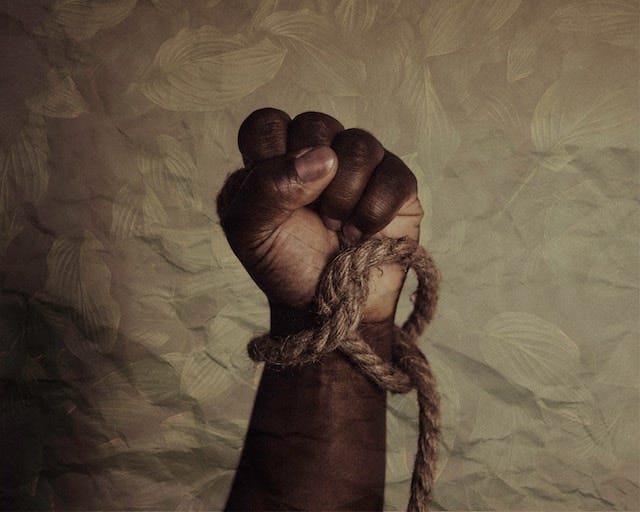
In fact, this idea of double dealing with African slaves and “Indians” would be further reinforced by Paine in his American Crisis papers where he equally condemned the cruelties of British colonialism across the globe to India and the Caribbean. In Crisis 2, he lashes out at the British for having “the means of civilizing” the East and West, but doing little more than “rip up the bowels of whole countries for what she could get.” Like Alexander the Great, Britain “has made war her sport, and inflicted misery for prodigality’s sake” for spilling the blood of India and creating wretchedness in Africa, not to mention enacting more “national cruelties by her butcherly destruction of the Caribbs of St. Vincent’s.” The issue of slavery returns in Crisis 3, where Paine comments caustically on Britain for “fill[ing] India with carnage and famine, Africa with slavery, and tamper[ing] with Indians and negroes to cut the throats of the freemen of America.”
Not least compelling is Paine’s easy, accessible style. Consider the sublime simplicity of the following passage, one of Paine’s most famous:
The Sun never shined on a cause of greater worth.’Tis not the affair of a City, a County, a Province, or a Kingdom; but of a Continent – of at least one eighth part of the habitable Globe.’Tis not the concern of a day, a year, or an age; posterity are virtually involved in the contest, and will be more or less affected even to the end of time, by the proceedings now. Now is the seed-time of Continental union, faith and honour. (17)
The two near-parallel sentences beginning with “’Tis” create an impression of a grand new nation in the making rather than a mere assortment of random colonies as “city” stretches out to “continent” and “day” to “age.”
Paine’s Common Sense and Crisis papers were beyond a doubt some of the most powerful writings of the revolution. Even today, scholars are still debating the extent of Paine’s role in drafting the Declaration of Independence, a project that is presently undertaken by some at the Thomas Paine National Historical Association. As Connecticut patriot Joel Barlow (not John Adams) put it, “Without the Pen of Paine, the sword of Washington would have been in vain.” Nor did Paine stop there. Fifteen years later, he would defend the French Revolution in his Rights of Man (1791–2) where he also advocated progressive taxation in addition to unions, and early archetypes of nationalized welfare, Social Security, and NATO.

So on this day, as we light the fireworks, let’s not forget the man who not only helped us declare independence but gave hints of a more just and inclusive world in his later works. To use the words of Harvey Kaye, Paine was indeed the promise of America – and as I like to say, our modern Prometheus: the man who brought the fires of revolution to the people.
Happy Fourth of July!
© Frances A. Chiu, July 4, 2023
Recommended readings:
Frances Chiu, The Routledge Guidebook to Paine’s Rights of Man (2020) (See for a more extensive treatment on Paine, Cartwright, and Common Sense.)
Harvey Kaye, Thomas Paine and the Promise of America (2005)
John Keane, Tom Paine: A Political Life (1995)
(Select) Thomas Paine organizations:
Thomas Paine Friends (Amherst, MA)
Thomas Paine National Historical Association (New Rochelle, NY)
Thomas Paine Society (Pasadena, CA)


