
JIGSAW GENS
G.I.-Gens — A Legacy of Frugality & Patriotism
The Greatest Generation (“Great Goldens” or “GI-Gens”) kept hope alive while setting their sights on new horizons
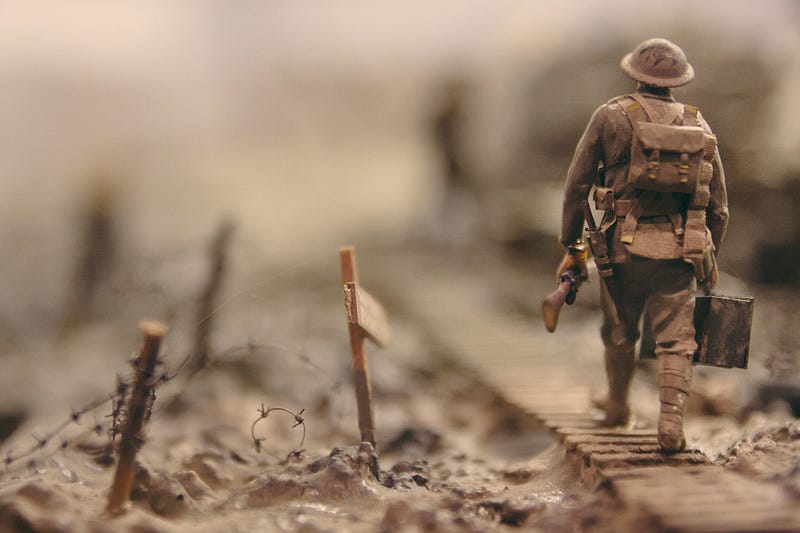
As part of an effort to combat ageism and foster intergenerational compassion, I’ve launched my “Jigsaw Gens” project. In this Medium anthology series, I’ll explore the histories and characteristics associated with each of America’s named generations.
My first installment focused on the “Hemingrebels” (aka “the Lost Generation”). These were the young adults of the Roaring Twenties who’d been born approximately from the mid-1880s up through the first couple of years of the Twentieth Century.
Next up: the “GI-Gens” (aka “the Greatest Generation”).
Who They Are
GI-Gens were born approximately between 1907 to 1924 — give or take a few years on either end. Their moniker of the “Greatest Generation” is widely attributed to journalist Tom Brokaw, who featured dozens of this generation’s members in his 1998 book.
I’ve coined the term “GI-Gen” for them since they can be alternately known as “the G.I. Generation” due to their wartime existence. However, “the G.I. Generation” is really a bit of a mouthful.
Other nicknames for GI-Gens could include: Great Goldens, due to how so many entertainers from this “Greatest” generation ending up transforming American culture throughout the “Golden Era” of Hollywood; FrugalJewels, since WWII-era rationing taught them to be frugal, but they still managed to shine through with noble accomplishments in the face of such scarcity; Centenarians, because their oldest members reached the age of 100 during the first two decades of the Twenty-First Century; SwingGens, seeing how they are often called “the Swing Generation” in light of their affinity for jazz music and swing dancing; or Good Warriors, in reference to how they carried on America’s military legacy that had already been paved by their parents and grandparents during World War I.
The GI-Gens would be the generation that currently has the fewest living members still on Earth, as of the date of this writing (June 2023).
What They Went Through
Writing for Learn in Color, Samantha Shank provides historical context for why the GI-Gens are known for their frugality. World War II forced them to ration food and materials. Therefore, they were trained to stretch out maximum usage of every item they could. Products were repurposed for creative uses. Clothes were patched up and handed down, rather than discarded in favor of brand-new wardrobes.
A majority of the GI-Gens were eligible to be drafted. If ineligible for military conscription, they’d be called into domestic support roles to compensate for the men sent into overseas battles. This constant pressure led to a host of daily innovations: Victory Gardens, carpooling, sharing literature with neighbors, and designing meals from leftovers.
If these Great Goldens seemed cantankerous even as they emerged into the second half of the Twentieth Century, it was because they feared another national crisis of that same magnitude arising. This was probably, at least in part, what fueled GI-Gens’ fears over McCarthyism and a “domino effect” of the Cold War.
To them, the surge of American materialism throughout the 1970s and beyond must have appeared mind-boggling. GI-Gens were terrified that our nation would repeat the mistakes of the Roaring Twenties, and they wanted to steer us away from such a trajectory.
How They’re Misunderstood
It makes sense that so many GI-Gens were humble yet confident. Their adolescence was marred by economic devastation, culminating in the Great Depression. During these hard times, the Great Goldens demanded accountability and personal responsibility from each other — and from themselves. Is it any wonder so many of them were irate when Richard Nixon and his cronies tried to dodge accountability for their roles in Watergate?
WWII-era spouses feared they would never see their husband or wife again due to the horrors of warfare. This is a major factor as to why so many of them who’d survived continued to place an outsized value on the sanctity of marriage throughout the rest of their lives.
Given how intensely they were forced to scrimp and conserve resources, their rejection of younger generations’ subsequent materialism seems understandable. GI-Gens could be frequently skeptical of the welfare state. If Americans were going to receive federal aid, this generation wanted those who succeeded them to value hard work and gratitude.
As America moved out of World War II, it confronted McCarthyism, the Cold War, and the 1960s counterculture movements. Across these decades, GI-Gens became parents, grandparents, and even great-grandparents. Things changed rapidly, and they undoubtedly felt they were losing control of the ability to protect their progeny.
Why They Matter
In his 1998 book The Greatest Generation, journalist Tom Brokaw explores how GI-Gens navigated the trauma of global bloodshed. The Great Depression and WWII were national emergencies that impelled these young adults to become self-made entrepreneurs and reject handouts.
Whether they were soldiers, frontline workers, or domestic familiars — Americans born during the 1910s and early-1920s shared a nexus of patriotism. Everyone had a common enemy in the Axis Nations. Each citizen wanted to do his or her part to steer the country back from the brink of destruction.
Their values included faith, loyalty, stoicism, obedience, affection, and integrity. GI-Gens finessed this realm of camaraderie in the name of helping as many of their fellow Americans’ families come out safely on the other side of raw misery.
Rigors of war and the necessity of collaboration drove the GI-Gens to push forward some major strides in equality. Many of those who would become lawmakers in the upcoming decades put that clarity into action when rallying for civil rights.
Others of their generation, however, resisted such progress based on a fear that ushering in the unknown might propel America backwards into the darker times that had existed prior to the Allied victory.
Those fears undoubtedly played a role in many Great Goldens’ hostility toward hippies and adjacent “whippersnappers” across the 1960s and 1970s. There were, of course, more tolerant members of the Greatest Generation — but those individuals would usually show greater appreciation to the Traditionalists, Baby Boomers, GenXers, Millennials, and Zoomers who built on the GI-Gens’ own talent for creativity and improvisation.
GI-Gens placed family and love of country at the center of their universe. Whether their interactions with future generations proved to be nurturing or misguided — they were normally based on a desire to help their protégés avoid mistakes made by power players from the Nineteenth Century.
Microgenerations represent the cusps of grey area straddling two larger generational cohorts. The youngest Hemingrebels and the oldest GI-Gens form the “Frugal Gatsbians” (born approximately between 1902 to 1906). They fuse together the Lost Generation’s appreciation for finery with the Greatest Generation’s penchant for scrimping-and-saving.
Frugal Gatsbians feature an array of American icons represented by the likes of Joan Crawford, Bob Hope, Satchel Page, Helen Wills Moody, and Clare Booth Luce.
On the flip side, “Golden-Builders” (born approximately between 1925 to 1929) land on a cusp that oscillated between patriotic pride and forward-thinking pragmatism. They combine the fighting spirit of the Great Goldens with the infrastructural focus of the Traditionalists (aka “Builders,” in Australian jargon).
Golden-Builders boast titans and moguls such as Andy Warhol, Shirley Temple, Marilyn Monroe, Sidney Poitier, and Cesar Chavez.
Perhaps the most famous GI-Gens serving as emblems of the Greatest Generation were Ronald Reagan, John F. Kennedy, Rosa Parks, Jackie Robinson, and Lucille Ball.
But this generation spawned a plethora of additional legends — especially with so many of them gracing the big screen and small screen as Hollywood gave them copious new opportunities to showcase their talent as entertainers.
A list of historical figures who belonged to the Great Golden generation:
Click here to subscribe to my stories.


