
Book Review — Last Call at the Hotel Imperial by Deborah Cohen
Deborah Cohen chronicles a massive treasure trove following historical journeys of Hemingrebels (“the Lost Generation”) across the first half of the Twentieth Century
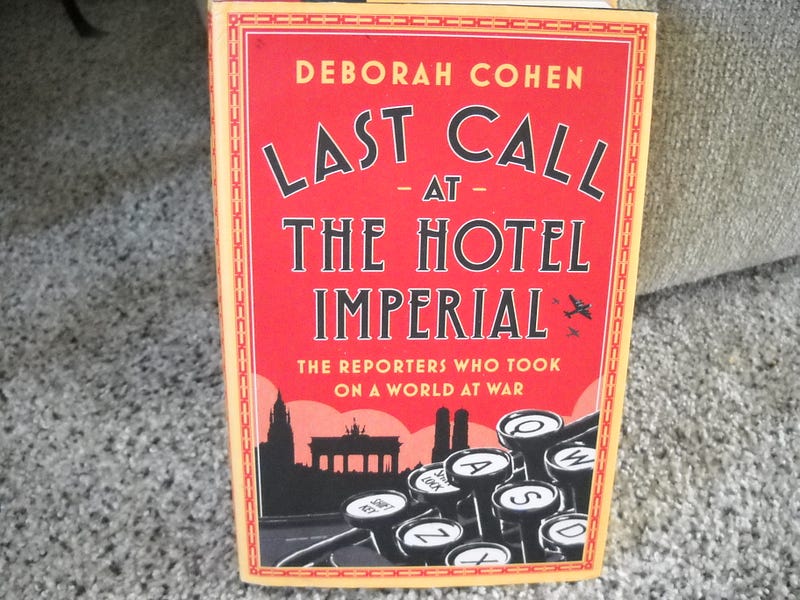
As somebody who values intergenerational solidarity, I love reading about how Americans with adjacent birthyears would approach life in different ways. Along with my desire to learn more about members of “the Lost Generation” — whom I have dubbed as “Hemingrebels” — this read ended up giving me greater context for global history as a whole.
That’s why I have zero regrets about spending so much time and energy absorbing the content of Last Call at the Hotel Imperial: The Reporters Who Took on a World at War, which was published in 2022 by historian and humanities professor Deborah Anne Cohen.
It’s a hefty read. But by humanizing its historical subjects, Cohen puts in perspective major world events of the past century. She brilliantly illustrates how the Hemingrebel cohort pioneered a generational shift that would reverberate long after the midpoint of the Twentieth Century had passed.
WHY YOU SHOULD READ THIS BOOK
I would only recommend this mammoth compendium for readers who absolutely love history — whether it’s reading about American history or world history. Cohen focuses on a quintet of global journalists known as “the inner circle.” This core group consists of John Gunther, Frances Fineman Gunther, Hubert Renfro Knickerbocker (“Knick”), James Vincent Sheean (“Jimmy”), and Dorothy Thompson.
Although all five of them are White, what their group lacks in racial diversity it makes up for in philosophical, ideological, and socioeconomic (during their respective childhoods) diversity.
The work of these five rabble-rousers sets the stage for an entirely new era of journalistic transparency and candor as both World Wars alter America’s destiny forever. Joining “the inner circle” are their close peers and companions, known as “the outer circle” — they include feminist Emily Hahn (“Mickey”), foreign affairs correspondent William Shirer (“Bill”), Indian Prime Minister Jawaharlal Nehru, Hungarian journalist Marcel Fodor, British music critic Edward Sackville-West, British diplomat Harold Nicolson, and British author Rebecca West.
STYLE / FORMAT
Cohen’s gargantuan tome is 424 pages long — not including its bibliographical archive. The book is divided into four main sections, each containing 3–5 chapters. Sandwiching this heft are a Prologue and an Epilogue, followed up by acknowledgments and citations.
Prologue — the author thrusts us straight into the main characters’ occupational peril, as John and Knick are trailed by Nazi operatives while covering the leadup to America’s involvement with World War II. Very early-on, they have pegged Hitler and Mussolini as tyrants who shouldn’t be underestimated. John was an isolationist, whereas Knick was anti-Hitler.
When including the other three members of their core: Frances was anti-British, Jimmy was anti-Chamberlain, and Dorothy was anti-Nazi. Their differing outlooks on U.S. foreign policy allowed these friends to have spirited debates while still sharing a common devotion to integrity and truth.
Chapter One — entitled “Why Not Go?,” Cohen summarizes John’s early life as a kid entranced by Europe and raised to be cultured and intellectual. At the University of Chicago, he rejected fraternity life and became “a barbarian.” John’s declared major in Literature led him to pen his own journalistic column at the university. By contrast, Jimmy was an unimpressive rural boy who didn’t take college seriously; he only stayed in journalism due to how skillfully he thrived at relating to his subjects.
Frances, in contrast to both John and Jimmy, was from an urban broken home. In college, she became a socialist and an antiwar activist. Expelled from multiple universities due to her tenacity and unwillingness to succumb to conventions, Frances eventually returned to Barnard College (her original school of enrollment) to graduate from her studies.
Chapter Two — entitled “Over There,” the author recounts how Frances and Dorothy met when they each were in Moscow covering the Bolshevist Revolution. Dorothy had become a suffragist and atheist at Syracuse University, and she was drawn to Eastern Europe out of her desire to report on the fall of the Habsburg empire. Frances was inspired by Dorothy, who never hesitated to compete with male journalists for the most substantive stories. Meanwhile, John began his long-running romance with Rebecca West.
Chapter Three — entitled “If One Wielded the Lash,” Cohen explores the romance between John and Frances that would ultimately lead to their tenuous marriage. Frances was an egalitarian “difference feminist” whose young adult abortion caused a temporary rift between her and John. The latter began to fraternize with Emily Hahn (aka “Mickey”), and soon ventured to Syria to report on the Syrian Rebellion. By coming to understand the perspectives of the Druze people, John developed his journalistic series The Rise of Dictators where he heavily criticized the foreign policy of President Woodrow Wilson. Rebecca soon accepted the fact that Frances was determined to marry John; the latter two eloped in Rome.
Chapter Four — entitled “To Find the Center,” the author follows future work colleagues Dorothy and Jimmy as they took on Weimar insurrectionists in Berlin. Subsequently, Jimmy covered the Rif assault in Morocco as well as the fall of China’s Hankou port. Jimmy and Dorothy developed a deep friendship, whereas John and Frances chose to maintain an open marriage. Even as they differed in their work perspectives and leisure activities, Frances pushed John to broaden his vantage point on foreign affairs by holding the Soviets and the Italians accountable.
Chapter Five — entitled “Filing The Minority Report,” Cohen delves deeper into Jimmy’s personal life. He was bisexual, with one of his male lovers being Eddy Sackville-West. Pro-Palestinian in his worldview, Jimmy placed more blame on Zionists even amidst the reciprocal violence in the Middle East. Jimmy ended up turning himself into a pariah for perceived antisemitism, as the pre-Holocaust climate in America harbored a lot of sympathy for Zionists. By calling out radical Zionism, both Jimmy and John were ahead of their time; they tried to publicly make distinctions between being anti-Jewish versus anti-Zionist, but not many amongst the masses would listen to them. As Frances suffered a miscarriage, John and Jimmy bonded over their shared pro-Arab views while on assignment in Palestine.
As this first section wraps, Cohen summarizes historian/poet Malcolm Cowley’s assessment of “the Lost Generation” and its defining traits.
Chapter Six — as Part Two begins, the author entitles its first chapter “Lost.” She documents the fast friendship forged between John and Knick while covering Hitler’s rise to power in Germany and the surge of Stalinism in the Soviet Union. Knick publicly exposed Stalin’s “Five-Year Plan” as well as Soviet-created human rights horrors — hoping to educate Americans who had communist sympathies. Meanwhile, John and Frances made Vienna their home base while working in Europe; Nazis began to turn rural Austrians against the Socialists, and the Austrian Heimwehr arose as a fascist alternative to Nazism.
As “The Great Depression” began, world dictators used it as an excuse to censor the media. The “inner circle” tried to raise awareness of this as they watched the Credit-Anstalt collapse. During this era, abortion wasn’t widely considered to be a sin amongst Americans — and Frances herself chose to have a second one. Amidst a sexual affair with British painter Duncan Grant, Jimmy criticized Ernest Hemingway’s characterization of “the Lost Generation” — including Hemingway’s views on who was qualified to belong to the cohort.
Chapter Seven — entitled “These Monsters,” Cohen breaks down the separate interviews that Dorothy and Knick each conducted with Adolf Hitler prior to his rise. Dorothy underestimated Hitler’s threat level (writing him off as “a little man”), whereas Knick saw Hitler for the fledgling tyrant who he was. Learning from Dorothy’s mistake, Knick charmed Benito Mussolini in multiple interviews. John interviewed the exiled Leon Trotsky, while Dorothy criticized President Wilson’s policies and profiled how Europeans dealt with The Great Depression.
As two of the few prominent women in global journalism, Dorothy and Frances gave each other moral support when it came to balancing marital strife with their professional careers. Collectively, John and Knick and Dorothy tried to warn Americans about the Nazi threat before World War II began, but too many citizens turned a deaf ear. As Austria fell to the Nazis, John explored much of Hitler’s familial secrets and personal backstory.
Chapter Eight — entitled “Mass Against Mass,” the author delves into Wilhelm Stekel’s increasing influence over John, who began to blur the lines between objectivity and editorial opinion. John and Frances witnessed the Nazi coup in Austria as it was happening, epitomized by the assassination of Chancellor Engelbert Dollfuss. Frances took this tragedy as vindication of her belief that European socialists should have doubled down on their own power-grab back when they’d still had an opportunity to do so.
Chapter Nine — entitled “Is He Hitler?,” Cohen documents how Hitler expelled Dorothy from Germany; in turn, Dorothy lashed out at Knick’s own reporting by roasting him in public. Frances turned to Stekel for personal guidance — to which the German psychologist opined that her present-day sexual dysfunction had been caused by trauma inflicted from her stepfather’s abuse. In tandem with his marriage to British writer Diana Forbes-Robertson, Jimmy’s successful 1935 autobiography, Personal History, created ripples within “the inner circle.”
Chapter Ten — entitled “Feeding The Tiger,” the author focuses on how Frances received blowback for her scathing anti-British critiques in American print. Knick covered the Ethiopian War, and he helped “the inner circle” to collectively realize how everything related to World War II would hinge upon with whom Italy decided to align. John published his epic 1936 journalistic travelogue, Inside Europe, to let Americans know what was really going on with dictators across the European continent. Due to a nervous breakdown induced by blackouts, Jimmy had himself temporarily institutionalized.
Chapter Eleven — as Part Three begins, Cohen entitles its first chapter “The Revolution Inside.” She captures the essence of Dorothy becoming America’s first full-fledged modern political columnist via Dorothy’s newspaper column and radio segments. Dorothy’s ideology became a precursor for what is now modern-day neoliberalism — she was both anti-Hitler and anti-FDR. Meanwhile, Frances and John wrote autobiographical accounts of their marriage and reevaluated their sex life. The Gunthers traveled throughout Asia, learning alternative points-of-view that rebuked Eurocentric foreign policy. They regularly socialized with Mahatma Gandhi and Jawahar Nehru.
Chapter Twelve — entitled “Warpath,” the author follows Frances’s path to politically supporting both Nehru and Gandhi. At the same time, Knick traveled through Spain where he adopted a hard line against French colonization. Jimmy escaped from both Vienna and Prague as the Nazi Party took over both capital cities.
Chapter Thirteen — entitled “I Told You So,” Cohen lauds how Knick came to expose the activities of Nazi leaders who engaged in nefarious banking through offshore accounts. Frances became increasingly anti-British and ardently anti-Zionist, corresponding with Nehru during his time as a political prisoner. Dorothy broke with Frances, ideologically, by becoming more sympathetic to Western values and FDR’s administration. A similar rift formed between John and Frances over his interventionism and her isolationism. As America entered World War II, Frances refused to grant John a formal divorce.
Chapter Fourteen — entitled “The Glass Coffee Table,” the author closes Part Three by exploring Jimmy’s decision to enlist in the Air Force while John dabbled in Hollywood writing. Frances threw her energy into supporting the Indian independence movement but became further entrenched in her own biases about Zionism. The Gunthers finally divorced as their career paths grew too incompatible.
Chapter Fifteen — as Part Four begins, Cohen entitles the first chapter of this final section “Love Your Enemy.” She explains how Dorothy used her 1942 book Listen, Hans to layout out her own vision for Germany’s post-war reconstruction; Dorothy reminded readers that Nazism was an archetype to which persons of any background could succumb. John wrote Inside U.S.A. in 1947 as a U.S.-centric follow-up to Inside Europe. The Gunthers’ only child, Johnny, thrived at his new boarding school — but his life was altered tragically when he had to undergo surgery for a brain tumor.
Chapter Sixteen — entitled “His Terrible Courage,” the author recounts the shared pain of the divorced Gunthers as they slowly watched their son die. Johnny temporarily rebounded after John and Frances put him on the Gerson Diet, but he soon came out of remission. After enduring a second operation for his regrown tumor, Johnny was allowed to take an honorary walk with his graduating high school class…but, the following month, he died. Amidst all of this tragedy, Knick shined a lens on the post-war brutality endured by Black communities in America.
Chapter Seventeen — entitled “The Week of Saying Everything,” Cohen closes the main body of this book by reviewing the enormous accolades that Inside U.S.A. brought to John. Jimmy traveled to India, got berated by Nehru, and witnessed Gandhi’s assassination. John and Frances co-published Death Be Not Proud to honor Johnny’s life and memory; this heart-wrenching autobiographical account changed millions of lives. Knick died in a 1949 plane crash while crusading against communism.
Epilogue — Cohen caps off this extensive historical narrative by summarizing the remaining fates of “the inner circle.” Jimmy outlives all four of his core friends, ultimately writing a biography of Dorothy’s life entitled Dorothy and Red; he got lung cancer in 1974, at which point he retired to Italy to live out his final days.
Last Call at the Hotel Imperial is unquestionably a massive undertaking. I definitely learned a lot from it, but I wouldn’t recommend trying to read it in casual succession. In order to get through Last Call, I had to split up my reading sessions of it over the course of several weeks.
Cohen writes from a position of authoritative expertise. It’s clear that she had done thorough research to bring these historical figures’ mentalities to life. I did take issue with some of her unnecessary usage of “faux-nouns” (such as “commonsensical,” “Jewishness,” and Germanness”) plus her racist juxtaposition of “Lowercase-white” alongside of “Capital-Black.” But those flaws are miniscule in the shadow of Cohen’s intellectual tapestry that merges the synergy spawned by the rich lived experiences of this incredible quintet.
Despite the high concentration of information that Cohen packs in, her underlying message is simple and profound. Cohen seems to suggest that this generation — the Hemingrebels — defied the norms of good manners and appeasement amidst trying to see the bigger picture. Although they operated out of self-interest, those actions often represented how members of “the Lost Generation” were infusing the spirit of collectivism into their ideals of accountability and introspection.
Click here to subscribe to my stories.


