
From Struggles to Strides: My Journey to Better Mental Health Through Running
Discovering the importance of routine, prioritisation and looking beyond the obvious

Yes, I’m as surprised as you are. Not about the exercise thing and the mental health benefits. I’ve known about that for ages, haven’t we all? Like many, I’ve always chosen to ignore it. Until now. It’s only taken me over a decade to listen.
But running. Running. That torturous exercise leaves you panting, sweating and more often than not with a stitch and weak knees. Who would have thought it had the power to make me feel so alive and free from the shackles of anxiety?
And this is not even running every day or every other day. But one or two runs a week. That’s it. That’s what I’ve been doing.
It’s made me feel more alive and hopeful than ever and I want to talk about it.
But I want to talk about more than the running itself — the importance of finding something that helps, sticking with it and prioritising it. This realisation may seem obvious, but it has recently put me on the path to better mental health.
Running is becoming the best non prescriptive drug for my anxiety
I’ve had anxiety for most of my life and have tried various anti-depressants, talking therapy and CBT. None of them worked. The anti-depressants did in the short term and got me through some very difficult years, but they never made the problem go away.
As a result, I believe I will never be ‘cured’. Anxiety is a part of my personality and I’ve accepted it. So recently, I’ve been on a mission to help find things to manage those feelings.
I’ve known about the benefits of exercise for improving mental health. At university, I fell in love with powerlifting and would wake up at 6 a.m. to go to the gym before lectures. It was crazy. But I also had more time back then.
For the past few years, exercise has not been a priority. I’ve told myself I don’t have time and I’m too tired. I viewed it as causing more mental strain than relief. Boy was I wrong.
A few months ago, I knew I had to do something. Although I’ve come to terms with accepting my body and it’s size I felt sluggish and like I had constant mental fatigue. Going to the gym was an option, but I struggle with gym anxiety and often use it as an excuse not to go.
So I downloaded the Couch to 5K app, probably for the fourth time in the space of a few years. But this time, I told myself I would stick to it and work the whole way through the runs, regardless of how long it would take me. I’ve missed weeks here and there and have done some runs back to back, but I am determined to complete it.
If you’re unfamiliar with the Couch to 5K running programme, it essentially is a series of interval runs that progressively get harder with time. At the end of it, the aim is to run 5K without stopping. The runs are often between 20–30 minutes and this has been key for me to stick to it.
I could go into details about the running itself, but this is not what I want to talk about. I want to talk about how this led me towards rediscovering the importance of routine, finding something that makes you feel good and sticking to it and how exploring new activities and methods can surprise you.
Running semi-regularly has done just that and I’ve never felt so positive and anxiety-free. I never got that from prescription drugs or counselling. I always came away feeling worse.
Making time for activities that make us feel better
Anti-depressants were a quick-fix solution for me. I know they work for some people, but for others, they just buy us time so we can get through life slightly easier, all the while masking the problem for a later date. The harder part is finding something that works and sticking to it.
This is because we all live lives that don’t have enough time. Or we tell ourselves we’re not doing something, or sticking to it because we don’t have enough time. That’s the lie we tell ourselves and believe. It’s a lie I told myself for years and until recently, maintained.
There are so many things I don’t like about running. The pain, the potential for injury, the stitches, the sweat and the way it makes my whole body wobble are just a few things I dislike about it. But the thing I don’t like the most? The time it takes. From start to finish, it always takes longer to complete a run than I think.
But I’m finally at that point where I can say the time it takes is worth it. And I do have time to waste on it. I just tell myself I don’t as an excuse, and I never feel any better for it.
Today I ran 4km. It’s not a lot in the grand scheme of things, and I could look at the stats for hours agonising over whether my time was better than last week. But I don’t. Instead, the one thing I want to remember is this glorious feeling of weightlessness after I finished.
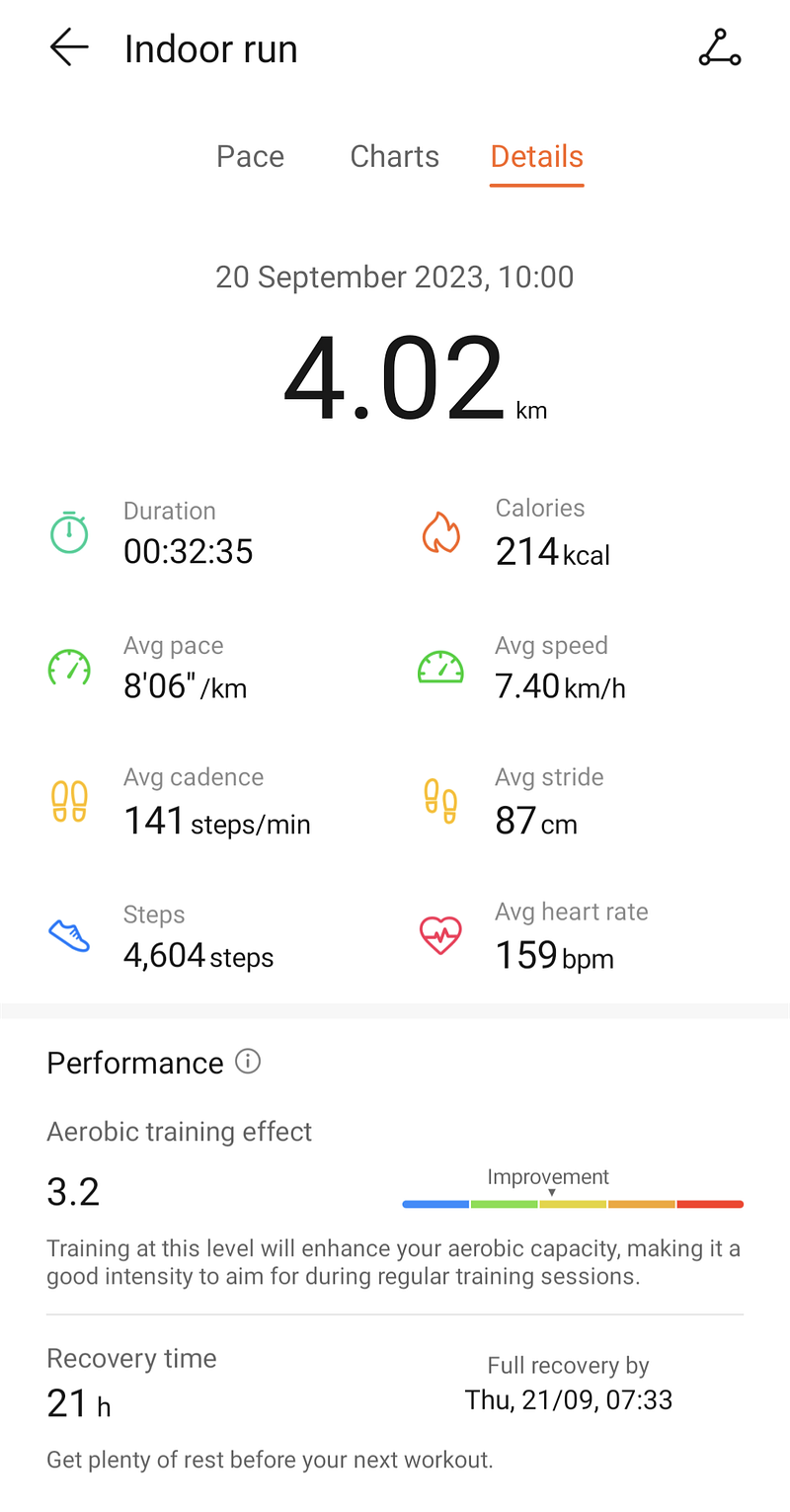
Runner’s high. According to Heathline, it can be defined as the following:
“a brief, deeply relaxing state of euphoria.”
This is a feeling I’ve never felt from other forms of exercise, therapies or medications. It has only happened to me after, or during running. Today it was particularly meditative and it made me stop and think, enough to want to write this article, and to know that from now on I have to make time for running because it’s the only proven way I can feel better mentally.
It isn’t about making my anxiety, or bouts of depression go away. But making me feel light enough to have hope to carry on. That’s what it gives me and it’s on me to protect and harness that.
I’m not telling you to go out and run. Many of you will hate it. Many of you won’t feel the benefits. But there will be other forms of activity out there that make you feel this way. If you find something, whatever it is, make sure to protect it and make time for it at all costs.
Our mental health is just as important as physical health. Without it, we are a shell of our amazing selves. Life is busy and full of distractions, but if we don’t make that time for ourselves we are doing ourselves a disservice.
A few weeks ago I read Oliver Burkeman’s book, Four Thousand Weeks and he talks about the myths of productivity and how we should shy away from spending all of our free time working and making money. Time spent on hobbies, activities, or idleness is not unproductive, but an essential way to get through life.
We should never deprive ourselves of using time for things that make us feel good. Whatever it is, chase it, discover it, and preserve it.
Even if it’s just sitting still without any distractions and just being. That can be a form of meditation itself, and as Burkeman argues in his book, far from a waste of time.
Consistent routine makes for better mental health
When I’m in the middle of a particularly bad bout of anxiety or PMS, my routine goes out of the window. I find it hard to get up when my alarm goes off or spend the day doing activities I enjoy. Instead, I doomscroll and whittle my time away. I tell myself it’s ‘self-care’ when ignoring the truth about how it makes me feel worse.
A route to better mental health isn’t about sticking to strict 5 a.m. starts and dragging yourself to the gym before the sun rises. It can work for some people, sure, but for me, it’s only something I can stick to for so long.
Instead, what I’ve taken away from my recent endeavours with running is the importance of repetition and how it gives me a sense of structure and purpose. This morning on my day off, I could have had a long lie-in and spent hours away srolling on my phone. It would have felt good in the short term, but I know not getting up and running straight away would have made me feel worse.
The running forces me to have structure and routine on my days off which is essential for improving my mental health. When I don’t have this, it’s so easy for me to go down a rabbit hole of anxiety and depression.
When I say that routine is important — I mean focusing on that activity you’ve found that makes you feel good and implementing it into your week regularly. You don’t have to go mad and do it daily, or every other day. But pencilling it in two or three times a week can make the world of difference.
This Couch to 5K plan is three runs a week. That’s it. No more. That’s achievable to me, and more than doable. By sticking to this, I’ve not only realised the benefits of ‘runners high’ but realised that I am someone who thrives from routine and repetition. That doesn’t mean I have to go crazy but stick to doing things I love regularly, and seeing the benefits.
Running semi-regularly gives me structure on days off. The repetitiveness of it gives me a sense of purpose. My anxiety brain is relishing this because it doesn’t have a chance to wander off.
By running, I am killing the possibility of idleness and wandering thoughts.
If you find an activity you love and that makes you feel good, make sure you stick to it. Making this small change can make a world of difference. Despite the numerous self-help gurus that go on about complicated 5 a.m. morning routines, making a small change like this is simply far easy to stick to.
Finding wins in the most unlikely of places
When I got up this morning, I didn’t think I’d have the motivation to sit down and write. Let alone be writing about the mental health benefits of running. Who do I think I am?
A lot of things.
But I am not a natural runner, I never will be. I’m simply not built for it. But I force myself to do it because it makes me feel alive. It doesn’t matter how slow I go or how far I run, but that I am moving semi-regularly and forcing myself to have this routine.
For years, I thought the only form of exercise that gave me any mental health benefits was powerlifting. After all, it saved me when I was at university. But now, after trying running for a month or two, I’ve realised the benefits of this are endless and far better than lifting weights, or any medications I’ve been on in the past.
I could rant about the benefits for ages. But I won’t. I know that most people are non-runners and most people reading this don’t want to run. But what I will say is this.
Through this self-discovery, I have learnt many important lessons. But the most significant one of all is that you can find wins in the least likely of places. A year ago, I would never have said running was better for my mental health than anything else I had tried.
I wouldn’t have made the connection between putting one leg in front of the other and feeling hope and happiness over worry and despair. But here we are. I tried something new and came away realising that unless I continue to do this I will never know what is out there that can help me manage my mental health.
For you, it might not be running. It could be walking, scheduling time to read every day, mindful colouring, listening to podcasts, yoga, journaling — but whatever it may end up becoming — you’re going to have to do a lot of exploring before you get there.
Because it’s about going beyond the typical solution for mental health. Everyone is so individual and complex, and no prescription can account for that fully.
But we, ourselves, can help explore other options and find activities that bring joy in the least likely of places. Once we’ve found those — it’s on us to hold onto them and never forget how good they make us feel.
Closing thoughts
This story is about running and mental health. But I hope it’s not just about that because I, more than anyone, know that running isn’t for everyone and that it won’t be a fix for most people’s mental health.
However, these are the three main takeaways to improve your mental health that I want you to remember after reading this:
- Make time for yourself
- Don’t underestimate the power of routine
- Happiness can be found in the least likely of places
Managing mental health conditions is an ongoing battle. We all have relapses, blips and moments where we don’t think we will be able to carry on. But making changes to how you prioritise your time, use routine and where you find your release and happiness can make all the difference.
Subscribe to never miss a story.