
OpenAI
From Easy Commands to Expert Coding
Codex “Honesty Game”
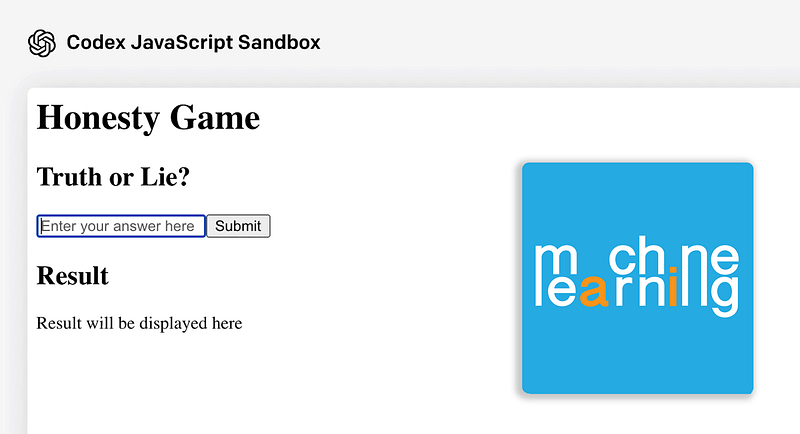
Codex was released its latest AI system that can now interpret simple commands in natural language and execute them on the user’s behalf with a minimum of work. So, of course, if you are like me, you want to take advantage of this fantastic new tool! In fact, I’ve been using Codex all around the internet, making AI assistants and static art pages by adding some extra options to make the bot more human.
One example is coding straightforward games for websites. If a site needs an algorithm that needs to be created from scratch or upon specific events, then Codex makes it easy! Just add what it needs (steps), and boom- there is your solution!
This summer, Open AI (GPT 3) released their latest AI system that translates natural language to code. It can now interpret simple commands in natural language and execute them on the user’s behalf — making it possible to build a natural language interface to existing applications.
OpenAI is now inviting businesses and developers to build on top of their Codex through an API. For example, OpenAI has already built GitHub copilot, which they launched in partnership with GitHub, with Codex as the model that powers it. Proficient in more than a dozen programming languages, Codex can now be used for simple commands in any other programming language.
Codex produces a code to your problem in a few seconds. Below is the minimalist design approach to using Codex.
Codex generates code from just two words in the two-word “Honesty Game,” just straight to the point. The simplicity is that it does not need for a programmer to prepare their requirements, which makes the code generation process faster. The time required from getting the request from the customer until a solution is ready in 30 seconds, whereas with traditional solutions, this time can be up to several minutes/hours.
As an AI artist, my goal is not to generate a perfect solution. However, if CODEX is developing code, my goal is to make it as close as possible to the simplest solution.
In the video below, you can see how Codex produces the code in real-time. Then, you can try the demo on gross.art for yourself.
Everything that I produce is open source, and you can follow the process on my Substack feed.
/* honesty game */
var honesty = document.createElement('div');
honesty.innerHTML = '<h1>Honesty Game</h1>';
document.body.appendChild(honesty);
var honesty_game = document.createElement('div');
honesty_game.innerHTML = '<h2>Truth or Lie?</h2>';
document.body.appendChild(honesty_game);
var honesty_game_input = document.createElement('input');
honesty_game_input.setAttribute('type', 'text');
honesty_game_input.setAttribute('id', 'honesty_game_input');
honesty_game_input.setAttribute('placeholder', 'Enter your answer here');
document.body.appendChild(honesty_game_input);
var honesty_game_button = document.createElement('button');
honesty_game_button.innerHTML = 'Submit';
document.body.appendChild(honesty_game_button);
var honesty_game_result = document.createElement('div');
honesty_game_result.innerHTML = '<h2>Result</h2>';
document.body.appendChild(honesty_game_result);
var honesty_game_result_text = document.createElement('div');
honesty_game_result_text.innerHTML = '<p>Result will be displayed here</p>';
document.body.appendChild(honesty_game_result_text);
honesty_game_button.addEventListener('click', function() {
  var answer = honesty_game_input.value;
  if (answer === 'truth') {
    honesty_game_result_text.innerHTML = '<p>You are a good person!</p>';
  } else {
    honesty_game_result_text.innerHTML = '<p>You are a bad person!</p>';
  }
});- Check out my instagram with new material every week
- If you enjoyed this, follow me on Medium for more
- Want to collaborate? Let’s connect on LinkedIn
- https://linktr.ee/datasculptor
- 3D Machine Learning generated model on sketchfab
- Substack


