
From Co-Sleeping To Sleep Training
My experiences with both and how I’ll never regret my choices.
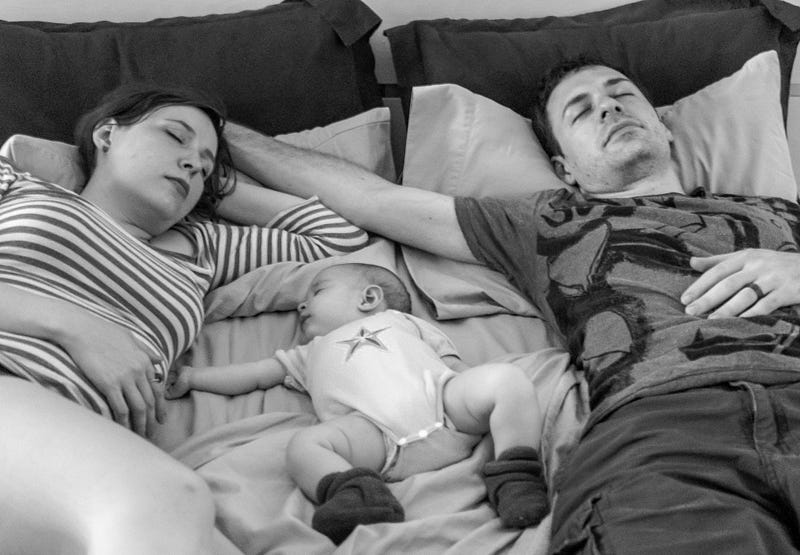
I loved the snuggles when my baby was small. I loved the neediness from him and my instinct to protect and comfort him. I loved picking him up and breastfeeding him. I loved every waking moment with him, even during those sleepless nights. The tenderness of motherhood, especially in those first few weeks, is something I will always treasure in my mind. The bond we formed is irreplaceable and unique, and I’m certain it’s because of it that motherhood has been so friggin’ awesome since. My 2.5-year-old and I are best friends.
I’m 35 weeks pregnant now and I cannot wait to form this solid bond with my second.
But I also plan on sleep training him.
My Priority Was and Is Good Health
I co-slept with my son when he was born at first simply because that’s what worked for us. As time went on, I tried for him to sleep in his cot, only for him to wake up dozens of times in the night. During the day, he napped mostly on me in the carrier. And I must admit, I loved it.
Until I didn’t.
I was exhausted. I mean the kind of exhaustion that stopped me from wanting to drive or use kitchen appliances.
And, to be honest, he was tired too — especially at night. Turns out, your baby grows mostly when he sleeps. You know when you wake up to greet your baby who shockingly looks like he grew overnight? That’s not your eyes fooling you — babies go through growth spurts, and they do this while sleeping.
If their sleep pattern isn’t well established and is disrupted, it could slow down their physical growth.
Italian researchers, studying children with deficient levels of growth hormone, have found that they sleep less deeply than average children do. — Parents.com
There is also growing evidence that not sleeping well is tied to obesity and other health conditions, often starting in infancy and getting considerably worse during adulthood.
As you may already know, food choices differ between those who are well-rested and those who are tired as adults — the same happens with children. If babies are not getting enough deep sleep and this issue carries on as they get older, their tired state can cause them to crave higher-fat or higher-carb foods.
Nurturing good sleeping habits when young also helps the baby to develop his immune system:
During sleep, children (and adults) also produce proteins known as cytokines, which the body relies on to fight infection, illness, and stress. — Parent.com
The effects of bad sleep could well lead to health issues later in life due to protein deficiency.
Enter sleep training, to ensure the growth and maintenance of both our physical and mental healths.
Why I Considered “Official” Sleep Training
Turns out, every parent, whether they know it or not, sleep trains their kids.
Whether you paid a professional to help you, or whether you co-slept, or whether your first years of parenting are a bit blurry because of the lack of sleep — it’s all training.
Training, according to the Google dictionary, means
“the action of teaching a person or animal a particular skill or type of behaviour.”
It’s like any kind of habit-building, and that’s what humans live off their entire lives — habits. Whether those habits are good or bad, it doesn’t matter. Whether you consciously live by them or not, they’re still there.
Joe Dispenza, in Science Built Success, discusses how we form patterns in our lives, down to our emotional state — meaning that even our reactions of anger, shame, and guilt, or happiness, joy, and gratitude, become habitual. In fact, he argues that:
“95% of who we are by the time were 35 years old is a memorised set of behaviours, emotional reactions, unconscious habits, hardwired attitudes, beliefs and perceptions, that function like a computer program.”
Apply this to how you are with your child, and you’re, without knowing it, influencing him with your habits, emotional reactions, and energy overall. You are helping him to form his own behaviours which will become habitual by the time he’s well into adulthood.
Which is why there are so many parenting books out there, right? So that we can mindfully “train” our kids to become well-rounded, happy, and healthy individuals.
The term “sleep training” is vastly misunderstood because of its association with neglect to the baby, and its famous “crying it out” method — which by the way, is only one of the many methods out there, but arguably also misunderstood.
More importantly: no parent who sleep trains their child makes the decision lightly.
In fact, every parent I know who has trained their kid to sleep had in mind providing as much comfort and support as humanly possible while also getting their sleep back.
It’s like getting the best of both worlds — something which is absolutely possible.
Sleep training implies selfishness and convenience on the parent’s part, and sacrifice on the baby’s part. This, again, is wrong.
I wanted to achieve these two goals:
- For my son to sleep well independently so we could reap the health benefits.
- For my sleep to improve in order to be able to enjoy motherhood and the rest of life to the full when I was awake, as well as taking some time back with my husband.
Here’s what I learned about sleep training and why I chose it.
Why Does Every Baby Cry When Being Sleep Trained?
Because over a set of time, the parent came to train their baby to sleep in their own way, and suddenly, there was a change made to that habit and the baby became confused.
That’s literally it.
Like when a baby might become confused when being rocked to sleep in his mother’s arms and then wake up in their cot. A change in their environment is just as confusing and hence why babies who fall asleep and wake up in different places tend to wake up and cry out.
This leads me to talk about wakeups.
Every baby wakes up often. In fact, every adult wakes up often.
Sleep-Cycles
Sleep-cycle durations differ depending on the age of the baby. When they’re newborn, they tend to last around 45 minutes.
By the time they’re 4 months old, their sleep cycles increase to about 1.5 hours.
According to sleepfoundation.org, all adults go through 4 to 6 cycles each night.
What happens at the end of these cycles is fascinating.
We do a check of our environment, and if everything seems cool, we go back to sleep. That’s why mostly, as adults, we don’t realize we’re waking up at all. We have learned to do this over a certain period of time. But if our environment changes, such as sleeping in a hotel, or staying at a friend’s or relative’s, you may think you’re waking up often when in actual fact, your body is simply more alert because it is not used to the new environment in which you’re sleeping in. You’re waking up just as often, but you’re more aware of your wake-ups.
This is why your baby doesn’t just fall asleep again at the end of each sleep cycle at first. They’re still working on feeling safe and comfortable in their environment. Hence they cry out and seek that safety they know best — usually, a parent’s arms.
Why Is My Baby A Bad Sleeper?
My first lesson when researching sleep training was that there is no such thing as a bad sleeper. Period. Every baby and child has the ability within them to learn how to sleep soundly.
I know this may be hard to hear for some parents because their children really struggled with sleep and they can’t possibly think of any reason other than “being a bad sleeper”. I was offended to learn this too and it made me feel like something was wrong with my son.
My son was waking every 20 minutes in his cot when he was 4 months old and he would only sleep soundly on my chest. But I had got him accustomed to sleeping on me all the time because that’s simply what worked. And when I tried anything else, he would protest, and I would resort to what I knew worked because my goal was for him to sleep.
When I wanted him to be able to sleep independently, it took us 2 nights of more crying than usual to get him to break away from me. By this I mean he did protest as he would have normally when he woke up in his cot. I would lie next to him, patting his tummy, shhing him, humming to him, kissing his cheeks, picking him up for a cuddle, and putting him back down. Everything I could think of except letting him fall asleep on me.
What We Are Supposed To Teach Our Kids
It’s about helping them to find comfort and feel safe in their own cot or main place of sleep — which is why the advice is to let your baby fall asleep in their cot from as early age as possible — to avoid later intervention or changes.
That’s it.
Sleep training by professionals is simply teaching the parent to teach their baby to associate their usual place of rest with safety, in the same way that their mother’s arms might be. It’s widening their comfort zone.
A baby who is taught to feel safe in their cot from a young age, officially or not, will go through exactly the same sleep cycles as a baby who has not. The difference is that the baby who familiarised himself with the cot will simply go back to sleep (unless he’s hungry or needs a nappy change) and the baby who does not, will cry out. For my baby it was worse because dropping his pacifier woke him up even more often, so his natural sleep cycles were interrupted too.
Some changes are more unsettling than others, and changing the way a baby goes to sleep is a big one for such an innocent, tiny human being. Hence, that’s why they cry and need comfort. But it doesn’t mean resorting back to the old ways. It just means comforting them and being there for them while they learn to adapt — because they are capable of this without being scarred.
But I didn't find this the biggest lesson of all. I learned that, through this sleep training journey, I was teaching my son something far more important.
It was the first of many to come — in how we deal with problems, and how we cope with our emotions.
My Battle With Anger As a Parent
Ensuring our son feels loved regardless of our feelings.
medium.com
Sleep training my son represented objective thinking. It meant not accepting problems. It meant thinking outside the box, changing my expectations as a parent, and challenging the views of others.
It meant choosing guilt-free self-care.
All of this will only benefit my son when he grows up.
Food For Thought
The change definitely unsettled him, but my son managed to fall asleep within 25 minutes the first night with only 2 wakeups for a feed. After that, he would take 10–15 minutes to fall asleep and he wouldn’t cry, but make sounds that indicated he was self-soothing — something all babies learn to do at some point in their lives, but again, are actually able to from a young age.
He still slept in the carrier or snuggled on me for some naps during the day depending on what we were doing, but he was also comfortable napping in the car, in the stroller, or in his cot.
When he was 9 months old, my son slept through the night without any input from me to try to stop the wakeups. He simply stopped needing me at all for a feed because he was getting enough during the day.
My son wakes up happy in the mornings. If he wakes up during the night, I know something is up and of course, I go to him.
One thing to remember throughout the entire process is that, as long as your baby’s awake times are positive — he will get through the changes brought on by sleep training.
If you aren’t promoting as much positivity throughout the day because you’re tired as hell, you could be making things worse for your baby.
If sleep training my son is still seen as a selfish act —then I am selfish and so be it.
But because of my selfishness, I was able to love him more deliberately and energetically. I was able to not only take him to all the baby classes but enjoy them fully, without that tired cloud over my head.
By getting my sleep back, I got my mental health back too.
Takeaways
Co-sleeping is great as long as both the parent and baby are sleeping well. It worked for me for a couple of months. But when it stopped working, something had to change.
It is not necessary for any parent to sacrifice their own sleep and health in order for their baby to sleep well. Everyone needs to look after themselves and only then can they wholeheartedly and lovingly look after their children. That includes solving any sleep issues.
I was a better parent to my son when I got a good night’s rest, and he absolutely reaped the benefits of sleeping well too.
You should not have to resort to giving up your own sanity — that’s not what parenting is about.
Sylvia Emokpae is passionate about self-love, relationships, and motherhood. See more work like this.