high natural gas prices due to the Covid-19 pandemic, hitting the European Union (EU) market extremely hard.</p><figure id="8a0c"><img src="https://cdn-images-1.readmedium.com/v2/resize:fit:800/0*7lAbQydKl3ll_V6_.png"><figcaption></figcaption></figure><p id="6595">This data was found at Geopolitical Futures (GF). Francesco Casarotto, “Europe’s Fertilizer Crisis Could Become a Food crisis” December 14, 2021.
But in 2020, analysts from Geopolitical Futures reveal that Russia’s fertilizer production of mineral fertilizers grew at a rate of 5% hitting approximately 54.8 million tons. By comparison, the world average grew at around 2% in 2020.</p><p id="cfb9">Read more about prices through 2021–22 with the information below provided by the World Bank.</p><div id="c11f" class="link-block">
<a href="https://blogs.worldbank.org/opendata/fertilizer-prices-rise-moderately-2021">
<div>
<div>
<h2>Fertilizer prices to rise moderately in 2021</h2>
<div><h3>Although fertilizer prices have been resilient amid the pandemic, they have followed different paths. Phosphate and…</h3></div>
<div><p>blogs.worldbank.org</p></div>
</div>
<div>
<div style="background-image: url(https://miro.readmedium.com/v2/resize:fit:320/0*3nl0xpTonp0671D3)"></div>
</div>
</div>
</a>
</div><div id="6d9f" class="link-block">
<a href="https://blogs.worldbank.org/opendata/fertilizer-prices-expected-remain-higher-longer">
<div>
<div>
<h2>Fertilizer prices expected to remain higher for longer</h2>
<div><h3>Fertilizer prices have risen nearly 30 percent since the start of 2022, following last year's 80 percent surge. Soaring…</h3></div>
<div><p>blogs.worldbank.org</p></div>
</div>
<div>
<div style="background-image: url(https://miro.readmedium.com/v2/resize:fit:320/0*7C9rgpc2uMM6HaJx)"></div>
</div>
</div>
</a>
</div><p id="221d">The truth is that this fertilizer diplomacy seems to be unraveling during the worst times of this century — global pandemic, food crisis, inflation — while also the Russia’s invasion of Ukraine has caused severe changes to commodities and other aspects of the global economy.</p><figure id="1055"><img src="https://cdn-images-1.readmedium.com/v2/resize:fit:800/0*sskbWi-vqziYuJir.png"><figcaption></figcaption></figure><p id="3b10">No wonder the governments of the world are already conceptualizing critical global commodities as way to engage in diplomacy. This adds a geopolitical factor to any country’s supply and production targets. As the dimensions of political leverage grow in their favor, they would continue to use fertilizer as a way to influence important political decisions.</p><p id="d394">On the other hand, when fertilizer prices subside, fertilizer diplomacy could contribute to the health of global economic recovery and help alleviate the global food crisis. Africa is a case in point, as Morocco seeks to lead the way as Africa’s main supplier to increase agricultural productivity and modernity. This would be a major boon to Africa’s growth and development.</p><div id="bca3" class="link-block">
<a href="https://readmedium.com/three-of-menas-leading-fertilizer-players-ocp-maa-den-qafco-5dbb353d04ae">
<div>
<div>
<h2>Three of MENA’s Leading Fertilizer Players: OCP, Maa’den, QAFCO</h2>
<div><h3>The purpose of this story is to share the latest news and developments from three of the Middle East and Noth Africa’s…</h3></div>
<div><p>medium.com</p></div>
</div>
<div>
<div style="background-image: url(https://miro.readmedium.com/v2/resize:fit:320/1*ghllfaJx1TDPyxmIFd1T0A.jpeg)"></div>
</div>
</div>
</a>
</div><h1 id="7c16">What’s Likely To Happen In 2023?</h1><p id="af6c">As reported by <a href="https://en.fshow.org/news/show/id/531.shtml"><b>FSHOW</b></a><b> </b>the American producer The Mosaic Company sees global fertilizer supplies to continue growing into 2023, despite higher prices, due to the tight grain and oilseeds international marketplace. According to a statement from Mosaic Company: “The war in Ukraine, high temperatures in North America and Europe, and developing drought conditions in parts of South America highlight the risk for reduced yields globally.”</p><p id="77bf">This comes at a time when Mosaic Company has reportedly cut its sales year-over year (yoy) from approximately 1.2 million tonnes of fertilizer in July 2021 to 921,000 tonnes in July 2022. <a href="https://www.moroccoworldnews.com/2022/09/351146/mosaic-reduces-production-despite-calls-to-boost-fertilizer-supply"><b>Morocco World News</b></a>.</p><div id="d8a4" class="link-block">
<a href="https://www.moroccoworldnews.com/2022/09/351146/mosaic-reduces-production-despite-calls-to-boost-fertilizer-supply">
<div>
<div>
<h2>Mosaic Reduces Production Despite Calls to Boost Fertilizer Supply</h2>
<div><h3>US fertilizer giant Mosaic is selling less fertilizer, at significant profit, despite US farmers' pleas to expand the…</h3></div>
<div><p>www.moroccoworldnews.com</p></div>
</div>
<div>
<div style="background-image: url(https://miro.readmedium.com/v2/resize:fit:320/0*zumv6QZIdzbWcmf_)"></div>
</div>
</div>
</a>
</div><p id="7a0f">In fact, The Mosaic Company has been embroiled in a high-level <a href="https://readmedium.com/legal-analysis-american-fertilizer-producer-the-mosaic-companys-countervailing-duties-cvd-case-1ff63ee17c05"><b>international trade dispute</b></a> between the United States and Morocco since 2021. The case is a countervailing duties (CVD)/anti-dumping (AD) case initiated by Mosaic Company against Morocco’s OCP Group. The American fertilizer producer was awarded by the United States International Trade Court (USITC) when the final ruling to apply CVD rates on exports of phosphate fertilizers from Morocco were applied to American markets.</p><p id="cd3c">Mosaic Company claimed that OCP Group benefits from government subsidies which allow the company to sell phosphate fertilizer products for below their comparative value in the United States market. It’s a critical case not only for American fertilizer supplies, but also for how important the global fertilizer industry has become for food security and global commodites.</p><div id="d33c" class="link-block">
<a href="https://readmedium.com/legal-analysis-american-fertilizer-producer-the-mosaic-companys-countervailing-duties-cvd-case-1ff63ee17c05">
<div>
<div>
<h2>Legal Analysis: American Fertilizer Producer The Mosaic Company’s Countervailing Duties (CVD) Case…</h2>
<div><h3>The Mosaic Company has Russia’s and Morocco’s phosphate fertilizer subsidies investigated for Countervailing Duties…</h3></div>
<div><p>medium.com</p></div>
</div>
<div>
<div style="background-image: url(https://miro.readmedium.com/v2/resize:fit:320/0*ugZ9zwweElxTdadY)"></div>
</div>
</div>
</a>
</div><p id="99bb">However, this is by far <i>not</i> the only crucial event taking place in the overall spectrum of the global fertilizer industry. Josh Linville of StoneX asserts that a series of <a href="https://www.agweb.com/news/business/taxes-and-finance/series-black-swans-driving-fertilizer-prices"><b>Black Swan events</b></a><b> </b>since September 2021 have led to higher prices and tighter supplies in the fertilizer markets worldwide.</p><p id="a00f">On <a href="https://www.tfi.org/content/statement-russia-ukraine-conflict"><b>3 March 2022</b></a><b> </b>The Fertilizer Institute (TFI) released a statement about the Russia-Ukraine conflict’s impact to global fertilizer supplies: “Because of Russia’s large fertilizer production and its role as a global fertilizer supplier, the removal of Russian product from the global marketplace will have an impact on supply.”</p><p id="f1d6">United States President Joe Biden has announced at least two separate actions, on <a href="https://www.whitehouse.gov/briefing-room/statements-releases/2022/05/11/fact-sheet-president-biden-announces-new-actions-to-address-putins-price-hike-make-food-more-affordable-and-lower-costs-for-farmers/"><b>11 May 2022</b></a> and <a href="https://www.whitehouse.gov/briefing-room/statements-releases/2022/06/17/fact-sheet-president-biden-to-galvanize-global-action-to-strengthen-energy-security-and-tackle-the-climate-crisis-through-the-major-economies-forum-on-energy-and-climate/"><b>17 June 2022</b></a>, respectively, to reign in critical fertilizer supplies for farmers who cannot afford them, and to stave off a spike in energy prices that would exacerbate the price of fertiliers and the global food crisis.</p><div id="0f7a" class="link-block">
<a href="https://missouriindependent.com/briefs/biden-administration-plays-long-game-for-agriculture-and-trade/">
<div>
<div>
<h2>Biden administration plays long game for agriculture and trade * Missouri Independent</h2>
<div><h3>WOODWARD, Iowa - The United States could take international tr
Options
ade actions that might have an immediate impact on the…</h3></div>
<div><p>missouriindependent.com</p></div>
</div>
<div>
<div style="background-image: url(https://miro.readmedium.com/v2/resize:fit:320/0*eTKs9rGh9dyqWC68)"></div>
</div>
</div>
</a>
</div><p id="306d">Speaking at an event in Washington DC from October 10–16, 2022, <a href="https://www.moroccoworldnews.com/2022/10/351806/mostafa-terrab-africa-could-be-the-solution-to-global-food-crisis"><b>Chairman & CEO of Morocco’s OCP Group Mostafa Terrab</b></a><b> </b>explained Africa’s role in alleviating food security around the globe:</p><blockquote id="2a8e"><p><i>“Putting things in context is very important. There is a visible crisis today; a shortfall of fertilizers today, but we should recognize that what’s visible today has been revealed by a crisis, but is based on a long-term situation that we have to address”</i></p></blockquote><figure id="f985"><img src="https://cdn-images-1.readmedium.com/v2/resize:fit:800/0*a29ZGPTnWBAqe1fG.jpg"><figcaption>I inserted this photo from The North Africa Post. Access the link here: <a href="https://northafricapost.com/61612-moroccos-ocp-group-to-donate-4-mln-tons-of-fertilizers-to-african-countries.html">https://northafricapost.com/61612-moroccos-ocp-group-to-donate-4-mln-tons-of-fertilizers-to-african-countries.html</a></figcaption></figure><p id="c9bb">At the event, OCP Group announced that the company would send <a href="https://northafricapost.com/61612-moroccos-ocp-group-to-donate-4-mln-tons-of-fertilizers-to-african-countries.html"><b>4 million tonnes of fertilizers</b></a> to farmers throughout Africa in 2023.</p><p id="f954">This initiative is being led by the subsidiary, OCP Africa. According to <i>The North Africa Post</i>, OCP Africa aims to develop a comprehensive farmer-centric approach for agriculture and food security on the African contient.</p><p id="3da0">On Africa’s Green Revolution, OCP Group Chairman & CEO pointed out that it could not be similiar to the Green Revolution carried out by industrial farming practices in other parts of the world. The circumstances of land ownership and ag technology would need to priortized in the context of Africa’s Green Revolution. He compared the Green Revolution to how African countries realized the “telecom revolution” — instead of increasing landline density — which led to the first mobile payment by M-PESA Kenya.</p><figure id="9d36"><img src="https://cdn-images-1.readmedium.com/v2/resize:fit:800/0*73fpDMOus1YD8zRN.jpeg"><figcaption></figcaption></figure><p id="2eef">At an event held simultaneously in Casablanca, Morocco, OCP Africa jointly hoted the Africa Fertilizer Financing Forum from October 11–13, 2022, with the African Development Bank Group. The other partner of the event, Africa Fertilizer Financing Mechanism (AFFM), is a key organization to OCP Africa’s initiatives to increase fertilizer supplies and agricultural productivity across Africa.</p><div id="0a38" class="link-block">
<a href="https://www.moroccoworldnews.com/2022/09/351329/ocp-african-development-bank-to-host-africa-fertilizer-financing-forum">
<div>
<div>
<h2>OCP Africa, African Development Bank to Host Africa Fertilizer Financing Forum</h2>
<div><h3>Morocco's OCP Africa and the African Development Bank Group will jointly host Africa Fertilizer Financing Forum in…</h3></div>
<div><p>www.moroccoworldnews.com</p></div>
</div>
<div>
<div style="background-image: url(https://miro.readmedium.com/v2/resize:fit:320/0*xYddm4QMq8aAvdxU)"></div>
</div>
</div>
</a>
</div><h1 id="921b">Concluding Thoughts</h1><p id="6134">OCP Group donated 15,000 tonnes of Di-ammonium phosphate (DAP) fertilizer to Rwanda in <a href="https://www.moroccoworldnews.com/2022/07/350306/moroccos-ocp-group-donates-15-000-tonnes-of-fertilizers-to-rwanda"><b>July 2022</b></a>.</p><p id="d696">This kickstarted a wave of Russian attempts to donate its own fertilizer supplies to Africa. For instance, in <a href="https://www.reuters.com/world/africa/russias-lavrov-courts-africa-quest-more-non-western-friends-2022-07-25/"><b>July 2022</b></a>, Russian Foreign Minister Sergei Lavrov began the <a href="https://www.theguardian.com/world/2022/jul/25/sergei-lavrov-africa-tour-russia-foreign-minister-analysis"><b>African Tour</b></a><b>.</b> This tour coincided with visits from French President Emmanuel Macron and U.S. Special Envoy for the Horn of Africa Mike Hammer to the Middle East and North Africa (MENA) region.</p><p id="23c4">Afterwards, it was reported on <a href="https://africa.businessinsider.com/local/lifestyle/russian-fertilizers-to-be-delivered-to-africa-free-of-charge-as-part-of-humanitarian/e4kw38q"><b>29 July 2022 </b></a>that Russia’s Uralchem had agreed to send 25,000 tonnes of fertilizer supplies to Africa. It shouldn’t surprise anyone that the sanctions on Russia caused this act of courtesy to be turned into another act of fertilizer diplomacy by Russia. It was reported on <a href="https://www-businessdailyafrica-com.translate.goog/bd/opinion-analysis/columnists/eu-sanctions-derail-russian-fertilisers-supply-to-africa-3956832?_x_tr_sl=en&_x_tr_tl=fr&_x_tr_hl=fr&_x_tr_pto=sc"><b>22 September 2022</b></a><b> </b>that the sanctions by the European Union (EU) had effectively curtailed Russia’s fertilizer exports to Africa. The Embassy of the Russian Federation also quickly denied a so-called <a href="https://www.citizen.digital/news/fact-check-reports-of-fertilizer-donated-by-russia-being-sold-to-kenyan-farmers-are-fake-n306221"><b>fake press release</b></a> about fertilizer donations from Uralchem to a Kenyan company on 23 September 2022.</p><p id="6ad8">Regardless of what officials and diplomats are doing or saying — or <i>not</i> doing and saying — it’s clear to me that <a href="https://readmedium.com/the-effects-from-geopolitics-and-sanctions-on-industrial-policies-during-the-russia-ukraine-dcaaf480d9b0"><b>Geopolitics</b></a> are playing a much greater role in industrial policies around fertilizer and food.</p><div id="b2d6" class="link-block">
<a href="https://foreignpolicy.com/2022/10/08/fertilizer-war-climate-shortage-food-agriculture-africa-europe/">
<div>
<div>
<h2>Africa Needs More, Not Less, Fertilizer</h2>
<div><h3>Russia's war in Ukraine has exacerbated food shortages-already worsened by the COVID-19 pandemic-and shed light on…</h3></div>
<div><p>foreignpolicy.com</p></div>
</div>
<div>
<div style="background-image: url(https://miro.readmedium.com/v2/resize:fit:320/0*n6LZDeSTz9Y3-mag)"></div>
</div>
</div>
</a>
</div><div id="9b7c" class="link-block">
<a href="https://readmedium.com/brazils-fertilizer-diplomacy-reveals-insights-on-the-global-food-crisis-industrial-policies-28f200dee84c">
<div>
<div>
<h2>Brazil’s Fertilizer Diplomacy Reveals Insights on the Global Food Crisis, Industrial Policies &…</h2>
<div><h3>I put together this summary of headlines and reports in response to a piece from the “Voices of the Inflated World” Sam…</h3></div>
<div><p>medium.com</p></div>
</div>
<div>
<div style="background-image: url(https://miro.readmedium.com/v2/resize:fit:320/0*pFYBV9WNU93FYL2f)"></div>
</div>
</div>
</a>
</div><p id="26cb">The <a href="https://odessa-journal.com/ukraine-exported-more-than-20-million-tons-of-grain-corn-wheat-barley-in-january-august-2022/"><b><i>Odessa Journal</i> </b></a>reported that Ukraine was able to export 20.2 million tons of grain crops from January-August 2022. These figures are down considerably yoy while China continues to be Ukraine’s main food importer at $749 million (14.4%). The Ukrainian Agrarian Business Club (UCAB) association claimed that much of the success in Ukraine’s agriculture products exports in September 2022 were due to the Istanbul Grain Agreements, which allowed food exports from three Black Sea ports.</p><p id="8b88">From the industry perspective, <a href="https://www.yara.com/corporate-releases/yara-delivers-strong-performance-despite-market-volatility/"><b>Yara President & CEO Svein Tore Holsether</b></a> noted that although Yara International delivered strong results in Q3 2022 that “we remain deeply concerned about the food and fertilizer supply situation in Europe and globally, and repeat our call for urgent action to reduce dependency on Russia.”</p><p id="b45d">While the financial market and investing platform <a href="https://readmedium.com/seeking-alpha-highlights-fertilizer-and-copper-production-to-cap-off-end-of-2022-e41cf855c4c5"><b>Seeking Alpha</b></a> highlighted a key fertilizer producer <a href="https://seekingalpha.com/article/4546721-oci-nv-could-outperform-competitors"><b>OCI N.V.</b></a> as well-positioned to outperform their competitors going into 2023. For instance, OCI N.V. is in an advantageous position to withstand higher gas prices due to its available supply of natural gas in the Middle East and North Africa (MENA).</p><p id="fc76">Thus, energy security and dependence shall play another big role in global fertilizer prices and supplies going into 2023.</p></article></body>
Fertilizer Diplomacy 2.0
Does the newly proposed deal by the United Nations give hope for the success of the Grain Export Corridor (Black Sea Grain Deal) or is it just another act of Fertilizer Diplomacy for Russia?

It was reported on 13 September 2022that the United Nations (UN) is seeking to arrange a deal whereby Russia and Ukraine would allow ammonia exported from Russia through Ukraine to global markets. The ammonia is intended for international markets in a worldwide effort to combat the global food crisis amid a sharp rise in global fertilizer prices and tight supplies.
Devex wrote an in-depth report about this latest deal to send ammonia from Russia through Ukraine. Per their report, a UN task force, led by the United Nations Conference for Trade and Development’s (UNCTAD) Rebeca Grynspan, is supposed to ensure negotiations continue unabated by visiting with Russian officials in Moscow.
This proposal is being touted as a viable option for Russia to commit to the “landmark grain deal” orginally put together in cooperation between Turkey’s President Recep Tayyip Erdogan and Russia’s President Vladimir Putin, under the auspices of the UN with Ukraine’s President Volodymyr Zelensky, on 22 July 2022.
Heralded as a “beacon of hope” UN Secretary General António Guterres posted on Twitter: “It will help avoid a food shortage catastrophe for millions worldwide.”
This alternative form of Fertilizer Diplomacy, of course, would benefit Russia’s fertilizer producer Uralchem as the company would be responsible for sending the ammonia via pipeline to Urkaine. This means that Uralchem controls the amount of production and supply, irrespective of any arrangements made with Ukraine and other third-party actors. It’s ultimately another barganing chip for Russia to exploit and use to its advantage in the international system; hence the critical nature of Fertilizer Diplomacy.
The next part of the deal really blows my mind. At the Russia-Ukraine border, an American commodities trader, Trammo, would then be responsible for purchasing the ammonia and ensuring that it is exported through Ukrainian territory. Under the terms of this agreement, Trammo would own the ammonia, as it traverses Ukraine, and therefore pay all pumping and transit fees before the shipments make it to the final destination for shipping to global markets: the Black Sea.
As anyone following the Russia-Ukraine conflict knows, the Black Sea has been one of the highest-risk and volatile areas on the international marketplace ever since Russia invaded Ukraine on Februrary 24, 2022. This proposed deal does try to shape the narrative that the Black Sea is getting back to business as usual, but the actual circumstances there could tell a completely different story if this deal is finalized. Russia has already proven time and time again that UN-sponsored deals do not decrease the likelihood of military action against Ukraine. In fact, the pipeline in question had its operations completely shut down on Februrary 24, 2022.
The pipeline can pump 2.5 million tonnes of ammonia per year. Reuters
This proposed deal is seen by many international companies and organizations as a necessity for combatting the global food crisis.
According to CEO of Trammo, Ed Weiner: “The absence from the market of ammonia formerly shipped through Ukraine has caused substantial hardship in countries dependent on that product. We believe that resumption of shipments will help to stabilize fertilizer prices worldwide and to avoid a global food crisis.”
In an interesting side note, I found that CEO Ed Weiner visited with Georgian Ambassador David Bakradze and Deputy Chief of Mission George Tsikolia on 26 September 2019 to discuss the construction of a new terminal at the Batumi Sea Port.
Speaking on behalf of the World Food Programme (WFP), George Fominyen said: “We are currently seeing a global food crisis that is largely due to high prices … But without fertilizer in 2022, the current crisis could grow into one of food availability in 2023, as harvest yields decrease.”
However, since this proposed deal in September, the conflict between Russia and Ukraine has intensified on both sides of the fighting. BBC
This concept has reshaped the whole narrative of the global fertilizer industry. It implies that the fertilizer markets have become susceptible to geopolitical forces. Perhaps because the world is facing an unprecendented food crisis, but mainly because of renewed conflict over geopolitics and military strategy, as evidenced by Russia and Belarus — Belarus is one of the world’s largest potash producers — and how the countries have used their influence over fertilizer supply to increase political leverage.
In fact, the concept of “Fertilizer Diplomacy” originated around the time that Russia began initiating countermeasures against Europe for the Nord Stream 2 pipeline. This occurred under the backdrop of extremely high natural gas prices due to the Covid-19 pandemic, hitting the European Union (EU) market extremely hard.
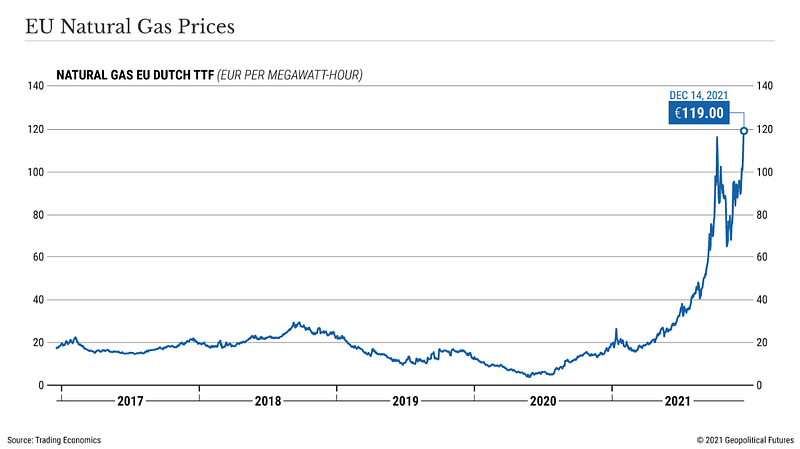
This data was found at Geopolitical Futures (GF). Francesco Casarotto, “Europe’s Fertilizer Crisis Could Become a Food crisis” December 14, 2021.
But in 2020, analysts from Geopolitical Futures reveal that Russia’s fertilizer production of mineral fertilizers grew at a rate of 5% hitting approximately 54.8 million tons. By comparison, the world average grew at around 2% in 2020.
Read more about prices through 2021–22 with the information below provided by the World Bank.
The truth is that this fertilizer diplomacy seems to be unraveling during the worst times of this century — global pandemic, food crisis, inflation — while also the Russia’s invasion of Ukraine has caused severe changes to commodities and other aspects of the global economy.
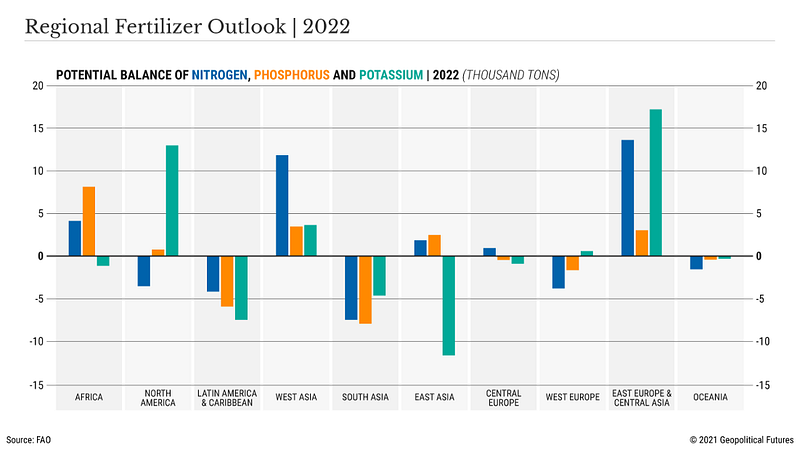
No wonder the governments of the world are already conceptualizing critical global commodities as way to engage in diplomacy. This adds a geopolitical factor to any country’s supply and production targets. As the dimensions of political leverage grow in their favor, they would continue to use fertilizer as a way to influence important political decisions.
On the other hand, when fertilizer prices subside, fertilizer diplomacy could contribute to the health of global economic recovery and help alleviate the global food crisis. Africa is a case in point, as Morocco seeks to lead the way as Africa’s main supplier to increase agricultural productivity and modernity. This would be a major boon to Africa’s growth and development.
As reported by FSHOWthe American producer The Mosaic Company sees global fertilizer supplies to continue growing into 2023, despite higher prices, due to the tight grain and oilseeds international marketplace. According to a statement from Mosaic Company: “The war in Ukraine, high temperatures in North America and Europe, and developing drought conditions in parts of South America highlight the risk for reduced yields globally.”
This comes at a time when Mosaic Company has reportedly cut its sales year-over year (yoy) from approximately 1.2 million tonnes of fertilizer in July 2021 to 921,000 tonnes in July 2022. Morocco World News.
In fact, The Mosaic Company has been embroiled in a high-level international trade dispute between the United States and Morocco since 2021. The case is a countervailing duties (CVD)/anti-dumping (AD) case initiated by Mosaic Company against Morocco’s OCP Group. The American fertilizer producer was awarded by the United States International Trade Court (USITC) when the final ruling to apply CVD rates on exports of phosphate fertilizers from Morocco were applied to American markets.
Mosaic Company claimed that OCP Group benefits from government subsidies which allow the company to sell phosphate fertilizer products for below their comparative value in the United States market. It’s a critical case not only for American fertilizer supplies, but also for how important the global fertilizer industry has become for food security and global commodites.
However, this is by far not the only crucial event taking place in the overall spectrum of the global fertilizer industry. Josh Linville of StoneX asserts that a series of Black Swan eventssince September 2021 have led to higher prices and tighter supplies in the fertilizer markets worldwide.
On 3 March 2022The Fertilizer Institute (TFI) released a statement about the Russia-Ukraine conflict’s impact to global fertilizer supplies: “Because of Russia’s large fertilizer production and its role as a global fertilizer supplier, the removal of Russian product from the global marketplace will have an impact on supply.”
United States President Joe Biden has announced at least two separate actions, on 11 May 2022 and 17 June 2022, respectively, to reign in critical fertilizer supplies for farmers who cannot afford them, and to stave off a spike in energy prices that would exacerbate the price of fertiliers and the global food crisis.
“Putting things in context is very important. There is a visible crisis today; a shortfall of fertilizers today, but we should recognize that what’s visible today has been revealed by a crisis, but is based on a long-term situation that we have to address”
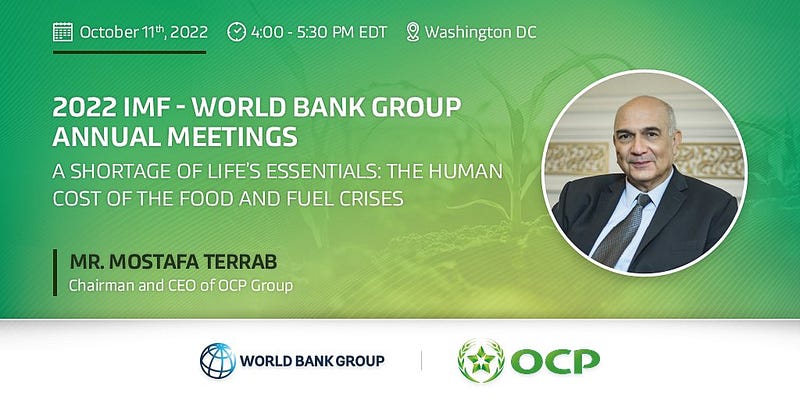
At the event, OCP Group announced that the company would send 4 million tonnes of fertilizers to farmers throughout Africa in 2023.
This initiative is being led by the subsidiary, OCP Africa. According to The North Africa Post, OCP Africa aims to develop a comprehensive farmer-centric approach for agriculture and food security on the African contient.
On Africa’s Green Revolution, OCP Group Chairman & CEO pointed out that it could not be similiar to the Green Revolution carried out by industrial farming practices in other parts of the world. The circumstances of land ownership and ag technology would need to priortized in the context of Africa’s Green Revolution. He compared the Green Revolution to how African countries realized the “telecom revolution” — instead of increasing landline density — which led to the first mobile payment by M-PESA Kenya.
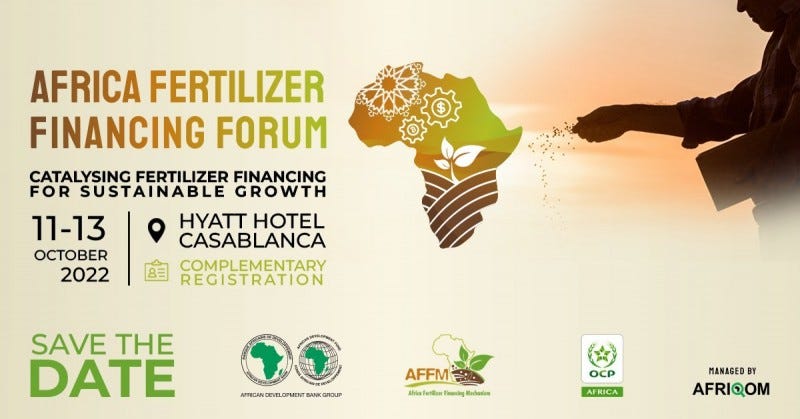
At an event held simultaneously in Casablanca, Morocco, OCP Africa jointly hoted the Africa Fertilizer Financing Forum from October 11–13, 2022, with the African Development Bank Group. The other partner of the event, Africa Fertilizer Financing Mechanism (AFFM), is a key organization to OCP Africa’s initiatives to increase fertilizer supplies and agricultural productivity across Africa.
OCP Group donated 15,000 tonnes of Di-ammonium phosphate (DAP) fertilizer to Rwanda in July 2022.
This kickstarted a wave of Russian attempts to donate its own fertilizer supplies to Africa. For instance, in July 2022, Russian Foreign Minister Sergei Lavrov began the African Tour. This tour coincided with visits from French President Emmanuel Macron and U.S. Special Envoy for the Horn of Africa Mike Hammer to the Middle East and North Africa (MENA) region.
Afterwards, it was reported on 29 July 2022 that Russia’s Uralchem had agreed to send 25,000 tonnes of fertilizer supplies to Africa. It shouldn’t surprise anyone that the sanctions on Russia caused this act of courtesy to be turned into another act of fertilizer diplomacy by Russia. It was reported on 22 September 2022that the sanctions by the European Union (EU) had effectively curtailed Russia’s fertilizer exports to Africa. The Embassy of the Russian Federation also quickly denied a so-called fake press release about fertilizer donations from Uralchem to a Kenyan company on 23 September 2022.
Regardless of what officials and diplomats are doing or saying — or not doing and saying — it’s clear to me that Geopolitics are playing a much greater role in industrial policies around fertilizer and food.
The Odessa Journalreported that Ukraine was able to export 20.2 million tons of grain crops from January-August 2022. These figures are down considerably yoy while China continues to be Ukraine’s main food importer at $749 million (14.4%). The Ukrainian Agrarian Business Club (UCAB) association claimed that much of the success in Ukraine’s agriculture products exports in September 2022 were due to the Istanbul Grain Agreements, which allowed food exports from three Black Sea ports.
From the industry perspective, Yara President & CEO Svein Tore Holsether noted that although Yara International delivered strong results in Q3 2022 that “we remain deeply concerned about the food and fertilizer supply situation in Europe and globally, and repeat our call for urgent action to reduce dependency on Russia.”
While the financial market and investing platform Seeking Alpha highlighted a key fertilizer producer OCI N.V. as well-positioned to outperform their competitors going into 2023. For instance, OCI N.V. is in an advantageous position to withstand higher gas prices due to its available supply of natural gas in the Middle East and North Africa (MENA).
Thus, energy security and dependence shall play another big role in global fertilizer prices and supplies going into 2023.