Favourite Films From Every Year I’ve Been Alive: Part Three (2006–2021)
Part three of an agonisingly difficult selection.
Click here for Part One (1975–1989)
Click here for Part Two (1990–2005)
Herewith the final part of my contribution to an epic writing prompt set by Sir Paul Combs (Knight of the Dillon Empire). The prompt in question, to select one film as a favourite per year, for every year I’ve been alive, is a bit of enjoyable fun for most. Yet for me, someone who eats, sleeps, and breathes cinema, it has left me a shell of a man haunted by the films I omitted, tormented at the memory of those I failed to give an honourable mention.
One last time, here is my selection criteria. For a full explanation, please click the above link to part one and read the introduction, but the following summary of the essentials should suffice if you’re already losing the will to live and want to cut to the chase.
I’m allowing myself one film per director and one film per series, to ensure a wider variety of films. I must also reiterate this is emphatically not a list of what I consider the greatest films, nor even necessarily my absolute favourites from those years. However, each film selected is one I return to time and again, and each film comes highly recommended.
With no further ado, here’s my final selection.
Das Leben der Anderen (The Lives of Others) (2006)
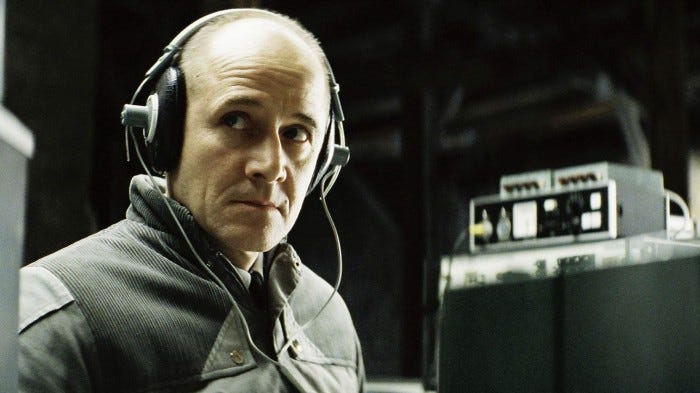
Probably my favourite film of the 21st Century, director Florian Henckel von Donnermarck (quite a mouthful) sucker-punched me with the brilliance of this outstanding slow-burn surveillance thriller pointedly set in 1984 East Germany. It concerns Stasi Captain Wiesler (the brilliant Ulrich Muhe), assigned by corrupt politician Hempf (Thomas Thieme) to dig up dirt on playwright Georg Dreyman (Sebastian Koch) for dubious reasons concerning his sexual obsession with Dreyman’s drug-dabbling girlfriend Christa (Martina Gedek). Unhappy to be a pawn in Hempf’s tawdry affairs, Weisler’s heart of ice begins to thaw as he comes to admire Dreyman and Christa from afar, to the point that he dangerously looks the other way when they become involved in genuine political subversion.
I’ve written at greater length elsewhere about my love for this film (here for instance). However, in summary, this isn’t merely brilliantly acted, scripted, and directed. It is personal to me in a number of ways, not least because I have relatives who lived through the horrors of East Germany. Beyond that, the film almost feels like a personal statement, as inherent within the story are both my political and spiritual beliefs. The latter is represented by Wiesler’s redemptive character arc, but the film is even more than that. As a writer, I find the final act (far too moving to spoil here) deep, profound, and cathartic. Leaving aside such personal musings, I would urge every single human being alive on the face of the Earth (over the age of fifteen) to watch this historically fascinating yet timelessly relevant, gripping, darkly comic, thought-provoking, poignant masterpiece.
The Assassination of Jesse James by the Coward Robert Ford (2007)
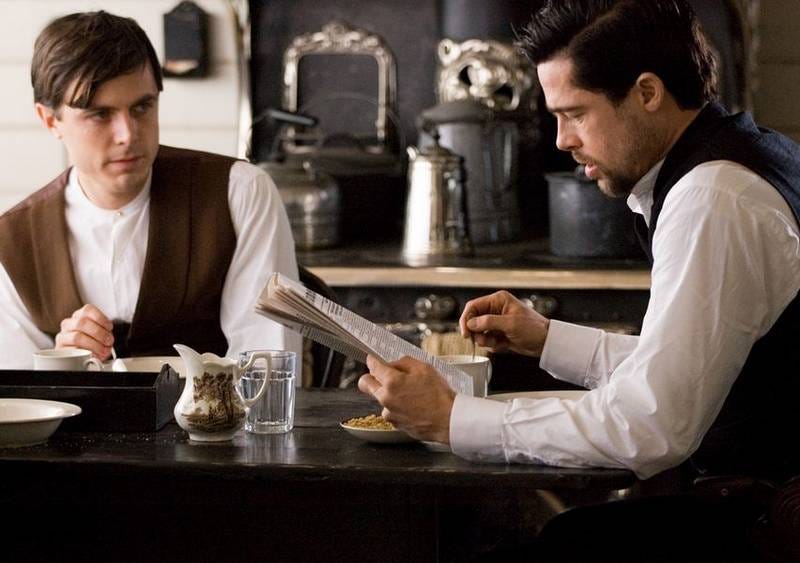
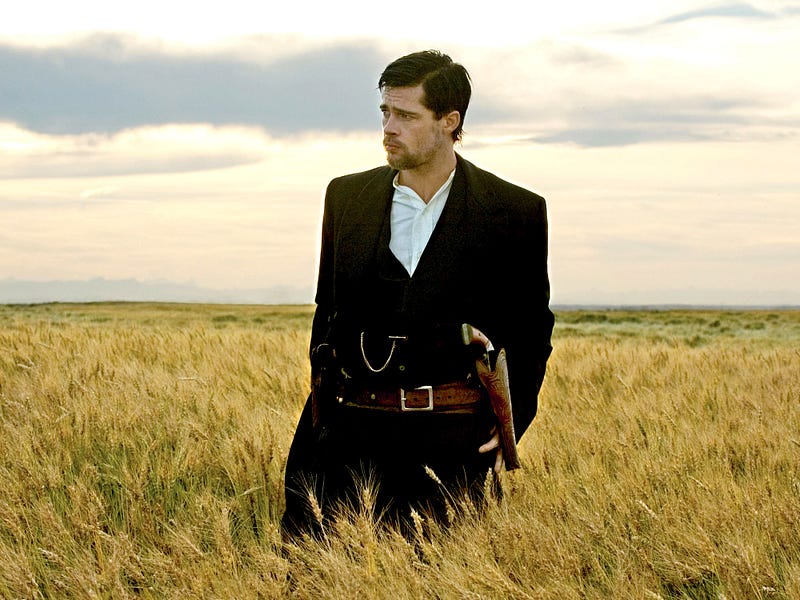
The entire plot of this melancholy two-hour forty-minute western is told in the title. However, it isn’t what happens but how it happens that makes this criminally underrated picture stand out. It seems absurd that a film containing Brad Pitt’s finest performance should see him upstaged by Casey Affleck, yet that’s an indication of the embarrassment of riches contained within director Andrew Dominik’s masterpiece. Other riches include Roger Deakins’s gorgeous cinematography and Nick Cave and Warren Ellis’s haunting score. Mind you, critics weren’t kind to this film when it first appeared. There were a few noble exceptions, including Empire magazine, Mark Kermode, and yours truly, but many reviewers grumbled about the film lacking action, claiming it was long, slow, and boring.
Three of the four epithets above are accurate. Yes, this lacks action. In fact, aside from an early (brilliant) set-piece involving a train robbery, we don’t see Jesse James involved in much criminal activity. Nor is he depicted as the romantic outlaw seen in so many other westerns. As for being long and slow, that’s also correct. This is a deliberately paced, meditative, atmospheric piece of cinema. However, calling it boring is a claim with which I most emphatically take issue. I’d argue this hypnotic gem isn’t a second too long, and what it lacks in action it gains in depth of character. Furthermore, as a study of obsession and worship of celebrity, it is extraordinarily relevant. Jesse James fanboy Robert Ford is slowly soured by the realisation that his idol isn’t all he’s cracked up to be. What’s more, Ford and James’s respective legacies are separated by James having better PR via the penny dreadful fiction that made him a figure of myth in the Old West. It’s a theme that couldn’t be more contemporary. If I’d had my way, this would have won Best Picture (and considering the strength of competition, in a year that also included There Will Be Blood and No Country for Old Men, that’s really saying something).
Slumdog Millionaire (2008)
It’s a Wonderful Life meets Oliver Twist in Mumbai is a crude summary of Danny Boyle’s absorbing, Oscar-winning fable. The key word there is fable as the film’s reputation has dwindled somewhat in recent years, dismissed by cynics as unrealistic. Well of course it is, you dimwits. It’s a fable — a fable that uses realism to good effect, but it isn’t intended as realistic. I still think Slumdog Millionaire is a bloody good film, and I’m utterly unrepentant in my love for it.
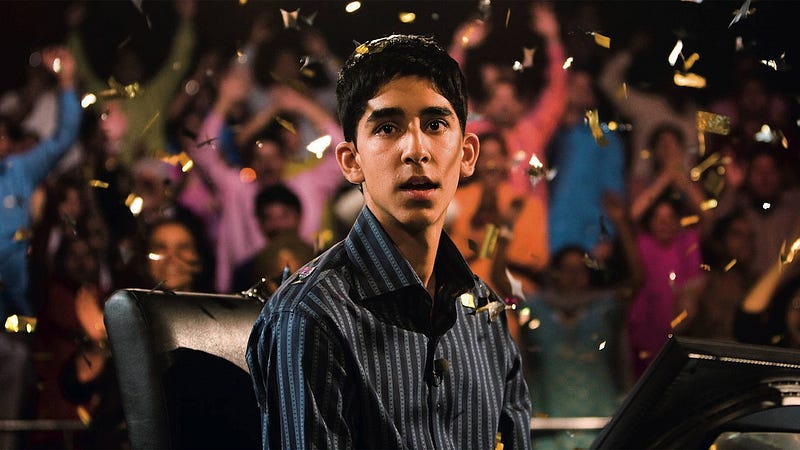
A loose adaptation of Vikas Swarup’s novel Q&A, it tells how eighteen-year-old slum-dweller Jamal Malik (Dev Patel) becomes a contestant on the Hindi version of Who Wants to Be a Millionaire? To everyone’s astonishment (including his), he knows the answers to all the questions, because they specifically relate to incidents from his past, some of them harrowing and tragic. It’s as though fate has intervened. Flashbacks reveal Jamal’s story, which also involves his elder brother Salim (Madhur Mittal) and their friend Latika (Freida Pinto), with whom Jamal later becomes romantically involved. The cast is top-notch, including the younger counterparts of the main trio (Ayush Mahesh Khedekar and Tanay Chheda for Jamal, Rubiana Ali and Tanvi Ganesh Lonkar for Latika, Ashutosh Lobo Gajiwala and Azharuddin Mohammed Ismail for Salim). Boyle’s exhilarating direction, Simon Beaufoy’s superb screenplay, and AR Rahman’s stunning music elevate this propulsive, poignant gem even higher.
Un Prophète (A Prophet) (2009)
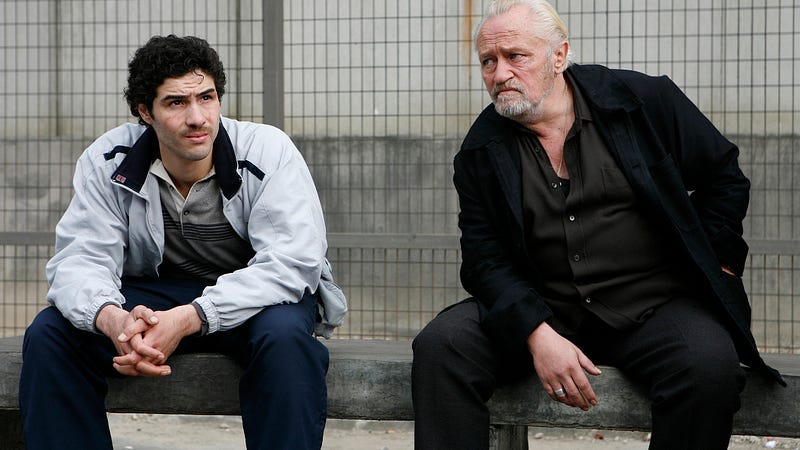
Jacques Audiard’s bold, visceral, fierce prison drama is all Shawshank and no redemption. Malik (Tahar Rahim) is incarcerated for six years for an unspecified minor crime. Once inside he’s ordered by Corsican kingpin Cesar Luciani (Neils Arestrup) to kill Reyeb (Hichen Yacoubi), a key witness in a mafia trial. If Malik fails to carry out these instructions, he will be killed instead. The bloody murder scene that follows, depicting just how difficult it is to overpower and kill a man with a razor blade, will have the hardiest of viewers covering their eyes. Yet in context with the gripping narrative that ensues, I must concede the scene isn’t gratuitous. Any toning down of the violence would have undermined the film.
Performances are all brilliant, especially from Rahim. Audiard’s claustrophobic direction is lean, stripped-down, and gritty, yet also includes tormented visions of Reyeb, amid Malik’s conscience-stricken rise in the prison system to something of a kingpin himself. The mixture of metaphysical and realism works on multiple levels; not just as an uncompromising prison drama, but also as an allegory of modern France in microcosm, with the distrust and suspicion between Muslim, French, and Corsican inmates reflecting present racial and cultural tensions. It is also a critique of not just a corrupt prison system, but a corrupt legal system. Arguments about what the film is saying politically can also be read into the finale. On top of all that, this is a cautionary tale about the perils of ignoring one’s conscience. A masterpiece.
Inception (2010)
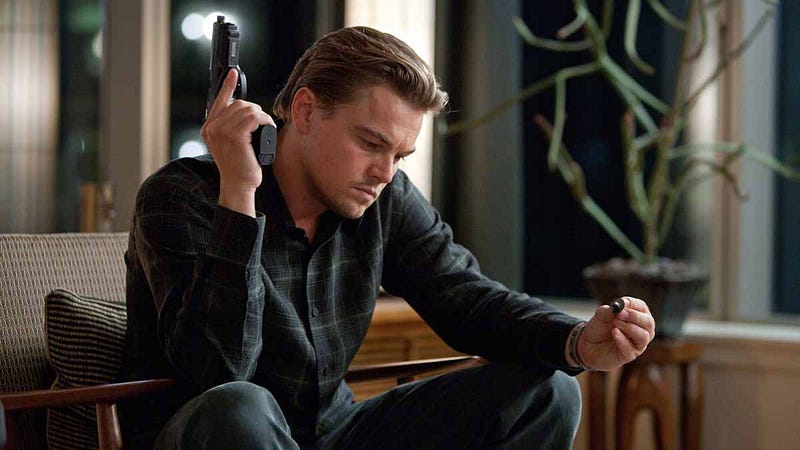
Christopher Nolan is a singular artistic voice and a stern rebuke to the Hollywood idea that big blockbuster filmmaking needs to pander and dumb down, treating audiences as unintelligent. In the case of Inception, Nolan adds non-linear realities to his trademark non-linear timelines, with a truly extraordinary, metaphysical heist action movie. Perhaps the nifty premise — dream infiltration to implant ideas in the subconscious — isn’t entirely original (Dreamscape attempted a similar trick in 1984), but Nolan explored the notion far more intriguingly and satisfyingly.
Performances are uniformly brilliant, especially from Leonardo DiCaprio, who is ably supported by the likes of Cillian Murphy, Michael Caine, Ken Watanabe, Marion Cotillard, Tom Berenger, Ellen (now Elliot) Page, Joseph Gordon-Levitt, Pete Postlethwaite, Lukas Haas, and a particularly amusing Tom Hardy. The sets and mostly non-CGI visual effects are staggering, as is Wally Pfister’s vivid cinematography. Lee Smith’s bafflingly complex yet always coherent editing deserves a special mention, as do the sound effects, and Hans Zimmer’s score. The exhilarating zero gravity fight is a particular stand-out. Critics sometimes claim Nolan’s films have no heart (wrongly, in my view) but the tragic backstory in the past of DiCaprio’s protagonist gives this film surprising emotional urgency, right up to its cleverly teasing final shot. An endlessly rewatchable, visually iconic, mind-bending spectacle of dizzying proportions.
The Tree of Life (2011)
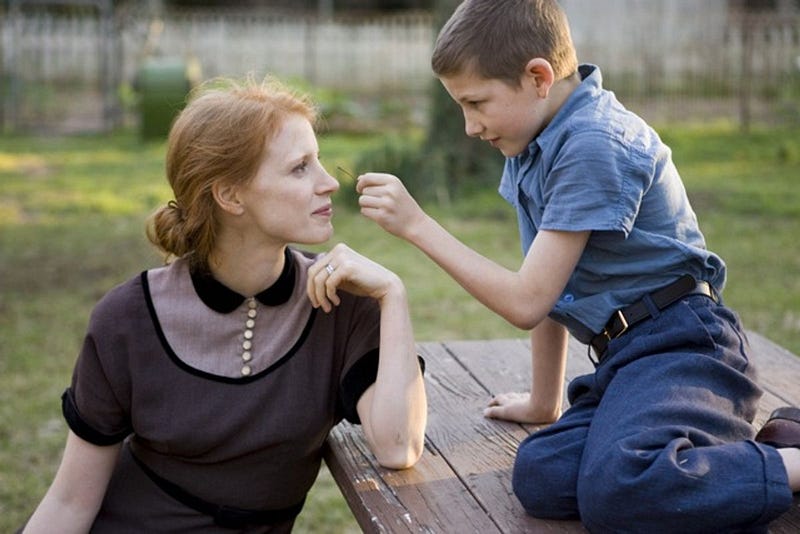
Critics and audiences were divided when this singular feature from Terrence Malick hit cinema screens. Those with a preference for straightforward three-act narratives hated it, but others willing to embrace Malick’s meditative, stream-of-consciousness, intuitive approach were entranced. I found it one of the most staggeringly beautiful pieces of cinematic poetry that I’ve ever experienced. Its ambition and scope are extraordinary, which perhaps isn’t surprising as the film is essentially a riff on the Book of Job.
Much of the dialogue in the film is directed at God in voiceover, as Jack (Sean Penn) looks back on his childhood, and his relationship with his parents. His father (Brad Pitt) encapsulates the way of “Nature” and his mother (Jessica Chastain) the way of “Grace”. Their differing approaches to life are put to the test in the wake of bereavement. This grief is interrupted by a lengthy sequence depicting creation, the dinosaurs, and more. Later, there’s a sequence in heaven. Is Malick overreaching? Is the whole thing just a very expensive way of saying “It’s all right”? Possibly. But this film jabbed so many personal raw nerves that it moved me to tears. I’m not going to get into why here, but I’ve read many stories of how this film has comforted those in pain. For example, I read about a couple who claimed seeing this helped them come to terms with their baby’s tragic cot death. For that alone, God bless Terrence Malick.
En Kongelig Affære (A Royal Affair) (2012)
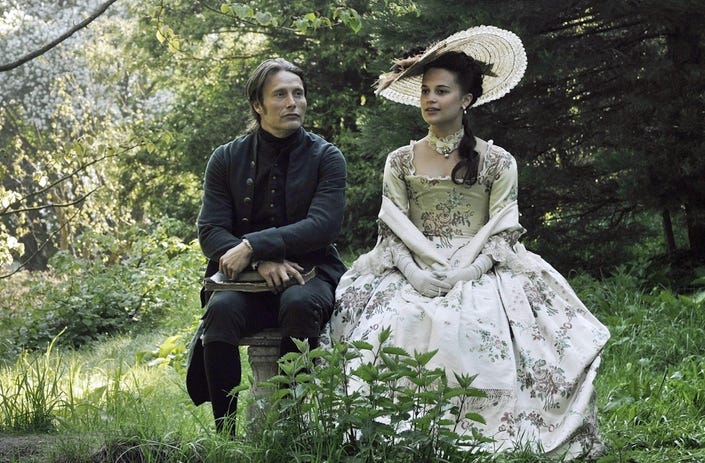
Based on a notorious incident from the Danish royal family in the eighteenth century, this film sees English Princess Caroline Mathilde (Alicia Vikander) finding herself married to insane King Christian VII of Denmark (Mikkel Boe Folsgaard). Trapped in an unhappy life and marriage, she begins an ill-advised affair with royal physician Johann Struensee (Mads Mikkelsen). In his unique position as both lover to the Queen and trusted confidant to the disturbed Christian, Struensee finds he can exert his influence on Danish law. In doing so he begins to make some of his Enlightenment ideals a reality — banning peasant floggings, abolishing censorship, introducing compulsory smallpox inoculations, and so forth. But the bubble begins to burst when money for his rapid reforms runs out, and his increasingly harsh taxes on the estates of the rich cause them to conspire against him.
Director Nikolaj Arcel’s riveting tale of passion, political intrigue, forbidden love, and betrayal is an excellent piece of work, superbly acted by all concerned. As with all the best historical dramas, it reflects contemporary concerns about everything from political corruption to censorship and economic cutbacks. It is also full of dramatic ironies. For instance, Struensee abolishes censorship, then reintroduces it when it suits him. He also encourages Christian to stand up to the politicians and not be their puppet, only for him to end up being Struensee’s puppet. There are also lessons about reform (the dangers of doing too much too quickly), and even the hoary old absolute-power-corrupts-absolutely theme is explored in fresh and exciting ways. If that isn’t enough, A Royal Affair is also a full-on, punch-in-the-guts, emotional rollercoaster in the great tradition of the tragic romantic epic.
Blue Jasmine (2013)
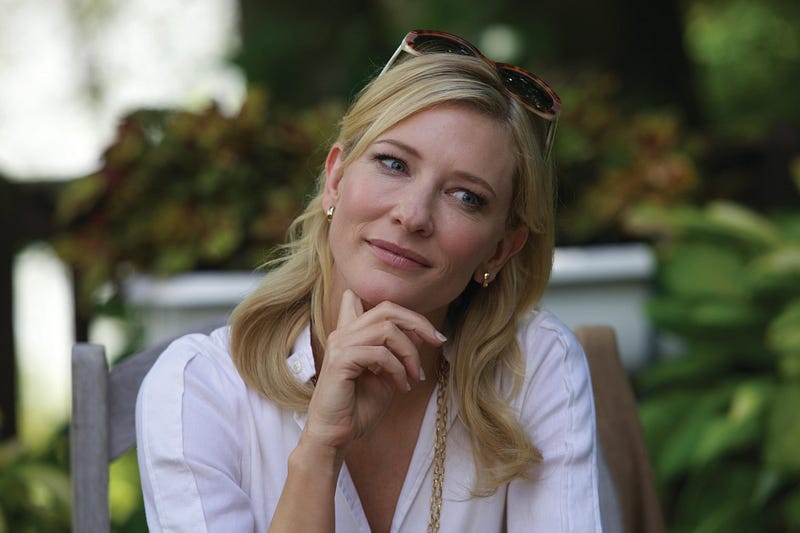
An agonising one as Gravity is so thrilling, but Woody Allen’s bittersweet, melancholy drama just pipped it to the post. Blue Jasmine features an Oscar-winning, career-best turn from Cate Blanchett, as the New York socialite of the title. She has fallen on hard times and seeks solace in San Francisco with her adopted sister Ginger (Sally Hawkins). Flashbacks reveal how Jasmine’s rich, serial-adulterer husband Hal (Alec Baldwin) was indicted for financial fraud, which led to her predicament. Subsequent flashbacks and present events reveal Jasmine as a condescending, selfish, self-deluded, pill-popping, near-alcoholic struggling to remain on the right side of multiple nervous breakdowns.
Although it clearly belongs to Allen’s “serious” works (Crimes and Misdemeanors, Husbands and Wives, and so on), there is nevertheless a deliciously dark, satirical sense of humour running throughout much of the film, even though the comedy is greatly outweighed by the tragedy. There are also echoes of Tennessee Williams’s A Streetcar Named Desire in the way the snobby, delusional Jasmine causes trouble for the downtrodden Ginger, particularly in her outspoken criticism of Ginger’s unrefined but essentially decent steady boyfriend Chilli (Bobby Cannavale). As a character study about how denial prevents change for the better, this is particularly insightful in the subplot involving Jasmine’s attempts to secure aspiring congressman Dwight (Peter Sarsgaard) as another rich husband, with her lying to him at every turn. Ultimately, Blue Jasmine aptly demonstrates the old adage that money cannot buy true happiness. Also — a rarity for Allen — it tackles the subject of infidelity with refreshing maturity and sobriety, clearly laying out the potentially devastating consequences.
The Babadook (2014)

Essie Davis and Daniel Henshall are superb as lonely single mother Amelia, and her young son with behavioural difficulties, Robbie. After an unsettling children’s book mysteriously appears in their home, both are menaced by the supernatural force of the title. About thirty minutes into my first viewing, I experienced that all too rare feeling every horror fan lives for: That I might not make it to the end alive. Of course, being terrorised with such ruthless dexterity by a genius filmmaker jabbing raw nerves is the ultimate masochistic pleasure for someone of my temperament, so leaving the cinema would never have crossed my mind. I wanted The Babadook to hurt, and it did. But it also deeply moved me, as this is a film about grief, guilt, and catharsis. I may have spent my first viewing watching from between my fingers, but I spent my second with tears in my eyes.
Jennifer Kent’s old-school direction eschews CGI and jump-scares, concentrating instead on sheer bone-chilling atmosphere. Radek Ladczuk’s cinematography has a big part to play, cramming every frame with menace whether they be dark interiors, skeletal black tree branches, or bugs crawling out from holes in the wall (from behind wallpaper — an obvious but effective metaphor for Amelia’s repressive approach to dealing with loss). The hugely imaginative sound design is another major plus. Yet for all its psychological terrors, The Babadook is ultimately an empowering film, shot through with deep, humane compassion. If you have the temperament for horror, it’s an absolute must-see.
Victoria (2015)
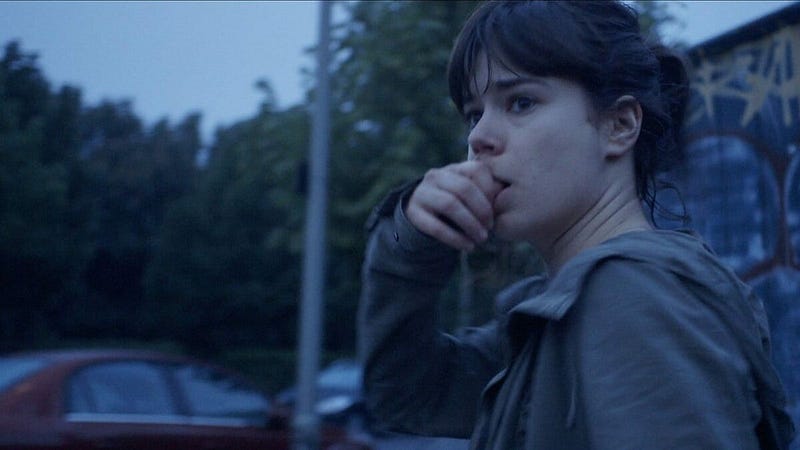
That cinematographer Sturla Brandth appears on the end credits before director Sebastian Schipper of this truly remarkable film is understandable, considering the entire two-hour eighteen-minute running time is one continuous take throughout various locations in Berlin. Not pseudo-one-take ala Birdman or (The Unexpected Virtue of Ignorance) (2014), which used post production digital joins, or Hitchcock’s Rope (1948), where ends of reels are covered by obvious tricks such as moving the camera into the back of someone’s jacket, but genuine one-take, without any cheats. In this case, shooting digitally rather than on 35mm made such cinematic audacity possible.
If Victoria was an elaborate single take and nothing else, for all its technical prowess it could be dismissed as a gimmicky stunt. Yet the film’s beating heart centres around two superb performances: Laia Costa as the eponymous Victoria, and Frederick Lau as small-time, in-over-his-head crook Sonne. I shan’t detail the plot, as this is best experienced with no foreknowledge. What I will say is Victoria is a thrilling, emotionally exhilarating, out-of-body experience of a film. It moves from talky improvised drama/comedy to romance, heist thriller, and melodrama with a gut-wrenching power that left me reeling. By the time the film was over, I felt distraught having to say goodbye to these characters, having rather fallen in love with them.
Hunt for the Wilderpeople (2016)
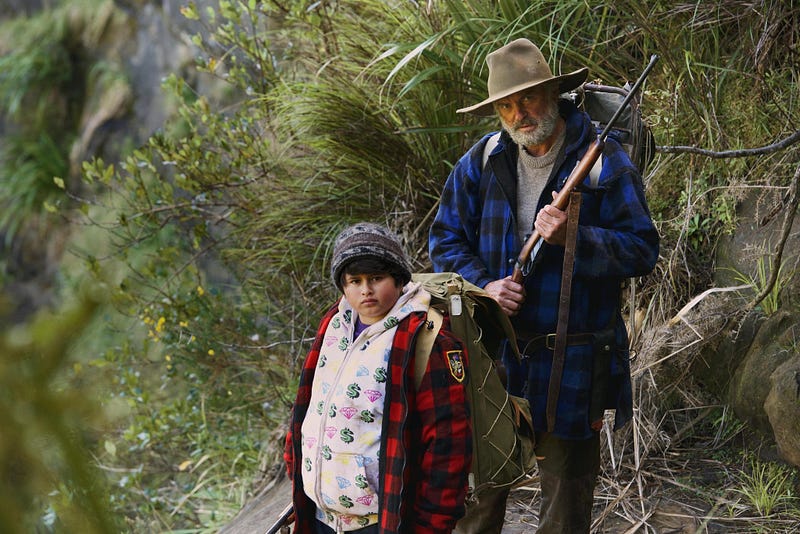
My favourite Taika Waititi film is an adaptation of Barry Crump’s novel Wild Pork and Watercress. It concerns troubled foster kid Ricky Baker (Julian Dennison), who comes to live with Bella (Rima Te Wiata) and Hec (Sam Neill), on their remote farm by the bush. Ricky forms an attachment to Bella, though the gruff Hec is initially a lot more reluctant to have him around. However, a series of unfortunate events lead to Hec and Ricky roughing it in the bush, on the run from the authorities and social services, who mistakenly believe Hec has abducted Ricky. Over time, they begin to bond.
Superbly acted and directed, this offbeat, poignant, frequently hilarious adventure story features some stand-out funny scenes. These include a hysterically inept funeral address with Waititi himself playing the officiating minister, and the farcical pursuit of somewhat unhinged child welfare officer Paula Hall (Rachel House). Yet ultimately, Hunt for the Wilderpeople is a surprisingly touching story about the importance of fostering and adoption. Bella’s Christ-like unconditional love in her determination to look after the neglected, leading to Ricky and Hec’s odd-couple relationship, makes the message understated but clear: Every child, no matter how problematic their background, needs a loving home to develop and grow into their true potential.
Paddington 2 (2017)
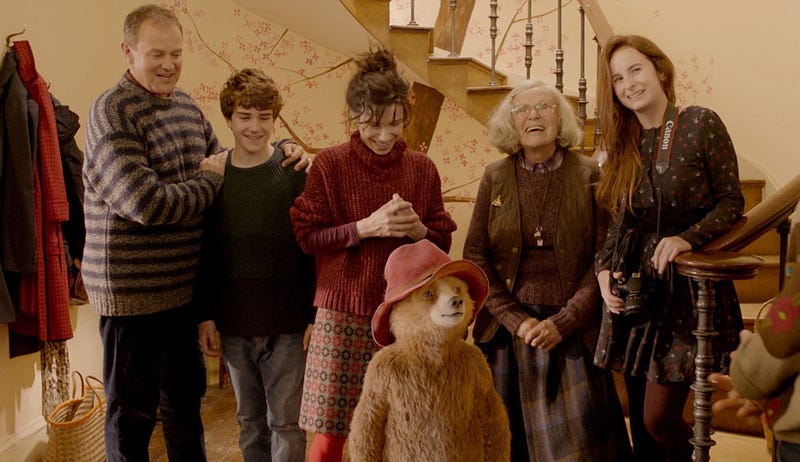
Not many excellent films have sequels that equal their predecessors, but Paddington 2 is a rare exception. This hugely entertaining film involves Peruvian bear immigrant Paddington getting falsely accused of stealing a rare pop-up book. Has-been actor Phoenix Buchanan (Hugh Grant), the man responsible for the theft, wants the book for nefarious purposes, so it’s up to Paddington’s London adopters, the Brown family, to thwart him and clear Paddington’s name. In the meantime, Paddington introduces marmalade sandwiches to a bunch of prison thugs. Hilarity ensues.
Ben Whishaw voices Paddington perfectly and Hugh Grant makes a wonderfully egocentric, master-of-disguise villain. The Brown family cast — Hugh Bonneville, Sally Hawkins, Samuel Joshlin, Madeleine Harris, and Julie Walters — are also on great form. Jim Broadbent returns as antique shop dealer Mr Gruber, along with mean-spirited Mr Curry (Peter Capaldi), and new characters in the form of criminal chef Knuckles McGinty (Brendan Gleeson), and a particularly harassed judge (Tom Conti), both of whom add to the tremendous, whimsical fun. Director Paul King helms some splendid slapstick action set pieces, notably the break-in sequence when Paddington gets framed, and the train chase finale (a thrilling stand-out). In addition to laughs and thrills, the film is perfectly pitched with just the right level of Mary Poppins-esque poignancy, particularly in the note-perfect final scene.
A Star is Born (2018)

I like all versions of A Star is Born, but this one is my favourite. A labour of love for director and star Bradley Cooper, his take on the classic story sees fading, boozing, pill-popping rock/country star Jackson Maine (Cooper) meet Ally (Lady Gaga), after seeing her perform at a drag queen bar. He recognises her diamond-in-the-rough potential, helps launch her career, and they become lovers. But as she rises, he falls. Cooper completely convinces as a professional musician past his peak, whilst Lady Gaga is equally superb at playing someone initially nervous and awkward, despite her obvious real-life talent as a consummate performer. Needless to say, when Lady Gaga sings, the film becomes absolutely electrifying.
As well as great music, there’s a smidgeon of satire concerning the current pop scene (to Jackson’s chagrin, Ally’s producer tries to mould her into something bland and marketable, even though it is clear she has so much more to offer). The story is nigh-on bulletproof, and actually lends itself well to a remake every so often. In this case, Cooper puts a fresh spin on the latter section, with Jackson’s downfall being less about bitterness and jealousy, and more about a lifetime of emotional trauma and addiction. The latter subject is treated compassionately and humanely, with Ally’s unconditional, sacrificial love in the face of Jackson’s drunken antics proving particularly moving. I also want to add a shout for Sam Elliott’s supporting performance as Jackson’s brother Bobby, who proves equally moving.
Parasite (2019)

Bong Joon-Ho’s masterpiece was the first non-English language film to win Best Picture at the Oscars. Donald Trump didn’t approve, but I doubt he saw the film. Even if he did, I expect the inherent (non-preachy) messages concerning social inequalities went over his head. At any rate, this is an absolute must-see best experienced with no foreknowledge whatsoever. A singular, gripping, unpredictable work that defies easy genre definition, it will appeal to even the most subtitle-phobic of viewers.
Parasite is part social satire, part dark comedy, part Hitchcockian thriller (there’s some tremendous, nerve-shredding suspense), and even puts a toe in horror territory. But it is so much more than all these things, and there really is nothing else quite like it. This is a rare example of a film that challenges the notion of what cinema can be, making many other features look bland, predictable, and insubstantial by comparison. Featuring sublime performances (including Song Kang-ho, Lee Sun-kyun, Cho Yeo-jeong, Choi Woo-sik, Park So-dam, Jang Hye-jin, and Lee Jung-eun), superb direction, and a slow-burn narrative that tightens a vicelike grip over the viewer, Parasite rattles around in the subconscious and demands many repeat viewings.
Judas and the Black Messiah (2020)
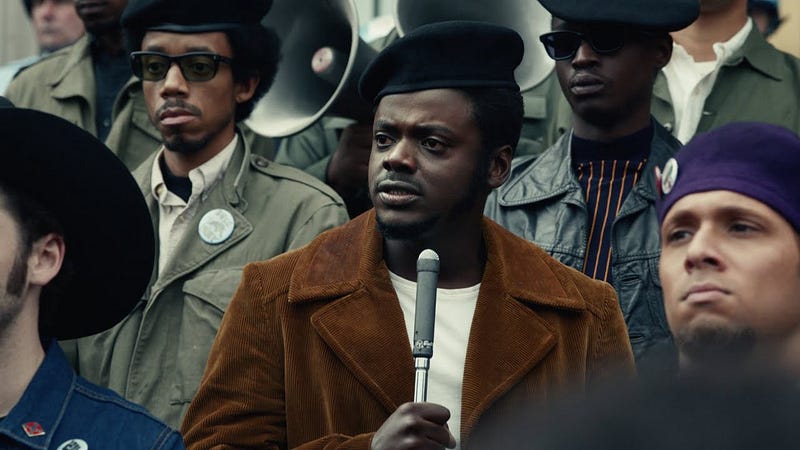
Shaka King’s fact-based film concerns William O’Neal (LaKeith Stanfield), a young man blackmailed by the FBI into going undercover with the Black Panthers, spying on charismatic leader Fred Hampton (Daniel Kaluuya), circa Chicago 1968. King and co-writer Will Berson employ some dramatic licence but remain true to the essence of historic events, capturing the fierce racial tensions with gritty aplomb. Performances are stunning, especially from the Oscar-winning Kaluuya, who demonstrates quiet vulnerability as well as scenery-chewing. Considerable suspense is generated over what will happen when O’Neal is inevitably found out, but even greater anguish is inherent in O’Neal’s escalating guilt and remorse for betraying a cause in which he comes to believe, despite being an FBI informer.
The institutional racism in both the police and FBI is shrewdly depicted. For instance, O’Neal’s FBI handler Roy Mitchell (Jesse Plemons) asserts that the Black Panthers and Ku Klux Klan are two sides of the same coin. This is deftly exposed as a fallacy without editorial axe-grinding, since the Black Panthers had supporters from other racial groups, including disaffected impoverished whites from southern states. A later scene with J Edgar Hoover (Martin Sheen) exposes his own racist hypocrisy. As a result, Judas and the Black Messiah is an irresistibly compelling drama that seethes with rage and contemporary resonance. It made me angry in the best possible way — organically via a great true story with outstanding cinematic kudos.
Dune (2021)
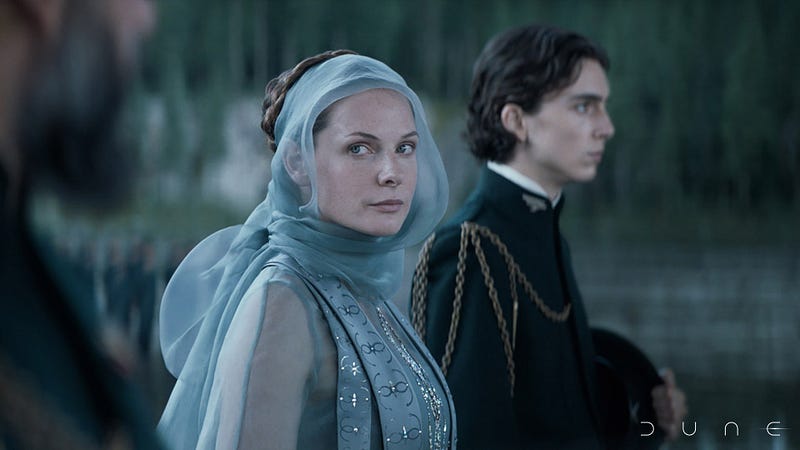
My favourite science fiction novel defied successful translation to cinema until Denis Villeneuve’s bold, confident, faithful adaptation emerged last year. It’s a triumph; a masterpiece of epic cinema that demands to be seen on the big screen. It also features a knockout cast including Timothée Chalamet, Rebecca Ferguson, Oscar Isaac, Charlotte Rampling, Josh Brolin, Jason Momoa, Stellan Skarsgård, Stephen McKinley Henderson, Chen Chang, Sharon Duncan-Brewster, Zendaya, David Dastmalchian, and Javier Bardem. The story — about a future human civilisation reverted to feudalism that depends on a mysterious spice for space travel found only on the desert planet Arrakis — is too dense to get into here, but Villeneuve and screenwriters Eric Roth and Jon Spaihts have done an astonishing job streamlining Frank Herbert’s boundlessly imaginative text.
Villeneuve’s sense of scale is masterful, with vast wormhole portal ships dwarfing the comparatively miniscule spaceships passing through. Yet when they land, they too dwarf the tiny human figures waiting on planetary surfaces. The jaw-dropping desert landscapes, where monstrous giant sandworms lurk, are yet another reason I’ve dubbed this film Lawrence of Arrakis (in addition to deliberate historic parallels to TE Lawrence, and the allegory concerning the world’s dependence on oil). There’s more I could say about the story’s religious metaphors and critique of messiah figures, but I’m barely able to scratch the surface in two paragraphs. Suffice to say, Dune (or Dune Part One, as this only covers half the novel) is a staggering spectacle of immensely satisfying proportions.
I refuse to include an entry for 2022, since the year is not yet over. Also, looking back over this list, I’m disappointed by the many great directors not represented. For instance, no Ridley Scott, Spike Lee, Ingmar Bergman, Akira Kurosawa, Kathryn Bigelow, John Carpenter, or Quentin Tarantino. Plus at least four great Davids — Cronenberg, Fincher, Lynch, and Lean — were omitted, though the latter could only have been included for A Passage to India (1984); a fine film, but not a great in the manner of his earlier classics. No anime either (I almost went with Your Name over Hunt for the Wilderpeople).
Oh, well. As I said at the beginning, this isn’t a list of my favourite films of all time. Although the selection process for this prompt was painful, with time to heal and counselling, I may come to forgive Paul Combs for suggesting it in the first place. I just hope he and Eric Pierce can forgive me for excluding Marvel. To be clear, for anyone else foaming at the mouth about this: I like the Marvel Cinematic Universe a great deal, but none of those films — not even my personal favourite Captain America: Civil War — topped my annual favourite films list. If this enrages you, feel free vent your spleen in the comments. Or better still, write your own list.
Author’s note: I hope you enjoyed this article. For more about me and my writing on Medium, please click here. For information on my writing outside Medium, please click here. For a list of my published novels and other works, please click here.