Captain America: Civil War: 5 Years On
Yes, I know it’s too soon for a retrospective, but this is my favourite Marvel film.
Warning: Contains spoilers
My eldest son is a big fan of the Marvel Cinematic Universe, which means the films are practically a religion in our house and are played on hard rotation. They are to him what the heyday of Spielberg and Lucas is to my generation. Taken cumulatively, they represent an astonishing and unique success story, weaving a rich, entertaining, playful cinematic tapestry across multiple films, whilst never forgetting to make each instalment individually satisfying. With their usual overabundance of artistic integrity, other Hollywood studios have attempted to board the Marvel bandwagon with a vengeance, but no other so-called cinematic Universe has achieved anything like the same level of consistent success.
Avengers: Endgame felt like a significant landmark; a clear signpost ending one MCU era and beginning another. To that end, although it is too soon to see which films in the Marvel series will stand out as classics in future, I’m willing to put my money on one film in particular: Captain America: Civil War. After several viewings, it has overtaken Captain America: The Winter Soldier, to secure the prestigious position of my favourite Marvel movie.
That isn’t to say I didn’t love Civil War from the word go. Apart from anything else, it served as a shining example to a certain Zack Snyder, whose numbing, tedious, charisma-free Batman v Superman clogged up multiplex screens around the same time. This, Zack, is how you pit superheroes against one another.
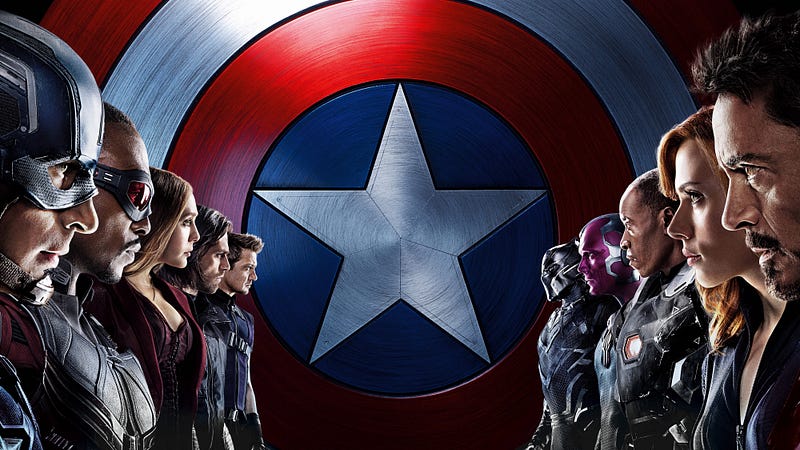
Civil War gets better with every viewing. The plot isn’t overly complicated, but presents a very clear moral dilemma that has no easy answers. Is it better for the Avengers to accept government oversight, or to operate independently? If they accept oversight, what happens when government rulings are corrupt or immoral? Does independence mean the freedom to make the right choice, or does it mean rampant, unaccountable anarchy? Tony Stark aka Iron Man falls on the oversight side of the debate, whilst Steve Rogers aka Captain America refuses to be answerable to authorities whose motivations could be compromised by politically dubious motives.
The Russo Brothers explore this quandary with wit, charm, and a plethora of thrilling action scenes. More importantly, unlike Zack Snyder they have the nerve to follow through on their premise, creating a genuine, irreversible schism between the Steve Rogers and Tony Stark schools of thought. Which side you take will depend on your political persuasion, and there are certainly merits to both. I have friends who are firmly in Iron Man’s camp. For the record, I am on Cap’s side.
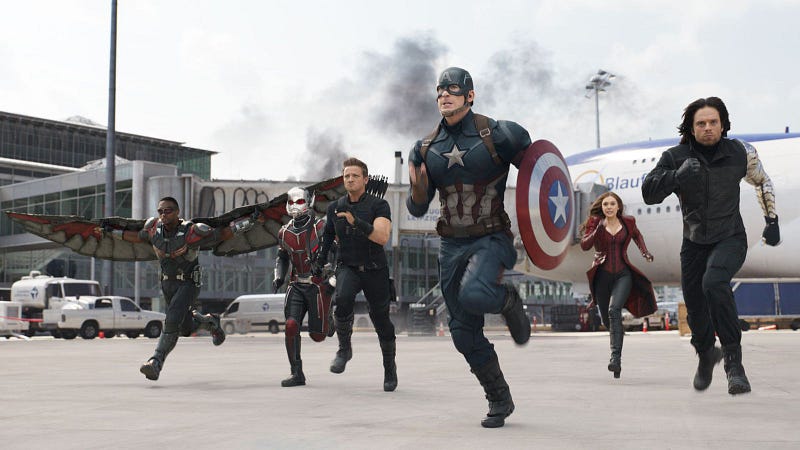
At its most basic level, Civil War is an exceptionally well put together superhero picture. Chris Evans and Robert Downey Jr are at the very top of their game. The supporting cast, including Sebastian Stan, Scarlett Johannsson, Anthony Mackie, Don Cheadle, Jeremy Renner, Elizabeth Olson, Paul Bettany, Paul Rudd, Tom Holland, and especially Chadwick Boseman, also make outstanding contributions. The Russo Brothers exhibit tremendous dramatic flair in both verbal and physical confrontations, deftly leavening the potentially heavy subject matter with a generous quantity of humour. The stand-out action sequence at the airport is a perfect example.
Yet Civil War is more than that. For me, it is the most emotionally resonant of the Marvel films because it asks the audience to feel sorry for all sides in the conflict, including the villain, Baron Zemo. The excellent Daniel Brühl is quite superb in the role, offering motivation and nuance rare in the superhero genre. He is a man grieving the loss of his family, dead due to cataclysmic actions taken in Avengers: Age of Ultron. Quite understandably, he blames the Avengers. His bitter desire for revenge is his fatal flaw, one shared by another key character in the narrative: Wakandan prince T’Challa aka Black Panther.
Black Panther’s character arc in Civil War is particularly satisfying, and introducing him here is a stroke of genius (by contrast, Spider-man’s introduction is wisely relegated to comic relief, given audience familiarity with the character). T’Challa’s father is killed in an explosion caused by Zemo, sending him on a quest to find the man responsible. The irony is Zemo’s own family was also killed as collateral damage, making him responsible for the very thing he swore to avenge. After T’Challa discovers the truth behinds Zemo’s machinations, and his plan to tear the Avengers apart, he lays aside revenge, overcoming the flaw Zemo could not:
“Vengeance has consumed you. It’s consuming them. I’m done letting it consume me.”
Then we come to Tony Stark. Civil War is almost as much an Iron Man film as it is a Captain America film, in view of the revelations concerning the deaths of Tony’s mother and father, and the involvement of Bucky Barnes aka the Winter Soldier. Again, Stark’s anger at Bucky is entirely understandable. Even if he was in brainwashed assassin mode, and is now reformed, he still killed Tony’s parents.
Finally, there’s Cap himself, whose unshakeable loyalty to his best friend is here tested to the absolute limit. Yet the key Steve Rogers moment comes earlier, during Peggy Carter’s poignant funeral scene. Peggy’s niece by marriage, Sharon, tells Steve the advice she once gave her:
“Compromise where you can. Where you can’t, don’t. Even if everyone is telling you that something wrong is something right. Even if the whole world is telling you to move, it is your duty to plant yourself like a tree, look them in the eye, and say ‘No, you move.’”
At that point, Peggy’s advice to Sharon becomes a quietly moving posthumous affirmation of Steve’s moral code. He cannot, will not, and does not let her down. He stands his ground. Again, we entirely understand why, and sympathise with his response, even though it means enmity with Tony Stark.
Civil War is a superhero spectacle telling a relatable human story. For once, we aren’t dealing with things-of-ultimate-power and crazed supervillains attempting to take over the world. Instead, we’re dealing with universally resonant themes of law versus liberty, the futility of vengeance, and the importance of counting the cost before taking a moral stand. In Civil War, there are real, lasting consequences to Captain America’s actions. For instance, the crippling of James Rhodes aka War Machine, and the imprisonment of Hawkeye and other Cap loyalists. Yes, they may end up putting their differences aside to fight Thanos in subsequent films, but that doesn’t detract from this film’s dramatic weight.
In conclusion, some say Avengers: Infinity War is The Empire Strikes Back of the Marvel Universe but for me it is Captain America: Civil War; a tremendously satisfying blockbuster entertainment, and my favourite Marvel movie.
Author’s note: I hope you enjoyed this article. For more about me and my writing, please click here.


