
British Network Television
‘Father Brown’: S03.E02. “The Curse of Amenhotep”
Lady Caterina Beresford, after expressing an interest in opening Amenhotep’s sarcophagus, dies in mysterious circumstances
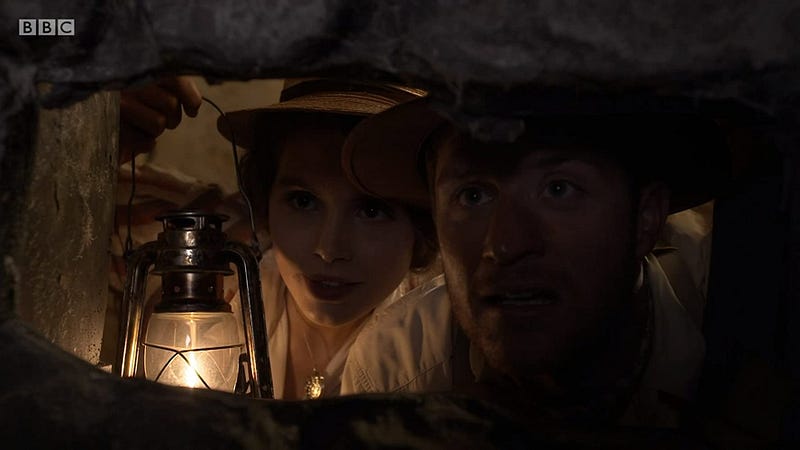
Matt Carter’s The Curse of Amenhotep, with a story penned by Jude Tindall, opens with a scene set in Egypt. It’s 1928 and an archaeological team as discovered the last resting place of Amenhotep. Amenhotep was an Eighteenth Dynasty Egyptian pharaoh.
Seconds after the sarcophagus is opened, something we should have immediately saw coming, part of the chamber collapses onto Sir Raleigh and Lady Evelyn Beresford. Whilst Sir Raleigh survived the roof collapsing, the same can’t be said for Lady Evelyn.
Leaping forward to 1953, we find Lady Felicia Montague, Father Brown, and Bridgette McCarthy visiting with Professor Walter Hubble at the Beresford Museum.
Lady Felicia, more intent talking about writing her novel, doesn’t seem interested in the Beresford Collection or the historical context.
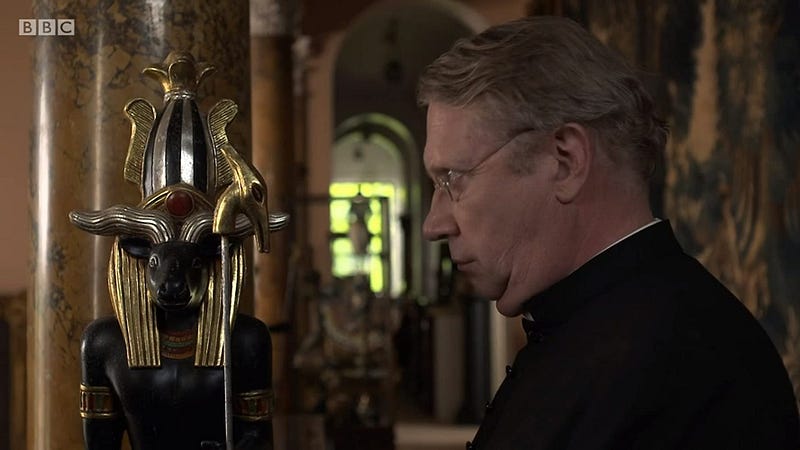
Father Brown episodes, even though we are talking about a classic British period drama, invariably provide television viewers with numerous opportunities to observe behaviours and thought patterns we see play out in contemporary life.
Lady Felicia’s presence in this episode, as one can immediately assume, is merely a way to explain why it is Father Brown and Mrs McCarthy is at the Beresford Museum.
Father Brown, even though he has previously been known to describe himself as a bumbling idiot, sees patterns not obvious to other people. The title character, not one to ignore the smallest of coincidences, typically leaves no stone upturned in his pursuit of the truth.
The Catholic priest, even though his attention to detail could be seen as an asset, has been a thorn in Inspector Sullivan’s side.
Mrs McCarthy, with apparently no middle ground, is one of those characters people seem to either love or hate. Her attitude frequently borders on xenophobia.
When Professor Hubble references a complete set of Twelfth Dynasty Egyptian embalming tools, not surprisingly, Mrs McCarthy expresses her usual intolerance for anything not Christian. It is almost as if Mrs McCarthy believes religious freedom exists exclusively for Christians.
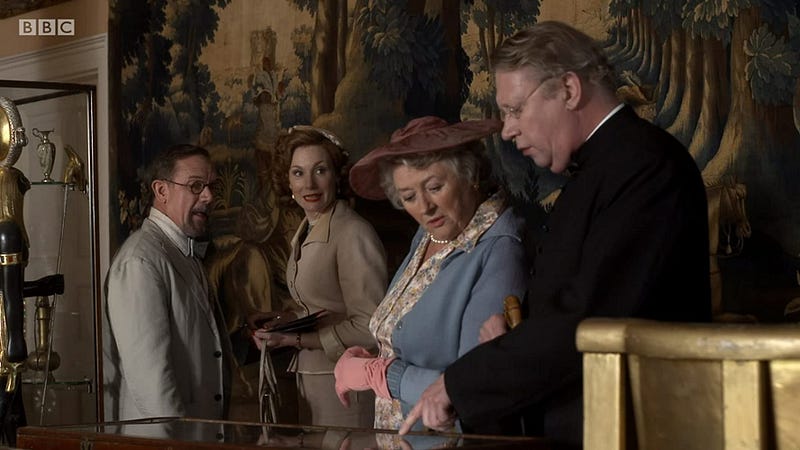
These early scenes, ones where the professor explains the significance of the Egyptian tools, shows Mrs McCarthy possessing a somewhat limited education.
Obviously, with ancient Egyptian not being in Mrs McCarthy’s wheelhouse, the parish secretary is unaware Professor Hubble was talking about tools that predates Jesus’s birth by more than 1,750 years.
The burial practices Mrs McCarthy references, not that she would know the historical fine points, wasn’t originally a Christian concept. Jews, Greeks, and Romans are known to have buried their dead. Greeks and Romans were also known to perform cremations.
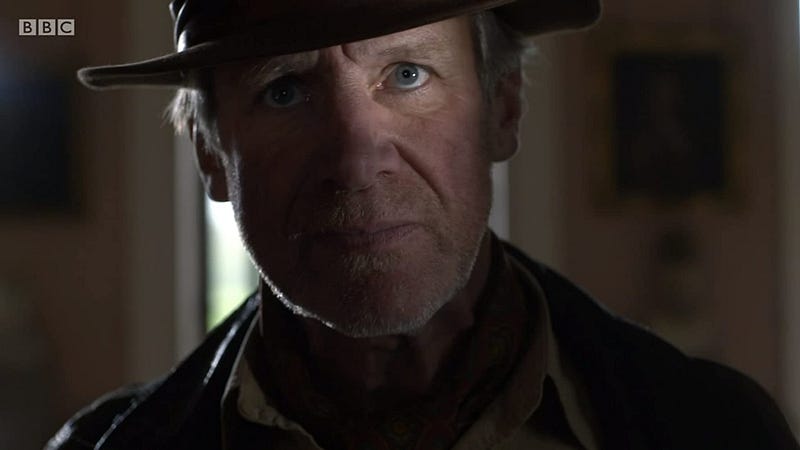
Sir Raleigh, recast for the character’s post-opening credits scenes, has a certain vibe about him which is supposed to point towards a British Indiana Jones. The more mature Sir Raleigh, now married to Lady Caterina Beresford, is less likely to engage in dangerous activities.
Lady Caterina, whilst there is much that can be said for the actress’s talent, seems a tad two dimensional. Even though there is nothing likeable about the character, not long into the episode, we find Lady Caterina poisoned.
If it weren’t for Father Brown, noting how the Catholic priest hardly ever misses anything, the episode subplot would go completely unnoticed. It turns out Sir Raleigh’s first wife, Lady Evelyn, was incapable of bearing children. If you are wondering where Leo Beresford came from, with Lady Evelyn being infertile, that would be Valerie Oliphant.
Mr Beresford, raised as a son to Sir Raleigh and Lady Evelyn, was never aware his real mother was Miss Oliphant. In many ways, as we can see from her interactions with her son, there is a real mother’s love.
For many years, even though Miss Oliphant seemingly never expressed any real interest in him romantically, Professor Hubble had his sights firmly set on her. His desire for Miss Oliphant, every time he looked at her, was readily apparent. Miss Oliphant was never going to choose being with the professor over access to her son.
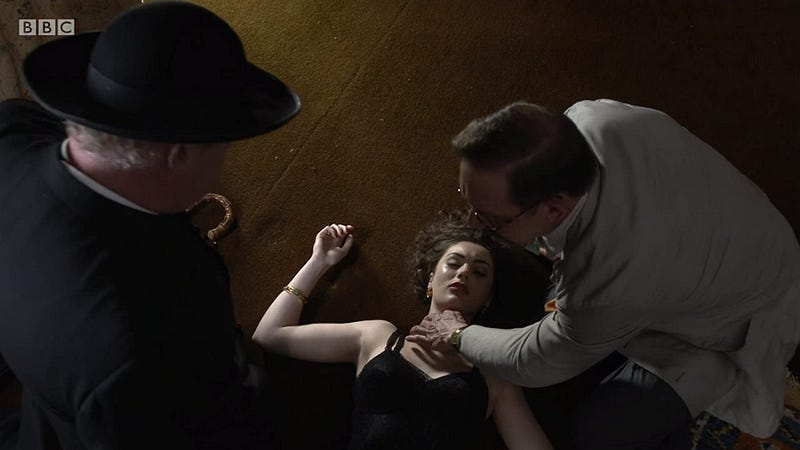
Professor Hubble, not wanting his crime discovered, poisoned Lady Caterina with his eye drops. Lady Caterina had wanted to look inside Amenhotep’s sarcophagus.
If Sir Raleigh had allowed her to open it, on doing so, she would have found nothing. Professor Hubble had sold the content to buyers of ancient antiquities. These buyers, less than scrupulous, were prepared to not ask questions. Amenhotep’s remains had been dumped in the nearby lake years earlier.
Father Brown, if it weren’t for Lady Felicia and Mrs McCarthy, came close to finding his end when the professor trapped the Catholic priest inside the sarcophagus.
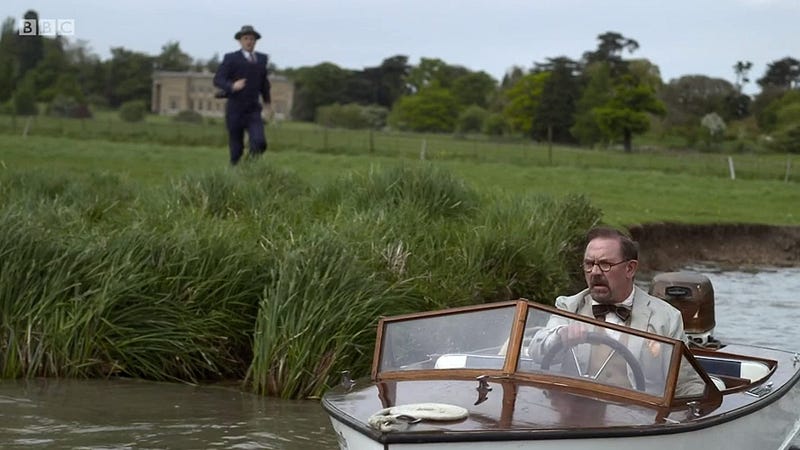
Trying to escape, Professor Hubble came close to drowning in the very lake he dumped Amenhotep’s remains. The vintage boat, perfect for the period which Father Brown is set, adds a degree of authenticity to the scene.
Inspector Sullivan, risking his own life, went into the water after the professor. The police inspector, in wet clothing and a towel, should know better to refuse a nice cup of tea from Lady Felicia and Mrs McCarthy.
Main Cast …
Mark Williams … Father Brown
Sorcha Cusack … Bridgette McCarthy
Nancy Carroll … Lady Felicia Montague
Alex Price … Sidney ‘Sid’ Carter (Credits Only)
Tom Chambers … Inspector Sullivan
John Burton … Sergeant Daniel Goodfellow
Guest Cast …
Chris MacDonald … Sir Raleigh Beresford (1928)
Genevieve Gaunt … Lady Evelyn Beresford (1928)
David Bamber … Professor Walter Hubble
Geraldine Alexander … Valerie Oliphant
Nicholas Farrell … Sir Raleigh Beresford (1953)
Poppy Corby-Tuech … Caterina Beresford
Josh O’Connor … Leo Beresford