
BRITISH NETWORK TELEVISION
‘Father Brown’: S02.E01-E10. “Series Two”
Do you remember Father Brown: Series Two?
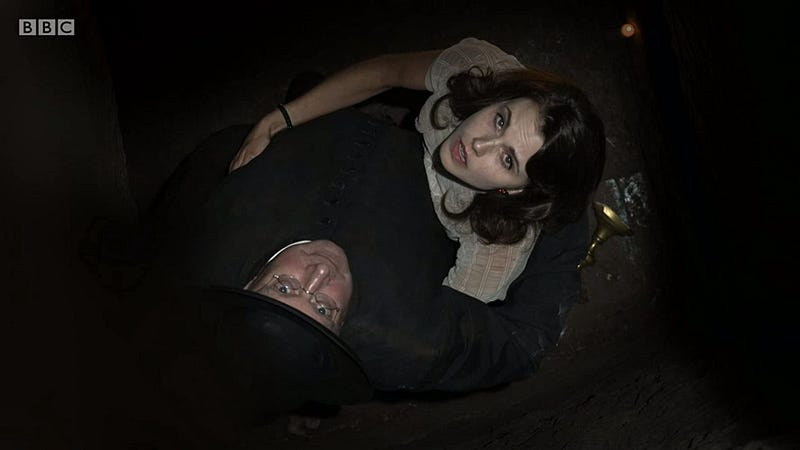
Father Brown’s second series, premiering with the Matt Carter-directed episode The Ghost in the Machine, begins the year off with a seriously sinister tale. The episode, with a story written by series co-creator Rachel Flowerday, begins with an unusual request.
Charlotte McKinley, convinced that her sister Elsbeth Granger is haunting her house, calls Father Brown out in the middle of the night to conduct an exorcism. Father Brown, mainly because he doesn’t believe in ghosts, flatly refuses.
Elsbeth, missing for years, was believed murdered by Charlotte’s husband Victor. This titbit of information, not that the St Mary’s parish secretary is one for malicious gossip, comes from Bridgette McCarthy.
Victor hadn’t been prosecuted because there was no evidence tying him to her disappearance. Lady Felicia Montague, contrary to everything Mrs McCarthy believes, thinks Elsbeth simply eloped.
When Mrs McKinley vanishes from her study, even though Inspector Valentine is suspicious of her husband, Father Brown is appropriately sceptical. The solution, with clues pointing to a historical hiding place, reveals no crime committed.
This Father Brown second series episode, The Maddest of All, opens with a strange scene. One of Father Brown’s former parishioners, Felix Underwood, can be seen stumbling through the village dressed only in a hospital gown.
Bridgette McCarthy, nearby, berates Inspector Sullivan for not taking her issues seriously. The newly appointed police inspector has more important things on his mind. His attention is soon drawn to the strangely dressed man. Mr Underwood, after collapsing in Inspector Sullivan’s arms, only manages to utter the word “murder” before dying.
Mr Underwood’s wife, Dorothy, reveals to both the police inspector and Father Brown that her husband had been a residential patient the Danvers Retreat. The Danvers Retreat, a local clinic specialising in treating shell shock and trauma related problems exhibited in former military service personnel, is under Dr Walter Henshaw’s direction.
Dr Henshaw, when Father Brown and Inspector Sullivan speak with the facility’s director, reveals Mr Underwood had been making progress. Despite the progress, according to the doctor, the patient had apparently been prone to sleepwalking.
During the funeral, when Mr Underwood’s body is suddenly reanimated, everyone attending the service is shocked. What could this possibly mean?
Father Brown, seeking answers, feigns mental illness to get himself admitted to the clinic. It doesn’t take long for the Roman Catholic priest to learn that Dr Henshaw is experimenting on his patients.
The discovery of a dead body in a well presents Father Brown and Inspector Sullivan with a murder for them to solve. Will the new police inspector tolerate Father Brown poking his nose in where it isn’t wanted?
The Paul Gibson-directed Father Brown episode The Pride of the Prydes opens with a sequence that takes us back to late fifteenth century England. Picture it: It’s 1488 and Lord Udolf Pryde has sentenced local woman, Branwen, to be burned at the stake for being a witch. Branwen, specifically targeting every first-born son, curses the Pryde family.
The episode brings us forwards to the contextual present day, 1953, where we find Audrey Diggle retelling the story in a book documenting the history of the Pryde family. The reading was done in preparation for an upcoming public open day event at the historic Pryde estate.
During a tour of the grounds, in vivid vibrant detail, Miss Diggle recounts Branwen’s story to the assembled visitors. Branwen, according to Miss Diggle, was killed by her archer son moments before she was to see death by fire. It is at this moment when an arrow strikes Miss Diggle in the back.
Whilst it is initially thought the arrow incident is all part of the show, quickly seeing something is wrong, Father Brown observes Miss Diggle is really dead.
Inspector Sullivan, accompanied by Sergeant Allbright, arrive on the scene. The police inspector, not having been informed of the open day, initially thinks finding the killer would be a somewhat quick and easy task as people typically don’t carry a longbow with them on a daily basis.
The police inspector soon discovers, with numerous people dressed in period costume and carrying medieval weaponry, the murder will take a lot longer to solve.
The police inspector, because of a legal dispute between tennent farmers and the Pryde family, immediately suspects Alan Archer of murdering Miss Diggle. Only an idiot would suspect a man named archer of murdering anyone with a bow and arrow. That, even for a Father Brown episode, would be too much on the nose. All Pryde family members are known to use a longbow.
Father Brown, when a page from the parish birth records goes missing, is convinced that the motive lies in the Pryde family’s past.
This second series Father Brown episode, The Shadow of the Scaffold, opens with Father Brown preparing to take Violet Fernsley’s confession. Violet, convicted of killing her pig-farmer husband whose body has never been found, is given a temporary reprieve from the gallows when she claims she is pregnant.
The pregnancy test gives Father Brown three days to find the real killer. When her husband’s finger turns up in a pig’s stomach, it points to a serial killer amongst the family. Father Brown’s investigation concludes God’s law is above man’s law.
The Lannington Rosary, missing for 500 years, is a relic blessed with healing powers. Professor Hilary Ambrose has sent an ancient prayer book containing a clue to its whereabouts to his old friend Father Brown, before he goes missing and his home is ransacked.
Father Brown receives unexpected help from French thief Hercule Flambeau. Monsignor Ignatius, terminally ill, desperately seeks the rosary to heal both himself and others.
The Matt Carter-directed Father Brown episode, The Daughters of Jerusalem, opens with a meeting at the Kembleford Women’s Institute. Father Roland Eager, with plans to show his documentary film revolving around African orphans, soon finds himself embarrassed when a pornographic film is shown.
Even though Lady Felicia Montague seems amused by the entire affair, noting her facial expression, the same can’t be said for St Mary’s Parish Secretary Bridgette McCarthy. Meanwhile, elsewhere, Father Brown isn’t feeling his usual chipper self.
Father Brown, confined to his attic bedroom, has a broken leg. Consequently, because of Father Brown’s condition, Father Eager is acting as his locum. Lady Felicia, seeing how Father Brown could become bored, dispatches Sidney “Sid” Carter to the St Mary’s Presbytery with a telescope.
The telescope, as we soon discover, is very useful. Father Eager, intent on seeing repairs to St Mary’s Catholic Church move forwards, implements a ‘Raise the Roof’ campaign. As the episode progresses, in the days following the meeting, two Women’s Institute members are murdered.
Judith Bunyon is poisoned, and not long thereafter, Vera Thimble is stabbed with a hatpin. PC Hywel Pugh, being the first policeman at each crime scene, has his theories.
The presence of a Raise the Roof envelope near Mrs Thimble’s body clearly suggests Father Eager had payed her a visit. Dianah Fortescue, whose husband was earlier arrested in a Soho pornographic cinema, is detained by Inspector Sullivan for questioning. The police inspector is repeatedly dismissive of the constable.
Father Brown, insistent on investigating the murders, is aided by Mrs McCarthy, Lady Felicia, and Sid. Is Mrs Fortescue a suspect or a potential victim? Father Brown learns Mrs Bunyon, Mrs Thimble, and Mrs Fortescue gave evidence against Albert Evans in a trial where he was found guilty of molesting and murdering a four year-old girl.
Mr Evans was hanged for the crime. The real murderer, years later, was discovered. Revenge is clearly the motive. Father Eager, something Father Brown immediately notices, is behaving in a seriously odd manner.
The Paul Gibson-directed Father Brown episode The Three Tools of Death, originally televised in the British Isles on Tuesday, 14 January 2014, opens with Sir Aaron Armstrong observing his daughter, Alice, undergo brutally painful electroshock therapy. The therapy, administered by a psychiatric doctor, is used to restore Alice’s memories. Miss Armstrong had accidentally killed her mother.
When Sir Aaron is murdered and a rope, gun, and knife are left behind, chauffeur Jim Magnus is suspected. Peter Royce, Armstrong’s private secretary, is also suspected. The truth, as Father Brown begins to uncover family secrets, reveals a conclusion about the deaths Inspector Sullivan might not have ever considered.
There is nothing quite like a Father Brown episode that begins with a scene set in the middle of a thunderstorm. The Ian Barber-directed Father Brown episode The Prize of Colonel Gerard, originally televised in the British Isles on Wednesday, 15 January 2014, opens with a boy wondering around in the dark with a lit candle. What could this child possibly be doing in the dead of night?
It is obviously long past his bed time. The following horrifying sequence reveals Edward Gerard was experiencing a nightmare. Jia-Li Gerard, Colonel Cecil Gerard’s adopted daughter, comes to her brother’s aid. The nightmare, considering Mr Gerard’s screams, must be significantly terrifying.
Colonel Gerard, having sent his adopted daughter to bed, warns his son to stay away from Miss Gerard. Mr Gerard, a prisoner of war who returns from North Korea sympathetic to his captors, greatly displeases his martinet uncle, Colonel Gerard, who threatens to commit him to an asylum.
When the Colonel is murdered, the suspects include Edward, the Colonel’s daughter who was going to run away with Edward, the brother-in-law, and the victim’s wife, Edward’s mother. Father Brown finds the solution lies in the family history and the Colonel’s sexual intentions with his adopted daughter.
This second series Father Brown episode, The Shadow of the Scaffold, opens with Father Brown preparing to take Violet Fernsley’s confession. Violet, convicted of killing her pig-farmer husband whose body has never been found, is given a temporary reprieve from the gallows when she claims she is pregnant.
The pregnancy test gives Father Brown three days to find the real killer. When her husband’s finger turns up in a pig’s stomach, it points to a serial killer amongst the family. Father Brown’s investigation concludes God’s law is above man’s law.
The Shadow of the Scaffold, written by series co-developer Rachel Flowerday, was originally televised in the British Isles on Thursday, 9 January 2014.
The Matt Carter-directed episode The Grim Reaper, originally televised in the British Isles on Thursday, 16 January 2014, introduces us to two of the most obnoxious characters ever featured. The Grim Reaper, with a story penned by David Semple, serves as the second series penultimate episode.
Farmer John Tatton and his son, Alfred, are like oil and water. There is nothing about these characters that suggests they should be in the same room for any great time. Farmer Tatton, remembering how his late wife died, feels Alfred is taking a similar drunken path.
Later, when at the doctor’s surgery, there is a tense uneasy moment between Alfred and Dr Adam Crawford regarding his young wife. The farmer’s son suggests Dr Crawford isn’t man enough to satisfy Oona Crawford’s sexual needs. Mrs Crawford, in a brief conversation with Bridgette McCarthy, confirms she is carrying her husband’s baby.
Not long thereafter, mangled in farm machinery, Alfred is discovered dead. Letters pointing the accusatory finger of blame towards Dr Crawford are circulated around Kembleford. It is believed Mrs Crawford, even though she adamantly denies it, was having an affair with Alfred.
Dr Crawford, hiding a secret of his own, confesses to the murder. Father Brown, feeling there is more to the story, starts his own investigation. The Catholic priest, with help from his friends, soon arrives at the truth.
The Paul Gibson-directed episode The Laws of Motion, the second series finale, introduces us to rally driver and property owner Audrey McMurray.
Mrs McMurray, even though she might appear somewhat philanthropic, is a ruthless businesswoman with a heart of stone. Her treatment of tenants, highlighting this point, caused Harriet Welsby’s husband to kill himself. Mrs Welsby, in a confrontation that looks most satisfying, slaps Mrs MacMurray across the face.
Further, in an unrelated storyline, Mrs MacMurray openly cheats on Walter with mechanic Gary Bakewell. Mrs MacMurray’s sexual relationship with Mr Bakewell suddenly ends when he catches her with Sidney ‘Sid’ Carter.
Shortly thereafter, an accident that causes Lady Felicia Montague to scream like a banshee, Mrs MacMurray is killed in a hill climb. It is soon discovered someone had tampered with the car she was driving. The brake cables had been cut. Mrs Welsby, because of her earlier altercation with Mrs MacMurray becomes Inspector Sullivan’s prime suspect and is arrested.
Later, when Mr Bakewell confesses, Father Brown suspects the young mechanic is trying to protect Mrs Welsby. The Catholic priest, not convinced either Mrs Welsby nor Mr Bakewell are responsible for Mrs MacMurray’s untimely death, believes Mr MacMurray might have had a hand in his wife’s demise.
Father Brown, after visiting the MacMurray residence, discovers Mr MacMurray and his wife’s secretary, Phyllis Stanwyck, have something they would rather Inspector Sullivan not know.
Inspector Sullivan, constantly annoyed with Father Brown poking his nose in where it isn’t wanted, isn’t initially convinced Mr MacMurray or Miss Stanwyck capable of murder.