
British Network Television
‘Father Brown’: S02.E06. “The Daughters of Jerusalem”
When Mrs Bunyon is killed after a row at a cake baking contest, evidence is gathered for Father Brown to unmask the murderer
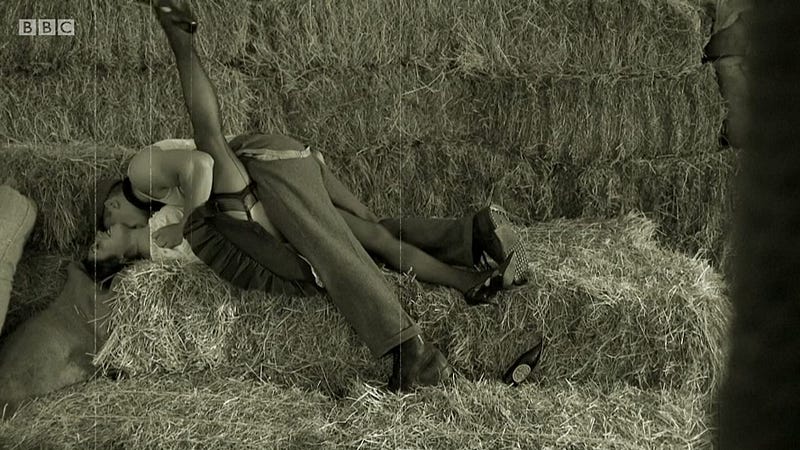
This Father Brown episode, The Daughters of Jerusalem, opens with a meeting of the WI. Father Roland Eager (James Rastall), filling in for Father Brown (Mark Williams), has a film documentary of his recent missionary work in Africa. Noting the title of the documentary, Educating the African Orphan, the Catholic Church’s approach to education is seriously questionable.
On the poster printed for the event, immediately after Father Eager’s documentary, there is a cookery talk scheduled. The cookery talk, oddly titled Going Gay without Meat, is presented by a Mrs Hunnisett. Before we get as far as the cookery talk, completely disrupting the event, someone swaps out Father Eager’s documentary for a pornographic film. This apparent pornographic film takes the phrase “a roll in the hay” a little too literally.
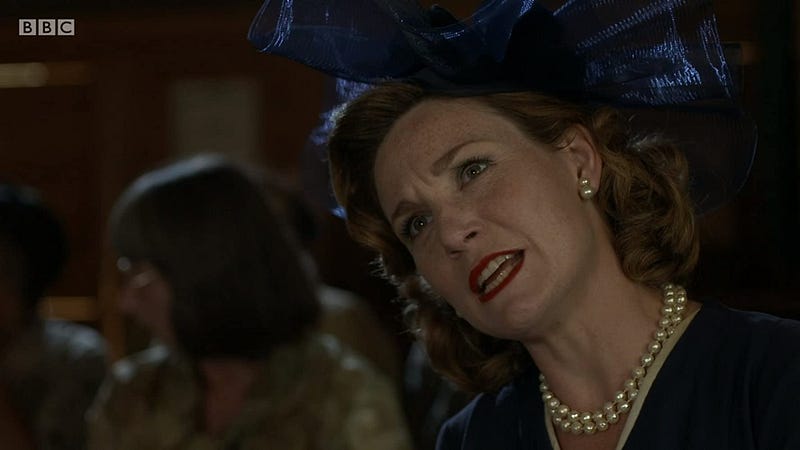
Everyone, except for Lady Felicia Montague (Nancy Carroll), is shocked by the spectacle. Lady Felicia, despite Mrs Bridgette McCarthy (Sorcha Cusack) being appalled, finds the film educational. When it comes to sexual matters, as one would expect from the parish secretary, Mrs McCarthy has a very stiff upper lip.
The next day, at the presbytery, Father Eager presents to Father Brown his suggestion for raising money to fix the church roof. Why is it always the roof that needs fixing? Naturally, mainly because she never needs her arm twisting, Mrs McCarthy is the first to make a small donation to the fund.
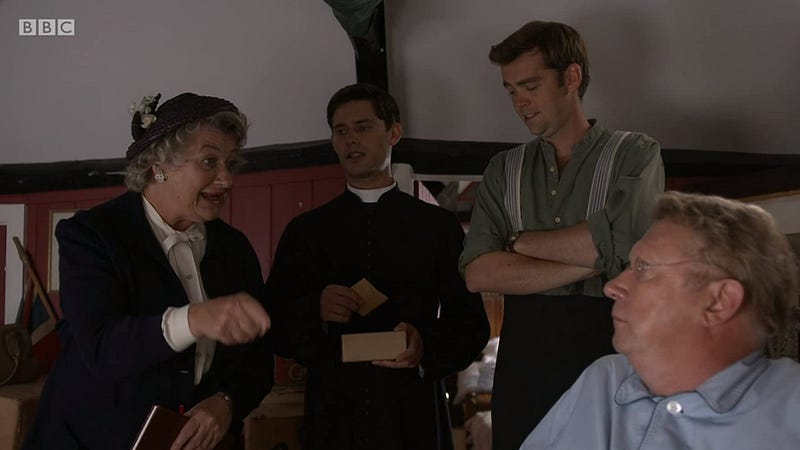
Shortly thereafter, with Sidney “Sid” Carter (Alex Price) arriving, Father Brown is presented with a gift of a telescope from Lady Felicia. Lady Felicia apparently thought the telescope would somehow alleviate Father Brown’s boredom. It doesn’t take long for Sid to reference the pornographic film. Mrs McCarthy isn’t amused Sid would mention it. Father Eager immediately protests his innocence. The young Catholic priest, with Father Brown recovering from having a broken leg, is acting as locum.
Later, with his head poking out of his bedroom window, Father Brown spies Constable Hywel Pugh (Justin Edwards) carrying flowers and immediately guesses this is a gift for his girlfriend. Gladys Clam (), the constable’s girlfriend, is a comely widow.
It is here that the constable informs Father Brown that Inspector Sullivan (Tom Chambers) is investigating the happening at the WI meeting. The police inspector is seemingly forced into the investigation because a VIP guest that was in attendance of the meeting just happens to be related to the Chief Superintendent. There is also a reference to there being significant tension in the village because of the coming fair. These events attract a significant competitiveness.
The fair seems like a nice event. Dinah Fortescue (Clare Higgins), the WI chairwoman, overhears Judith Bunyon (Annette Badland) joking about the film mix-up. Mrs Fortescue obviously has no sense of humour because she immediately scolds Mrs Bunyon for being so slanderous.
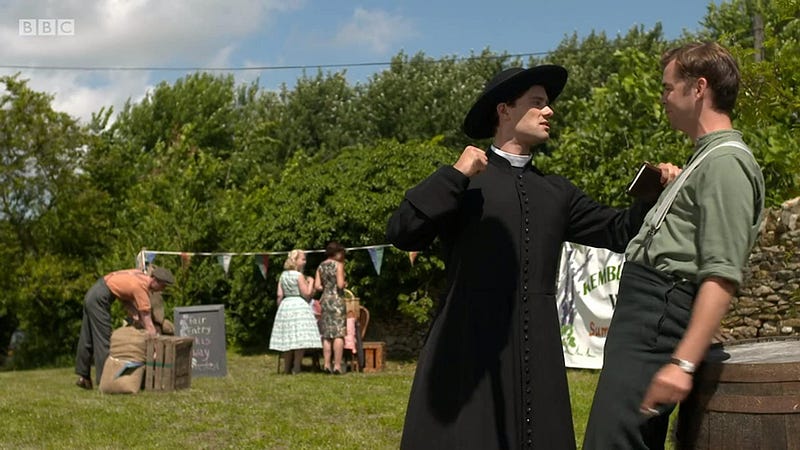
Someone else that clearly has no sense of humour is Father Eager. Sid, as regular viewers of the series will know, can be somewhat merciless when it comes to mocking people he doesn’t like.
It is obvious Father Eager can be easily antagonised. Father Eager, seemingly forgotten how a certain religious figure surrounded himself with undesirables, lacks the morals frequently demonstrated by Father Brown.
Father Eager, irritated by the chauffeur’s mocking, threatens to punch Sid. He quickly regains his clerical composure and walks away from the chauffeur. I wonder if Father Brown saw this with his newly acquired telescope.
Father Brown, from his bedroom window, observes George the Royal Mail Postman handing to Mrs Bunyon a letter. Noting her surprise at receiving a letter, it doesn’t look like she receives very much mail.
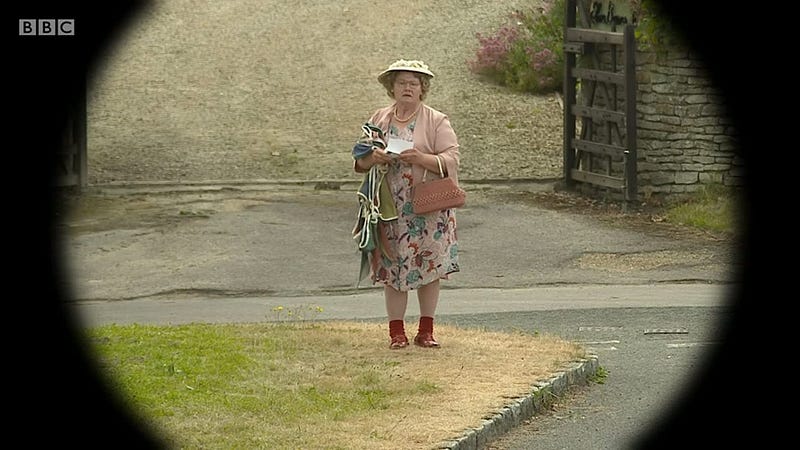
On opening the letter, with more than a hint of horror on her face, there is something pertaining to this letter which suggests terrible news. She tosses the letter away in a nearby rubbish bin before making her way to the fair. Mrs Bunyon is interested in learning the results of the WI baking competitions.
At the awards ceremony, as tensions fly high between Mrs Bunyon and Vera Thimble (Janet Henfrey), there are accusations of cheating. Mrs Thimble, even though she was nowhere near the tent when it happened, accused Mrs Bunyon of switching the cakes around. If you were paying attention, something that was clearly visible, it was Mrs Fortescue that switched the cakes. PC Pugh tries his best to defuse the situation.
Mrs McCarthy, with her apparent award winning strawberry scones, is shocked she didn’t win for her competition entry. Consequently, because of this misfortune, Mrs McCarthy vents her anger at Lady Felicia.
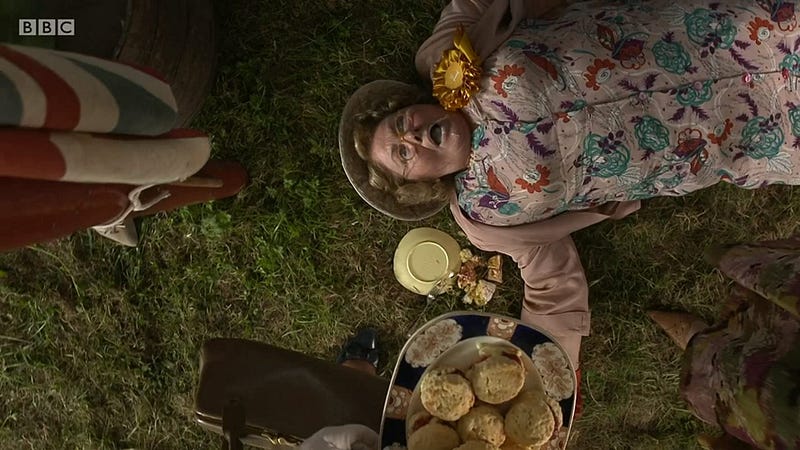
Lady Felicia, the stand-in judge, tells Mrs McCarthy that it was a blind taste test. Suddenly, in the background, we find Mrs Bunyon collapsing to the ground. The sudden death causes Lady Felicia to scream.
Inspector Sullivan, not taking long to arrive at the scene, immediately suspects Mrs Bunyon was poisoned. The police inspector is surprised to find no Father Brown at the crime scene. Father Eager, as PC Pugh correctly observes, is no Father Brown.
PC Pugh finds it amusing Father Eager, in comparison to the regular Catholic priest, has a very weak stomach. Father Eager’s issues with dead bodies is readily apparent. Inspector Sullivan sends a sample of the cake she was eating off to be examined. PC Pugh is dismissed from the crime scene.
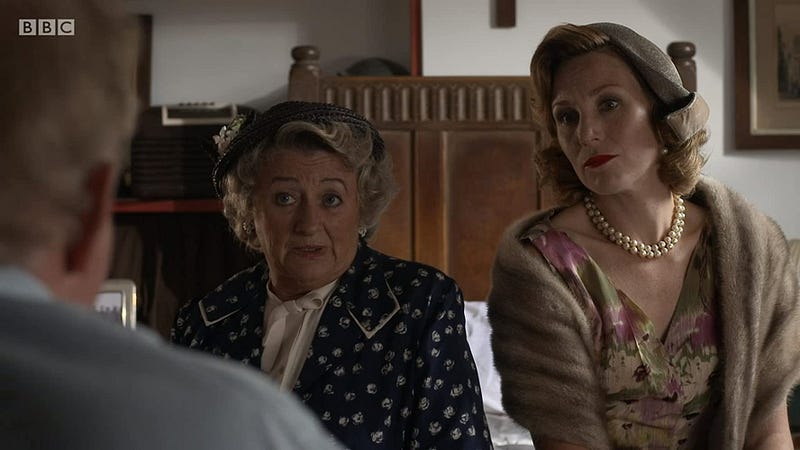
Mrs McCarthy and Lady Felicia, having dropped by the presbytery, speak with Father Brown about Mrs Bunyon and her apparent murder. Father Brown, immediately curious about the case, asks Mrs McCarthy to tell him about Mrs Bunyon.
Mrs McCarthy speaks of the now late Mrs Bunyon as being a gossip. Lady Felicia, with her reference to casting the first stone, correctly notes Mrs McCarthy is every bit as much as gossip as Mrs Bunyon. Lady Felicia, not being wrong, clearly knows as gossip when she sees one.
Father Brown, placed in a difficult position by Mrs McCarthy, must determine which one of the two women are more useful to him and his investigation. Not able to choose between Mrs McCarthy and Lady Felicia, something we should have seen coming, Father Brown sends both of them to retrieve the discarded letter.
Lady Felicia, despite wearing expensive gloves, extracts the letter fragments from the rubbish bin. The letter contains a string of numbers and a reference to Proverbs 19:9:
A false witness shall not be unpunished, and he who speaketh lies shall perish.
Father Brown correctly recognises it as a threat aimed directly at Mrs Bunyon. Mrs Bunyon, a notorious gossiper, was apparently not liked in the village. The finger of suspicion is soon pointed towards Mrs Fortescue. There are unsubstantiated rumours floating around the village Mrs Fortescue’s husband likes to watch pornographic films. The films Jeffery Fortescue () does or doesn’t watch shouldn’t be of any consequence to anyone.
Mrs McCarthy and Lady Felicia, with letter in hand, take it to Kembleford Police Station. PC Pugh informs them that Mrs Bunyon’s cake was laced with wasp killer.
Later, with the use of his telescope, Father Brown observes a shaken Mrs Thimble confronting Mrs Fortescue over a letter she has received. Mrs Fortescue, knowing nothing about the letter, strongly refutes sending it as personal confrontation is more her style.
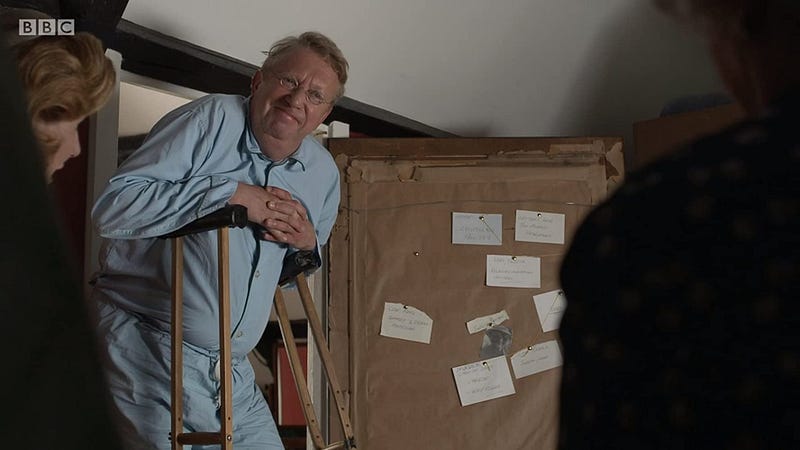
Lady Felicia, after an off-camera visit to the post office, informs Father Brown she was able to identify the writing paper by the watermark. This particular brand of writing paper had been sold to Mrs Fortescue, Mrs Thimble, and Mrs McCarthy.
Sid, despite Mrs McCarthy believing him ridiculous, suggests Father Eager could be a suspect as he had direct access to the writing supplies the parish secretary purchased from the post office.
Father Brown, not wanting to cause any arguments between the three of them, sends them to speak with Mrs Thimble. When Lady Felicia and Mrs McCarthy enter Mrs Thimble’s residence, Sid notices Father Eager behaving somewhat oddly. Father Eager, depositing a letter in a nearby Royal Mail postbox, isn’t aware Sid is watching him.
PC Pugh, with him sticking out like a sore thumb, was also walking past the residence when Lady Felicia and Mrs McCarthy entered the building. Sid was too focused on Father Eager to notice the passing policeman.
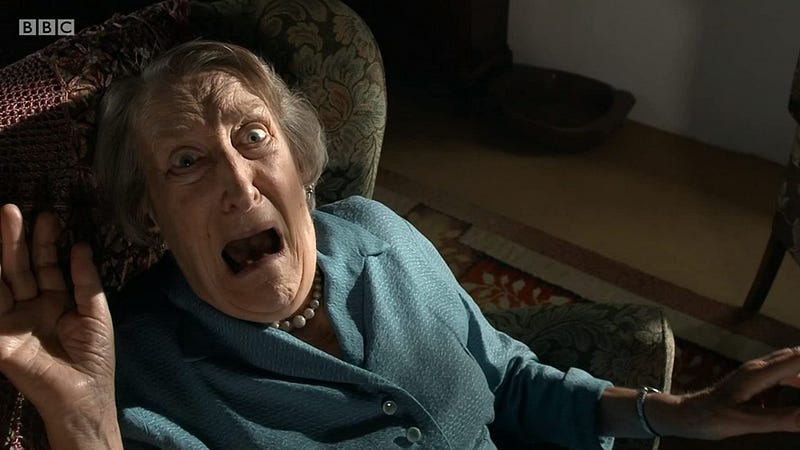
The scene cuts to Lady Felicia and Mrs McCarthy finding Mrs Thimble’s dead body. Mrs Thimble had been murdered with a hatpin. The presence of a second teacup on the nearby table clearly indicates she had been murdered by someone she knew because taking tea with strangers was never her thing.
The presence of a Raise the Roof envelope near Mrs Thimble’s body clearly suggests Father Eager had payed her a visit. Even Mrs McCarthy, with her noted living for the visiting Catholic priest, can’t deny he had been in Mrs Thimble’s house.
Mrs McCarthy goes for the police. Even though Mrs McCarthy had told Lady Felicia to not touch anything, remembering how she typically does her own thing, there is immediate snooping when the parish secretary left the building. It doesn’t take long for Lady Felicia to locate the letter Mrs Thimble received. It perfectly matches the one Mrs Bunyon received. Mrs McCarthy soon returns with PC Pugh.
Elsewhere, needing Sid to make a run to the local bookies to place a bet, rings the bell. Instead of drawing Sid’s attention, with Father Eager having come to the door, Father Brown tells him that he can’t reach the parish magazine. Noting the presence of a horse racing related publication on the floor, switching on the radio to confirm his suspicions, Father Eager quickly establishes Father Brown’s true intent.
There is a hint of annoyance in Father Eager’s voice which suggests he doesn’t approve of Father Brown’s activities. An innocent note left with Father Brown by Father Eager points the Kembleford Catholic priest toward cracking the code from Mrs Bunyon’s letter.
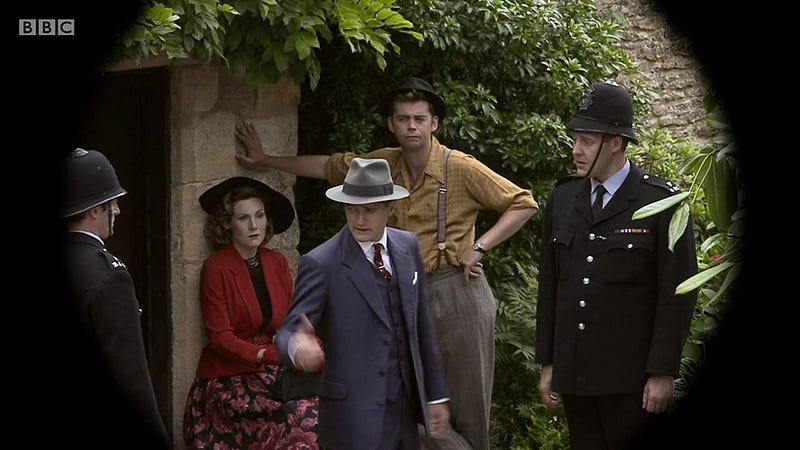
The sound of an approaching police car draws Father Brown’s attention to the window. Father Brown observes from his bedroom window Inspector Sullivan arriving at Mrs Thimble’s residence. The police inspector, with a casual wave of his hand, once again dismisses PC Pugh.
Later, back at the presbytery, we hear Father Brown conversing with Mrs McCarthy regarding Mrs Thimble and her killer. It is assumed, because there were two teacups visible on the table, Mrs Thimble must have known her killer.
The second teacup, according to Mrs McCarthy, had a smudge of lipstick. Lipstick isn’t something Mrs Thimble ever wore. Father Brown reveals he has cracked the code: 28111926900 is Sunday, 28 November 1926 at 09:00.
Father Brown, needing someone to go to the public library, has Lady Felicia and Mrs McCarthy doing a little digging in the newspaper archive. They return with information pertaining to an execution that occurred on the specified date and time.
Albert Evans, a known wife beater and drunk, was sentenced to death for raping and strangling 14-year-old Daisy Butler. If this is historically accurate, something that wouldn’t have occurred in these United States, this execution took place on a Sunday.
The newspaper article Mrs McCarthy and Lady Felicia discovered in the library archive is dated Monday, 29 November 1926. Mr Evans conviction was secured thanks to the eyewitness testimonies from Mrs Bunyon, Mrs Thimble, and Mrs Fortescue.
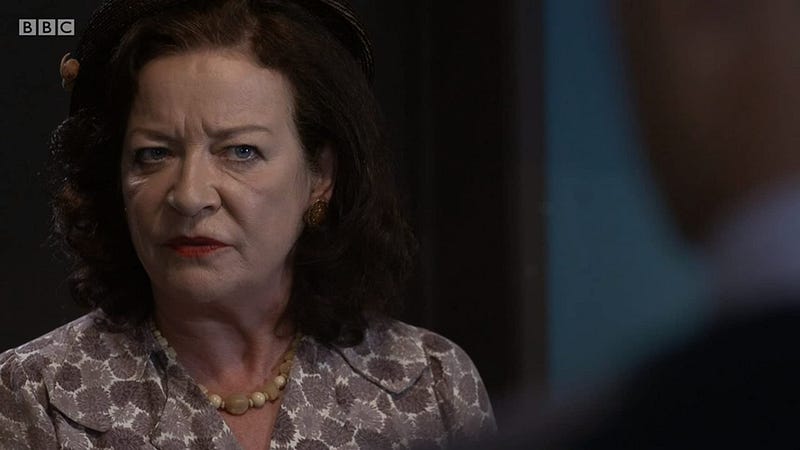
Elsewhere, at the Kembleford Police Station, we find Mrs Fortescue being questioned by Inspector Sullivan. The hatpin used to kill Mrs Thimble had her fingerprints. As for the second teacup, noting the shade of lipstick, that also belonged to Mrs Fortescue.
Inspector Sullivan, with evidence showing Mr Fortescue had been previously arrested for frequenting an illegal pornographic cinema, suspected Mrs Fortescue of murdering both Mrs Bunyon and Mrs Thimble because they knew too much. Even though Mr Fortescue was never charge, with him being a county court judge, the blot on his reputation would be devastating. The police inspector charges Mrs Fortescue with both murders.
There is a noticeable tension between Father Brown and Father Eager, during an exchange of words, which suggests the former knows something about the latter. Does Father Brown know an unsavoury fact Father Eager would rather have left buried?
Mrs McCarthy, during a teabreak, suddenly realises the teacups in Mrs Thimble’s house didn’t match. Mrs Thimble, similarly to how Mrs McCarthy took pride in her award winning strawberry scones, took amazing amount of pride in her tea set.
Mrs Thimble’s tea set was anything but cheap. The teacup with Mrs Fortescue’s lipstick on it was cheap china. Consequently, because of this find, it is suggested the cheap teacup was planted there to frame Mrs Fortescue.
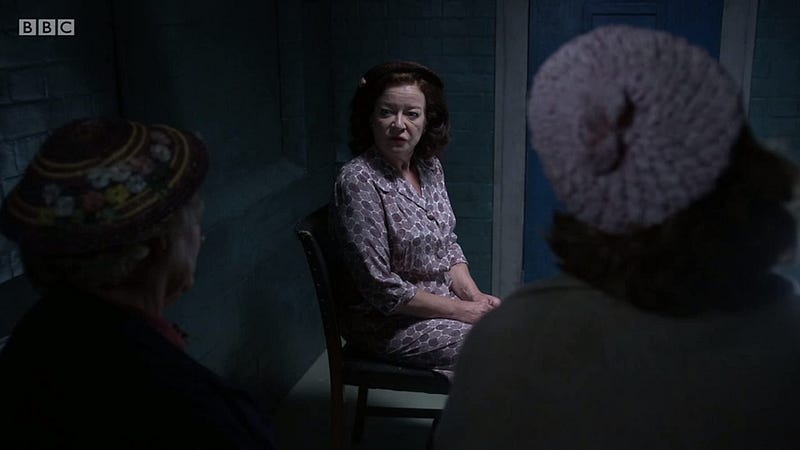
Lady Felicia and Mrs McCarthy, in a cell at the police station, is allowed a few minutes to speak with Mrs Fortescue. Mrs Fortescue, even though they believed at the time Evans raped and murdered the 14-year-old girl, reveals the real killer confessed many years later. Evans, with him having been executed for the crime, was posthumously pardoned.
Father Brown, back at the presbytery, suddenly figures out the identity of the killer. A gravestone for Iris Evans, visible from Father Brown’s bedroom window, mentions a son named Stephen. It doesn’t take long for Father Brown to figure out PC Pugh is the killer. PC Pugh’s birth name was Stephen Evans.
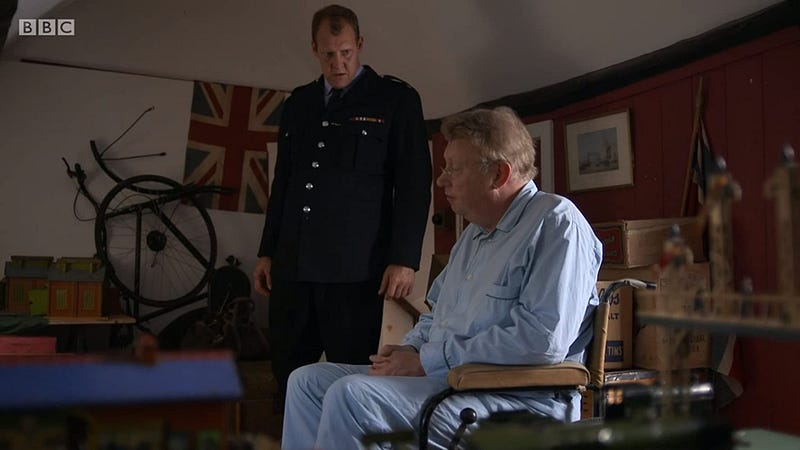
PC Pugh, the son of Mr Evans, changed his name and was sent to live with his welsh aunt after his mother committed suicide. The police constable was viciously bullied at school when the truth was revealed. His aunt, having locked her room at night, was terrified of the boy being like his father. PC Pugh killed both Mrs Bunyon and Mrs Thimble and then framed Mrs Fortescue for the murders. If you recall, as Lady Felicia and Mrs McCarthy entered Mrs Thimble’s residence, PC Pugh could be seen close by. The police constable wanted to put Mrs Fortescue through the same feeling of an impending execution for a crime she didn’t commit.
Father Brown, as he does with all killers that cross his path, attempts to get PC Pugh to seek forgiveness and turn himself in to the authorities. PC Pugh feigns remorse and ties the priest up. Not knowing what else to do, with limited options, PC Pugh plans to throw Father Brown down the stairs and fake an accident. Father Brown’s cries for help attracts the attention of Father Eager.
Even though PC Pugh is physically imposing, the police constable is no match for Father Eager. Father Eager easily defeats PC Pugh. PC Pugh is soon thereafter arrested by Inspector Sullivan. Father Eager, an amateur boxer in his youth, wins praise from Sid for his quick actions in saving Father Brown. Sid, feeling a modicum of shame for his behaviour, apologies to Father Eager for his earlier comments.
Father Eager confesses to Father Brown, during his Catholic mission in Africa, he developed romantic feelings for a young woman. Father Brown, convinced G-d doesn’t want to see him suffer, provides reassurance.

The advice Father Brown gives Father Eager prompts him to follow his heart and he decides to leave the priesthood. As Father Eager leaves the village, he waves to Father Brown.


