
British Network Television
‘Father Brown’: S02.E08. “The Prize of Colonel Gerard”
Kembleford has another murder for Father Brown to solve
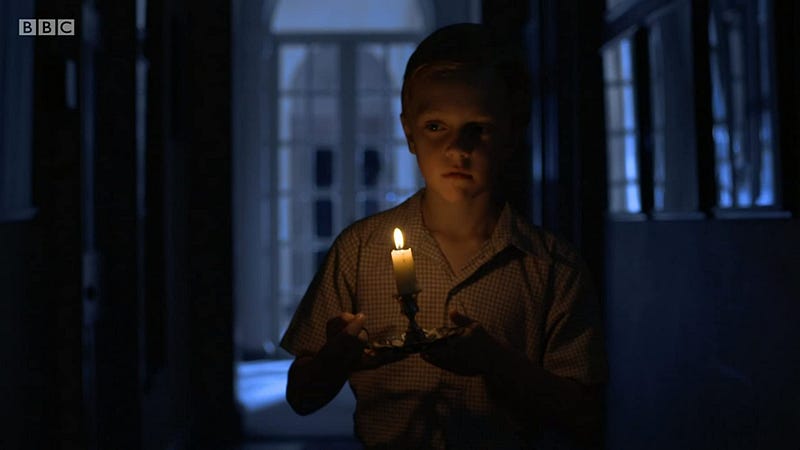
There is nothing quite like a Father Brown episode that begins with a scene set in the middle of a thunderstorm. This episode, The Prize of Colonel Gerard, opens with a boy wondering around in the dark with a lit candle. What could this child possibly be doing in the dead of night? It is obviously long past his bed time.
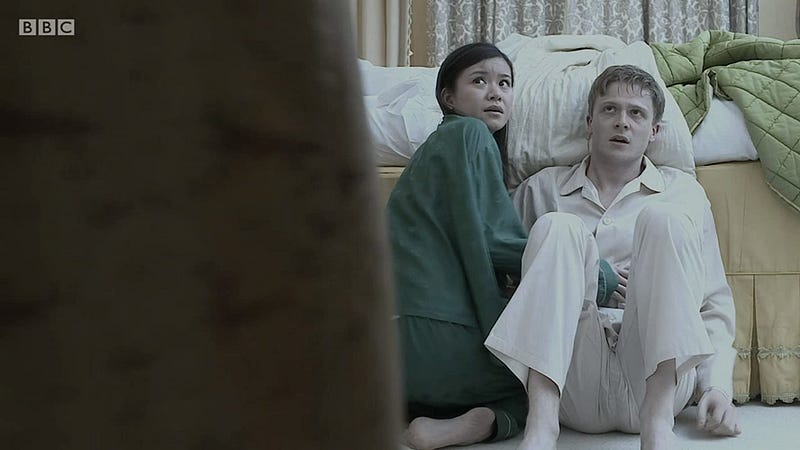
The following horrifying sequence reveals Edward Gerard (Simon Ginty) was experiencing a nightmare. Jia-Li Gerard (Katie Leung), Colonel Cecil Gerard’s (Nicholas Jones) adopted daughter, comes to her brother’s aid. The nightmare, considering Mr Gerard’s screams, must be significantly terrifying. Colonel Gerard, having sent his adopted daughter to bed, warns his son to stay away from Miss Gerard.
The episode, post opening credits, takes us to a welcome home party for Mr Gerard. Father Brown (Mark Williams), Mrs Bridgette McCarthy (Sorcha Cusack), Lady Felicia Montague (Nancy Carroll), and Sidney “Sid” Carter (Alex Price) are in attendance. There is a scene where Colonel Gerard brags to Father Brown, pointing to a stuffed tiger, he shot it himself. Father Brown’s response, noting how the Catholic priest agrees the animal was “a magnificent beast,” suggests a disdain for the pointless killing of G-d’s creatures.

Colonel Gerard takes a moment to introduce Father Brown to his adoptive daughter. Even though Miss Gerard reminds her father everyone knows the story, despite her obvious discomfort, Colonel Gerard proceeds to regale Father Brown. Ada Gerard (Emma Fielding), momentarily getting her husband’s attention, tells Colonel Gerard that Mr Gerard is refusing to leave his room.
Knowing how demonstrative Colonel Gerard can be, suggesting to him that he remain with the guests and enjoy the party, Miss Gerard offers to speak to her brother. Even though Miss Gerard makes it sound like she wants her father to enjoy the party, noting Father Brown’s facial expression, it is clear there is something else going on which the family would rather keep quiet. Colonel Gerard agrees to Miss Gerard’s request.
Father Brown suggests to Colonel Gerard that the party might not be the right thing for Mr Gerard. Colonel Gerard, disagreeing with such rubbish, believes he himself would have been proud of the honour. It is clear, from Colonel Gerard’s attitude, he doesn’t understand not everyone returns from war with the same experiences.
Mr Gerard experiences in a North Korean prisoner of war camp differs greatly from what both Colonel Gerard and Father Brown experienced during the First and Second World Wars.

There is a brief scene where a chef berates a maid for being too friendly with a gentleman. The tone Chef Henri Chapel (Philip Delancy) takes suggests isn’t as much a guest as he is a gatecrasher. The next time we see the chef, momentarily outside, it is with Mrs Gerard. The way she touched his arm suggested more than mere friendship.
Miss Gerard speaks with her brother. Mr Gerard, with no real interest in pleasing his uncle, is nothing like his sister. Even though she does what she can to keep the piece, when her father shows her off to his guests, Miss Gerard is obviously not amused. Miss Gerard doesn’t like be Colonel Gerard’s china doll.
Mr Gerard, mainly because it is his sister asking him, decides to join the party guests. There are momentary glances between them which suggests there could be more if it were allowed to grow. It doesn’t escape Colonel Gerard’s attention, when Mr Gerard makes an appearance with his sister, he’s not wearing any shoes or socks. Naturally, because he doesn’t want to cause a scene, Colonel Gerard doesn’t immediately mention his nephew’s attire.
In a brief speech, referencing the cancer of Communism, the guests are asked to raise their glasses in thanks to Mr Gerard’s valiant service. Mr Gerard, despite expressing his gratitude for everyone being there, has a very different view to the issue than the one his uncle trumpets.
Mr Gerard, a former prisoner of war, returned home from North Korea with a sympathetic to captor’s cause. This attitude greatly displeases Colonel Gerard. Colonel Gerard lives up to the word martinet as he is a strict disciplinarian. Mr Gerard’s comments, reverberating around the room, aren’t welcome. Father Brown suggests he should speak with Mr Gerard.

Father Brown, believing Mr Gerard might need a friendly ear, exits the house and walks over to where he was sitting. Not surprisingly, even though people don’t always warm to a Catholic priest attending a party, it has never stopped Father Brown from enjoying a good rum punch.
As Mr Gerard speaks with Father Brown, in the distance, Colonel Gerard can be seen observing the two men conversing. There are references to how draconian Colonel Gerard can be with people. He treats everyone like their under his command.
Whenever the colonel sees something he wants, no matter whether it is a little girl from China or his brother’s wife, he takes it. Mr Gerard, with his mother having married his uncle shortly after is father’s death, believes there was no accident.
Mrs McCarthy comments to Father Brown on the number of rum punches he has consumed. Even though it was only two, not that it is any of her business, Father Brown’s commitment to the Catholic Church doesn’t require sobriety. Mrs McCarthy, if she had bothered to pay attention to Father Brown’s drinking habits, she would know the Catholic priest enjoys everything in moderation. Personally, I like everything should be in moderation, especially moderation.
Soon thereafter, in the library, there is a confrontation between Colonel Gerard and Mr Gerard where the former punches the latter to the floor. If Mrs Gerard cared anything for her son, something which isn’t demonstrated by her actions, she would defend him.

Not interested in anything Father Brown has to say, noticed by Sid, Mr Gerard walks away from the building. Sid, seeing Father Brown not following Mr Gerard, decides to speak with him himself. Mr Gerard, assuring Sid what he saw wasn’t a performance, tells Lady Felicia’s chauffeur that he only stated what he believes.
Later, still seated next to a tree, Mr Gerard asks of Sid a curious question which requires serous thought. Mr Gerard, no questions asked, wants to know if Sid would do something for him. Even though this thing is illegal, noting Mr Gerard offers to pay him, Sid agrees. The illegal thing Mr Gerard wants Sid to do isn’t openly referenced in the scene.
Miss Gerard speaks with Father Brown regarding her brother. She wants to know if there is anything she can do to resolve the matter. Father Brown believes Mr Gerard needs some time to himself. When Miss Gerard references the fights, something that occurs frequently, Father Brown asks what the most recent argument was about. Miss Gerard, not knowing what caused the argument, states they simply flew at each other.
Father Brown, observing a book upside down, corrects it. When the Catholic priest places the book back the right way, even though Father Brown is an accomplished detective, he doesn’t immediately noticing anything odd. There is something about the book case, with how far back the book slid, which suggests there is possibly a hidden room.
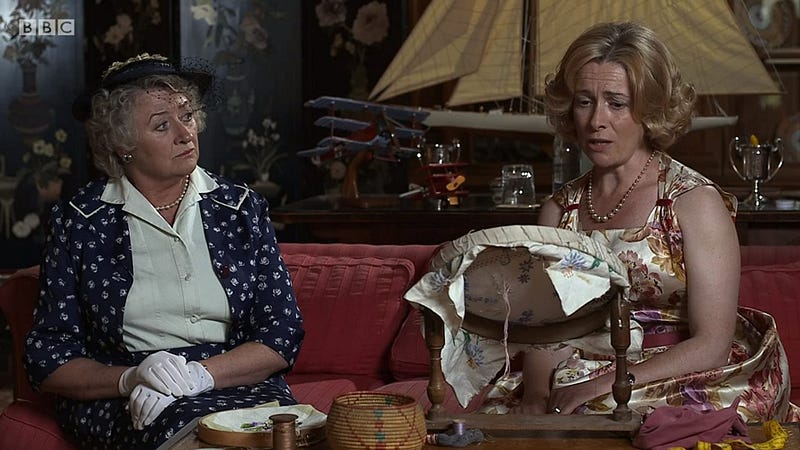
Mrs Gerard, wanting someone at the house she knows both Colonel Gerard and Mr Gerard trust, asks Father Brown if he will consider remaining at the house over night. As per usual, something which Mrs Gerard quickly picks upon, Mrs McCarthy invites herself.
There is a certain hypocrisy to Mrs McCarthy which isn’t easily ignored. When Lady Felicia invites herself, something Mrs McCarthy immediately notes in an overtly loud comment to Father Brown, the irony isn’t lost on Mrs Gerard. The glances Father Brown, Lady Felicia, and Mrs Gerard speak for themselves. Father Brown’s eyes shoot skywards as if he is looking to G-d for guidance.
Whilst that is a splendid hat Mrs McCarthy is wearing, even though we can’t see her in this related image, still wearing it whilst at the dining table is a bit much.
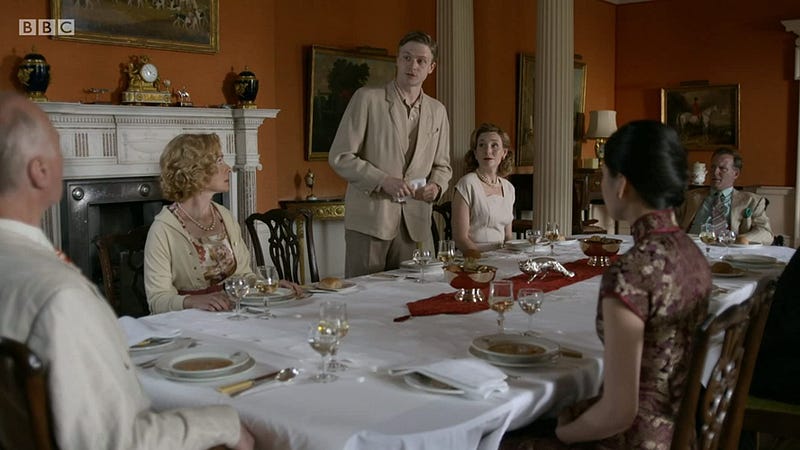
Even though Mr Gerard apologised for his tardy arrival, something which was immediate, Colonel Gerard couldn’t stop himself from commenting on it. Mr Gerard, standing to address everyone at the table, apologises for his earlier conduct.
Colonel Gerard incorrectly takes Mr Gerard’s apology as an indication that he believes the expressed views were somehow wrong. The visible swallow Mr Gerard does, a metaphorical lump in his throat, is most telling.
Father Brown, unlike Colonel Gerard, recognises Mr Gerard knows his own mind. Cutting in, mainly because the soup was getting cold, Mrs Gerard asks Father Brown to say grace.
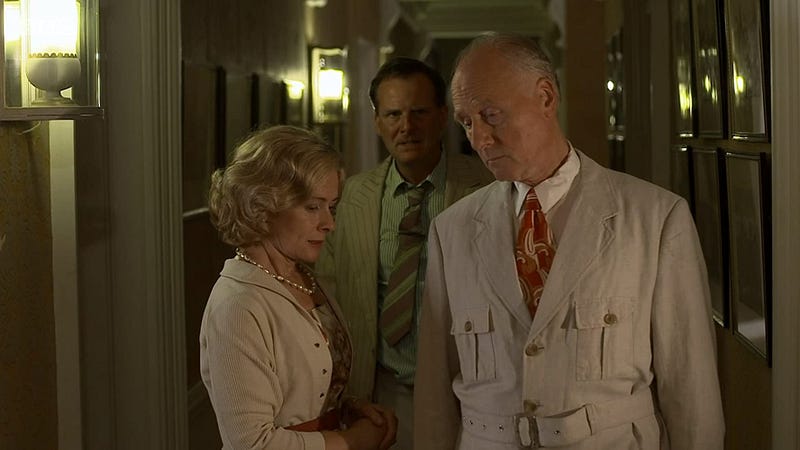
We soon discover all is not love and roses between Colonel Gerard and Mrs Gerard. Rupert Digby (Tim Wallers), the individual we saw earlier flirting with the maid, is Mrs Gerard’s brother. There is a nasty comment about her waning beauty. Mr Digby cares nothing for how Colonel Gerard treats his sister.
Colonel Gerard considers his brother-in-law a fat lazy imbecile that has lived off his hospitality for far too long. this conversation, unbeknowest to Colonel Gerard, Mrs Gerard, and Mr Digby, is overheard by Father Brown.
The following morning, noting how Mr Digby piles his breakfast plate, it soon becomes clear why it is Colonel Gerard has the opinion he holds. Mr Digby leaves practically nothing for Father Brown. Mrs Gerard, not knowing her husband late for anything, directs her adoptive daughter to seek him out.
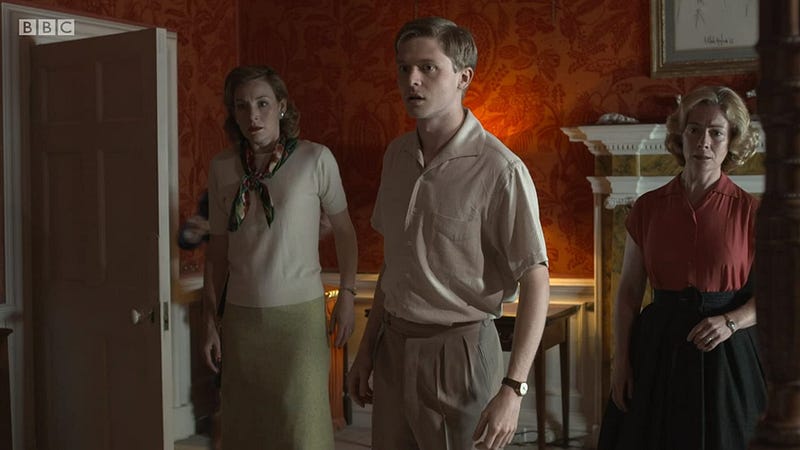
Miss Gerard and Mr Gerard cross in the doorway as she heads to Colonel Gerard’s bedroom. After a few pleasantries exchanged between mother and son, Mr Gerard tells his mother he slept through the night.
Mrs McCarthy, noting she didn’t get a wink of sleep, is about to inform Father Brown of something when Miss Gerard can be heard screaming. The explanation for Colonel Gerard’s tardiness becomes clear. He’s dead. Could this be the job Mr Gerard wanted Sid to do?
Father Brown, looking directly at Mr Digby, sees Colonel Gerard’s brother-in-law smiling. This smile perplexes Father Brown. Could it be a nervous reaction? The smile quickly dissipates when he sees Father Brown’s facial expression.
Inspector Sullivan (Tom Chambers) and Sergeant Albright (Keith Osborn) are soon on the scene. The police inspector, wondering why it took so long for the body to be discovered, asks Mrs Gerard why it wasn’t her that found her husband dead.
It turns out Colonel Gerard and Mrs Gerard didn’t share the same bedroom. People in their position, especially considering the period in which the series is set, rarely share the same bedroom.
After sniffing the content of a glass, nothing it did smell anything like stomach salts, Father Brown finds himself unable to identify the residue. Inspector Sullivan, in a somewhat frustrated tone, references laboratories. Lady Felicia, not mentioning names, states there was at least one person eating more than their fare share. The camera pans to Mr Digby looking directly at her with an unfriendly gaze.

Inspector Sullivan, in a tone that Mr Gerard takes immediate offence to, wants to know how Miss Gerard is related to Colonel Gerard. Mr Gerard informs the police inspector that Miss Gerard, his sister, was adopted by the colonel and his wife.
Nearby, in a brief conversation, Sid tells Father Brown that he could be involved with Colonel Gerard’s murder. It turns out, instead of being involved with the murder, Sid was asked to acquire for both Mr Gerard and his sister passports under different names.
Mr Gerard is seated on his bed when Father Brown enters the room. Referencing various Shakespeare plays, Father Brown not being remotely subtle, quickly transitions to talking about The Tragedy of Hamlet, Prince of Denmark. If you’re wondering, not that you asked, that is the full title for Shakespeare’s play.
There are obvious similarities between Shakespeare’s Denmark set play and what we see here with the Gerard family. Colonel Gerard was Claudius, Mrs Gerard is Queen Gertrude, and Mr Gerard is Hamlet. Mr Gerard doesn’t find the reference to Hamlet remotely funny. Father Brown tells Mr Gerard he knows about the passports. Mr Gerard merely wishes he had the courage to kill his uncle.
Mr Digby, wanting to make a quick exit from the house, has been actively avoiding Father Brown. Whilst there is something on his mind, Mr Digby would rather not address it with the Catholic priest. Mr Digby comes close to confessing something. Fortunately for Mr Digby, with Lady Felicia needing to know if it were too early for a drink, he sees an opportunity to escape Father Brown and takes it.
Discovering a tiger whisker on the floor, noting the significance of the find, Father Brown consults an encyclopaedia and soon discovers something remarkable. He tries to bring this to Inspector Sullivan’s attention. The police inspector, as per usual, tries to ignore Father Brown.
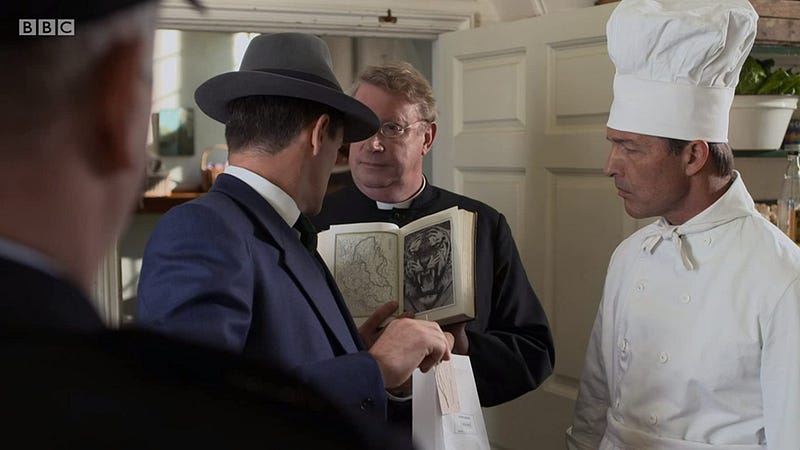
Inspector Sullivan is more interested in speaking with the chef than he is with Father Brown. Not put off by his rudeness, Father Brown follows the police inspector to the kitchen. When Father Brown arrives in the kitchen, with the chef having no idea what the police inspector is talking about, Father Brown tells him the fragments in his bag are tiger whiskers. Inspector Sullivan is baffled how the Catholic priest could know such a thing. Father Brown points the police inspector to the encyclopaedia volume in his hand.
Inspector Sullivan gathers everyone together and reveals the colonel died on massive haemorrhaging. Someone placed tiger whiskers in his food. The police inspector arrests Mr Gerard because he is apparently the only one in the room with a strong enough motive to kill his uncle. Mr Gerard wasn’t sorry his uncle was dead and he didn’t care who knows it. Miss Gerard doesn’t believe her brother could have done such a thing.
Miss Gerard wanting Father Brown’s support soon finds not the help she was wanted. Even though Father Brown believed the war had impacted Mr Gerard’s behaviour, the Catholic priest saw a completely sane man. This isn’t what Miss Gerard wanted to hear. When asked if he would testify to that effect, if called upon, Father Brown said he would.
Father Brown, with assistance from Mrs McCarthy, apply a little reason to the problem at hand. The Catholic priest figures the colonel must have swallowed the whiskers when they were dining together. An odd sound draws Father Brown’s attention to the library closet.
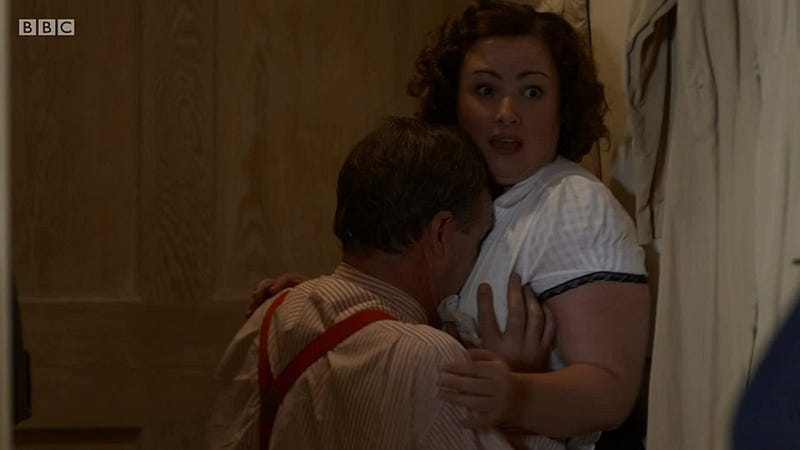
Mr Digby, getting ready to give the maid one in the closet, is discovered by Father Brown, Mrs McCarthy, and Lady Felicia. Whilst Lady Felicia is somewhat bemused by the spectacle, the same can’t be said for the conservatively minded Mrs McCarthy.
Father Brown directs Lady Felicia to take Mrs McCarthy into the garden so he might have a quick word alone with Mr Digby. Mr Digby was too busy getting busy with the maid to care about the colonel. The Catholic priest wanted to know what it was that he was going to confess earlier that day.
It turns out, when it was found Colonel Gerard was dead, Mr Digby had never been happier. Mr Digby was pleased his brother-in-law was dead. If you recall, shortly after Colonel Gerard’s body was discovered, Mr Digby was viably smiling.
What kind of chef smokes in the kitchen? Chef Chapel, possibly an accomplished French culinary talent, can be seen smoking in the kitchen whilst cooking. Father Brown asks of the chef if he can borrow some corn flour. Neither the chef nor the maid can locate it. The chef immediately blames the maid because she never places anything back where it belongs.
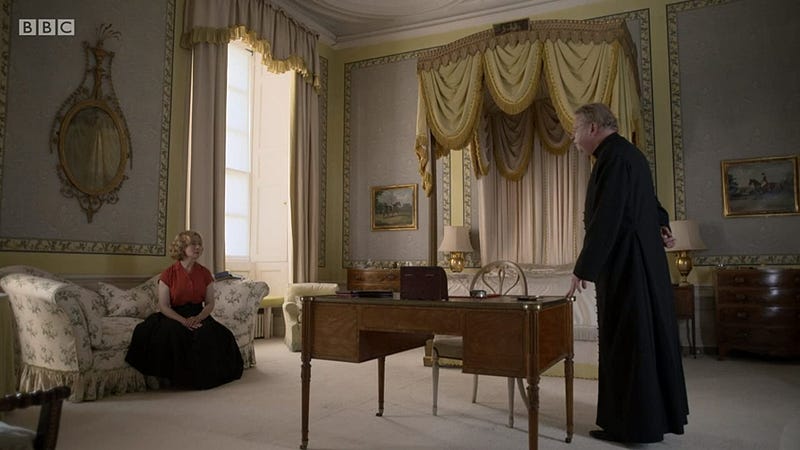
With everyone being a different piece in the same perplexing puzzle, Father Brown asks Mrs Gerard where she was when the previous evening’s meal was being prepared. The Catholic priest, not convinced Mr Gerard killed his uncle, is merely trying to figure out where all the pieces were at the same time. Even though Mrs Gerard believes she should speak ill of the dead, Father Brown correctly observes not everyone deserves a favourable epitaph.
Mrs Gerard invites Father Brown to stay for dinner. Before exiting the room, noting the presence of a French cigarette but, the Catholic priest comments on her smoking. Even though Mrs Gerard states she only occasionally smokes, noting her smile, this smoking most likely occurs after getting it on with the chef.
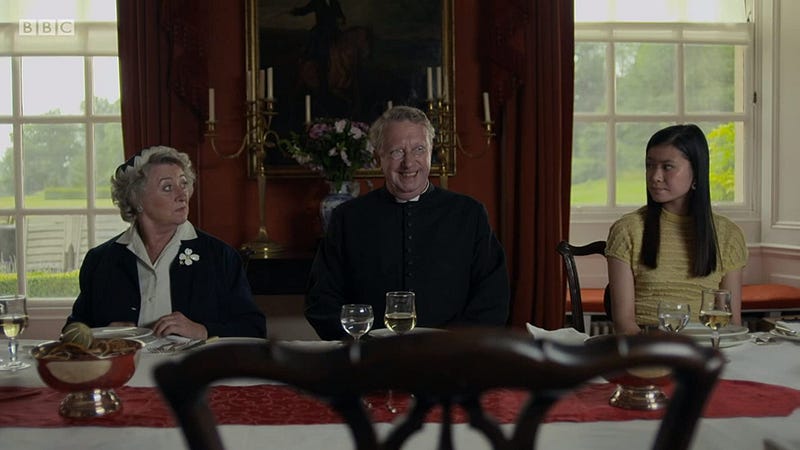
Soon thereafter, with everyone in the dinning room, Father Brown isn’t surprised to find himself confronted with a bowl of fish soup. If you have been watching Father Brown for as long as I have, not that you haven’t, there is no way the Catholic priest would ever eat fish soup because he doesn’t like it. He has always faked eating the soup. There is no reason for him to not do the same here.
Father Brown is perplexed because all the people resident of the house had a motive for killing the colonel. It doesn’t take long for the Catholic priest to notice the last remaining tiger whiskers are missing. There is a good chance the killer is still in the house and intends to get rid of someone else. Mrs Gerard questions why anyone would want to poison them. Mr Digby suddenly experiences stomach pains. With it only being gas, something we should have smelt coming, it’s a false alarm.
Noting no one is experiencing medical issues, looking at the situation logically, Father Brown quickly surmises the target was himself and immediately fakes being ill for the benefit of the killer. Everyone is convinced by Father Brown’s acting. Sid is told of Father Brown’s condition and he runs to the Catholic priest’s side. Miss Gerard takes this opportunity, when no one is looking, to visit with her brother.
Father Brown, seeing scrap marks on the floor, figures out Miss Gerard killed her adoptive father. It’s not as if he didn’t have it coming. Inspector Sullivan quickly arrives at the same conclusion as Father Brown. The police inspector, Father Brown, and Sid catch up with Miss Gerard at the Kembleford Police Station. It is here that Father Brown details the crime as he sees it. Miss Gerard, having no choice, escapes arrest by running into the police station public toilet. She escapes through an open window.
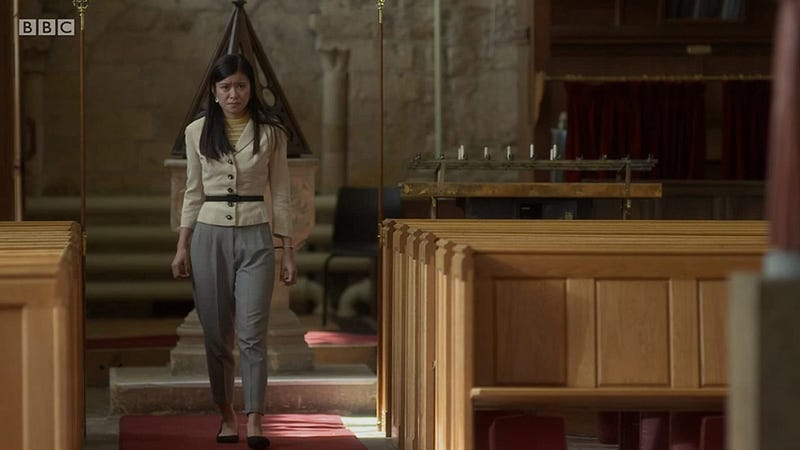
After Father Brown arrives at the church, not long thereafter, Miss Gerard reveals herself to the Catholic priest. She admits poisoning Colonel Gerard. In a flashback, before Colonel Gerard died, he admitted to Miss Gerard that he killed Mr Gerard’s father so that he could take her as his own wife. The reason Colonel Gerard adopted Miss Gerard was more to do with him wanting to bed her himself than have a daughter.
Father Brown, noting how he doesn’t like fish soup, tells her he merely faked eating it. No one, except for those of us that know better,really noticed he wasn’t eating the soup.
Sid, having already acquired the passports for Mr Gerard and his sister, gives them to his friend. Lady Felicia’s chauffeur correctly notes wasting good forged documents should be a crime. Father Brown allows them to exit the church through a rarely used door.
Meanwhile, shortly after they leave the church, we find Inspector Sullivan and Sergeant Albright arriving at the front of the building. Mrs McCarthy had alerted the police to Miss Gerard’s whereabouts. Miss Gerard had been seen entering St Mary’s Catholic Church. Not wanting to give the game away, noting how they could be in serious trouble, both Father Brown and Sid acted puzzled.
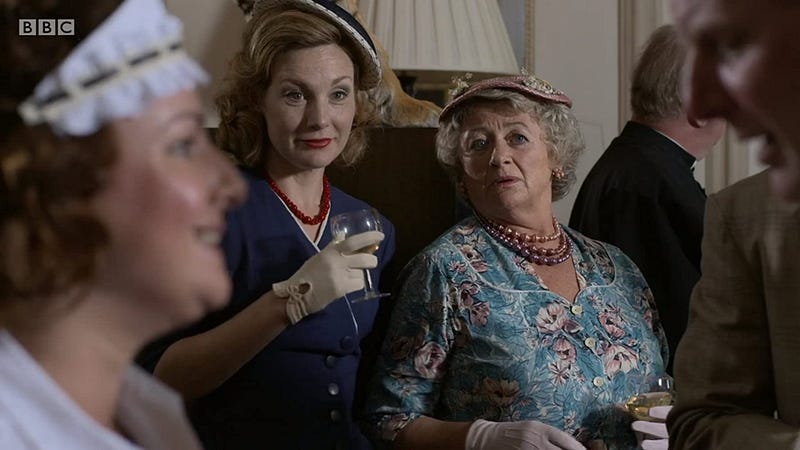
The episode closes with a party at the Gerard residence. The party, set almost a month after Colonel Gerard’s death, sees Mrs Gerard flirting with Chef Chapel. This brief flirting doesn’t go unnoticed as Mrs McCarthy rarely misses a thing. Whilst Mrs Gerard flirts with the chef, in every way possible, her brother continues to have his way with the maid.