
Everyone Is Not “A Little” ADHD or Autistic
Yes, there is a spectrum, but you either are or you aren’t. There is no “a little”.
Sub-clinical traits versus dismissive comments
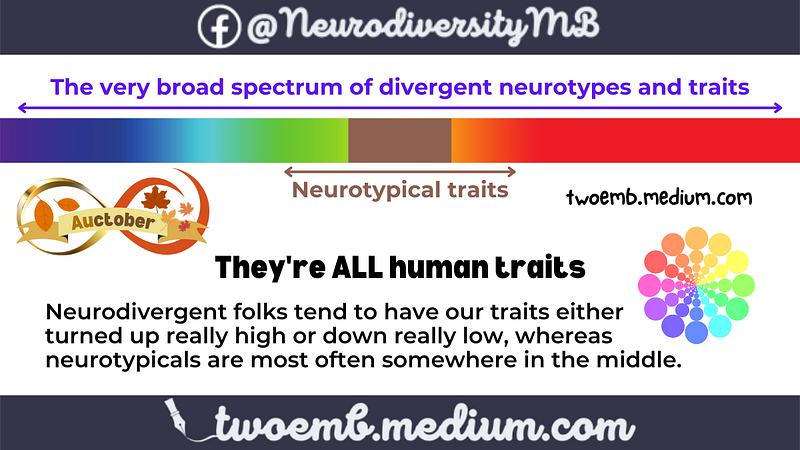
I want to begin by clarifying that absolutely, everyone has some traits in common with neurodivergent people. Why? Because neurodivergent traits are human traits! We’re all human beings.
Another reason is genetics. ADHD and autism are highly heritable, meaning they run in families. Often family members have some ADHD or Autistic traits, even if they don’t fully identify with either neurotype, or do not meet all the diagnostic criteria.
I take no issue with these points. The more we learn about neurology and divergent neurotypes, the more we are finding overlap between them. It is becoming increasingly obvious that our natural desire to put things into neat little categories isn’t so helpful when it comes to subjects as complex as the human brain.
I also have no desire to gate-keep from people who self-identify or self-diagnose as ADHD or Autistic. If the identity or diagnosis feels right for you, and the strategies and supports are helpful, by all means, welcome to the club.
Invalidating comments
That said, if someone tells you they struggle with a particular situation or skill because of a disability or divergent neurotype, please do not respond with “well, we’re all a little…”
In that context it sounds dismissive, and minimizes that person’s experiences. Sure, we’re all human, therefore we all have some traits in common. However, if someone’s disability or neurotype diverges from the norm far enough that it causes them challenges on a daily basis, pointing out that we all share some characteristics is probably not very helpful.
What spurred this article
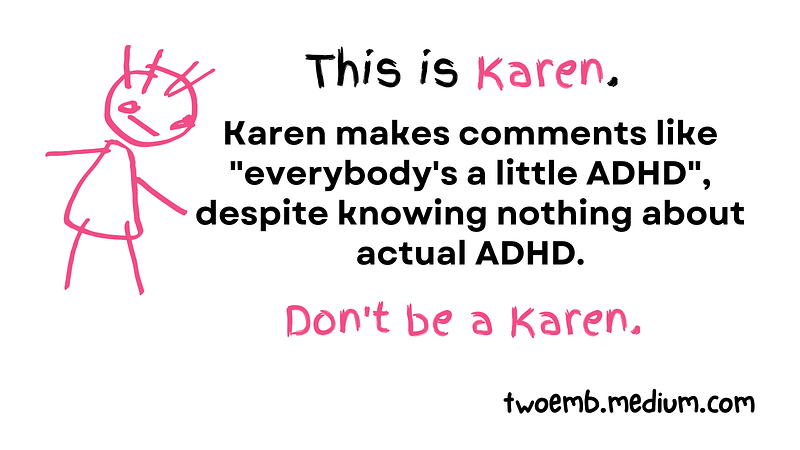
A parent, we’ll call her “Karen”, made this comment in my presence recently.
We were chatting about how the school year was going so far, and one parent mentioned that she and her son both have ADHD, so she can relate to his struggles and understand how his brain works because she has similar experiences.
Then Karen said the line.
“Well, everyone’s a little ADHD.”
No, they’re bloody not. Approximately 6–9% of the population has ADHD, nowhere near everyone.
Why that comment is ignorant and insensitive
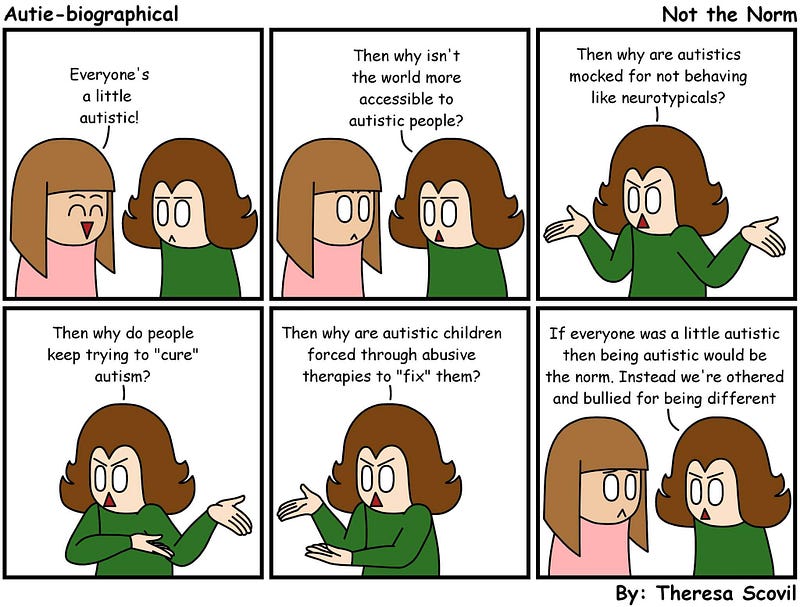
Saying that we’re all “a little” ADHD or Autistic is completely invalidating to people who live with daily struggles as a result of their divergent neurology.
Just because you’re sometimes forgetful or disorganized does not mean you have ADHD. The fact that you occasionally need alone time, or are introverted, does not mean you’re Autistic.
These are human traits that everyone experiences at times.
The difference is that ADHD and Autistic people experience them nearly all the time, to the extent that these symptoms impact our daily lives.
For those who need a basic “ADHD 101” or “Autism 101”, there are search engines and websites for that. Know that in order for someone to be diagnosed, they must experience persistent symptoms for at least 6 months or more, occurring in a variety of circumstances and environments (such as school, work, and home).
It ain’t easy being neurodivergent
ADHD and Autistic people face a number of increased challenges, in addition to hearing insensitive comments like, “we’re all a little ADHD/Autistic”.
ADHD and Autistic people are at increased risk for:
As well as a large number of comorbid conditions prevalent in ADHD and Autistic people.
That doesn’t even touch on the social and political difficulties that neurodivergent people encounter in their lifetimes, such as discrimination, under-employment, bullying and abuse, and a lack of understanding from the general public.
“Autistic individuals’ difficulties in smoothly participating in institutions’ social practices can lead to a stigma that lowers their status in the institutions’ social hierarchy.”
— Alan Jurgens
Brain Differences
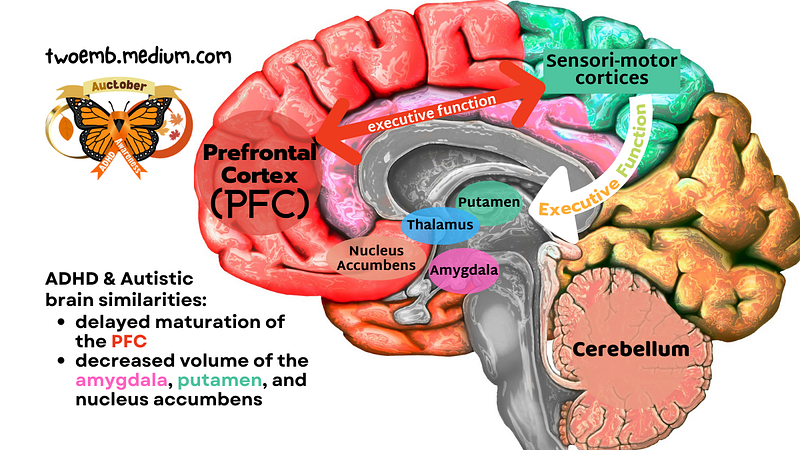
I’m not a neuroscientist, so I won’t go into great detail. Some of the well-documented brain differences that occur in both Autism and ADHD are a delayed maturation of the Prefrontal Cortex (PFC), and decreased volume of the amygdala, putamen, and nucleus accumbens.
The PFC is largely responsible for executive functions such as planning, decision-making, problem-solving, and exerting self-control.
The amygdala plays an important role in emotions. The delayed maturation of the PFC, paired with the decreased volume of the amygdala, likely play a significant role in struggles with emotion regulation.
The putamen plays an important role in facilitating movement, which may explain some of the symptoms in ADHD and Autism, such as deficits in interoception and proprioception.
The nucleus accumbens is part of the reward circuit of the brain. Decreased volume in this area may be part of the reason why Autistic people don’t find certain things (like social approval) as rewarding as neurotypical people do. This may also explain some of the difficulties with motivation in ADHD.
Those are just some of the neurological differences that Autistic and ADHD brains have in common, there are much more exclusive to each neurotype.
So, no. Everyone isn’t “a little” anything.
© Jillian Enright, Neurodiversity MB
Related Stories
When you join medium, as a member you’ll have access to unlimited reads for only $5 per month. If you use my referral link, I’ll earn a small commission.

References
Colombo-Dougovito A.M., Dillon S.R., Mpofu E. (2020). The Wellbeing of People with Neurodiverse Conditions. In: Mpofu E. (eds) Sustainable Community Health. Palgrave Macmillan. https://doi.org/10.1007/978-3-030-59687-3_15
Hoogman, M., van Rooij, D., Klein, M., Boedhoe, P., Ilioska, I., Li, T., Patel, Y., Postema, M. C., Zhang-James, Y… Franke, B., et al. (2020). Consortium neuroscience of attention-deficit/hyperactivity disorder and autism spectrum disorder: The ENIGMA adventure. Human Brain Mapping. https://doi.org/10.1002/hbm.25029
Jurgens, A. (2020). Neurodiversity in a neurotypical world. In Bertilsdotter Rosqvist, H., Chown, N., & Stenning, A. (Eds). Neurodiversity Studies: A new critical paradigm. Routledge.


