
Evangelicals cancel Amy Grant…again
A religion loves to hate its #1 musician
Back in 1998, the top musician in Evangelical America was cancelled for getting a divorce. But Amy Grant kept on misbehaving.
A religious brawl broke out recently after she noted in an interview that she’ll be hosting her niece’s marriage to another woman.

Amy Grant was the singer that Evangelicals grew up hearing.
She was an Evangelical Pop singer, which should have been an oxymoron. But she was religiously acceptable throughout the late 1970s and 1980s.
She was the only young woman, the only pretty woman, and often the only woman of any description on view in America’s largest religion.
Her prominence was mysterious. Female leaders were officially disallowed, and women often weren’t even allowed to speak in churches.
And yet, Amy Grant’s songs could be cited nearly as biblical texts, and her concerts were seen as worship experiences.
Men in the religion were promoted by clerical hierarchies.
But Amy made her way by sheer charisma and musical gifts. She all but invented a new musical genre to house her appeal—to be called ‘CCM’ or ‘Contemporary Christian Music’.
She sang about God, while having no theological education. She just read the Bible in a very different way. She’d explain:
“In the Old Testament there were some of the most charismatic, magnetic, daring, risking women — beautiful, sexual.”
That’s how she was herself, singing a Christianity no one had heard before. There was no terror of God, no longing to take over America and reform it, no sorting of humans by gender and race.
Inexplicably, Evangelicals realized they loved it—and hated it. Almost from the start she was a beacon of controversy.
She’d sing Christian songs and ‘secular’ songs.
But all of Amy Grant’s music is religious. Sometimes she was showing her religion it was all right to be playful, to dance, and to love people with ‘devotion’—just as God is loved.
That was the sermon of her 1991 hit, “Baby, Baby.”
She always had a strong gay appeal.
From the beginning of her career, her music was a kind of gay enclave in Evangelicalism. She’d been trained not by Christianity, after all, but by her childhood heroes—Cher, Bette Midler and Elton John.
She got a major creative ally in 1982, when joining forces with Rich Mullins, the singer-songwriter who seems to have been quietly gay. He wrote euphoric, genderless odes to a new Christianity that she made hits.
“Sing your praise to the Lord Come on everybody Stand up and sing one more hallelujah”
Mullins was often defending Amy’s outrageousness. His advice in 1986 seems as apt today:
“So what if she does things you don’t necessarily approve of. I am sure that God, or I, or she, or any number of people don’t approve of everything that you do. It’s really nobody’s business.”
But Evangelicalism means minding people’s business.
And Amy kept supplying more for the religion to find shocking. In 1998, she divorced her husband, Gary Chapman. They’d often spoken of their marital difficulties—his drug habit, the years of counseling, etc.
She re-married a man more to her liking: the country musician Vince Gill— and Evangelicals washed their hands of this ‘adulteress’.
Amy seemed happy in her new marriage, and their family seemed to recover from any shock the divorce had involved. Gary Chapman, who for awhile had shredded Amy in public, himself re-married…twice.
Over time, Evangelicals decided to semi-forgive the divorce.
Franklin Graham, the nominal head of the religion, had given Amy a kind of official pass when providing a blurb to her 2007 memoir.
As the blurb read:
“Like all of us, she has had her own personal storms in life; however, her faith has never wavered. Through it all, she has given of herself and her resources to help others, and remains an inspiration to millions.”
And so it was minimally acceptable to be an Amy Grant fan again. She was an example of godliness, apparently, to the world of country music, as in her husband’s recent song “When My Amy Prays.”
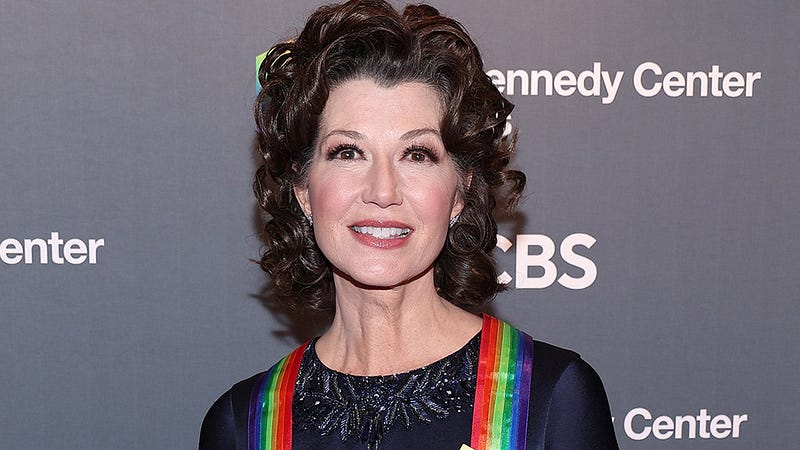
Recently she became an honoree of the Kennedy Center.
This was a statement that she was among the most significant performers in the arts in the world. An amazing designation for an Evangelical performer—and Amy Grant alone could have qualified for it.
In a profile of her in the Washington Post, she slipped in a disclosure:
“Now, she talks about her and Gill’s plans to host her niece’s wedding at their farm, which is her family’s ‘first bride and bride’ nuptials. Grant recalls her reaction when she learned her niece had come out: What a gift to our whole family to just widen the experience of our whole family.”
Amy had discussed a pro-LGBT Christianity since 2013.
She’s given several interviews on the subject, and her 2018 video for the song “Say It With a Kiss” featured same-sex couples.
As she’d told a ‘secular’ outlet, Pride Source.
“I know that the religious community has not been very welcoming, but I just want to stress that the journey of faith brings us into community, but it’s really about one relationship. The journey of faith is just being willing and open to have a relationship with God. And everybody is welcome. Everybody.”
But the prominence of the Kennedy Center ceremony combined with the imagery of a niece’s wedding was an amazingly public statement.
She could’ve hosted the event quietly. She wanted the religion to know.
Such a provocation could not be ignored.
Evangelicalism has lately become a religion that defines Christianity in terms of being anti-‘LGBT’. To be Christian, to be ‘saved’, is to be against sexual difference. That’s the talk.
Evangelicals know there is a way to be Christian and accepting of gays and lesbians. Just before his death in 1997, Rich Mullins—who is still viewed as an exemplary Christian, if not a “prophet”—had said:
“My understanding of what Christ told us was that Christians were to love. I didn’t know there were a lot of parameters set on that.”
But Amy Grant gave this message an unusual force, and shot it into the heart of the religion.
She had to be cancelled again.
Franklin Graham did not say as much. He posted on Twitter a rejoinder to the idea of Christianity just being ‘love’:
“Yes, we are to love God & love each other. But if we love God, we will seek to obey His Word. Jesus told us, ‘If you love Me, keep My commandments’ (John 14:15). God defines what is sin, not us; & His Word is clear that homosexuality is sin.”
To connect the religious dots is to understand that a woman promoting “sin“ is not in good standing with the religion, i.e. with ‘God’. The heavy suggestion is that Amy is not even ‘saved’.
For days, she trended on Twitter.
There was plenty of commentary on her divorce as having been, truly, the mark of a weak or non-Christian—and the lesbian wedding proved it.
Or as an #Exvangelical on Twitter put it:
“Amy Grant hosting her niece’s same sex wedding means the same people who hated her when I was a kid get a chance to hate her all over again.” 🔶


