
Was Rich Mullins gay?
An Evangelical star has to keep secrets
An early songwriter for Amy Grant, he helped make contemporary Christian music a commercial force. In 1988, his song “Awesome God” was a mega-hit.
Later albums were influential. He died in 1997 at age 41. Reading up on singer-songwriter Rich Mullins, I find vagueness and strangeness around his personal life. Never married, no girlfriends. Androgynous.
I wondered if he was gay.

If that was true, his entire value to the Christian demographic would depend on it being suppressed. Tricky. I might need an angel to whisper in my ear?
I kept researching, and was watching a 2014 documentary, Rich Mullins: A Ragamuffin’s Legacy. I paused the player, backed up, watched again.
Amy Grant said it again, exactly the same way.
“He was, you know, very— Um. Honest about his— Everything from his sexuality, to his appetites to his— He was just so raw.”
That’s not a very Christian way to be.
She recalls once being at a radio station, and people there asked her to talk about the “real” Rich Mullins. She threw out some “shocker stories”—without repeating them.
She adds: “Everybody in the radio station was very conservative and they kinda withdrew, and dropped the subject. And I thought: ‘You wanted to really know him.’”
I think over her odd comments about him, as in the 2017 book, Winds of Heaven, Stuff of Earth, where she dwells on his moral ambivalence.
“Rich didn’t waste any time trying to be good, or at least trying to appear good. There’s a little bit of good and bad in every one of us. But what Rich wanted to know, what we all want to know, is that we are loved.”
I hear back from Reed Arvin, Mullins’ longtime producer.
“He was the most authentic poet in the history of contemporary Christian music, a truth-teller in the best sense, and a true believer in Christ. I’ve never met anyone who so thoroughly conformed his life to the image of Christ, which, naturally, made him an outlier in many ways. I have no idea if Rich was gay or trying not to be gay. I do know that on the spectrum of ‘things that matter about Rich Mullins,’ his sexuality rates about 90th.”
But it might explain his whole life.
There’s been three documentaries and a biography.
None are really a coherent portrait of his life. The biography, An Arrow Pointing to Heaven by James Bryan Smith, is billed as a “devotional biography.” That seems to mean it often diverts into abstract discussions of Christian theology. I email Smith asking if he can supply evidence to disrupt a gay reading of Mullins’ life. I don’t hear back.
I sit thinking about all the vagueness, and abrubt endings. In Rich Mullins: A Ragamuffin’s Legacy, his friend Mitch McVicker says: “Resignation and longing are his two major themes, according to him, in his songs. And those wouldn’t be there if he wasn’t — ”
Mitch pauses, and adds: “The messed up pile of stuff that he was.”
I wonder what he’d been about to say.
To learn about Rich Mullins, there is always Rich Mullins.
Asked to speak about “grace” on a 1996 radio show, he’s somehow back in his childhood on a farm in rural Indiana:
“When I was young, I was angry and I was kind of going, ‘God, why am I such a freak? Why couldn’t I have been a good basketball player? I wanted to be a jock or something. Instead I’m a musician. I feel like such a sissy all the time. Why couldn’t I be just like a regular guy?’”
For a Christian man to say he was a “sissy” and not a “regular guy” was very unusual, but passed without comment.
In 1997, Mullins was interviewed, and again was back in his difficult youth:
“From my junior year of high school until age thirty I felt tormented all the time. I was depressed. I just think I have that sort of personality.”
He adds there was “more than ten years of darkness where I felt tormented all the time.”
He was the eldest son—a privileged position in Evangelical families.
But Richard Wayne Mullins wasn’t the kind of son his Christian father wanted. ‘Wayne’ was horrible at farm work. He was musical. His mother, Neva Mullins, recalls in a 1984 interview: “We went to see the movie Music Man when he was just a child. He came home and pecked out the songs he’d heard on our old upright piano.”
Smith quotes Neva reflecting on her husband: “John’s generation of men did not express their feelings to their children.”
Which isn’t true. John Mullins expressed disappointment. He was famous for saying: “I have two sons, two daughters, and a piano player.”

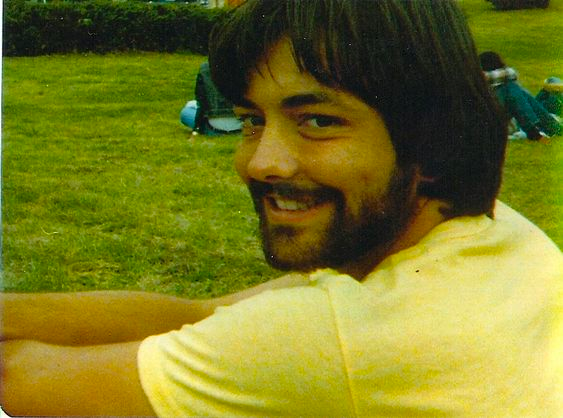
Others found Wayne mystical and magical.
After his death, his hometown paper has memories from schoolmates. “Even as a young teen-ager, it was apparent that he was not like all other kids,” a man writes. “He was chosen by God.”
A female classmate: “While most of us were asking questions about how do we get ahead in the world, he was asking why are we in this world? And wondering don’t we truly belong in the next world?”
By his teenage years his interest in Christianity was flagging—as may track with his father’s growing interest in it. Not wanting to be a “blah old Christian,” Mullins will recall:
“I knew I wouldn’t make a good atheist. But I do remember thinking I just wouldn’t have anything to do with God. Yet, even then, I felt driven back to God. I wanted intimacy with Him.”
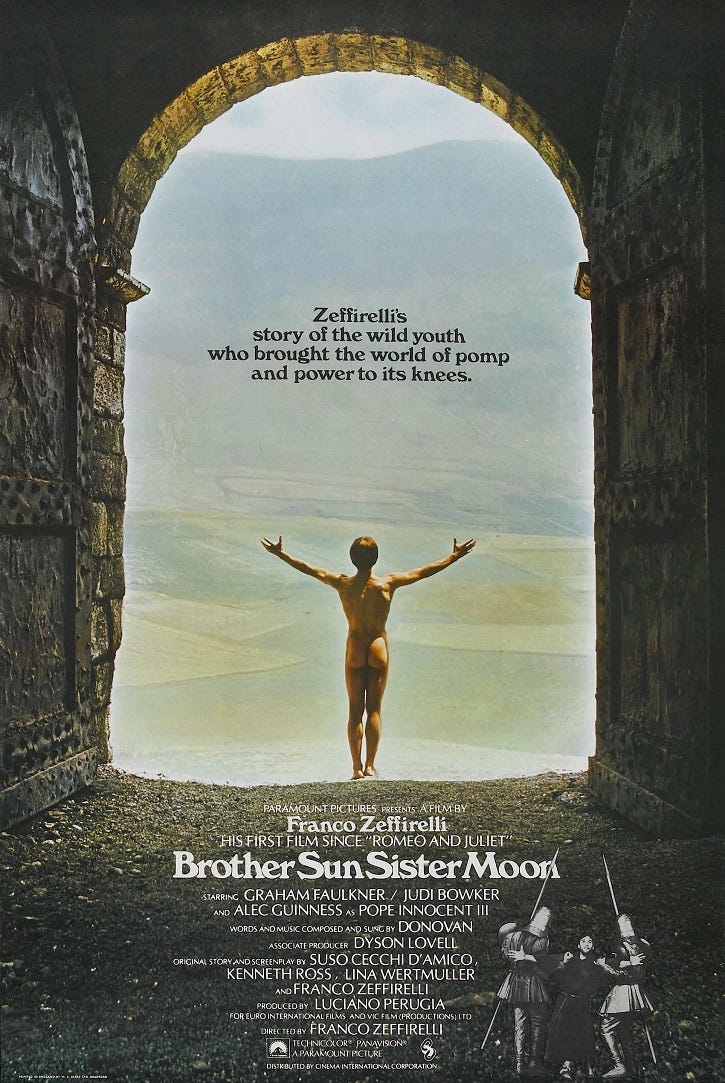
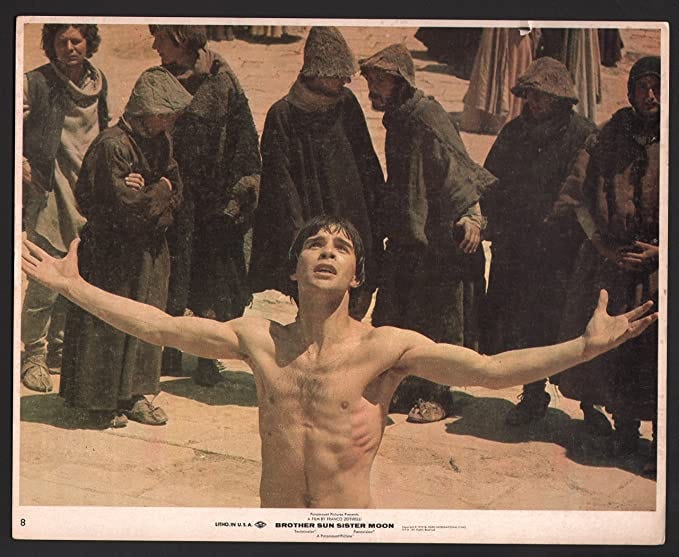
His real conversion may have happened at the movies. In 1972, age 17, he sees Brother Sun, Sister Moon, the Franco Zeffirelli bio-pic of Francis of Assisi. Mullins will nurture lifelong obsession with the saint, or the movie? He says in 1997: “My vision of Saint Francis was really just an actor dressed up in funny clothes.”
Though the actor was only sometimes wearing clothes.
The Smith biography and documentaries have no reference to any female love interest.
In no photo available is Mullins ever seen with a female love interest. But he mentions a relationship in a few interviews—never naming the woman, but saying he’d been engaged for ten years, as she broke it off.
He’d sometimes say he wrote his song “Damascus Road” that night.
In later years, he’d reference the engagement to explain why he didn’t have a girlfriend. He says in a 1997 interview:
“I have no interest in anybody else and she is married to someone else so that’s the way it goes and I don’t mind that. Right now I cannot imagine that life could be happier married than it is single so I’m not in a panic about getting married. And I think, you know, maybe God wanted me to be celibate and the way that he accomplished that was to break my heart. So that’s the way it goes.”
He’d also say the relationship was unsatisfying, as in a 1995 interview:
“I had a ten year thing with this girl and I would often wonder why, even in those most intimate moments of our relationship, I would still feel really lonely.”
The woman has never been identified, but commenter Jimrjohnson informed me her name was Ann Bartram. I locate and call her. My notes of what she said to me are as follows:
“I was engaged to him twice. I met him when I was in high school. He was my brother’s roommate. We dated. I knew him…”
She breaks off, asking to call me back, and never does.


The ‘romance’ seems to have largely taken place at Cincinnati Bible College.
Mullins’ early song “Seminary Girl / Seminary Boy” may be a glimpse of Ann Bartram, though I take it to be a satire on the Evangelical culture of compulsory marriage.
The commenter Jimrjohnson returns to insist Mullins was heterosexual. I note that an emotionally tortured relationship with two broken engagements doesn’t sound that ‘straight’ to me’. He replies:
“I didn’t say that they had a healthy relationship. It only lasted three or four years, not ten, and in between engagements, he got involved with other women. One of the reasons that Ann broke up with Rich is because she found out about his affairs with other women.”
In a next comment he adds: “His ten year relationship — with a different woman—was intense, and very complicated.”
So people around Mullins may have thought of him having a long history of weird, agonized, extended courtships with multiple women that the women finally terminated.
Mullins was glad to be free of his fiancé.
That’s the story of “Damascus Road.” The lyrics evoke a scene in the life of the Bible’s apostle Paul—the moment when he is blinded, and newly able to ‘see’ spiritually. The apostle was famously unmarried.
The song is best known to Mullins fans from a 1995 recording, but exists as a demo of 1984, and the demo, I notice, had another stanza:
“And when I finally found you, Lord, you took all those illusions away I give my life to sing your praise I wanna stay with you forever Lord, don’t let me go Now that I know you why would I ever want to go?”
If Mullins was writing this after a break-up, it could be read as him declaring he was “finally” letting go of the idea of marrying.
He’s mostly remembered in school for being weird .
Mullins was given to talking about Jesus as a human man, capable of an erotic relationship. His messiah was a “lover,” and he’d go on about being “ravaged” by the divine. He grew his hair out. “His dad did not like it at all, and sometimes they fought about it,” his mother says.
His college friend Beth Snell Lutz recalls in a recent interview: “He had a lot of darkness in him. There was a constant wrestling for him.”
That kind of talk is constant around Rich Mullins. In the 1998 Homeless Man documentary, future bandmember Rick Elias says:
“Rich’s appetite for sin was probably greater than even my own. But his pursuit of God and his decision to embrace God far oughtweighed his appetite for sin.”
What this ‘appetite’ was is never explained.
Mullins had a band called Zion.
With funding from a non-Christian uncle, he released an album, Behold the Man. The track “Heaven in His Eyes” might warrant attention, but “Praise to the Lord” was the standout. A praise song, it leaps from Bach’s Prelude & Fugue №2 in C Minor into a sonic extravaganza too exciting to be really Christian.
In the 2017 book, Winds of Heaven, Stuff of Earth, Amy Grant remembers first hearing it. She writes: “I have been moved by a lot of songs, but when that song reached its iconic release point, I was levitating.”
It became “Sing Your Praise to the Lord,” her first big hit.
The song should be read as a sexual experience.
In a 2019 analysis of “Awesome God,” the Christian scholar Nathan Myrick has an interview from Michael Blanton, head of Reunion Records, recalling Mullins talking about the song‘s long introduction.
“Well, it’s just like sex. You’ve gotta have a really good foreplay before you get to the climax.”
The song, Blanton thought, presented Christianity as “our love relationship with God,” with “some foreplay and then a wedding…”
But what kind of sex would this be? There are no gender references.
In Rich Mullins: A Ragamuffin’s Legacy, a friend recalls going to Nashville with him to help get him into the music biz. An industry gatekeeper, Jon Rivers, took her aside and advised her that Mullins had talked about “friends in Cincinnati,” and said he was in for a bumpy ride.
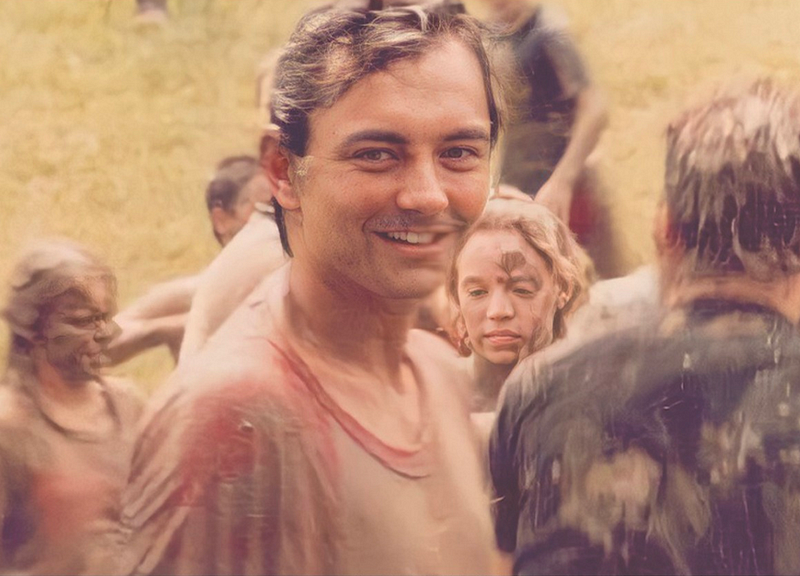
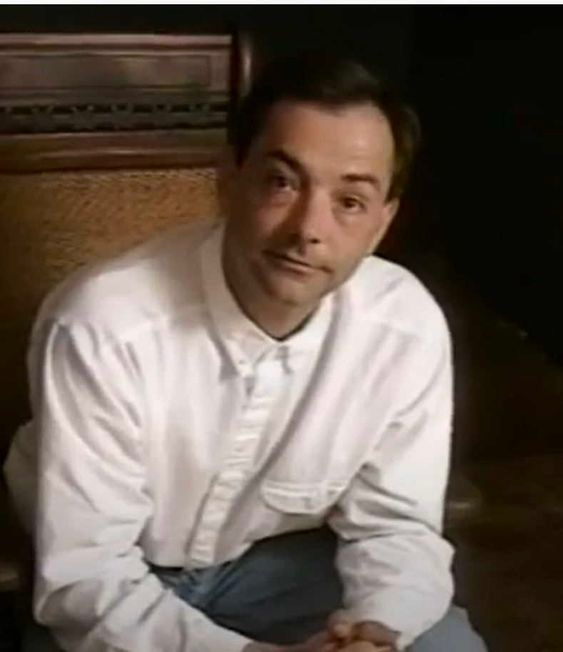
In the mid-1980s, Mullins worked as a youth minister.
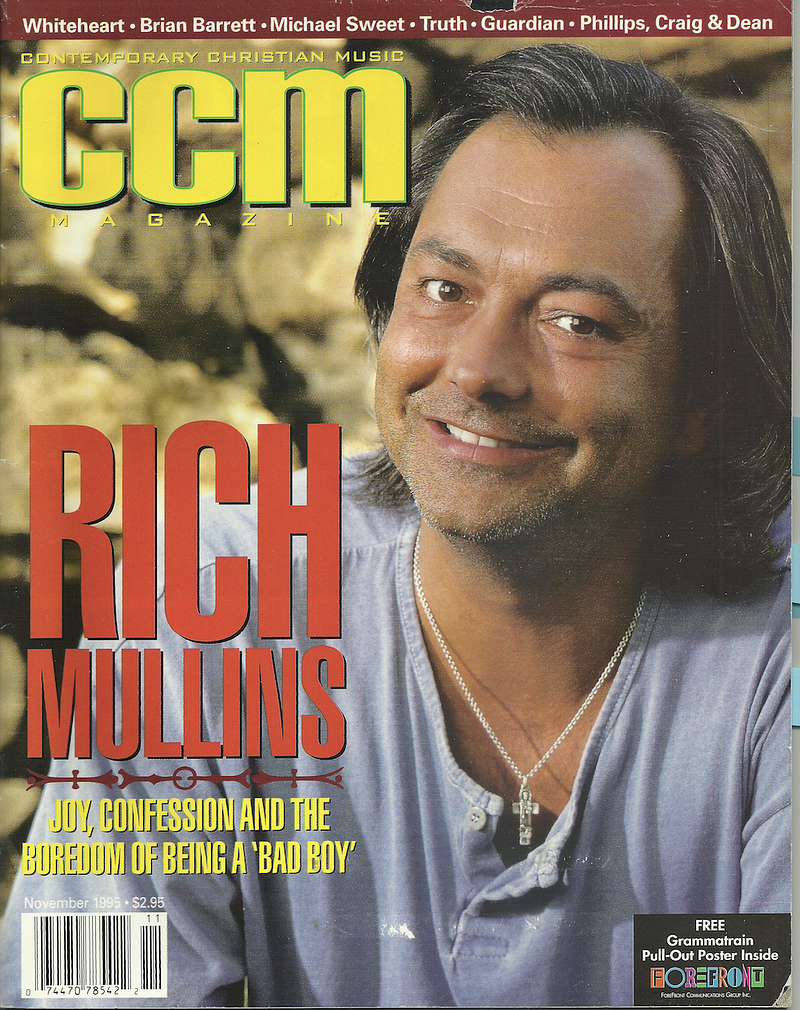
The year 1985 seems pivotal. It seems to be the year he broke off with Ann Bartram for good. Then comes a pivotal scene mentioned in a November 1995 interview with CCM. Mullins was “about 30 when he confronted the power of a secret sin and found a greater power in confession.”
So it was around 1985. Mullins relates a strange tale of going somewhere he knew he “ought not be going.” He continues:
“I started praying, ‘Oh God, why don’t you just make my car crash so I won’t get there because I can’t stop myself.’”
He hears God say: “Yeah, you’re right. You can’t.”
“Why can’t I?” Mullins replies. “What I’m doing makes me sick.”
He continues narrating the scene:
“And it was as if God responded, ‘Yes, what you do makes me sick too, but what you are makes me sicker. You do what you do, because you are what you are. You can’t do otherwise.’”
Two Bible verses, Mullins recalls, came to mind.
There was 1 John 1:9, “If we confess our sins, He is faithful and just and will forgive us our sins and purify us from all unrighteousness,” and then James 5:16: “Confess your sins to each other and pray for each other so that you may be healed.”
He mixed these verses together and a course appeared before him. He could confess in order to be healed. He continues: “I thought, I’m just going to stop and confess to the first preacher I see. The first church I go by, I’m going in there and I’m going to tell everything.”
He decided instead to drive to Cincinnati and confess his ‘secret sin’ to friends there. He continues:
“It was one of the most liberating things I have ever done. It’s not like I haven’t been tempted since that time. It’s not that I don’t still deal with the same sorts of things. I still have to make right choices. I still have to flee temptation. But the power of that sin was broken.”
He never said what the ‘secret sin’ had been.
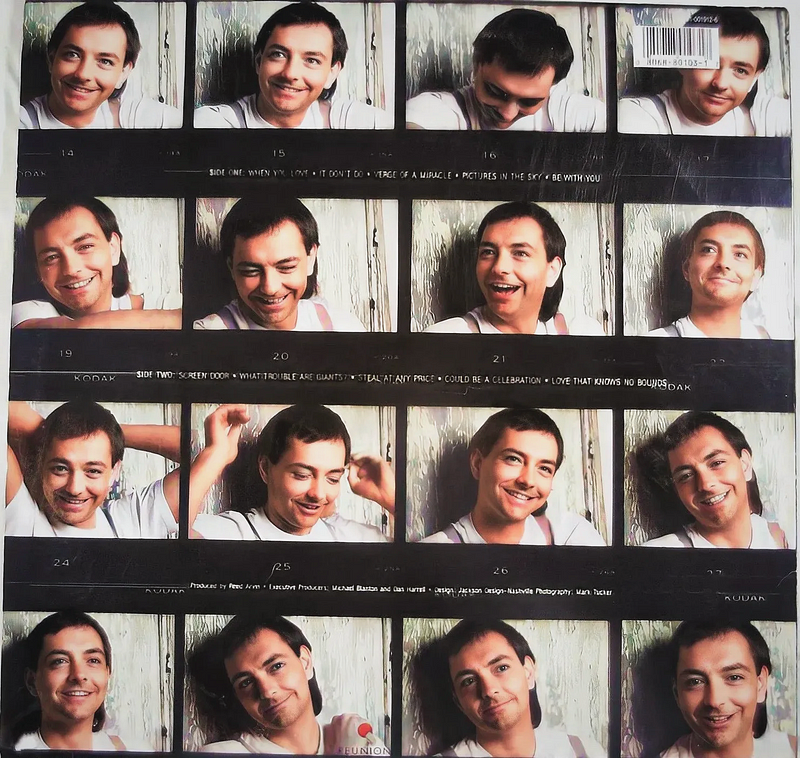
Amy Grant brought him back to the public eye.
Mullins was the opening act for her Unguarded tour, as she opened with his song, “Love of Another Kind,” which she’d covered for her Unguarded album. Her version is about her special love for Jesus:
“The love I know is a love so few discover.”
The song seems to have been written around 1984. On YouTube, there’s a few recordings of Mullins performing the song around 1987, with a distinctly Elton John-like flourish, and different lyrics. Instead of a “love so few discover,” Mullins sings: “I feel you’re closer than a brother.”
The song was sung to a man.
The title “Love of Another Kind” feels very queer. In 1977, the Christian author Richard Woods tried to define a positive gay Christian identity in the book Another Kind of Love.
Mullins’ first album flopped.
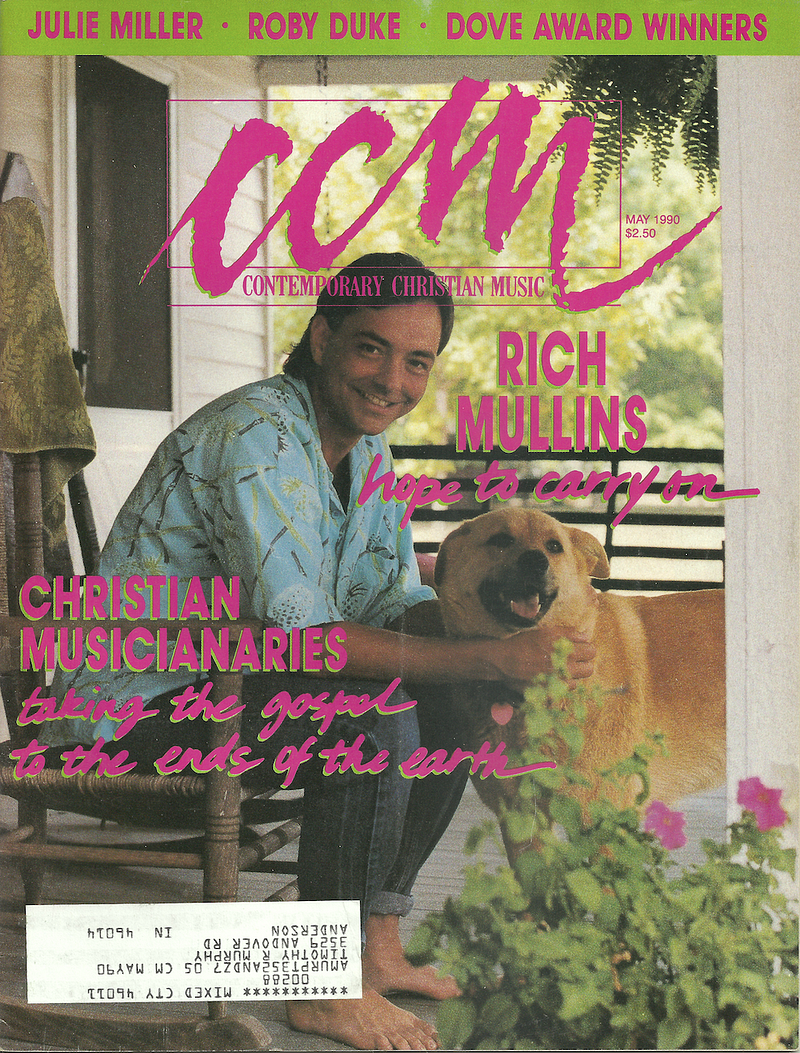
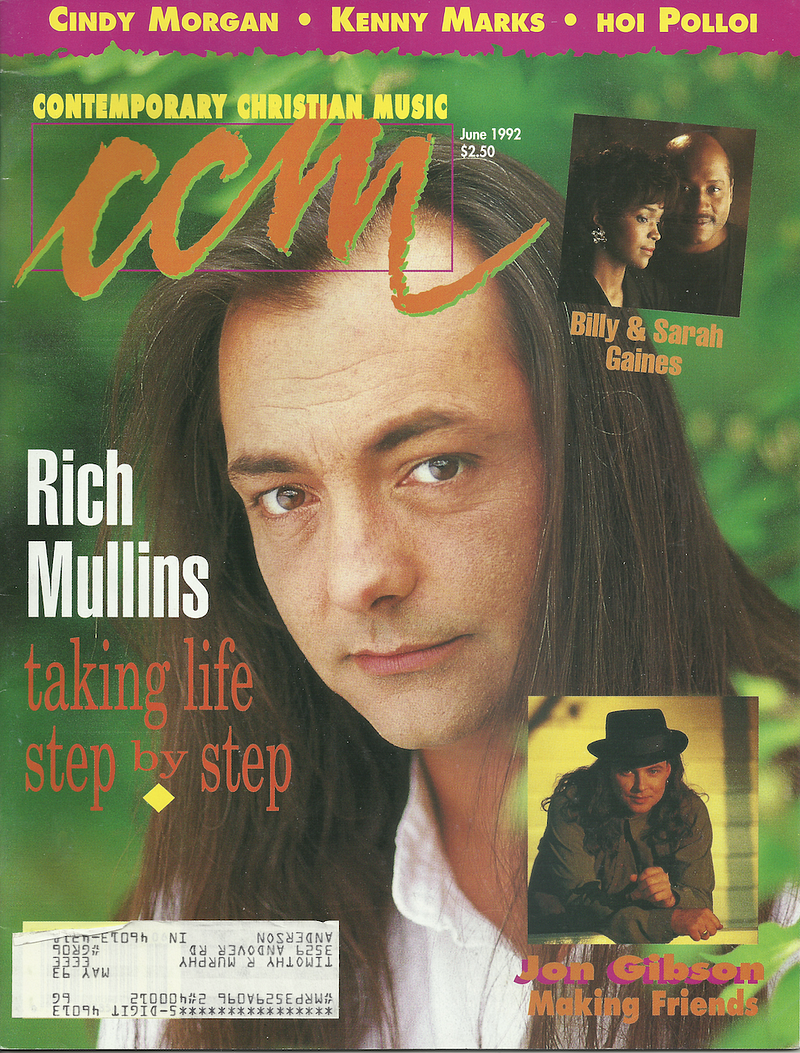
He’d describes it as an album “that nobody bought and that no one would play on the radio.” His second album, Pictures in the Sky also didn’t produce any hits. Neither album was overtly ‘Christian’.
His career in music seemed over. Reed Arvin once noted: “I sometimes think about how different my life would be if Rich hadn’t played me a certain rough cassette tape in 1988.”
Let’s read the “Awesome God.”
The opening line of the song has been a challenge for Christian listeners.
“When He rolls up His sleeves He ain’t just puttin’ on the Ritz…”
The “Ritz” language evokes Irving Berlin’s song “Puttin’ on the Ritz,” but perhaps more specifically the 1982 novelty cover by Taco, the flamboyant Dutch singer, as it was a staple on MTV. Taco seems not to have commented on his sexuality, but one would think: ‘very gay’.
A few lines down in “Awesome God,” Mullins nails down this context:
“Judgment and wrath He poured out on Sodom Mercy and grace He gave us at the cross”
It looks like “Awesome God” is about a deity with a long record of eliminating homosexuals. In 1987–88, the context was clearly AIDS.
“Awesome God” is a monologue by a Southern Baptist preacher.
Rich’s brother David Mullins recalled being told it was written in the voice of this character. For the 2006 book 100 Greatest Songs in Christian Music (where “Awesome God” was #1), David Mullins is quoted:
“He said he was thinking about Southern preachers, the kind that say short sentences, real strong. So he rolled his window down and started yelling these statements into the night, trying to stay awake.”
As Mullins seems averse to Southern Baptist theology, one can only wonder why he was writing in this voice. On the verge of being a commercial failure, was he trying to pander to the Christian public?
“Awesome God” made him a star, and was his only work the Nashville music establishment ever liked. An unnamed executive, quoted by Nathan Myrick, called him “a weirdo with one good song.”
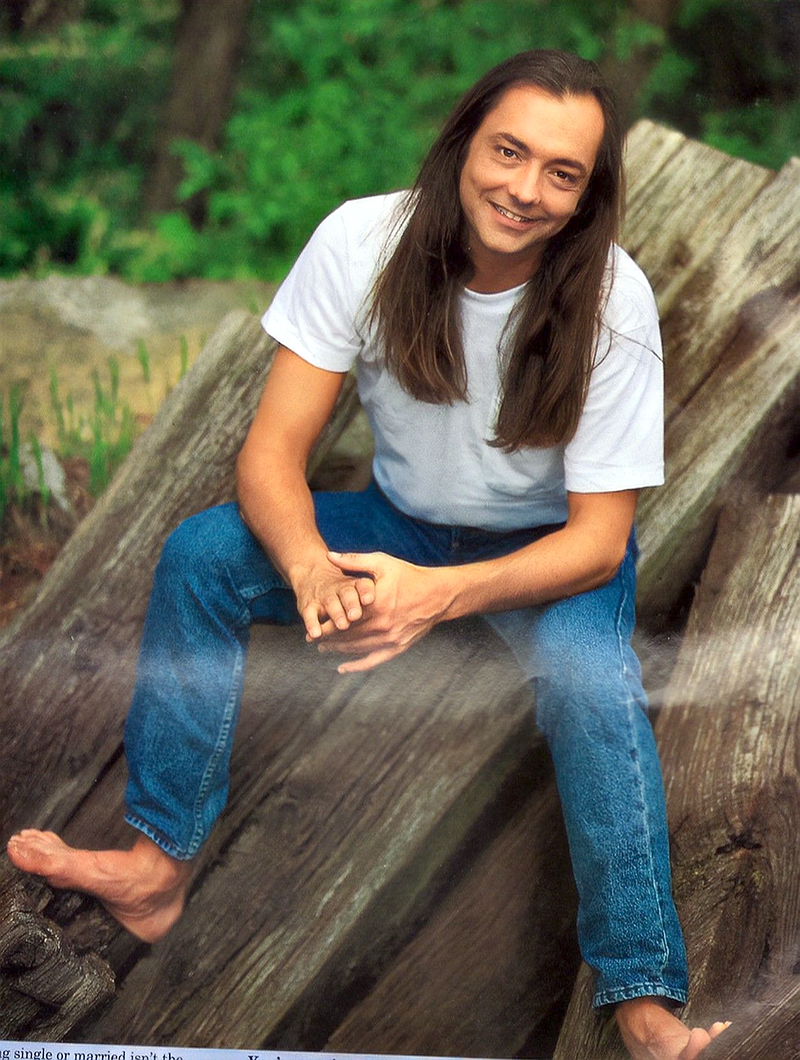
He was close with a younger man named Beaker—who later refused all interviews.
As in the video for Mullins’ 2006 song “Here in America,” the Evangelical world got a nice portrait of two men frolicking around the world.
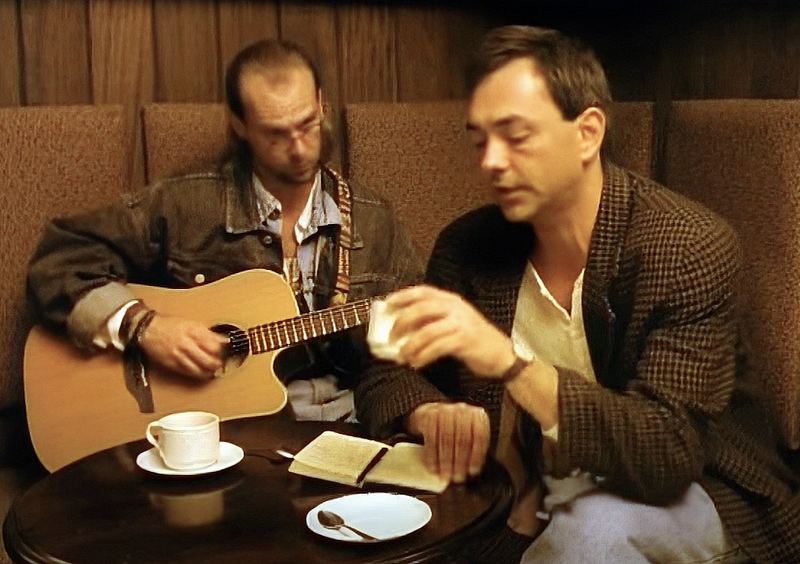
In 1992, the two were in a hotel room in Amsterdam.
Mullins told the story many times. Hoping Beaker would fall asleep, he thought to slip out into the city and do some unspecified illicit activity.
Note: Mullins fans have often generated a storyline that he had a problem with pornography viewed in hotel rooms, but he speaks of planning to go into the city to do some physical act.
He stayed awake in anticipation, as he narrates in 1994:
“After years of behaving myself as best as I could, I was really having to hang on for dear life. I was thinking, no one would know. I could do anything I wanted to do. Wouldn’t it be fun just to cut loose for a couple nights and misbehave as much as I want?”
The nature of the ‘misbehavior’ wasn’t specified. Unsure that Beaker was asleep, Mullins never left. He adds: “But I sure felt the temptation to toss out my morals for an evening.”
These tellings don’t suggest the intensity of the resulting song. “Hold Me Jesus” has a narrator all but destroyed by unnamed yearnings. It’s “so hot inside my soul,” he sings to God, as he prays for the power to ‘surrender’, rather than “fight you for something I don’t really want.”
Mullins had a big insight into the “nature” of his temptations.
At a train station, Mullins tells Beaker the story of the dark night of temptation in the hotel room. I’m transcribing:
“Well Beaker and I were talking in a train station about the whole thing, kinda where we were and where we wanted to be, and we got into some, actually, some pretty explicit detail about the nature of our temptations and of those struggles. And this guy leans over…in the train station, the only other guy in there, and he says, ‘Excuse me, but are you Rich Mullins?’
So I had to think back over our conversation to see if I was or not, and decided that I must be. Whether or not I like who I am, that is who I am.”
There was always talk about Mullins being gay.
In 2021, a CCM insider posted a comment on Reddit about gossip surrounding various stars of the genre. As he writes: “‘Rich Mullins might be gay!’ ‘So?’ ‘Ray Boltz is gay!’ ‘So?’”
Many Rich Mullins songs can be read as ‘queer’. Consider his hit “Creed,” which might seem just a list of Christian beliefs. But Mullins places unusual emphasis on those beliefs as defining himself.
“And I believe what I believe is what makes me what I am”
If Mullins was a closeted gay man, then this reads differently. He’s saying his belief makes him Christian, despite the sexuality which would cause many Evangelicals to define him as non-Christian.
Another Mullins song, “What Susan Said,” has often been read by gay fans as a gay disclosure.
An odd narration of “two lonely-eyed boys in a pick-up truck” has struck many listeners as charged with sexual suggestion. Their skin is “sweaty,” they’re “together”—and feeling “lost.” They return to the line:
“…love is found in the things we’ve given up”
It might seem a motto of Evangelical gay repression.
The blogger Ray Barnhart posted a 2012 post discussing the song as a queer situation. He added a memory of seeing Mullins at a concert in early 1990s, and thinking they had, as he put it, “something in common.”
I wrote to Barnhart asking him to expand. He replies by email:
“I do remember at a week long conference where Rich was the worship leader there was this insanely handsome young guy who followed Rich around everywhere and that was the first time it occurred to me Rich might be gay.”
He’s known of the subject to be discussed, he adds, having heard that Mullins was gay and also that “Rich was definitely not gay,” as he adds: “My friend who was emphatic about Rich being straight was quick to tell me Rich was an alcoholic.”
So these two ideas of Rich Mullins’ behavior seem to have gone around in his circles. In one he was gay, and in the other the gay suspicion was diverted into volunteering that he was alcoholic.
He’d developed a devoted fanbase
A blog post from 2014 speaks to Mullins’ appeal in his heyday:
“Rich Mullins was the Holden Caulfield of our faith: the one guy who refused to be phony. The one guy who refused to play the game. The one guy who questioned the status quo in a music industry often driven by image and sales. The one guy who made faith seem real rather than cliché to Gen-Xers hungry for something authentic.”
But Mullins himself, in stark contrast, discussed the period in terms of his phoniness. In September 1995, he’s interviewed by the Arizona Republic:
“There are times when I know that the overwhelming motivating factor for me is the acceptance and the applause of the audience,” he says. “So you feel like a total phony because you’re up there talking about all this great, grand stuff and you’re going, ‘The filthy truth is I’m saying this because they will clap.’”
He left his career to go back to college.
His story was that he wanted to teach music at a Navajo reservation in New Mexico. He told people that he was going to Friends University to get a degree to teach music, though such a certification wasn’t required.
At Friends University, Mullins met James Bryan Smith, his future biographer, who was a professor at the school. Smith notes in the 2014 documentary that he often did Mullins’ homework. He didn’t mention that in his biography. He also didn’t mention in the book a scene he told the New York Times in 2022.
Mullins stopped one day, Smith recalls, and said: “I want to be friends and you need to know the worst.”
Smith adds that the conversation, “the details of which he will never share, was immensely difficult.” He just adds that the conversation concerned what he called “dark seasons of sin” in Mullins’ life.
He adds that he will never reveal what Mullins told him.
Mullins seemed to make horrifying confessions.
In a 2016 podcast interview, his friend Ben Pearson recalls Mullins showing up one evening and asking to go on a ride around town, apparently in 1997. “He was pretty angry that night at God,” Pearson replies. “While we’re driving around I’m waiting for the lightning bolts to hit. Rich is being very honest. I’m like, ‘Oh God, please help us. Jesus help me.’”
Pearson’s delivery is comic, but the impression seems to be of some confession far outside the norm. I write him at his website asking if he could say that Mullins was not discussing gay issues. No reply.
In a September 1997 interview, Amy Grant narrates a scene of someone telling her something very deeply distressing. The friend is left unnamed. As she says:
“I let down a friend who was going through a really difficult time. I couldn’t deal with the situation so I disappeared. A while later I came back and said I was so sorry. I just didn’t know what to say or do. I had been so overwhelmed. My friend looked at me and said: ‘I didn’t need your answers, Amy. I needed you — your arms around me.’”
Asking to be held might suggest Mullins’ song “Hold Me Jesus,” which Amy would later cover and call her favorite Mullins song.
I write Amy’s management asking if she would say if this person was Mullins, and if she could confirm he had AIDS. I don’t hear back.

In 1994, Mullins gave a lecture on ‘Christian living’.
Long shelved until dug up by fans, it turned out to be a bizarre performance, full of unexpected personal disclosures. He was in college at the time, and yet speaks of going to the movies a lot. He says:
“I really have to watch or I would go to a movie constantly and never do homework, never make my bed. If they showed movies at 8 in the morning I would get up and go. It’s the only excuse I can think of for getting up in the morning.”
He chatters about his non-existent love life. “Most women who get to know me do not want to marry me,” he says. “My life does not play out like my albums do. It’s even worse than my music.”
He had a love song once on an album, he says. It was his producer’s idea. He doesn’t write them. “I don’t have a lot of occasions to do that.”
He is likely referring here to a hypothetical romance that feels oddly inserted into his 1991 song “The River.”
“Maybe she could come to Wichita And maybe we could borrow Beaker’s bike”
He adds that he does write songs about his actual life, but throws those songs away, since they’re “my own business,” and “my own personal therapy going on here. There’s no reason to burden listeners with that.”
The result, he says, is people think his albums are about him. “I kinda go, ‘Wow, these albums don’t address some of the real central issues of my life.’ And I have some real hang-ups.”
His albums are illusions, he says.
He chatters on. “The truth is you know what I have chosen for you to know. I have shown you my absolute best side.”
That was another strange thing to say. His songs are full of personal darkness: loneliness, with suggestions of a drinking problem—especially after Beaker got married and moved to Atlanta.
Take Mullins’ 1995 song “Wounds of Love,” with him singing to a distant, unnamed, ungendered person…in Atlanta.
“The bottle is still so full There’s no one here to turn the tap So much in me wants to reach out and hold you But you’re so far away I can’t do that…”
Mullins was well-known for being ‘messed up’ and ‘screwed up’.
In various blog posts I’m finding notes about him that emphasize his disordered self. One writes:
“Telling ‘Rich was messed-up’ stories is rather like breaking into an AA meeting and saying, ‘Ha HA! You’re all alcoholics! Gotcha!’”
Another comments:
“I was always blown away with how he could smoke then sing beautifully, cuss then write profoundly.”
Mullins’ friend Kathy Sprinkle shows up in a range of pages. She writes:
“He was a walking contradiction, wasn’t he? I guess that is true for all of us, but we decide to hide it rather than celebrate our humanness.”
A woman noted in a comment that she’d briefly met him.
“He casually mentioned in the car ride that he dealt with depression and I was a bit surprised at his transparency at that time.”
In 2007, the Christian musician Shaun Groves leaves a memoir in a comment that is a bit startling.
“He had a foul mouth, quirky irreverent stage presence at times and despised elements of American culture and politics, and often had as hard time liking those he played music for, yet he possessed a deep love of liturgies, creeds, silence, solitude, prayer, mercy, children, and Jesus and he kept, making music for us no matter how much we perplexed him. This paradox confounded and still does.
This man pooped his pants during a concert and then cleaned up in the church bathroom afterward (long afterward) using the soiled boxers he’d worn and tossed them in the church trash can like they were a tissue. He got stoned drunk and sobered up just in time to play ‘Awesome God’ for a bunch of Baptists in Texas. He wrote a song about a homeless man he met with a colostomy bag — the song compared the American Church to this colostomy bag: ‘full of shit,’ he said. It never got recorded. He sent all his royalties to charity and paid himself a teacher’s salary and he never knew how much he’d actually made from all that music he made us. He didn’t smell good, look good, or act good a lot of the time. Rich was, well, just weird. Very weird.”
In 1995, Mullins moved to New Mexico.
Though often said to be a missionary effort, he discouraged that idea.
“If you don’t love your neighbor where you live, you’re not going to love them in another place,” he told the Greenville News. “I just happen to like this region, and so my neighbors are going to be Navajo.”
He’d acquired a new special younger male friend in a fellow student, Mitch McVicker—or as Mullins says, “just this basketball player who happened to be in this religion class I was in.”
In all, five young men from the college went down to New Mexico with him, with the idea to create a sort of spiritual community, the ‘Kid Brothers of St. Frank’ as Mullins and Beaker had called it, after Francis of Assisi.
Mullins did concerts, and phone interviews with regional newspapers. Unnoticed at the time, they now seem darkly revealing. He chats with the Indianapolis News in 1995:
“Everybody struggles. If people knew the stuff I struggled with, they would hate me . . . I do the best I can. I have failures and I don’t think Christianity is less true because I’m not an exemplary Christian. What I want to communicate to people is what I think is at the heart of the gospel, which is that God loves us.”
A young reporter spends a week in New Mexico, doing a profile.
Today, Lou Carlozo doesn’t like any talk of Mullins and same-sex intimacy, but notes of their few days together: “I slept with Rich Mullins—in the same way I slept with my kid brother as a kid.”
Mullins tells him, in the profile, that he isn’t sure why he’s ducking out of his career. “I don’t know if I’m afraid of success; I might be,” he says. “I can make records for the rest of my life and talk about love, but it won’t mean anything until I love somebody.”
Why is he on the reservation? He replies: “For me, it’s much more to work out my own salvation with fear and trembling.”
It’s fine if his celebrity fades. “If it continues, that’d be fine,” he says. “If it doesn’t, that’d be fine. I’ve had more than my 15 minutes.”
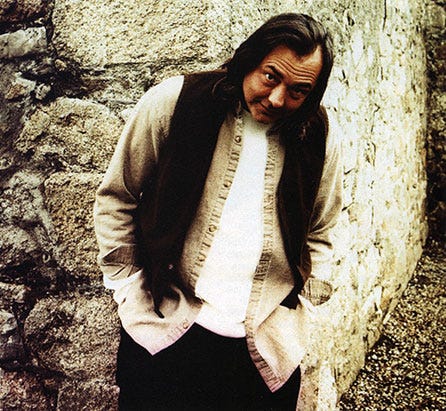
In a 1997 interview, Mullins tells a story about his dad.
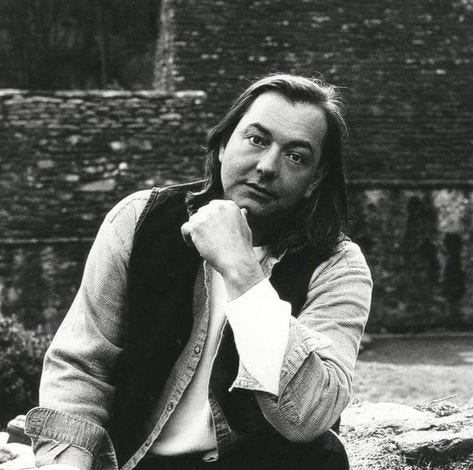
It’s a curious narration. Mullins is recalling that “a friend of mine” had been a youth pastor—realizing he was gay and was “in crisis” about it. He decided to tell Mullins’ dad for some unstated reason.
“He was going, ‘Gosh I feel like I’m a phony because I, you know, I go to church and I tell kids all this stuff.’”
Presented with this news, Mullins continues:
“…my Dad said, ‘You need to decide what’s most important to you and do it. You can’t do everything. And uh, you know what the Bible teaches and uh, decide if you can live with the Bible or if you can live without it.’”
Is this Mullins telling his own story? I go back and re-read the ‘secret sin’ interview, when ‘God’ said to him:
“Yes, what you do makes me sick too, but what you are makes me sicker. You do what you do, because you are what you are.”
Was that God—or his dad?
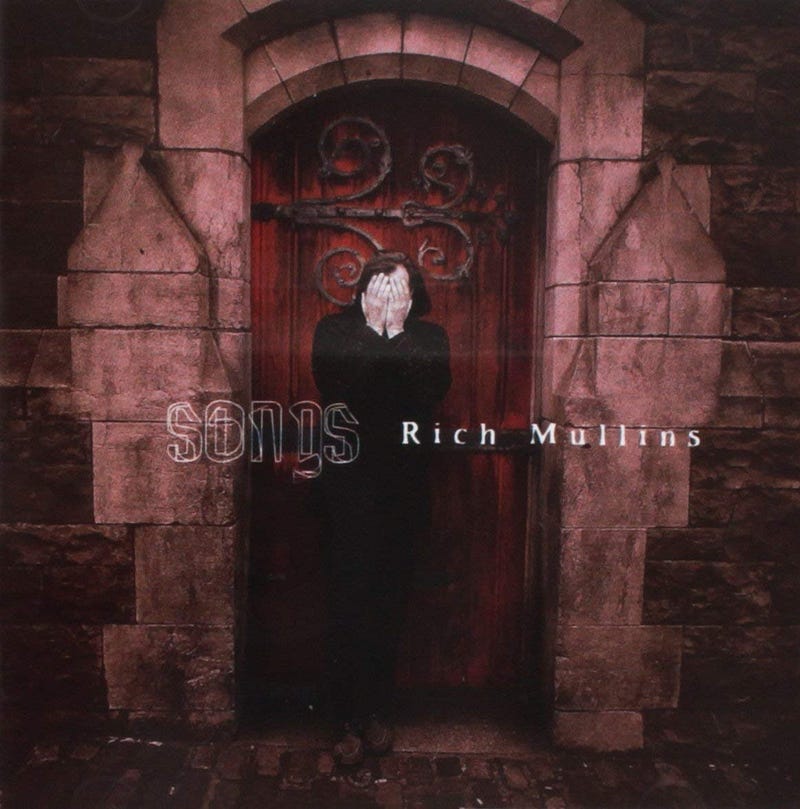
He worked as a music teacher on the reservation.
The story he told about quitting the school was that it was fundamentalist Christian, and he wasn’t. “And I can respect that,” he said. “We both agreed that I don’t really need to be there right now, just because I don’t get fundamentalists, and I don’t really know that I want to be stuck with a bunch of ’em.”
In a 2014 blog post, Melody K. Anderson, the daughter of a well-known Christian author, recalls spending a week visiting a Christian school in New Mexico in March 1995. She was at first unaware of the identity of the man wearing shorts on a snowy day.
“He seemed uncomfortable, nervous, distracted, and out of place.”
Mullins’ musicality was magical, but something was wrong. “Rich seemed ill-suited in his own skin and misplaced on the planet,” she writes. When she later hears of his death, she adds, “my first reaction was relief.”
Toward the end, there was a wasting.
As Jeremy Klaszus observes: “In his last months he looked like hell — haggard with big bags under his eyes. A man passing through. He seemed almost to know what was coming.”
Mullins explained his worn appearance as from being so long on tour. In photos, his body shape changes rapidly from overweight to frail.
People came to interview him to ask about the key questions of life. Like how does he, a super duper Christian, manage to live among Native Americans? “The same way I dealt with living in Middle America,” he replies. “I think most Middle-American beliefs are in direct conflict with the scriptures.”
In March 1997 he says: “I really came here more to try to get beyond my white, middle-class Protestant upbringing and see life through a different lens.”
For years he spoke of converting to Catholicism.
In a 1994 interview he talked up the Pope as an important religious voice: “You know, at least this guy has some credentials.”
At the same time, he did also self-identify as a religious outsider. He explains in 1988:
“I take comfort in knowing that it was the shepherds in whom the angels appeared when they announced Christ’s birth. Invariably throughout the course of history, God has appeared to people on the fringes.”
He was also the speaker the Evangelical world turned to for ‘outsider’ views on key subjects, like homosexuality. In June 1997, CCM did a feature on AIDS and quoted him: “It seems like the church has picked homosexuality out to be the ultimate evil thing, and I’m just not always sure that it is.”
Mullins was clearly very unwell.
In a 2018 interview, an associate, Chuck Harper, recalled that Mullins “was getting really exhausted. He was having stomach problems. He was weaker.”
Several friends in Rich Mullins: A Ragamuffin’s Legacy have vague updates. One of his young bandmates recalls: “He was real, real tired. Real tired.”
Another friend recalls:
“He called me out on the porch and he said, ‘You know all these things we’ve been dreaming about doing — I’m not going to be able to do these things.’ He said, ‘My health has been bad.’ He said, ‘I don’t what’s going on or why, but I just know I’m not going to be able to do this.’”
One friend says vaguely: “There was something going on beyond him that he couldn’t control, something greater.” No explanation.
This problem seemed to threaten to cut short all his ongoing plans. Another friend recalls Mullins saying: “I don’t have time to get everything done, and that’s part of why I’m so crazy right now.”
In his final months, his concert banter got edgier.
He’s speak of his anticipation of resurrection. “I’ll have no bags under my eyes. I’ll have a jaw line, biceps, the whole works. I’ll be a jock. Either a jock or a fife player, I haven’t decided which.”
That a 41-year-old Christian man was so focused on his death seems to have passed largely without notice. On April 11, 1997, he was giving a performance in the chapel of Wheaton College. He dismisses Christian music. “If you really tuned into that stuff all the time, it would warp you.”
His own fans only knew part of his music. “The grim stuff doesn’t sell well,” he says. Then he’s back in his childhood. “I think I was raised Christian, but once I left home I began to find out how un-Christian my family was.”
Tapping out background music, he’s Kierkegaard at the piano:
“We live in a time when we have come to believe that there are answers. I don’t know why we believe that. Even more worrisome is: I’m not even sure why we ever came to believe the questions are all that important.”
He dismisses academic treatments of the faith.
“Christianity is communicated the same way diseases are. It’s communicated through touch, through breath, through life, not through information.”
He was saying he would be disappearing.
A church friend who is interviewed in the Ragamuffin documentary recalls Mullins calling and saying plans for work on the reservation were being dropped: “My health has been bad. I don’t know what’s going on or why. I just know I’m not going to be able to do this.”
In the later interview for the documentary The Work You Began: The Last Days of Rich Mullins, Harper adds that Mullins had called him outside for a private talk. As he puts it, Mullins says: “I’m not going to be able to finish all the stuff we were wanting to do.”
Harper protested that Mullins would surely be able to record, no matter where in the world he went. Mullins said:
“No I don’t know what it is. I’m not going to be able to carry out all these things that we’ve talked about. But I will be able to fund it.”
Harper quotes him again:
“I don’t know if I’ll be in the States. I don’t know what’s going on. I don’t even know if I’m going to keep recording music. Just some things have changed.”
In September 1997, Mullins and crew stayed at the home of young Caleb Kruse.
Kruse remembers the three week visit in a 2016 memoir, Meeting Rich. He hadn’t at first recognized Mullins, he recalls, who explained his haggard appearance: “We’re doing a couple things right now, which is why we look really tired.”
Caleb writes: “When he spoke, he was polite. Almost even shy.”
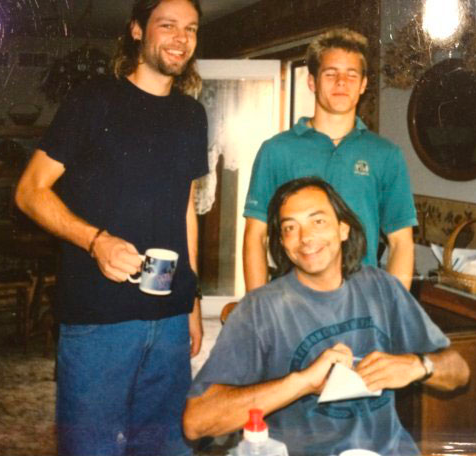
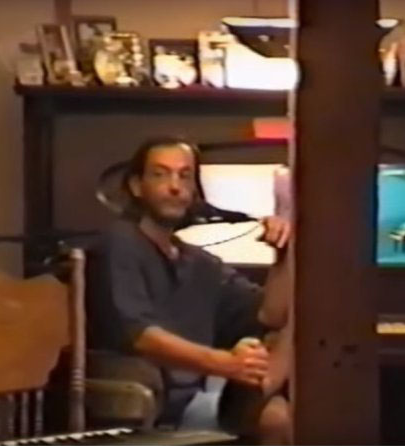
They had several musical projects in progress.
There was Mitch’s first solo album and Mullins’ latest project, a concept album. The Jesus Record would narrate the birth and rise of the messiah— in the wilderness, among the shepherds.
Mullins gave a concert in Kruse house, with lots of talky interludes. “I wanted to be a jock, but I don’t have any athletic skills at all,” he says. He’s back remembering the house he’d lived in Cincinnati as a struggling Bible college student:
“And I had so little money, I was in the attic with one other guy. And we had to sleep together for the two years I lived there, because he had an electric blanket. I woke him up one night, my teeth were chattering so loud. He said, ‘Why don’t you just sleep with me? That way, I can get some sleep and you can too.’”
During the stay, Caleb’s mom had an odd moment where she wonders if something’s amiss. “I just need to ask,” she says, “are you okay?”
“Yeah,” Mullins says.
“I just feel like something’s wrong,” she says.
“Don’t worry,” he says.
Mitch recalls the gas station where they refueled.
On September 19, 1997, they were headed southbound on I-39 north of Bloomington, Illinois. Mitch remembers Mullins at the cappuccino machine, now spilling all over the floor. Mullins walks away?
The gas station clerk recognized him. “It was just funny to me that he made that big mess and gets recognized,” Mitch says. “That’s my last memory.”
The Jeep veered off the road. Both men were thrown out. Mullins hit the road. That might’ve been it for him. The semi truck didn’t help.
Memorials were held across the country for the author of “Awesome God.” The newspaper at Liberty University quoted a mourner saying: “A prophet of God has left the earth.” 🔶


