
Evangelicalism is ghostwritten
A religion’s books are written by somebody else
To Evangelicals, pastors are “men of God” with special divine status. They step up to the pulpit to speak, and the God just flows out of them.
They write books too. Or do they? I’m looking into the long case that Evangelical books, like its sermons, are largely produced by an army of unseen ghostwriters—many of them female, or gay.

There’s notorious cases — like Billy Graham.
In 2000, the Washington Times did a feature on Evangelical ghostwriting, and noted: “By some insider estimates, 85 percent of the Rev. Billy Graham’s books have been ghostwritten.”
But to follow Billy Graham’s career is to wonder if he wrote anything. He had little religious education and spent his life hectically busy doing “crusade” after “crusade.” His 2006 memoir Just As I Am reports: “I have never been able to have others help me do my evangelistic sermons.”
But a biographer slipped in the disclosure: “Throughout his ministry, Graham would use a variety of assistants and ghostwriters to help with sermons and publications.”
The ghostwriting got ridiculous at the end, when he was known to be blind and senile. In 2015, at age 95, he was senile and released a new book, Where I Am: Heaven, Eternity, and Our Life Beyond..
As observers noted, the voice didn’t even sound like ‘Billy Graham’.
Then there’s Hal Lindsey…or rather, Carole Carlson.
In 1971, Lindsey’s mega-selling book The Late Great Planet Earth introduced to the Evangelical world an idea that all the true Christians would soon be whisked up to Heaven, as the ungodly would be ‘left behind’.
People flocked back to churches, to make sure they’d be getting ‘raptured’. The co-author was listed in small print: ‘C.C. Carlson’.
As Lindsey sometimes notes, his own language skills are quite poor. It appears Carole C. Carlson, a middle-aged journalist, wrote the whole thing—disguising her gender to make the book acceptable to Evangelicals.
The religion says, publicly, that women are spiritually infirm beings.
In many churches, women are disallowed even to speak. Privately, the religion uses one female ghostwriter after another. The greatest modern Protestant writer might be Elizabeth Sherrill. With her husband, John, she wrote three mega-selling modern Evangelical classics: God’s Smuggler, The Hiding Place, and The Cross and the Switchblade.
The Sherrills were journalists without any theological education. For years into their careers as Christian writers they weren’t even Christian. Elizabeth Sherrill’s 2012 memoir, All the Way to Heaven, and scattered news clippings, leave the impression she was the major creative force.
James Dobson had a female ghostwriter. She gave an interview in 2016 as ‘Jane Doe’. Chuck Colson, Evangelical superstar, said the award-winning 2000 book How Now Shall We Live was “the most important book I have ever written.” As the Washington Times article noted, most of the book was written by his co-writer Nancy Pearcey, who had to remind him, and their publisher, since she’d been promised a public credit she wasn’t receiving.
Then there’s the gay Evangelical ghostwriters.
A Christian pastor and ghostwriter named Mel White made a splash in the late 1980s and 1990s by coming out as a ghostwriter for household Evangelical names—and coming out as gay.
The books he’d written were a church library: Billy Graham’s Approaching Hoofbeats, Jerry Falwell’s Strength for the Journey and If I Should Die Before I Wake!, Pat Robertson’s America’s Dates with Destiny, W. A. Criswell’s Standing on the Promises.
The religion writer Jonathan Meritt mentions in his online bio:
“As a collaborator or ghostwriter, Jonathan has worked on more than 50 books, with several titles landing on the New York Times, USA Today, and Wall Street Journal bestsellers lists.”
After Merritt came out as gay, it might’ve been nice to know if any of those Evangelical books had anti-gay content.
A typical “pastor book” is really just a few sermon transcripts and maybe an interview.
The Christian ghostwriter Phil Cooke noted in a blog post that often he’s given “little more than a few interviews, a sermon tape, or a conversation or two with the pastor.” He’s never been credited, he notes.
And his clients, he’d notice, lie about the authorship:
“For one project, I actually wrote a book for a client and then he stood up on national television and described how he had ‘labored night after night writing without stopping, until his wife had to beg him to get some sleep.’”
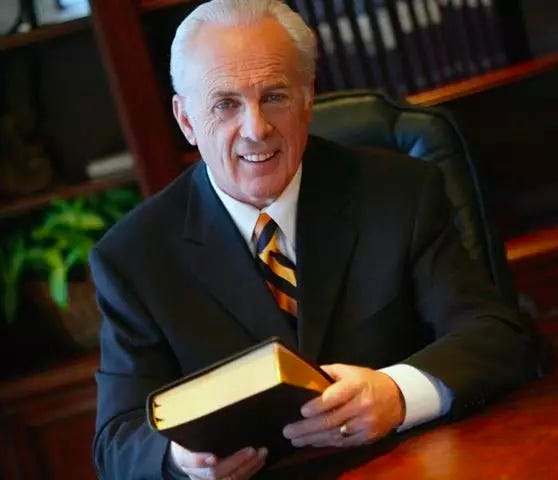
The key Evangelical cleric John MacArthur is often discussed as using ghostwriters.
The Bible scholar Michael F. Bird noted in 2014: “It’s a well known fact that John MacArthur’s books are not written by John MacArthur, but by Philip R. Johnson at GCC.”
Philip R. Johnson is a staffer at the church. He has only a bachelor’s degree, as typically ghostwriters have no theological education. All the degrees, all the ordinations as signs of divine wisdom are just part of the show.
The “names” go on and on.
The Washington Times listed a few household names in the Evangelical world: “Pat Robertson and D. James Kennedy, megachurch pastor Bill Hybels and marriage guru Gary Smalley.”
The ghostwriter Larry Walker recently gave a podcast interview. He says that writing Oral Roberts’ 1990 book Prayer Cover Over Your Life was his first big job — of many to follow. The interviewer offers: “You’ve sat down with people like a Joel Osteen or a T.D. Jakes.”
“Yes,” Walker replies, though he adds: “The most famous ones always include clauses about anonymity.”
That T.D. Jakes uses ghostwriters is noted in a biography, with the detail that he makes them “sign waivers prohibiting them from discussing their contributions to his books.” Nothing says ‘Christianity’ like an N.D.A.
Sometimes, the religion protests ghostwriting.
In 1982, Christianity Today declared it a religious violation. That doesn’t mean the magazine stopped reviewing ghostwritten books.
In 2002, the right-wing stalwart Randy Alcorn wrote a blog post: “I believe Christian ghostwriting is a scandal waiting to explode.”
“It’s virtually a scam,” says Jim Fletcher in 2014 in WND.
But without naming names, do they really want to end the practice?
John Piper wasn’t having it.
In 2013, the famous pastor from Minneapolis wrote a blog post against the practice. If readers see a name on the cover, he writes, they assume that is the author: “Therefore, I think putting your name on a book you didn’t write is a lie.”
But how deep was this critique going? The only person he specifically targeted was Mel White, and Billy Graham by silent inference for having hired a homosexual ghostwriter. As Piper put it: “It really sank my estimation of those men’s integrity several notches.”
The Christian ghostwriter they prefer is someone like Jerry B. Jenkins, the sturdily masculine figure who wrote everything from the mega-selling Left Behind series to Billy Graham’s In His Own Words.
Rick Warren is one of the hazy cases.
A biography of Evangelical superstar Rick Warren noted his mega-selling The Purpose Driven Life was ghostwritten, but Warren adds that he took over the authorship in order to put his own stamp on it. Does that mean he wrote it cover to cover? I’m guessing not.
In 2012, Warren was widely quoted for tweeting that ghostwriting was “deceptive and dishonest”—but that Tweet has been deleted.
A Christian ghostwriter named John Fischer notes in his online C.V. that he has been “Rick Warren’s ghostwriter for secular articles in national publications.”
Evangelicals like to talk about it.
In 1993, a feature in World magazine noted that Christian writing had been dominated by “people long on reputation but short on time, self-discipline, or writing ability.”
Beth Allison Barr, whose book The Making of Biblical Womanhood is a minor bestseller, tweeted recently that as hard as it was to write a book, “it irritates me when I discover that male pastors at big churches w/popular books used ghost writers.”
Commenters were filling in details: “I know a megachurch pastor with an honorary doctorate who has written several books that sold very well. I also know that they were all ghostwritten by someone who works for him.” (note: tweet later deleted)
Another tweeted: “The dad of my best friend in school ghost-wrote all of Oral Robert’s books.” Or another: “I once met a big name pastors ghost writer and this author is a woman.”
I wrote all these commenters asking for names. None replied.
But really, the religon is just showbiz.
Like T.V., movies, or Broadway shows, you never see the writer. You see the actors. These “men of God” up on stage are just guys who look the part. The act is scripted. It was from the start of their careers. They get fraud degrees from diploma mills, and they preach plagiarized sermons.
They get book contracts and publishers create their brands for them. In a comment to a Julie Roys story on plagiarism, a man who says he’d worked in Christian publishing for decades said pastors would be assigned ghostwriters and a marketing team.
They need do nothing but play the part. 🔶


