
Sustainable Economy
Does the Coronavirus Trigger New Economic Ways With Less Pollution?
NASA satellite footage shows an astonishing drop in Chinese pollution
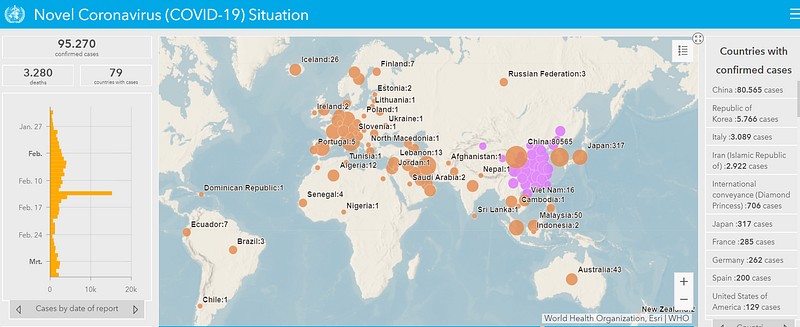
The coronavirus outbreak has many consequences for people, public life and the economy. On March 5, the World Health Organization (WHO) reports 95,270 confirmed cases in 79 countries and 3,280 deaths. This is what the coronavirus outbreak looks like in terms of being spread widely.
However, behind the clouds of health fears and plummeting stock exchanges, there might be a silver lining. Don’t get me wrong, I’m not cheering. People are dying! I’m rather thinking, how could we have let it come this far? And now that it has come this far, can it be a trigger for change?
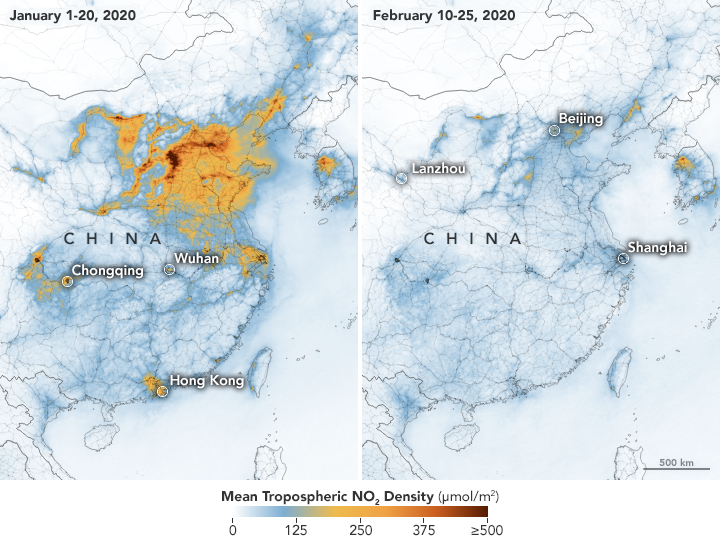
What am I talking about? New NASA satellite footage shows that air pollution in China has dropped significantly. And this is not only due to the Chinese New Year festivities (Jan 25-Feb 8) when the whole country comes to a standstill every year…
“ NASA and European Space Agency (ESA) pollution monitoring satellites have detected significant decreases in nitrogen dioxide (NO2) over China. There is evidence that the change is at least partly related to the economic slowdown following the outbreak of coronavirus.”
The article by NASA continues to say that every year a drop in pollution statistics is measured during the Chinese New Year. And in the past years, specific events have shown similar drops. The recession of 2008 was one of them. And the Beijing Olympics another.
However, the Chinese area in which pollution has dropped is much wider this time. Wuhan, where the virus was first spotted, is situated somewhere between Beijing, Shanghai and Hong Kong, the large economic centers of China, as you can see in the top pictures.
These pictures also show that pollution has dropped in the whole area. The yellow, reddish, and brownish colors are signifying NO2 pollution. The darker the color, the higher the pollution.
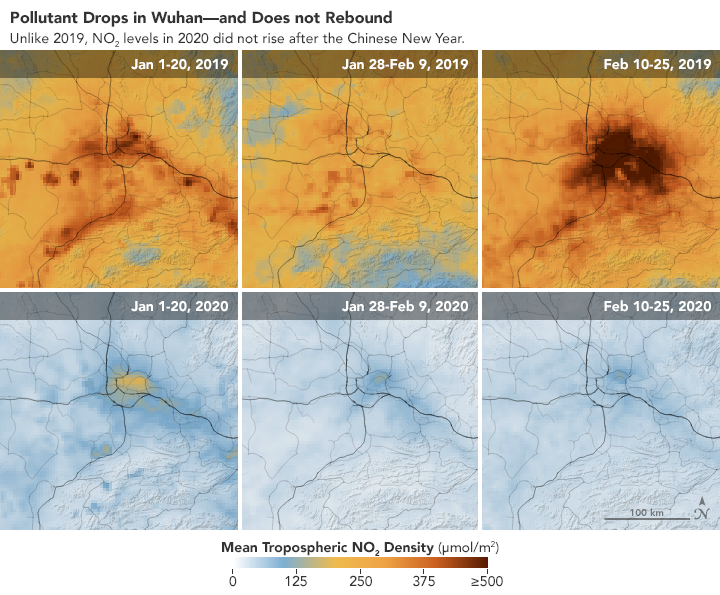
The drop in pollution also seems to be lasting longer than in 2019. “This is the first time I have seen such a dramatic drop-off over such a wide area for a specific event,” said Fei Liu, an air quality researcher at NASA’s Goddard Space Flight Center in the article.
“This is the first time I have seen such a dramatic drop-off over such a wide area for a specific event,” said Fei Liu, an air quality researcher at NASA’s Goddard Space Flight Center.
Here are more pictures, comparing the data from 2019 and 2020. In the pictures below, you see the same area of China on different dates in 2019 and 2020. As you can see the color coding depicts a significant reduction in NO2 pollution before, during and after the Chinese New Year.
What does this mean for our global economy? What if this coronavirus outbreak can be made into a first trigger towards new economic ways with much less pollution?
People who read my work, know that I think the solution to our destructive way of living lay in local, regenerative economies providing for basic needs and working with synergy instead of scale as an economic driver.
We all know big scale consumption and infinite growth of the economy cannot go on without depleting our resources and polluting our planet. But synergy might be a way out of this negative spiral. It creates active economies, creates value upon value, and waste can be used as a resource for the next product. Furthermore, in a regenerative economy, we give back to nature to unleash the abundance of our natural resources.
My motto is this: first, we have to restore damaged ecosystems worldwide and then we have to learn how to live within planetary boundaries together. To make a living within these restored ecosystems.
We have some major tasks here. Adapt to climate change. Adapt the path of infinite growth with all its negative consequences. Change quantitative growth into qualitative growth and create many jobs in the process. I’m not saying that the transition will be easy. But it’s necessary and now might be the time to get on with it.
“Let’s restore ecosystems and learn how to live within the boundaries of our planet together” — Desiree Driesenaar
It can be done! If you want to know more about the ecosystem restoration part of my motto, please read this article about how large scale restoration is definitely possible.
And if you want to know more about our planetary boundaries, this might be a good entrance into the solutions found with systemic thinking.
So, let’s take a look at some of the economic consequences that the coronavirus epidemic have caused so far:
- CNBC reports on Feb 20: “ Air travel demand is set to decline for the first time since 2009, IATA warned.” And: “Coronavirus to cost airlines more than $29 billion in revenue this year”
- The NYTimes reports on Feb 20: “The world’s second-largest economy [China] practically shut down three weeks ago” and “ Some factories are firing up again, but with many workers quarantined and parts in short supply, production is limited”
- Bloomberg reports on Feb 26: “Most of the big Korean companies are hunkering down. Some are telling employees in the Daegu area, the virus hot spot in the country, to work from home and are disinfecting factories and labs every day”
- BBC News reports on Feb 27: “Coronavirus prompts buyers to look closer to home”
- CNBC reports on March 3: “Italy closes all schools and universities as coronavirus death toll rivals Iran’s.” And “Iran cancels Friday prayers in major cities as death toll rises”
- CNBC Reports on March 3: “China’s passenger car sales fall 80% in February as demand drops”
- Washington Post reports on March 5: “Economic fears about the coronavirus weighed on U.S. stocks on Thursday, shaking investors who are desperate for clarity on the growing global outbreak”
Apparently, there are two sides of the medal. Pollution decreases and economies falter. But these economies are also changing. Spreading risks, becoming more local. So, what if we took the economic side of the medal several steps further?
Could these coronavirus effects be the trigger for a new and different form of economic thinking? We have created our economic system ourselves. We can also change her if we think the current system is not serving us and our planet anymore.
Let’s take a look at what we could do to affect change in the right direction.
- We can start realizing what’s really important in life and cut back on consuming nonsense stuff. We can simplify life and create an abundant lifestyle with what’s vital to living our best lives. Basic needs? Health? Love? Clean air? Clean water?
- We can create new economic activities around basic needs in our communities, so we can be self-sufficient. This way we can prevent and decrease poverty in the face of further environmental disaster
- We can restore degraded ecosystems big time. We will strengthen the immune system of our planet when the ecosystems are functioning properly. And by doing that, eating the healthy food these ecosystems provide, breathe clean air, drink vital water, we will improve our own personal immune systems as well
- We can start giving back to nature in our business models and unleash the abundance of value in our economies
- We can wake up and start living a purposeful life. We might consider embracing the ‘right livelihood principles’ of work and living. Karryn Olson wrote about it in Permaculture Women's Guild
- We can travel wisely in the future. We can go as a traveler, not as a tourist. We might stay longer so we can really learn from our experience. Return as a wiser human being, embracing cultural and natural diversity. Adopt local ways and give back to the communities and nature we visit
Whenever I lecture about this transition towards a different economic model, people ask me: “What about jobs? People won’t have jobs…”
We will have jobs, though. Gunter Pauli calculates the new jobs that can be created all the time. His book ‘The Blue Economy’, published in 2010 as a report to the Club of Rome, has the subtitle: ‘10 years, 100 innovations, 100 million jobs’.
In version 2.0, published in 2016, Gunter explores all the innovations that have already been realized. It has as a subtitle: ‘200 projects implemented, US$ 4 billion invested, 3 million jobs created’.
So my advice is: let’s face the transition head-on. Let’s do it creatively. Let’s do it in an entrepreneurial way and create those jobs. When new jobs are being created, we can handle the fact that other jobs — the ones in our broken, linear economy— will be lost.
Every cloud has a silver lining. And this might be the silver lining of the devastating fears around the coronavirus. Let’s mourn the lives lost, yes. But let’s also look at the bright side. Let’s transform our fear and grief into action. Let’s reinvent ourselves, our communities and our economies!
I’m always open to comments. And if you want to connect, you can find me on LinkedIn or somewhere in our food forest, restoring ecosystems on a small scale…
Thank you, Mike, for adding your wise energy to my world view.
After publishing
This article with wise words of Li Edelkoort, one of the most influential future analysts of the world, came to me after I published my story. It offers great additional reading…
“It seems we are massively entering a quarantine of consumption where we will learn how to be happy just with a simple dress, rediscovering old favorites we own, reading a forgotten book and cooking up a storm to make life beautiful. The impact of the virus will be cultural and crucial to building an alternative and profoundly different world.”
“A regulated shut down of production plants for two months a year could be part of this concept, as are collective creative studios that would produce ideas for several brands at a time, bringing about an economy with a much lighter environmental footprint.”
“Local industries and activities would gain momentum and people-based initiatives will take over with bartering systems and open tables, farmers markets and street events, dance and singing contests and a very dominant DIY aesthetic. My future forecast for the Age of the Amateur seems to come much faster then I anticipated.”