How can our livelihoods be REGENERATIVE?
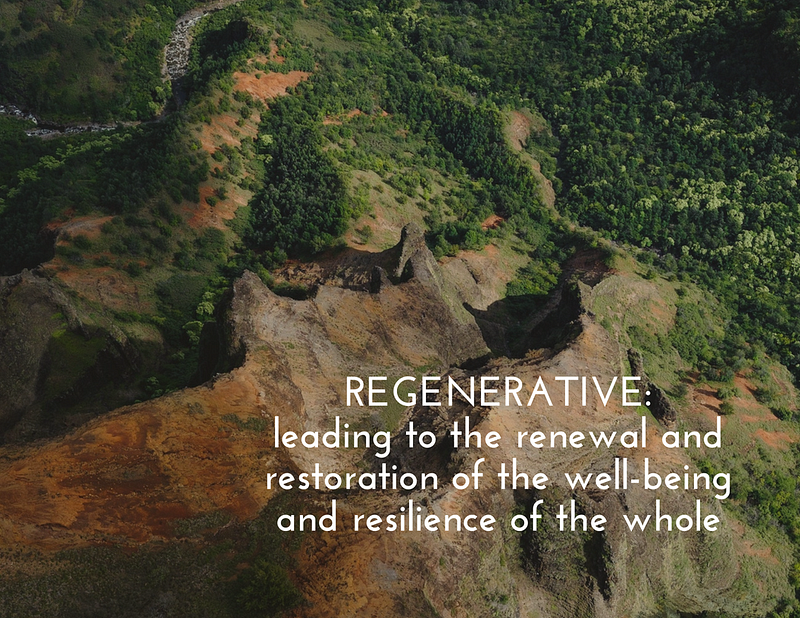
Recently, I’ve been breaking down the term “regenerative right livelihood” to clarify the concepts so we can discuss and evolve them, and apply them in our lives.
In a prior post, I shared some of my thinking about how the simple but profound concept of “right livelihoods” can help shift society towards a more life-honoring economy.
Today, I want to share some criteria that I believe can make our right livelihoods themselves more regenerative.
But first, let’s say it like it is…
The dominant economy is degenerating ecosystems and communities, endangering life on our planet.
Why?
How is it that we have created an economy that could lead to our own demise?
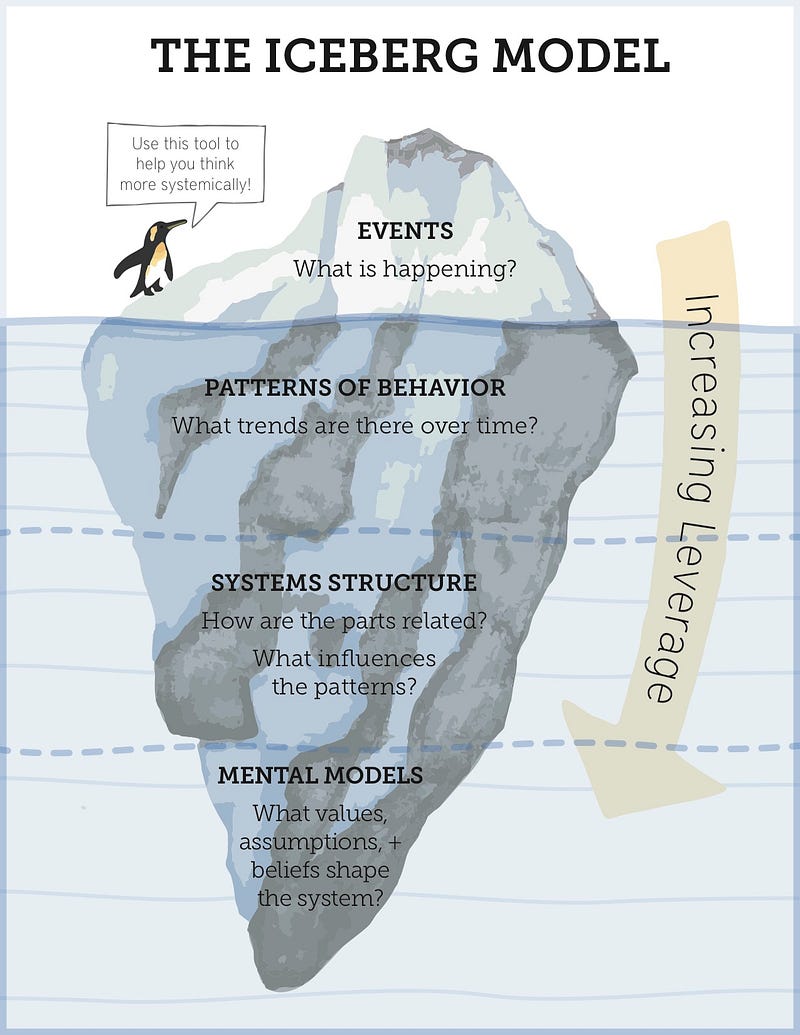
To answer that, let’s use the iceberg model, a tool often used by systems thinkers to understand problems. This approach helps us go beyond looking at “the surface” of current problematic events (such as utter political impotence to curb greenhouse gas emissions) to look for underlying patterns of behavior, and the structures that give rise to them. Our goal is to “daylight” the mental models that give rise to these systems and patterns of behavior that actually cause the events.
So, what are the mental models that give rise to a degenerative economy?
I’ve facilitated World Cafe format sessions around this, and I believe that THE WORK is in each person reflecting on the questions. Please pause and consider the question above before you read on.
I’ve thought about this a lot, on my own and with groups, and my conclusion is:
The root cause is a dominant worldview that sees Earth and people as resources to be extracted - in service to empire building.
Whoa, that’s heavy, I know.
The good news is that when we realize that our current mental models aren’t a good fit for the current reality, we can discard them like clothes we have outgrown, and choose new ones.
What if instead, our economy was underpinned by beliefs grounded in the reality that Earth is a living planet — whose aliveness emerges from the many living systems (biological and social) nested within?
What if we simultaneously nurtured the emergence of economic systems rooted in paradigms that consider THE PURPOSE of WORK is to enhance the well-being and integrity of these living systems — our lifesheds and communities, through our individual, unique, highest contribution?
Referring to the iceberg model above, what systems structures, patterns of behavior, and discrete events might arise from those worldviews?
Again, please stop and reflect on these questions for yourself before reading on.
Approaches like this already exist, and give us some insight into how shape social structures:
The Haudenosaunee worldview, as explained by Joyce Tekahnawiiaks King, holds that water is sacred.
“From the perspective of the traditional Haudenosaunee, we speak in terms of responsibilities with respect to water, not in terms of water rights. This shift in emphasis is not casual in our eyes and takes us to the central premise of this paper. From time immemorial, we have held the view that the “law of the land” is not man-made law, but a greater natural law, the Great Law of Peace. This law, in our view, is divine. The Haudenosaunee have a deep respect for the waters of the Earth. For example, one of the root words for “rain” in Mohawk means expensive, or precious or holy. Culturally, we would not abuse this resource. Our society treats and cares for the waters as a sacred element so that water remains pristine.’”
From this articulated worldview, new questions emerge:
- How might we live and work if our environments were sacred to us and we had to ensure they thrive?
- Likewise, if we shift away from the concept of rights to land, what societies might we then build?
- What if we decide that together, we can build an economy based on compassion and equity?
These changes in world views would change everything.
The next, difficult question then, is:
How do we change world views?
The late systems scientist Donella Meadows wrote this:
“In a nutshell, you keep pointing at the anomalies and failures in the old paradigm, you keep coming yourself, and loudly and with assurance from the new one, you insert people with the new paradigm in places of public visibility and power. You don’t waste time with reactionaries; rather you work with active change agents and with the vast middle ground of people who are open-minded.”
Briefly re-phrased:
We speak and live regenerative paradigms into being.
So far, in my work, I’ve identified some criteria that can help us ensure our right livelihoods are promoting these life-enhancing paradigm shifts:
Regenerative right livelihoods
- are Place-sourced, thus based on learning from and co-creating with ecosystems
- are rooted in equity and justice, and a vision of each person developing the skills to co-create a future in which all can thrive
- honor and center the insights of historically marginalized people as wisdom-keepers whose vital perspectives enable us, together, to find better solutions
- incorporate science and appropriate technology, but also include other ways of knowing, and valorize and value the caring work that is the core economy.
YOUR LIFE’S WORK IS A PARTICULARLY POWERFUL WAY to speak and live a regenerative paradigm into life, because you can lend your expertise and a good chunk of your life energy in service to co-creating our regenerative future.
If through our livelihoods we can enable many small-scale regenerative solutions to self-organize into regenerative economies in our regions, then we will truly be able to speak loudly and from assurance from a new paradigm, and we will insert people with the new paradigm in places of public visibility and power.
These are not skills we learn in a course, these are capabilities we develop over time, and this is best done with support, in community. We do this work in Regenepreneurs.
I’ll look forward to hearing your insights on how our livelihoods can be more regenerative. Please share your insights in the comments, or email me at [email protected]. I’ll look forward to hearing from you!
Also, if this post resonated, highlight sections, clap as many times as you’d like, or please do share it further!
I started out working with women to thrive in their right livelihoods in permaculture. If that is of interest to you, I was part of the initial vision for this course, though I’m no longer actively teaching there:


