
Circular Economy: It’s Time to Add Reciprocity to the Model. Will Kelp Be the Change?
We need business models that give back to nature and learn how to stay within the boundaries of our planet
Circular Economy is spreading its wings widely. And I applaud it. It’s a good step to rethink our linear business models and create something better. Materials will be reused while retaining as much value as possible within the system.
However, time is running out. We need to go fast now beyond the circular economy, towards a regenerative economy. What’s the difference, you ask? Well, the difference is one word: RECIPROCITY.
A regenerative business model will always give back to nature. It will always create more values than just money. And it will focus on the basic needs of all species, not just humans.
Regenerative business models will create clean air, clean water, healthy food, community, and everything else we need in order to live a purposeful life within the boundaries of our planet.
It’s very possible and in this article, I will explain why, how, and what.
Let’s start with my motto:
“We should restore ecosystems and learn together how to live within the boundaries of our planet” — Desiree Driesenaar
But why? Why is nature so important? What’s wrong with our ecosystems? It’s really very simple. We live on a planet that might seem vast and endless, but it isn’t. Already in 1972, the Club of Rome shook the world with its report: “The Limits to Growth”.
In that day and age, there was lots of criticism on the report. But in 2014, new research by the University of Melbourne showed that 40 years after publication the predictions are coming true. The predictions in Limits to Growth are that the effects of collapse will start to bite around 2015–2030. Well, that’s around now…
Before we go and explore some directions to advance in, let me explain a bit more about the planetary boundaries. What are they? The Stockholm Resilience Center has visualized them in a graph. They have defined 9 planetary boundaries and keep updating calculations on how far we are in or out.
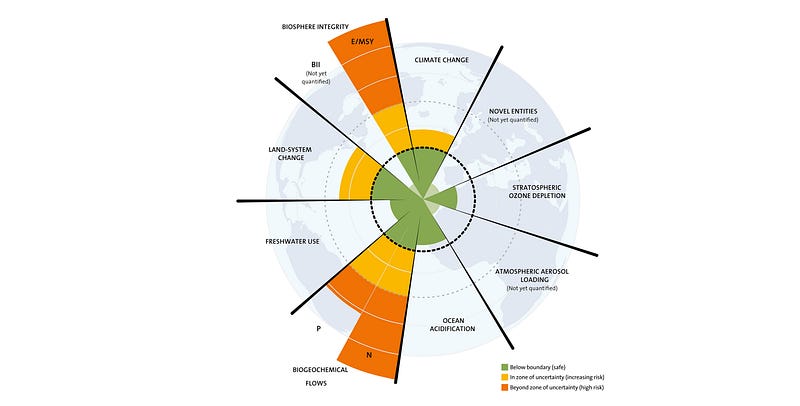
In a glimpse, we can see that we overshoot dramatically on biosphere integrity (mostly called biodiversity) and the biochemical flows Nitrogen and Phosphorous. These are the orange bits.
We also overshoot on climate change and land-system change (yellow). On subjects such as freshwater use, ozone layer depletion, and ocean acidification we still seem to be in the safe zone. On their website, you can read more details on the nine boundaries and their way of calculating.
Another way of calculating is done by Earth Overshoot Day. They come to the same overall conclusion, however. We use a lot more resources every year than we give back.
“Earth Overshoot Day marks the date when humanity’s demand for ecological resources (fish and forests, for instance) and services in a given year exceeds what Earth can regenerate in that year” — Earth Overshoot Day
In 2019, the Global Earth Overshoot Day was on July 29. That means we have been living ‘in debt to nature’ for the rest of the year! 5 Months of debt!
Okay, so let’s get back to the business models. Why is the circular economy failing when it comes to overshooting the planetary boundaries? Remember the butterfly model by the Ellen MacArthur Foundation?

At the bottom of the model, it says: “Minimize systemic leakage and negative externalities”. And in my opinion, that’s where it goes wrong.
How do you mean, minimize? We need to give back to nature! We need to restore ecosystems! We need to unleash the abundance of nature if we ever want an economy that works for all of us on this planet.
Before I go into that, though, let’s look at the circular economy on a bit deeper level. ‘Het Groene Brein’ (the green brain) gives a lot of in-depth explanation about the ways businesses create their circular business models.
“A circular economy is an economic system of closed loops in which raw materials, components and products lose their value as little as possible. Renewable energy sources are used and systems thinking is at the core.”
Definitions often focus on the use of raw materials or on system change. When businesses focus on resources, they often use the 3-R method:
- Reduce (minimum use of raw materials)
- Reuse (maximum reuse of products and components)
- Recycle (high-quality reuse of raw materials)
Mobility gives a good example. Car sharing is offered by many companies nowadays. Hopefully, this means that fewer people buy cars. This reduces the use of raw materials (reduce). Complete technical parts of engines can be repaired and remanufactured to obtain high-quality, just-like-new engine parts. Also, the chassis and interior of a used car can be upgraded to be used in a new car (reuse). When the complete parts can no longer be used, the materials themselves (metal, textile, plastics) can be melted down so that a new car can be made of them (recycling).
Systems change often focuses on four elements:
- Closed cycles. Here the focus is on no waste. Waste is always a new resource for something else and will never be wasted. Optimum waste use will be designed in the system from the beginning.
- Renewable energy. Away from fossil fuels, often focusing on solar, wind, water power and biomass.
- Systemic thinking. Everything is connected so we need to look at what we do in relation to each other.
- Social inclusiveness. The social aspects of our business are often overlooked in the circular economy. But for some practitioners, it’s very much part of it. And in my opinion, it’s a very important aspect.
So, back to my point in the beginning. Where is the reciprocity in the circular economy? When do we start giving back to nature? It is so logical to me that when we take from nature (resources), we should give back. It’s taught to children by every mother. There should be no taking without giving…
“Earth provides enough to satisfy every man’s needs, but not every man’s greed” — Mahatma Gandhi
But there’s more to it. If we really want to create an abundant economy, we need to change our mindset from scarcity to abundance. Think about it: we can start with the giving and the abundance will be a result. The laws of nature don’t know any better. They are made for abundance!
If we start by giving to nature, nature will produce more and more and more... The spirals either go down (scarcity) or up (abundance).
And if we are wise and humble enough to use only what we really need… If we share with each other and other species on our beautiful planet, we are on the right track. We have made a beginning, creating an economy that stays within the boundaries of our planet.
HOW FASHION CAN GIVE ABUNDANCE
Let me explain it with the example of fashion. Say, we will from now on only produce our fashionable clothes with local, abundantly available materials that are fully biodegradable in soil, saltwater and freshwater. It’s very possible.
Let’s make sure we produce locally. In a safe and socially acceptable way. Creating jobs that people are happy in. That’s a must from the beginning.
Clothes are already made from seaweed, bamboo, industrial hemp fibers, nettles, jute, wool, etc. Some of the production processes are not completely free from chemicals yet, but we can innovate ourselves out of that. Let’s also make sure we print them with non-toxic, biodegradable inks and yarn.
Well, designers, this is your opportunity. Step up and give us a completely new league of fashion! You can do it!
At the end of their lifecycle, the clothes (completely biodegradable) will not end up in landfills or be burned. No, they will be food for our soils. We will make terra preta out of them, or Bokashi, or other microorganism-and-beneficial-fungi-rich compost.
And the regenerative farmers will grow our food on these soils. Mother Nature will be so grateful for our generosity that she will supply us with an abundance of healthy food. All nutrients included, life-energy giving food. Oh, how we need that!
But Mother Nature will give us more. She will give us healthy skin and clean water. From Fashion to Food. Don’t think it’s a utopia, it can be done!
So, what would be needed in a nutshell:
- Local, abundantly available materials
- Production processes that innovated away from chemicals and really provide us with healthy, non-toxic end-results
- Companies with a strong purpose
- A strong connection between the company and its environment
- Business models that create multiple values, work with synergy as a driver instead of scale and use everything that is locally available in an optimum way
- Optimizing the whole, instead of maximizing money for a few shareholders
Well, some more elements of regenerative business models can be found in this article.
And if you want to read how we can restore ecosystems, you might like to read this article as well. It has already been done on a large-scale! So what’s stopping us from doing it again… and again… and again…
We have been so powerful as a human species to destroy things. Let’s be powerful now to restore and create a regenerative economy within planetary boundaries!
Luckily, many people are already working hard to make it happen. All in their own ways. Here are some of the trends I see. And although it’s not going fast enough by far, I want you all to be inspired and make your contribution.
- Companies are making more and more business models with local, abundantly growing materials. Examples are bamboo, seaweed, industrial hemp, nettles, etc.
- The bamboo buildings of Green School Bali impressed me immensely when I gave a talk about island economies on the island.
- Fungi and mycelium will be important resource materials of the future. There are many companies and foundations working on building materials, packaging or furniture made with the material. To me, the most inspiring European entrepreneur in this field is Ivanka Milenkovic. As an expert biologist, she really changes production methods (little energy, organic) for the resource itself, food and other end-products.
- Seaweed can be grown in biodiverse settings, restoring our oceans and giving us resources at the same time. Many entrepreneurs worldwide are experimenting and scaling up this very functional resource material.
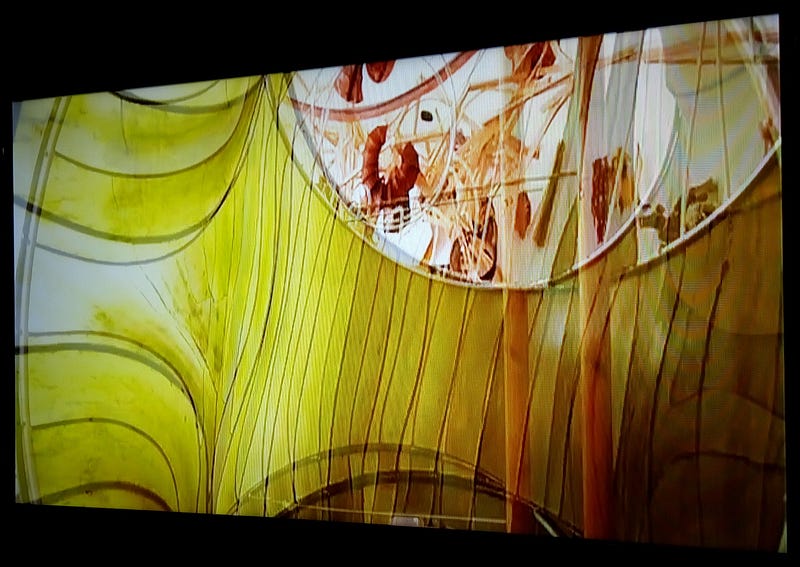
- Julia Lohmann, professor at Aalto University in Finland, designed a magnificent seaweed pavilion at the 50th World Economic Forum this year in Davos. She motivates designers to look at the vast opportunities of kelp to transform our material choices and stay within the boundaries of our planet.
- Please, watch her TEDx talk to find out how functional kelp can be, as resource material. And read this article in which Julia speaks the words I do wholeheartedly agree with:
“We know too much and we do too little” — Julia Lohmann
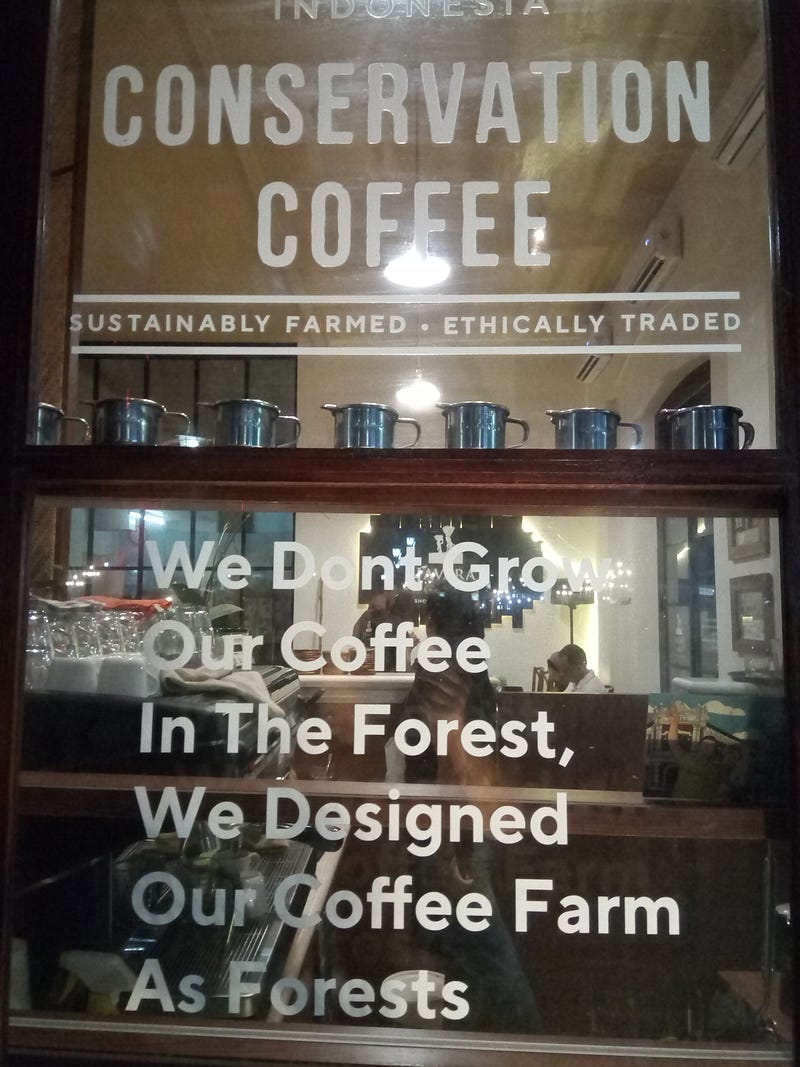
- Food is grown in biodiverse ecosystems. I see organic coffee and other crops grown in biodiverse food forests. Food companies such as Javara Indigenous Indonesia are giving these farmers training and a global market to sell their products to.
- Some companies at the edge of Nature Reserve areas are transforming into organic, biodiverse plantations. They combine jobs with nature protection. Hathikuli is an example from Assam, India. An account of their story and business case has been shared by the Blue Economy in 2016. Drink their tea and change the world…
The entrepreneurs behind these companies and foundations are the (s)heroes that I applaud. It’s not easy to create these new regenerative business models and make them work. But they do it!
They are motivated, creative and skilled to make it happen! They put all their entrepreneurial passion into their companies and do it! Two words are high on their agenda: CARE and RESPONSIBILITY.
They care enough to want a different business model. Not just a circular business model, but one that gives back to nature. One that uses synergy to create multiple values for all species.
And they take the responsibility to keep all the consequences of their business within the company. They do not throw their garbage over the wall of society.
And before you say to me: I’m not an entrepreneur. This is interesting but has nothing to do with me. Please, think again. We all have our own role in this oh, so important Millenium of Change.
- Consumers. We are all consumers and we can vote with our wallets. Please, spend your money where your heart is. Make your life abundant this way! Spend time with your loved ones and in nature instead of buying stuff you don’t need. And if you do buy stuff, support the companies that think systemically. The ones that are trying to make this change happen!
- Entrepreneurs. Please, put care and responsibility high on the agenda and have fun creating these new business models. There is a vibrant community out there doing it. And you can be part of it! These are exciting times for entrepreneurs…
- Designers. Please create new products with local, abundantly available materials and make them hip and sexy!
- Politicians and government officials. Please, help create the laws and environment for change.
- Scientists. Please, combine your head and your heart and help us research the fields that need your brilliance. And make the connection to entrepreneurs to bring all these wonderful inventions to our doorsteps.
- Farmers. Please, feel your connection to nature and use your heart and your knowledge about soil and plants wisely. Join the league of regenerative farmers.
Everyone can be involved and can be an inspiration for other people! We love to grow our networks and invite new people to join. We love connecting and collaborating! We need to invent this more beautiful future together, so please join…
After the publication of this article, industrial designer Megan Valanidas commented and showed me her work on bacteria-centered design and bioplastics that automatically decompose in the soil and ocean. I love it! The materials can be used in 3D printers and that triggers my imagination immensely… A new story starts to emerge…
“In creating my contributions [to these exhibitions], I focused on soil as the end user,” Valanidas says in this article, “designing objects that will be attractive to bacterial decomposers.”
I’m always open to discussion and alternative opinions, so feel invited to leave a message in the comments. And if you want to connect, you can find me on LinkedIn or Facebook or somewhere on a boat, checking out the vibrant ocean communities within the kelp forests…
Thank you, Mike, for adding your wise energy to my business words.
Further reading
And if you want to know more about scaling regenerative business models or steps that can be taken by existing companies, please check out these articles.


