
Elon Musk Fires 50% Twitter, and Why I Like It
Big Tech is an overblown centralization of talent

Thursday night, it was a lightning thunderstorm on Twitter, the world’s most vocal social media. Elon Musk fired practically half of Twitter’s employees.
As a result, Twitter’s total strength would go to 3700 from 7500.
However, Musk’s original plan was to fire 75% (5600 employees) — an announcement on which he backtracked later.
Here is a leaked email that sealed their fates:
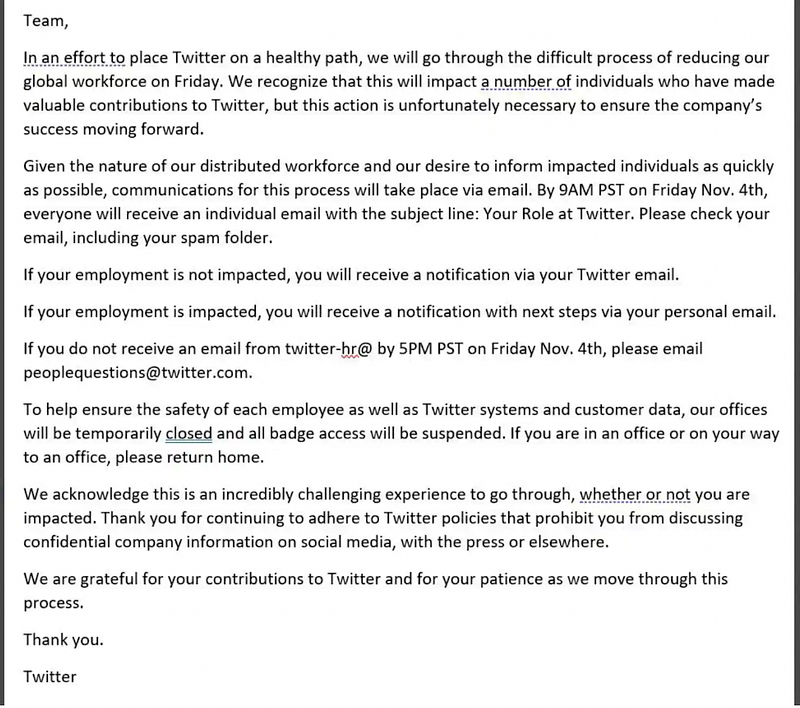
Unlike other layoffs in the big tech domain, this one is a bit unprecedented: Engineering has been a prominent part of the layoffs, and Musk is going in a structured way (structure as defined by himself) to make this happen.
How Twitter Programmers will get fired?
There are rumors that Twitter programmers will be fired based on the number of LOC they have written in the past 3–6 months. I am unable to find any source that supports it.
There are also reports that say that some Twitter managers have instructed their staff to work 12 hours a day, 7 days a week (84 hours/week). If this is how it’s trickling down, I am definitely not with it. At best, it will drive the best minds away. At worst, it will make Twitter a place full of mental health patients.
According to a Washington Post article, many Twitter engineers received a calendar invite that said:
“Stop printing, please be ready to show your recent code,” a reference to engineers being asked to show the code they had written in the last 30 to 60 days on their computers.The note continues, “Please come prepared with code as a backup to review on your machines with Elon.” Later, people inside the company reported that Tesla engineers were reviewing the code.What does this mean?
Assuming Musk is quite sincere in his “Fix the Twitter” mission, these are the likely yardsticks:
Who will be let go from Twitter:
- Those having less or zero commits (yes, they may exist) in the last 3–6 months
- Programmers with cosmetic commits. Example: Bug fixes resulting from tech debt and regressions, trivial changes needing no engineering talent (localization, error messages, massive library imports, version updates, etc).
Who will be retained at Twitter:
- Programmers who wrote reusable components — more so, if their contribution is in line with Musk’s future Twitter product rollouts.
- People who can talk both tech & business, irrespective of their code contribution, and can show it to Musk’s regiment without fluff PPTs.
I am quite skeptical about how much culture-building Elon himself believes in. Twitter will be a private firm from now on. The one thing that will change for sure is the drastic reduction in things leaking outside.
As opposed to today wherein the world feels entitled to know how many toilets in the Twitter offices need renovation.
Some things just can’t be rebuilt without being destroyed:
Elon Musk has a debatable way of doing things. But at least, in this case, I seem to think there is a method in his madness.
It’s easier to think he is a ruthless capitalist or a sociopath who loves firing people. But given his clout, he could as well crowdfund hiring his pet staff and run Twitter without huge layoffs.
Cutting Twitter in half seems drastic. But it might just be the first domino in a series of other disruptive moves.
It’s massive. It’s unprecedented. It’s also painful.
Twitter has empowered the world with many great ideas and discussions, but it has rarely used them for its own benefit and growth.
But there is a feeling I have about this, and it has got to do with Physics. If a pendulum has shifted far left (pun unintended), you need to tap it lightly toward the right (again, I am only talking about Physics), so it can eventually rest at the center, with an organic loss of momentum.
That’s how it should happen in a world functioning on democracy and free markets, right?
DHH of Hey has written quite a meaningful post about why Steve Jobs fired 4100 employees from Apple when he returned to it.
Twitter has been a bloated place. Having 7500 employees just to maintain an international forum with likes, retweets, and comments? I find it laughable that a software organization with that impact can’t get its productivity equation right.
Take the example of running a national taxi operator. In the US, with 20K towns, you would need to hire 5000 customer care people (a ballpark) to make 24x7 bookings.
If you solve this problem using software engineering, you get Uber.
True, that Uber and its friends need billions to fix customer grievances and lawsuits. They are the infamous money pits and do little good to their contracted drivers across the world.
But that’s Uber, right? We are talking about an ideological giant, the free speech platform Twitter!
It has been around for 2 decades. It has empowered the world with many great ideas and discussions, but it has rarely used them for its own benefit and growth.
In the last decade, Twitter has gotten stale in ideas and finds itself solving the wrong problems more often than creating revolutionary stuff.
Here is some of its most recent noteworthy stuff (taken from Wikipedia):
- 2017: Tweet limit doubled to 280 characters (yay! 👏 👏 👏 😏).
- 2018: Locked accounts would no longer count toward the follower count
- 2020: Jeff Bezos and other celebrities’ Twitter accounts got hacked
- 2021: Twitter acquires Revue, a newsletter platform to compete with Substack and scoop up the growing newsletter market
- 2022: Elon Musk's long-running Twitter purchase episode
Does any of this seem world-changing, let alone growth? Can any of it be picked to justify the need for 7500 strong team (most of which are on tech-level salary)?
Well, some developers might argue: It has a gigantic codebase, with world-spanning infrastructure.
True, but it’s already written. It just needs smart maintainers. With developers of Twitter’s caliber (algorithmically, in line with Google aspirants), even a rewrite from scratch should be completely possible.
Twitter is far from NASA’s lunar mission. And only now, it started playing in the hands of the chief engineer, SpaceX.
But what about Twitter content moderators‘ layoffs?
Content moderation cannot be profitable and effective at the same time until AI bots nail it
Many of the fired Twitter employees are content moderators who help it remain a free speech platform, at least in theory.
I am not a political analyst. I am not qualified enough to say those layoffs are justified or wrongful. Nor I am eligible to claim the whole Twitter takeover is the far right’s agenda to choke free speech worldwide.
However, I have the following things to say.
Content moderation isn’t a social platform’s cup of tea. It’s not profitable. If they are doing it, it’s because the law dictates them to do it.
What they fail to engineer, they outsource.
Cognizant (a content moderation provider hired by Facebook, Twitter, and Google) used to employ thousands to watch over hate speech, terrorism, and other inappropriate content. In 2019, it terminated this moderation contract with Facebook following a journalistic investigation. What was it about? The mental trauma its employees were going through while moderating hateful content.
Until AI bots nail it with 100% accuracy (again, a debatable variable), content moderation is not profitable and effective at the same time. Musk might want this at some point, I suppose.
Again, content moderation is neither big tech’s main aim nor their competency.
Their competency lies in continually disrupting fields that are not digitized yet.
Their aim is to make profits in a merciless manner.
Twitter isn’t alone (and that’s the scary part):
It is one thing to employ people in thousands, with great perks, a nice work culture, and the ultimate freedom of speech. It’s another thing to bleed investor money, yet not be innovative enough to even your 10% capacity.
Perhaps, that last italicized part applies to many other big tech companies as well.
It’s not just Twitter.
All of FAAMG are oversized megacorps:
Take a look at their employee count (approx. from Wikipedia)
Google: 1,40,000
Microsoft: 2,20,000
Apple: 1,55,000
Meta (Facebook): 83,000
Amazon: 1.5 M (includes shipping + delivery staff)
In 2020, a financial firm named Tipalti released a research paper named “profit per employee”.
What was the top tech firm according to that report? Any guesses?
Despite the pandemic online boom, it was none of our favorite FAAMG boys. It was NortonLifeLock (you know it by the name Symantec antivirus). In 2020, it earned $3.9bn in net income, employing 3600 people. That meant every employee earned $1,079,722 for it.
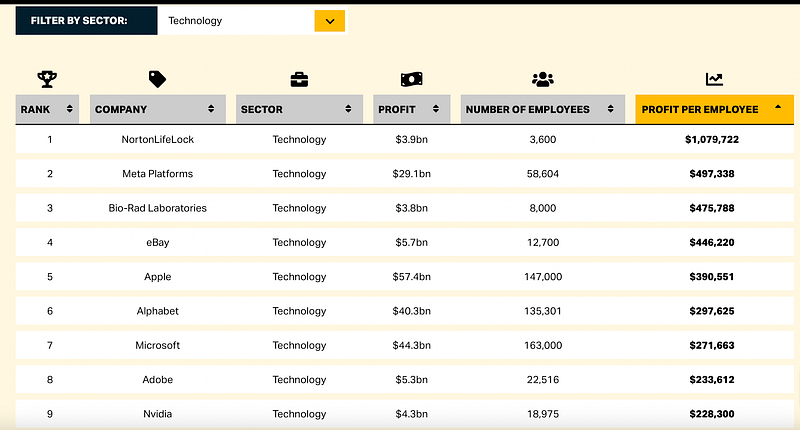
Except for Amazon, we find the entire FAAMG and Netflix (reported under the Media sector) on the profitable side (2020).
Tables have turned today, however. Past pandemic, Netflix and Facebook have visibly bled billions in revenue. If such a report would be made today, some of the big boys (FAAMG) would appear far below their 2020 positions.
No one earning $300K+ in cash + stocks at Google has the guts to revamp Google’s ugly UI and repulsive UX.
I am not an economist. The point I am driving home is that at all the big tech firms, a glaring lack of efficiency & oversight is finally showing up.
- Google’s products have trash UX. Their open-source offerings (Flutter) have failed to feed the revenue mouth. Lately, in order to beat TikTok, it has been heavily prioritizing YouTube search results. An 8-year-old can tell that it’s pure greed to earn from high-paying video ads by increasing user friction. Can you believe it? In their urge to remain data-driven (we don’t fix it unless figures show they suck), no Googler (earning $300K+ in cash + stocks) has the guts to revamp Google’s ugly UI and repulsive UX.
- Google’s text search results are also faltering in relevance, penalizing organic results in favor of AdWords customers, or junk affiliate SEO-friendly sites. By the way, Google is the company that gave the term SEO its meaning and later exploited it to control the web using its short-sighted AMP framework. The only reason DuckDuckGo isn’t winning is Google’s deep dominance via Gmail, Chrome, and Apple partnership.
- Amazon is a ruthless efficiency machine. It is good at scaling products without caring much about its staff. But it is far too shortsighted in building a tech culture. As a result, future CS talent may not see it as an employer worthy of their dreams. It faces deep attrition, and I have written about its possible reasoning here.
- Apple is the most secretive among big tech. Since the demise of Steve Jobs, it has not come up with any revolutionary product, barring industry-killing Macbooks. Its developer collaboration systems (App Store Connect) are worse than $15 stock websites. Found a simple CRUD bug? File a radar where it rots in the long queue — there goes the ownership principle! Using iCloud is a nightmare for most users, but Apple keeps it that way to sell more cloud storage.
- Apple, the most innovative company is also infamous for sherlocking popular apps — stealing successful app developers’ salable business ideas. Killing competition is one thing, but cutting that hand that feeds you is outlandishly foolish. Once its secrecy is broken, no one knows how many skeletons will come out of Apple’s closet.
- Microsoft is the farthest when it comes to innovation. The rare times it has done it is via acquisition. With its deep pockets, it could have rewritten Windows OS while dumping Intel (a la Apple move) a long time ago, but it has never happened. Its trump card so far has been its long-time enterprise customers. It keeps winning over the competitors with a bullish packaging strategy: First give low-quality products for free, and later force them to use those at a higher cost. That’s how MS Teams won over Slack. Its latest AI offering OpenAI’s DALL-E won’t be changing the world, at least in its present pricing structure and form.
- Facebook, for now, is out of my radar because Metaverse is far from its grand promise, and Facebook has already cut some jobs quietly and is planning to cut even more.
What does this say? One: My last June prediction of FAAMG falling like a domino is pathetically coming true.
FAAMG layoffs are more imminent than they might seem:
FAAMG employees are hired and onboarded like cargo bags on a conveyor belt in an airport arrival hall.
- In their continual chase of growth, FAAMG club has hired beyond the limit. At C-level, it is to justify more investment dollars. At a lower managerial level, it is to fatten one’s organization, thus increasing one’s promotional points.
- FAAMG has not only overhired but hired irrelevantly in the pyramid base which is the widest. While hiring, FAAMG put extreme emphasis on the skillset rather than the role. Just compare their boilerplate job descriptions against those of the smaller tech companies. Algorithms? Get in! Product management degree? Welcome! Stanford/MIT? most welcome! As long as you pass the 6–8 interview gates, you are welcome. I have heard that at Google, new employees await until a manager picks them for their project. Until then, they are in a common resource pool. FAAMG employees are onboarded like cargo bags on a conveyor belt in an airport arrival hall. Where is the focus?
- FAAMG developers have an elevated sense of ego. They treat outside devs as an inferior breed. Take a look at their open-source repos and forums. GitHub issues are closed without justification. They offer little explanation besides speaking tech-heavy jargon that only their colleagues understand. They live in a high sense of entitlement, without doing enough in the proportion of their packages & clout. This is also evident in their hiring practices, wherein they reject competent devs for trivial reasons. Because of this entitlement, they feel extra insured against the coming tides and are more likely to lose ownership than their smaller company peers. The product falters, and when losses mount, firing happens.
- Many FAAMG devs dedicate themselves fully to loss-making irrelevant R & D projects. When the investors pull the rug or the management changes, they end up swallowing the bitter most layoff pill. These are the devs with whom I most sympathize — they are the modern-day scientists that are rendered jobless by companies whose CEOs dream about Mars missions, spaceships, ballon internet, wonderdrugs, and human genome DNA maps. It’s talent mismanagement of the cruelest level.
- Big tech creates a lot of managers who play no role in writing code that generates revenue. Elon’s following tweet says this could be happening on Twitter:
The reason behind this is simple. Everyone, right from the investors that keep these companies afloat, needs data. Charts, charts, and more charts. This practice trickles down, and not much in a desirable way; it makes newbie developers overstressed.
Fired Twitter Developers would do just fine:
In 2021 in the middle of COVID, General Electric said it halved its workforce in 3 years. That’s 139,000 people — mostly from the power and aviation sector.
(GE is the company of Jack Welch — the Newtron Jack who glamorized layoffs by introducing a 10% bottom firing rule every year.)
Most of them would find themselves in no man’s land because these industries are driven by monopolies. Also, those machines are extremely coupled with industrial design. Talk about getting retrained and hired by a competitor.
Terminated employees from the service sector have it worse.
Software, on the other hand, has a very high degree of skill transferability, because it works on the principle of decoupling. Even if your skills aren’t transferrable, getting trained is a zero-cost, low-effort task compared to other industries.
Being an ex-Twitter employee, one’s chances are only brighter. They may even find an investor to roll out their ventures. Software is the only field supporting solopreneurship. So many software developers realized their true potential during the great resignation movement.
In general, tech talents (especially highly paid ones) across the world must face a newer work-life reality:
- No amount of talent can guarantee continued employment.
- Protests brandishing entitlement aren’t taking you anywhere. There are way more unemployed people on the street to advance your cause against crony capitalism.
- You do not change the world by parroting dollar-driven mission statements in the interviews. The only way to do it is through competence and hard work.
- The tech kind of hard work has different rules: O(log N) is better than O(N), and it is often achieved via O(N^X) efforts. One needs to use those efforts beyond interviews.
Conclusion:
I have full sympathy for Twitter devs who got (not so abruptly) fired. I have been fired twice by my tech employers with no severance. As a programmer in Finland, I have heard horror stories of 10000+ Nokia employees getting fired at once due to a takeover by Microsoft, and how it affected families worldwide.
I have this to say, though.
Most of you, however, had it much better than the majority of software developers across the world.
Just because you crossed some interview gates X years ago doesn’t mean you are the one in charge. They say they need you to change the world. No, they don’t. They don’t need you.
Yes, they need you, but only up to the extent of your irreplaceability. Be the missing jigsaw piece, or get replaced/erased.
Unite, by all means. Fighting with slogans and courts might be necessary for some of you. But it’s not enough.
What would be enough?
You gotta complete the circle.
Layoffs are the fallouts (symptoms) of structural deficiencies. Fighting them on the street won’t complete the circle.
The leeches that breed, promote and hail inefficiencies are unfair by design. They aren’t singular, but have one thing in common: They support making the rich richer every second.
That’s whom you need to prevent from breeding.
I know it sounds unfair, especially at this moment.
But so is this: Only the top 5 (or 25) organizations with trillions in banks rent and overstock the best algorithmic brains (even before hiring, during interview practice) — the kind that can write quick sort under 5 minutes that’s available on StackOverFlow.
Bring the revolution from the street into your dorm rooms. Build micro orgs to challenge the big tech that keeps feeding the fat layers.
Distribute your cognitive assets. Train devs from across the globe up to your level. Bridge the gaps.
It’s only you who can do it. And you can only do it collectively.
Replace greed with equity, and build it into the system. Like a protocol — a standard that tech has to adhere to. Remember HTTPS?
By the way, how many Twitter employees have heard about Jack Dorsey’s conversation with Elon Musk about Twitter’s future being in a free speech protocol?
Want to read every Medium story? Become a member using this link. A part of your membership fee will support Pen Magnet’s writings.
Want to get an email every time Pen Magnet publishes? Click here to join his subscriber list.


