
Why Senior Developers Are Leading the Great Resignation Movement

The Great Resignation Movement is turning the US job market upside down.
Around 4 million employees left their jobs in July 2021, according to the U.S. Bureau of Labor Statistics.
This should be surprising, especially in an aftermath of the pandemic, where the economy of the entire world is in shambles.
What is more surprising is that programmers are leading this movement.
According to data, 3.6% more healthcare professionals quit their jobs. This is understandable, considering the health risks and stress associated with the handling of pandemics.
However, in the tech industry, the rise in resignations stood at 4.5%.
While there is no data for developers outside the US, developers globally are quite in the negotiation mode about remote and other job conditions with their employers.
This, despite the fact that among all other professions struck by pandemic, programmers had it the easiest: They got to be fully remote. This not only gave them the comfort of home + family but also brought down their monthly survival budgets by opening up relocation opportunities.
Why?
The tipping point came far earlier:
Any booming industry can have employee turnover problems. However, turnover simply means that one company’s loss can be another company’s gain. During my 2 decades of software career, I witnessed high employee turnover only 2 times:
- During 2002–2007, soon after the dot-com bust, Google rose as the prominent search engine. This was indeed the pivotal timeframe with minimal or no regulations around tech. WordPress, YouTube, Orkut, Facebook, MySpace, Reddit, StackOverflow — all of them became the information engine of the planet.
- Soon after the Lehman Brother’s crisis of 2008 (in the decade following 2010), the FAAMG 1st rung (Facebook, Amazon, Apple, Microsoft, and Google) solidified their positions. Cloud became mainstream. Agile became the defacto industry standard. The idea of Lean Startup began to define great profitable software. Companies like Uber, Airbnb, WhatsApp, Instagram, Snapchat, Netflix, and Slack created 2nd rung software empires.
Past or during pandemics, none of such transformative events happened, except for the radical shift in the work locations.
So what has really triggered (the soon to grow even bigger) developer exodus?
The answer lies in the two points I just mentioned above.
Broadly speaking:
In the 2000–2010 decade, the rise of the content platforms turned the Internet into a giant school from which non-techies could learn to program, and smart people could create better, more efficient programs. While smart programmers moved up the value chain to create tech companies, non-tech people began entering the workforce to fill up their gaps.
2010 and the following decade pushed both of these classes further: Tutorial platforms such as Udemy, Coursera, and Udacity tried to bridge the talent gap especially in the emerging fields such as AI, Machine learning, and IoT.
But to fully understand the curve, we must understand what has been happening on a deeper level.
Remote pushed things to the edge:
Not during the pandemic, but much before.
In 2010, I quit my Fortune 500 company to go fully remote, only to be in my hometown, away from the hassles of big city traffic and pollution. This was the time when freelance marketplaces such as ODesk & Elance (currently joined as Upwork) were booming, despite their ridiculously low rates.
Reason? Experienced developers were so fed up with company hierarchies and surrounding choices (city life) of employment that they were ready to accept low-pay freelancer jobs past the market reeling from the 2008 crisis.
Meanwhile, the Internet inspired the vagabond lot to move to Thailand and Bali. Nomadlist — a job board for remote jobs worldwide — got launched in 2014, and was profitable from day 1. One of their first clients was Automattic, the creators of WordPress.
Remote liberated a programmer from many old beliefs that chained her in-built entrepreneur:
- A programmer no longer needed to be around her coworkers to produce software
- A skillful developer also didn’t need a hardware / IT guy to repair her machine/network, thanks to 24x7 troubleshooting help available on Reddit, YouTube, and StackOverflow.
- The equipment investment was negligible or zero, because of low-cost hardware and/or online tools (sometimes this was paid for by remote employers)
- The operational costs were also negligible, barring the internet charges and VPN costs (which were often paid by remote employers). More often, scenic excursion resorts came cheaper compared to house rent in the country of residence.
In other words, the worker no longer needed his factory (and definitely not the boss) for tangible support — and this was a well-established truth since the beginning of the 2010 decade.
The nudge that toppled:
The only thing that remained was an ever-thinning company-culture thread that said: Employee needs (the) company! You can’t produce without people (read managers!)
Sadly, the exploiter didn’t realize he was already fighting a losing battle, and the only way he could regain a foothold was to pay some respect.
The thread was broken by:
- Supervisory managers brandishing Agile + endless meetings — much more in the office setup than in a remote company setup.
- Despite booming productivity, stone age 8 hours (12, if you consider 996 from China) work culture (before the pandemic, remote was considered a privilege even in huge tech companies).
- Hire and fire culture by crony capitalist startups
- Angst against capitalism past 2008 crisis: Astronomical profits earned by tech founders and management with stock options, as opposed to little, extremely conditional, or no upward financial mobility for developers. In other words, if a developer produced software that yielded 10x profits along with her manager who only contributed 1x, the developer’s pockets will fill only marginally (with 1000 conditions attached to stock options liquidation), and that too not without the manager’s discretion.
The first inflection point had already happened in terms of remote work. The emotional drag of the company culture made the great escape necessary.
Yes, the great escape.
The final destination:
An escape could also happen to another company. That’s how turnover happens, right?
This time, however, is different. The numbers will only increase with time.
The pandemic has come as the 2nd inflection point.
This time, developers are quitting for themselves. If you read about the Great Resignation movement, the biggest exodus is happening in the age group of 30 to 45. Now intersect that with the highest quitting tech sector, and you read the writing on the wall.
One reason is the ridiculous entry barriers put by tech companies — even in the smaller and mid-sized firms.
- All companies (regardless of size and paycheck) make competent developers go through grueling 4–7 rounds of interviews.
- A verifiable track record is overlooked, while CVs filled with adjectives top the stack.
- The whiteboard interviews test reproducibility of the solutions, not the actual understanding.
- The verbal interviews (+personality tests) are formulaic, and one can rarely get past them without lying about their careers.
- Instead of one competent developer, companies hire 3 inexperienced programmers who are ready to jump the ship within 2 years, leaving huge tech debt for the next troubleshooter (mostly senior) guy.
- There is also rampant ageism in tech. And age-discriminated programmers are those without any representation. Their only way to raise their voice is to revolt, and quit.
As a result, senior and competent developers (age group 30–45) no longer want to join another company. They want to roll out their own business.
This might look like a giant leap to many, but it isn’t.
Just look at global funding figures of 2020 compared to 2019, and up to July 2021 vs 2020.
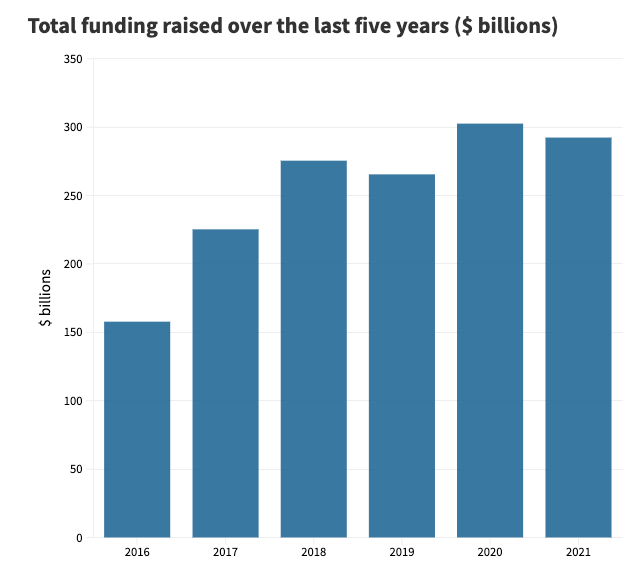
It isn’t the pandemic event that caused it. It surely fueled it.
Pandemic simply offered a window of time + office-free environment to competent developers.
A time window, not only to explore the technical possibilities of their side project but also their enterprising spirit. Such exploration can only happen when basic assumptions about livelihood and work-life balance are challenged.
Pandemic did exactly that thing.
The last whole decade had created the necessary platform for indies. The factors that contributed to it are as follows (I have tried to list them in the cause-effect order, but some items can be shuffled too)
- Cloud has minimized the DevOps learning curve by creating an abstraction on top of different platform VMs.
- Cloud has also solved the fixed cost problem in establishing a startup
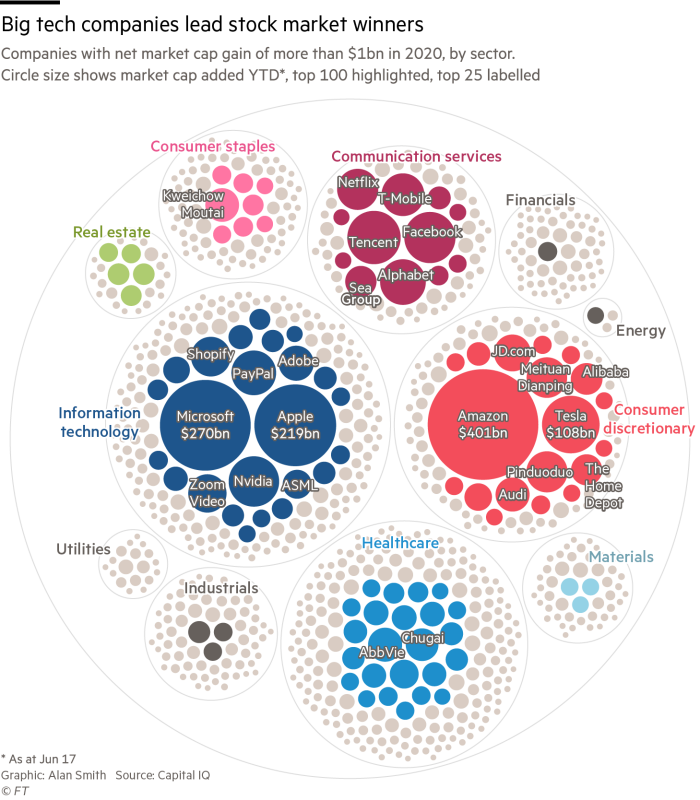
- In the adjoining figure, barring pharma, the companies that have most benefitted from the pandemic are either those who supply cloud services or are those who leverage it the most.
- Open-source bent down the learning curve to roll out a full-fledged MVP.
- Communities like ProductHunt / Discord and crowdfunding platforms (example: Indiegogo, Kickstarter) brought marketing dollars almost down to zero. While not everyone can succeed on such platforms, the entry barrier is definitely 100x lower for promising projects.
- The rise of BitCoin and Ethereum showed that courageous developers could achieve much more decentralization than mighty, egoistic, bureaucratic organizations.
- No-code is bringing a deluge of non-tech founders to the tech industry.
- Mobile platforms (iOS, Android) became examples of indie developer success stories.
- Gaming platforms (Valve), Streaming platforms (Youtube, Twitch), teaching platforms (Udemy, Teachable, Thinkific) and Podcasts brought so many tech content creators out of 9–5 offices (sometimes, even schools and colleges)
- The startup ecosystem is way more connected. The huge money is pouring since 2020, and it is not stopping anymore, thanks to rosy projections of online offices/schools/hospitals/everything.
Conclusion:
For ages, they (managers, owners, and human resources) stopped competent people by saying: The grass looks always greener on the other side.
Now, the other side is no longer invisible.
If one can work for a company being on the other side, she can surely work for herself being on the other side.
And it doesn’t matter if the grass is greener or not.
What matters is that this other side offers much more than just the grass: it has trees, the trees can have fruits, and those fruits will give seeds to sow a thousand more trees.
What is important is not whether those trees will grow beautifully, and yield fruits.
What’s important is that those trees will be your own. You are no longer tending the grass on someone else’s lawn. And you may need no one to tend your own lawn, too.
- If you want to be emailed any time Pen Magnet publishes, please click here.
- If you are not a Medium member yet and want to become one, click here. (A part of your subscription fee might be paid to Pen Magnet.)
Latest in Programming:
https://tipsnguts.medium.com/robust-programmers-do-these-3-radical-things-a4dbcb544dbc
https://readmedium.com/why-this-childish-programming-meme-got-23k-upvotes-on-reddit-8a0881713a32
https://betterprogramming.pub/3-habits-to-become-a-better-indie-developer-e8f4234f3f2d
https://betterprogramming.pub/why-frontend-development-is-so-hard-c055bce2fd3a


